
When a blockchain splits, it’s called a fork, a change in the blockchain’s protocol that creates two versions of the ledger. Also known as chain split, it’s not a bug—it’s how crypto networks adapt, argue, or innovate.
Fork examples aren’t rare. They happen when developers, miners, or users can’t agree on rules. A hard fork, a permanent split that requires all nodes to upgrade creates a new coin. That’s what happened with Bitcoin Cash in 2017, when a group wanted bigger blocks for faster transactions. Bitcoin stayed the same; Bitcoin Cash became its own thing. You didn’t need to do anything to get the new coin—if you held Bitcoin before the split, you got Bitcoin Cash too. On the other hand, a soft fork, a backward-compatible upgrade that doesn’t split the chain is like a software update. Everyone stays on the same chain, but only new rules apply. Ethereum’s transition to Proof of Stake was a soft fork—no new coin, just a better system.
Not all forks are smooth. Sometimes, they’re messy fights over control. Ethereum Classic is a fork example born from a hack. When the DAO was drained in 2016, Ethereum’s team decided to roll back the blockchain to undo it. But some people believed that code should never be changed, even to fix a mistake. They kept the old chain—and Ethereum Classic was born. That’s why you see two Ethereums today: one with the rollback, one without. Fork examples like these show that crypto isn’t just about tech—it’s about values. Who gets to decide? What’s immutable? What’s fair?
These splits matter to you. If you hold crypto, you might get free coins from a fork. Or you might lose access if an exchange doesn’t support the new chain. You might see price swings when a fork is announced. That’s why knowing the difference between a hard fork and a soft fork helps you stay ahead. You’re not just watching the news—you’re watching the future of money get rewritten.
Below, you’ll find real-world cases that show exactly how forks play out—from new tokens popping up overnight to exchanges scrambling to keep up. These aren’t theoretical. They’re the kind of events that change portfolios, spark debates, and reshape entire ecosystems.
Posted by Minoru SUDA with 16 comment(s)
Oct
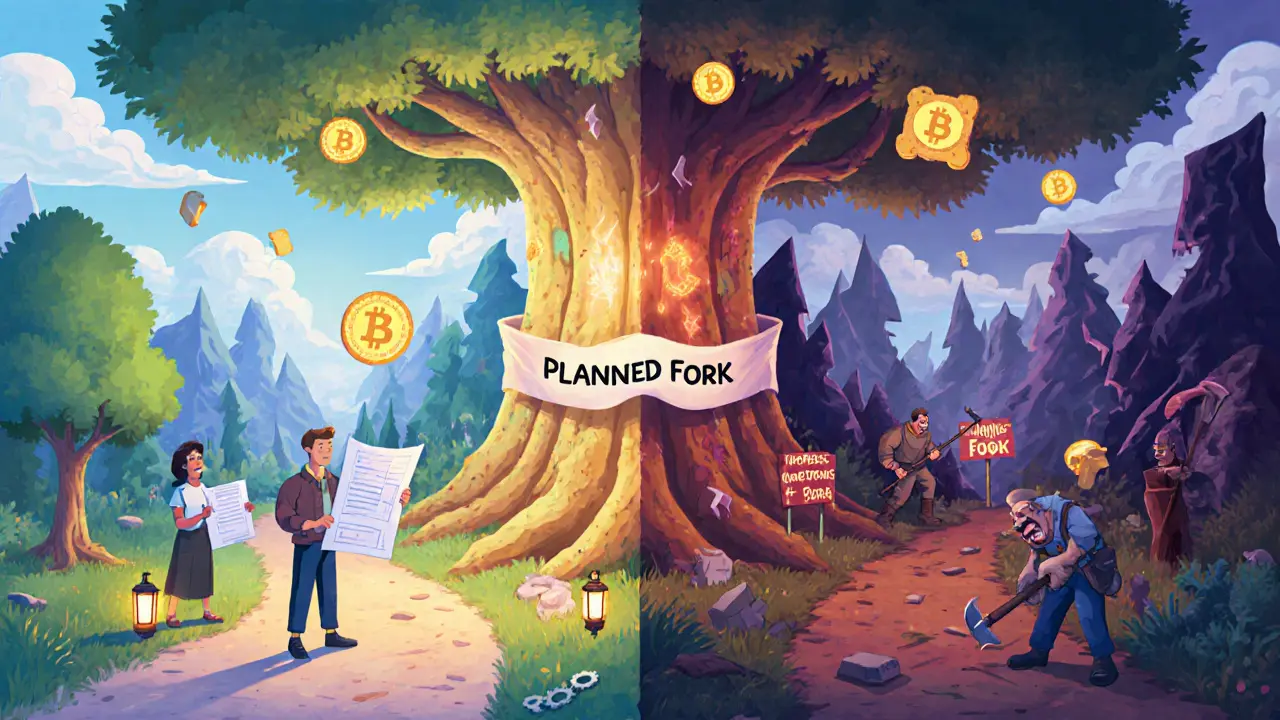
Learn the key differences between contentious and planned blockchain forks, their technical impacts, market effects, and how to navigate them safely.
view more