
Blockchain Fork Assessment Tool
Determine Fork Type
Assess whether a blockchain fork is likely to be planned or contentious based on key parameters described in the article.
PLANNED FORK
Based on the inputs, this fork is likely to be a planned fork. The community has likely reached consensus with advance notice and coordinated implementation, preserving a single chain.
CONTENTIOUS FORK
Based on the inputs, this fork is likely to be contentious. The community appears to have significant disagreement with minimal advance notice, likely resulting in a split chain.
When a blockchain’s rulebook changes, the network can take two very different paths. Some splits are carefully choreographed, while others erupt with drama and division. Knowing the difference between contentious forks and planned upgrades is essential for anyone who holds, develops, or invests in crypto.
Quick Takeaways
- Planned forks are scheduled, consensus‑driven upgrades that keep a single chain intact.
- Contentious forks arise from deep community disagreements and create permanently competing chains.
- Technical, economic, and governance impacts vary dramatically between the two.
- Ethereum’s Berlin and Shanghai upgrades showcase smooth planned forks; Bitcoin Cash exemplifies a noisy contentious split.
- Robust governance frameworks cut the odds of costly contentious forks by up to 75%.
What Is a Blockchain Fork?
Blockchain fork is a divergence in a blockchain’s transaction history caused by changes to consensus rules, resulting in two or more separate chains. Forks can be hard (incompatible) or soft (backward‑compatible). The key question is whether the split is intentional and coordinated, or sudden and combative.
Planned Forks: The Organized Upgrade
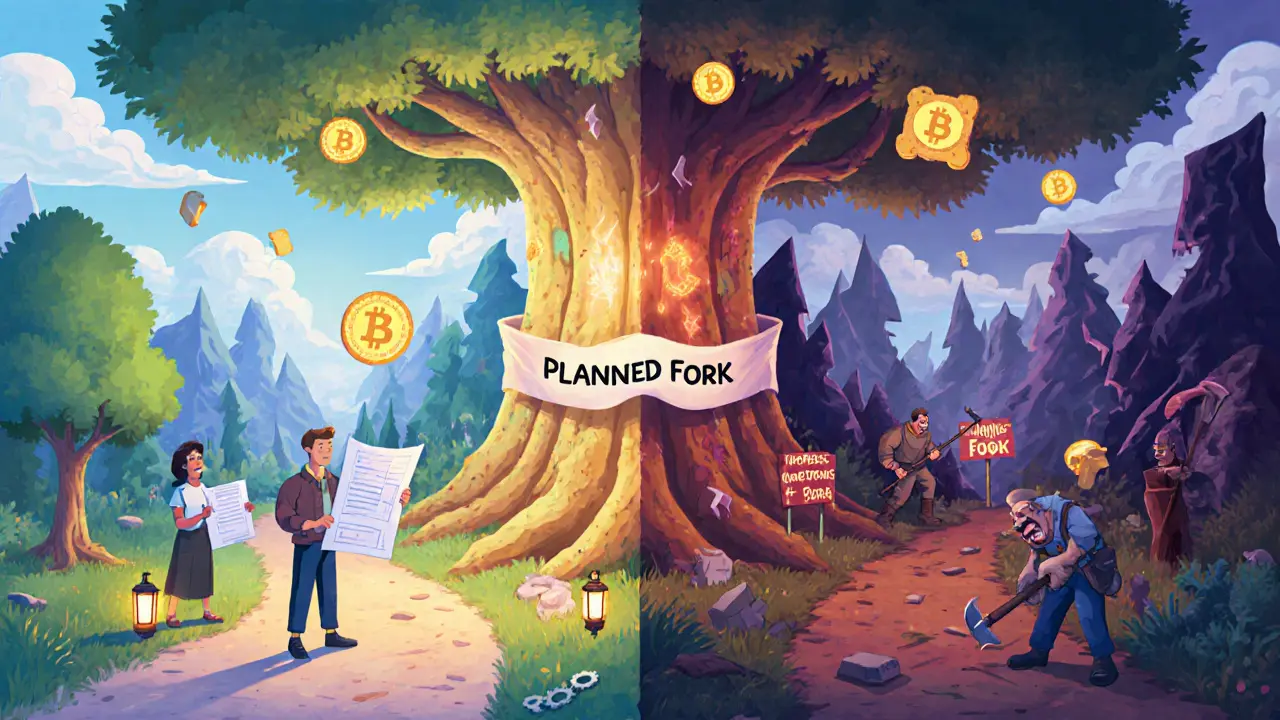
Planned fork is a pre‑announced, community‑consensus driven change that follows a structured roadmap, often months in advance. These forks are typically executed through a hard‑fork mechanism, but because every major participant upgrades at the same block height, the network remains a single chain after activation.
Key hallmarks of a planned fork:
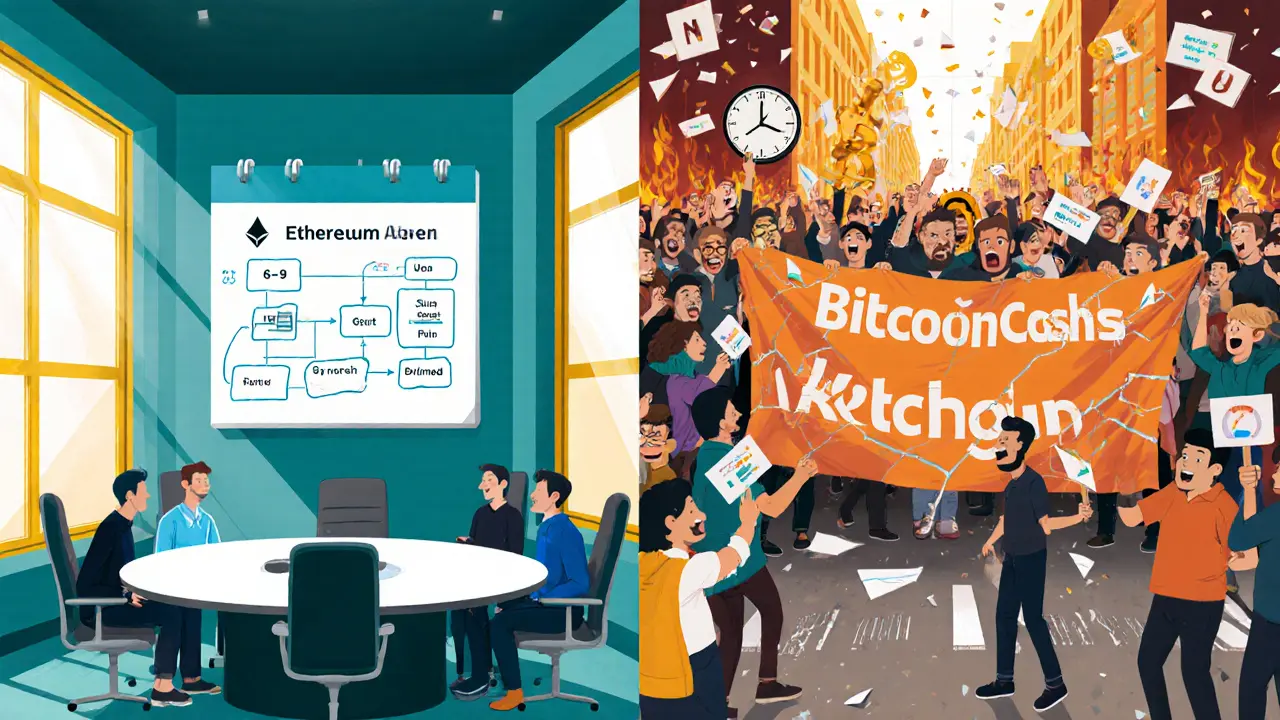
- Advance notice - most networks announce upgrades 6‑9 months ahead (e.g., Ethereum’s London fork announced in July 2021, activated August 2021).
- Broad stakeholder involvement - core developers, wallet providers, exchanges, and miners all coordinate via mailing lists, GitHub, and governance forums.
- High upgrade compliance - post‑fork data shows 95‑99% of nodes switch within 24‑48 hours (Ethereum Berlin: 99.5% at block 12,244,000).
- Single chain continuity - the protocol changes, but the token and network identity stay the same.
Contentious Forks: The Unruly Split
Contentious fork is a unplanned split that occurs when a community cannot reach consensus on protocol direction, leading to two incompatible blockchains. Unlike planned upgrades, contentious forks generate permanent competition for hash power, developer talent, and market capital.
Typical traits:
- Reactive trigger - often a disagreement over scaling, monetary policy, or security (e.g., Bitcoin Cash’s 8 MB block size debate).
- Fragmented communication - multiple proposals, opposite social media narratives, and no single timeline.
- Uneven support - mining power, node count, and exchange listings split (Bitcoin Cash vs. Bitcoin: 55% vs. 45% hash‑rate share).
- Permanent divergence - two tokens, two ecosystems, two market caps.
Technical Differences in Practice
Both fork types require code changes, but the depth and coordination differ. In a planned fork, developers work on a shared branch, run extensive testnets, and produce a release schedule. In a contentious fork, opposing teams fork the source code independently, often rewriting hundreds of lines of consensus logic.
For example, the Bitcoin Cash hard fork required ~1,250 additional lines to support 8 MB blocks, while Ethereum’s Berlin upgrade introduced EIP‑2929, which rewrote gas cost calculations for a handful of opcodes across the whole client codebase. The coordinated testing of Berlin led to a 92% issue‑resolution rate before activation, whereas Bitcoin Cash saw 43% of post‑fork issues linger for six months.
Governance: Why Some Networks Stay United
Formal governance frameworks act like a version control system for blockchains. The Cambridge Centre for Alternative Finance found that projects with structured decision‑making experienced 68% fewer contentious forks. Ethereum’s AllCoreDevs calls, Bitcoin’s BIP process, and Cardano’s on‑chain treasury all illustrate how clear voting and proposal pipelines keep upgrades orderly.
By contrast, Bitcoin’s original governance is largely informal, relying on community consensus without a defined proposal hierarchy. That openness gave rise to the scaling debate that birthed Bitcoin Cash in 2017.
Economic Impact: Market Caps, Token Value, and Community Size
Planned forks tend to preserve or even boost market value. Ethereum’s market cap grew from $18 B pre‑Byzantium (2017) to $550 B pre‑Merge (2022), reflecting investor confidence in a predictable upgrade roadmap.
Contentious forks usually dilute value. Bitcoin Cash captured only 0.15% of Bitcoin’s market cap shortly after the split, and its daily transaction volume dropped to ~1,200 tx/day versus Bitcoin’s 300,000 tx/day-a classic case of a “zombie chain”.
Developer community metrics echo this pattern. Electric Capital reported 4,332 active Ethereum contributors in 2023, while Bitcoin Cash’s active developers fell to 147, a 63% decline since the fork’s peak.
Real‑World Examples
| Aspect | Planned Fork | Contentious Fork |
|---|---|---|
| Trigger | Consensus‑driven upgrade (e.g., Ethereum London) | Community disagreement (e.g., Bitcoin Cash) |
| Announcement lead‑time | 6‑9 months | None or short notice |
| Node upgrade compliance | ≥95% within 48 h | 30‑70% split |
| Chain continuity | Single chain after fork | Two permanent chains |
| Market impact | Stable or upside | Value dilution |
| Developer sentiment | High confidence (78% feel ready) | Low morale (44% report frustration) |

Checklist for Assessing a Fork’s Risk Profile
- Is there an official announcement? Check the project’s blog or governance forum.
- What is the proposed upgrade window? Look for a block height and timestamp.
- How many core developers have signed off? Review the EIP or BIP discussion.
- Are major exchanges publishing a support schedule?
- What is the community split percentage? Monitor hash‑rate distribution on sites like Blockchain.com.
- Do you have a fallback plan? Prepare a node with the previous version in case of a rollback.
Future Outlook: Forks in 2025 and Beyond
Governance is maturing fast. Gartner predicts that 90% of major blockchains will have formal upgrade frameworks by 2025, shrinking contentious forks to under 15% of all splits. Projects like Polkadot already run “forkless” on‑chain upgrades, eliminating the need for hard‑fork coordination altogether.
Nevertheless, replay attacks and security bugs remain a risk. Chainalysis logged 17 replay incidents between 2017‑2023, the most severe costing $1.2 M during the Ethereum Classic/Ethereum split. Continuous auditing and cross‑chain communication safeguards will be critical.
Bottom Line: How to Navigate Forks as a User
If you’re a holder, keep an eye on official channels. For planned forks, most wallets will update automatically; you may only need to re‑enable staking or withdraw options after a scheduled upgrade. For contentious forks, decide which chain aligns with your goals-security, community, or ideology-then move funds to the chosen chain before the split.
Developers should clone the repository early, run test‑net nodes, and follow the project’s upgrade checklist. Ignoring the coordination timeline can lead to lost transactions or even permanent loss of funds on an abandoned chain.
Frequently Asked Questions
What is the difference between a hard fork and a soft fork?
A hard fork introduces changes that are not backward‑compatible, so nodes that don’t upgrade will follow a different chain. A soft fork is backward‑compatible; non‑upgraded nodes still accept the new blocks, preventing a permanent split.
Can a contentious fork become a planned fork later?
Sometimes the two resulting chains converge on a governance process and future upgrades become coordinated. However, the initial split remains a contentious event, and each chain retains its own upgrade path.
How do exchanges handle forks?
For planned forks, exchanges list the same ticker and update node software silently. For contentious forks, they often create separate trading pairs (e.g., BTC vs. BCH) and may pause withdrawals until the split is clarified.
Do I need to move my coins before a fork?
If the fork is planned, most wallets handle the transition automatically. For contentious forks, move funds to the chain you intend to keep before the split to avoid losing access to the other chain’s tokens.
Which type of fork is safer for long‑term investors?
Planned forks generally preserve network security and market confidence, making them safer for holders. Contentious forks can fragment liquidity and expose users to higher volatility.
Comments
Nisha Sharmal
If you think you can reinvent Bitcoin without consensus, good luck surviving the flash‑crash.
October 26, 2025 AT 07:23
adam pop
They've hidden the real fork schedule in the deep web, and the elite miners are pulling strings behind the scenes. Don't be fooled by official blogs.
October 30, 2025 AT 16:56
Anastasia Alamanou
When evaluating fork risk, the first metric to examine is the on‑chain governance maturity index, which quantifies procedural rigor across proposal lifecycle stages. A high maturity score correlates with pre‑fork signalling via EIP‑1559‑style fee market adjustments, reducing uncertainty for validator sets. Planned forks typically leverage deterministic state transition functions, ensuring that the post‑fork state root is reproducible across heterogeneous client implementations. In contrast, contentious forks often diverge at the consensus layer, introducing non‑deterministic state forks that can cause replay attacks if transaction ordering is not adequately replay‑protected. Empirical data from the Cambridge Centre for Alternative Finance indicates that projects with a structured BIP‑style proposal pipeline experience a 68% reduction in fork‑related volatility spikes. Moreover, the Ethereum Improvement Proposal process enforces a mandatory 3‑month review period, during which the community can audit the codebase via public testnets like Goerli and Sepolia. This transparency is reflected in the 99.5% node upgrade compliance observed during the Berlin hard fork, a benchmark for coordinated network upgrades. Contentious forks, such as Bitcoin Cash, lack this systematic vetting, resulting in a fragmented miner pool where hash‑rate distribution can swing dramatically within hours of activation. The resulting market impact is often a dilution of liquidity, as evidenced by the 0.15% market‑cap capture of BCH compared to BTC after the 2017 split. From a developer ecosystem perspective, active contributor counts serve as a leading indicator of post‑fork health, with Ethereum maintaining over 4,000 active developers versus sub‑200 for most contentious off‑shoots. Security audits, both formal verification and fuzz testing, are typically scheduled well in advance for planned upgrades, mitigating the risk of critical vulnerabilities being exploited on launch day. Conversely, contentious forks may ship with limited audit coverage, as the accelerated timeline prioritizes ideological momentum over comprehensive code review. Investors should therefore incorporate fork typology into their risk‑adjusted return models, assigning higher volatility premiums to tokens emerging from contentious splits. Portfolio rebalancing strategies might include hedging with stablecoins or synthetic exposure to the underlying protocol rather than the forked token itself. In summary, a disciplined assessment framework that accounts for governance structures, upgrade signaling, and developer activity can dramatically improve fork‑related decision making.
November 4, 2025 AT 02:30
Michael Hagerman
Wow, the drama around this fork is insane-like watching a reality show where the producers forgot the script! I mean, everybody's yelling about 'consensus' one minute and 'chaos' the next. The community is basically on a rollercoaster, and you can feel the tension in every GitHub commit. Definately, someone should calm down before the blockchain breaks. But hey, that's crypto for you.
November 8, 2025 AT 12:03
Laura Herrelop
The fork of a blockchain is a metaphorical Schrodinger's cat, existing as both unity and division until the network observes it. When the collective consciousness of the participants fractures, the blockchain splits, reflecting the deeper ontological discord. Some think the split is merely technical, but it's really about power structures veiled behind code. If you follow the secret cabal, you’ll see that the so‑called 'planned' upgrades are just rehearsed performances for the masses. The real battle is in the shadows, where a handful of miners pull levers that steer the destiny of the ledger. Thus, every fork is both an inevitability and a choice, dictated by the hidden hands that script our digital future.
November 12, 2025 AT 21:36
Richard Williams
Great breakdown! For anyone navigating upcoming upgrades, I recommend building a test‑net node early and syncing it before the hard fork. Keep an eye on the official changelog, and allocate some time to run the migration scripts on a sandbox environment. If anything goes wrong, you’ll have a fallback ready, and the stress will be minimal. Stay proactive, stay safe!
November 17, 2025 AT 07:10
Prabhleen Bhatti
Folks, let’s dive deep into the mechanics, shall we?; Planned forks, with their structured timelines, offer a predictable cadence, and that’s absolutely crucial for institutional adoption!; Conversely, contentious forks erupt spontaneously, creating volatility, uncertainty, and-yes-opportunity for the bold!; Remember, monitoring hash‑rate distribution, developer activity, and exchange support can guide your strategic positioning!
November 21, 2025 AT 16:43
Elizabeth Mitchell
Both fork types have their pros and cons, so the best approach is to stay informed and adjust your holdings accordingly.
November 26, 2025 AT 02:16
Chris Houser
When a project announces a hard fork, start by checking the release notes for the exact block height, then update your client software before that point. This way you avoid missing the upgrade and keep your funds secure.
November 30, 2025 AT 11:50
William Burns
It is incumbent upon the discerning participant to recognize that the epistemic rigor inherent in a meticulously orchestrated protocol upgrade distinguishes it from the capriciousness of a dissent‑driven bifurcation, thereby warranting a commensurately elevated degree of confidence.
December 4, 2025 AT 21:23
Ashley Cecil
From an ethical standpoint, endorsing a planned fork aligns with the principle of collective responsibility, whereas advocating for a contentious split may inadvertently exacerbate fragmentation and undermine the communal trust essential to the blockchain’s integrity.
December 9, 2025 AT 06:56
John E Owren
Make sure you have a backup node running the previous version just in case the upgrade encounters unforeseen issues.
December 13, 2025 AT 16:30
Joseph Eckelkamp
Oh, brilliant-because sitting on a legacy node is the ultimate hedge against innovation; what could possibly go wrong when you refuse to embrace progress? Yet, in all seriousness, maintaining a fallback client does provide a safety net during volatile transitions, and this redundancy is a best practice endorsed by the majority of core developers.
December 18, 2025 AT 02:03
Jennifer Rosada
While your sarcasm is noted, it is imperative to underscore that a methodical contingency plan, executed with decorum and precision, promotes network stability and safeguards stakeholder assets; therefore, I advocate for a balanced approach that respects both innovation and prudence.
December 22, 2025 AT 11:36
emma bullivant
Forks are like choices in a choose‑your‑own‑adventur, each path leads to diffrent outcomes, and the blockchain mus t adapt to the decisions made by its communty.
December 26, 2025 AT 21:10
Abby Gonzales Hoffman
Keep that curiosity alive-explore the specs, talk to devs, and turn those questions into concrete actions, because the more you engage, the stronger your crypto journey becomes!
December 31, 2025 AT 06:43