
When you think of blockchain, you probably picture Bitcoin or Ethereum—but behind every major update, fork, or rule change is something quieter but just as powerful: blockchain governance, the system of rules and processes that lets communities decide how a decentralized network evolves without a central boss. Also known as crypto governance, it’s what stops a single developer or company from controlling the fate of a network. Unlike traditional companies, where CEOs make calls, blockchain networks rely on token holders, node operators, and developers to vote, propose, and argue over changes. This isn’t just theory—it’s happening right now on Ethereum, Solana, and dozens of DAOs.
One big piece of blockchain governance is on-chain voting, a system where token holders cast votes directly on the blockchain using their crypto holdings as weight. Think of it like shareholders voting on a company merger, but without paper ballots or boardrooms. If you hold 1% of a token’s supply, you get 1% of the vote. This is how projects like Compound and Aave roll out new features or adjust interest rates. But it’s not perfect—big wallets can dominate, and many users don’t even bother voting. That’s why some networks combine on-chain votes with DAOs, decentralized autonomous organizations that act like digital cooperatives, pooling resources and decision-making power among members. DAOs often use off-chain discussions on Discord or forums before moving to formal votes, making sure ideas are tested before they go live.
Real-world examples show how messy this can get. When the Ethereum community debated switching from proof-of-work to proof-of-stake, thousands of people argued for months. Some miners lost money. Others worried about centralization. The final decision didn’t come from one person—it came from a mix of developers, node operators, exchanges, and everyday users. That’s blockchain governance in action. And it’s not just for big coins. Smaller projects use the same tools to decide token distribution, fee structures, or even how to spend their treasury. But not all systems work well. Some DAOs get hijacked by whales. Others are too slow. Some don’t even have clear rules written down.
What you’ll find below are real cases—some successful, some cautionary—of how governance plays out in the wild. From a $34 billion fine that forced a major exchange to rethink compliance, to meme coins trying to build voting systems from scratch, these posts show you how governance isn’t just code—it’s people, power, and sometimes, chaos.
Posted by Minoru SUDA with 16 comment(s)
Oct
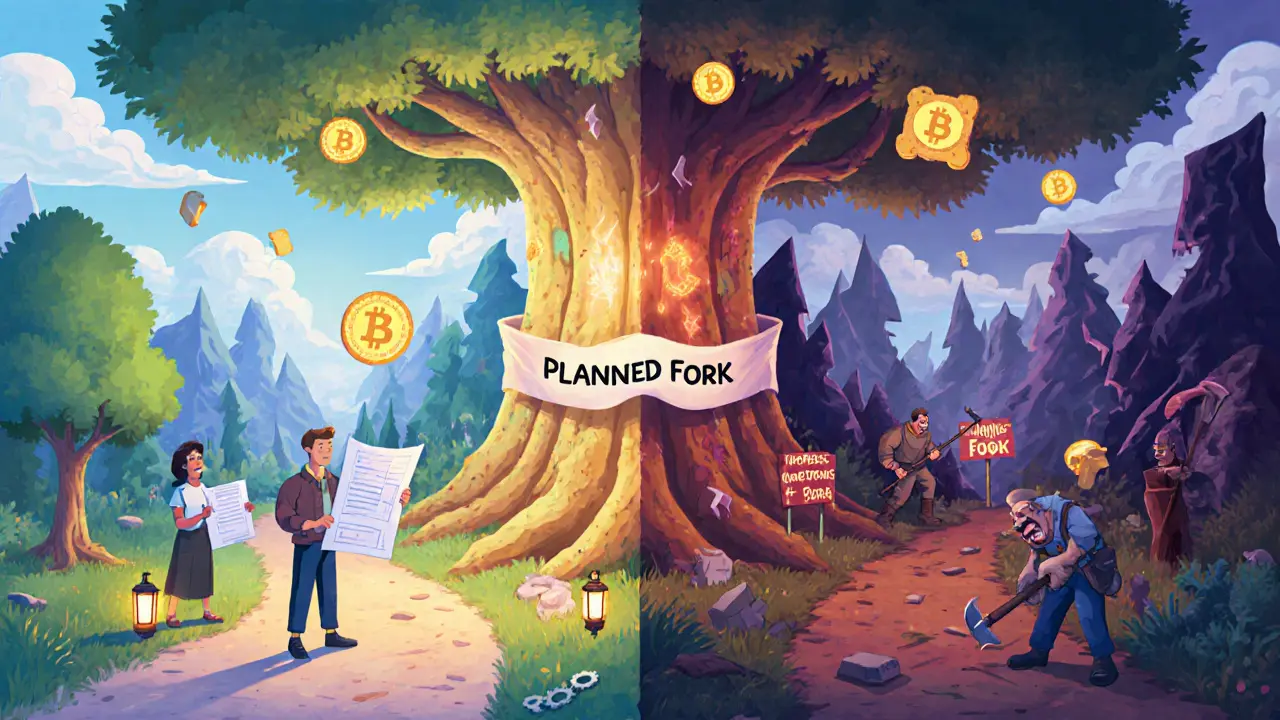
Learn the key differences between contentious and planned blockchain forks, their technical impacts, market effects, and how to navigate them safely.
view more