

By 2025, over 18 countries have already launched their own digital money - not Bitcoin, not Ethereum, but CBDCs. Central Bank Digital Currencies are the official, government-backed digital version of your dollar, euro, or yen. They’re not a new cryptocurrency. They’re not a stablecoin. They’re your national currency, but in app form. And now, the big question is: are they about to kill off cash - and even cryptocurrencies?
CBDCs Are Already Here - And They’re Not What You Think
Most people picture CBDCs as something like Bitcoin: decentralized, anonymous, and run by code. That’s wrong. CBDCs are the opposite. They’re controlled entirely by your country’s central bank. Every transaction can be tracked. Every wallet is tied to your identity. In China, you need your national ID to even open a digital yuan wallet. In the Bahamas, the Sand Dollar works on basic phones - but still requires government verification.
The numbers don’t lie. By late 2023, China’s digital yuan had processed over $250 billion in transactions across 261 million wallets. The Bahamas saw 90% of adults adopt their CBDC within two years. Sweden’s e-krona pilot is testing offline payments so elderly users without smartphones can still pay for groceries. These aren’t experiments anymore. They’re live systems.
But here’s the catch: CBDCs aren’t designed to replace Bitcoin. They’re designed to replace cash. And maybe, eventually, to outcompete private digital currencies like stablecoins. The European Central Bank says it clearly: private digital money could undermine their ability to control interest rates and inflation. That’s the real threat - not Bitcoin’s volatility, but the fact that people might stop using the official currency at all.
Why Cash Isn’t Dying - Even With CBDCs Around
You might think cash is dead. After all, we pay with phones, cards, and apps. But in 2024, the total value of physical cash in circulation grew by 4.2% in advanced economies. That’s not a glitch. That’s a trend. People still want cash. Why? Because it’s private. Because it works without power. Because it doesn’t require a bank account or government ID.
In the U.S., 5.4% of households are unbanked. That’s 7 million people who rely on cash to survive. Federal Reserve Chair Jerome Powell said it plainly in February 2025: “CBDCs should not replace physical cash.” He’s not being nice. He’s being realistic. Take away cash, and you cut off access for the poorest, the oldest, the most vulnerable.
Even in Europe, where digital euro plans are far along, 62% of members of the European Parliament are worried about giving the central bank too much control. That’s why the digital euro legislation is stalled. People don’t trust a system that can see every coffee purchase, every donation, every gift. Cash doesn’t ask questions. CBDCs do.
Cryptocurrencies Aren’t Going Anywhere - Here’s Why
Bitcoin and Ethereum aren’t going to vanish because a government launches a digital dollar. Why? Because they serve a different purpose. CBDCs are for paying your rent. Cryptocurrencies are for betting, speculating, and moving money across borders without permission.
Chainalysis found that 73% of Bitcoin transactions in 2024 were speculative. People aren’t using Bitcoin to buy groceries. They’re using it to gamble on price swings. Meanwhile, the stablecoin market - like USDT and USDC - hit $160 billion in circulation by early 2025, settling over $12 trillion in transactions annually. These are the real competitors to CBDCs. Not Bitcoin. Not Ethereum. But the private, dollar-backed digital tokens that move money faster and cheaper than banks.
And here’s the twist: CBDCs can’t match that. Stablecoins are built on open networks. Anyone can build on them. Developers create DeFi apps, lending protocols, and automated markets without asking a central bank for permission. CBDCs? They’re walled gardens. You can’t build a DeFi app on the digital yuan. You can’t lend your digital euro to someone in Nigeria through the European system. That’s not a flaw - it’s by design. But it’s also why people still turn to crypto.
The Real Battle: CBDCs vs. Stablecoins
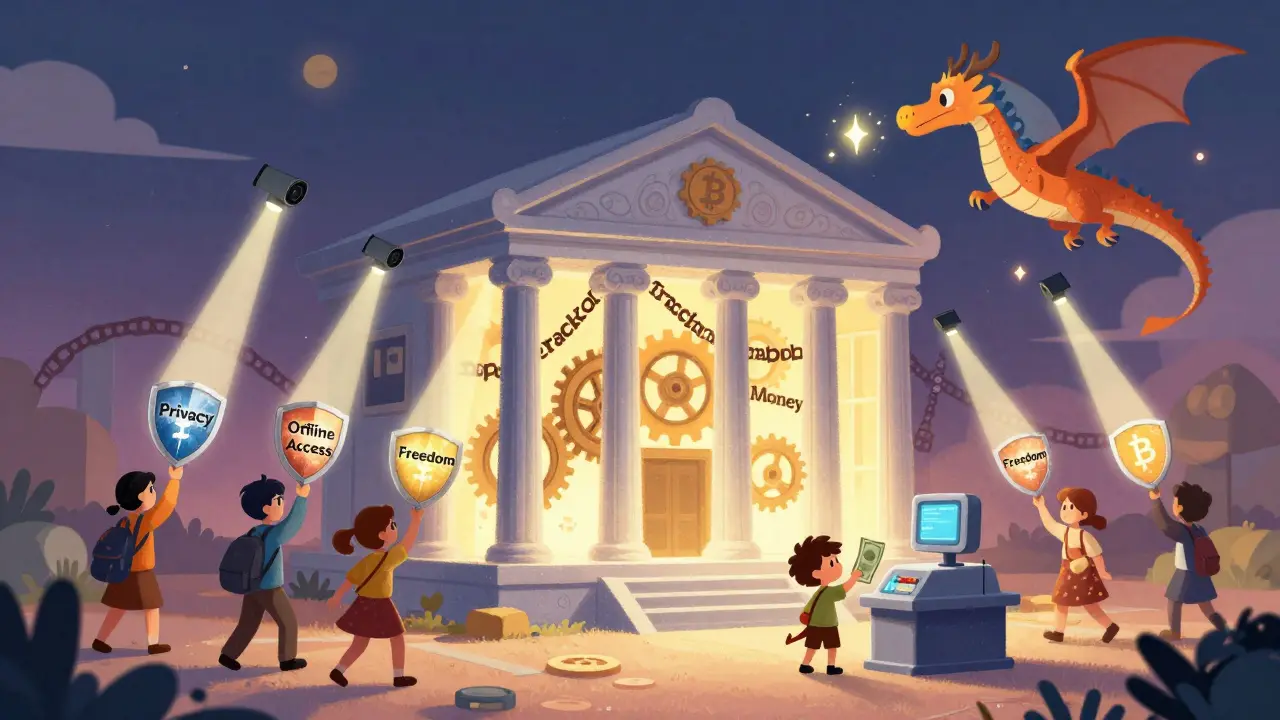
The biggest threat to CBDCs isn’t cash. It’s stablecoins. And the battle is already being fought.
The U.S. government, under Executive Order 14110 signed in January 2025, is pushing hard for dollar-backed stablecoins - not CBDCs. Why? Because private companies can innovate faster. Tether and Circle can roll out new features, integrate with apps, and scale globally without waiting for Congress.
But stablecoins have a fatal weakness: they depend on reserves. When TerraUSD collapsed in 2022, it wiped out $40 billion in value overnight because its algorithm couldn’t hold the peg. The SEC later sued Tether for hiding the fact that most of its reserves weren’t cash - they were risky commercial paper. That’s the risk of private money: no transparency, no safety net.
CBDCs don’t have that problem. They’re backed by the full faith and credit of the government. If you hold a digital euro, you’re holding a claim on the European Central Bank - not a private company’s balance sheet. That’s why central banks think they’re safer. But safety comes at a cost: control.
What CBDCs Can Do That Cash and Crypto Can’t
CBDCs aren’t just digital cash. They’re programmable money. That means governments can write rules into the currency itself.
In China, the digital yuan can be set to expire if not spent by a certain date - a way to force people to spend stimulus money instead of hoarding it. In Nigeria, the eNaira caps individual holdings at $600 to stop people from pulling all their money out of banks. In the EU, future versions might only allow spending on green energy or local businesses.
This is where CBDCs become powerful - and terrifying. Imagine if your government could block you from buying alcohol, or only let you pay for groceries with your digital dollar. That’s not science fiction. It’s already being tested.
That’s why Nobel laureate Paul Krugman warned in early 2025: “CBDCs could concentrate financial control to dangerous levels.” He’s not alone. In Sweden, users praised the e-krona for instant payments - but 72% of negative reviews complained about “excessive transaction monitoring.” People don’t mind convenience. They mind being watched.
Who’s Winning? The Numbers Say It All
Let’s look at the real data:
- Cash: $178 trillion in global transactions in 2024.
- CBDCs: Estimated $1.5 trillion in pilot transactions - all combined.
- Stablecoins: $12 trillion in annual transactions.
- Cryptocurrencies (total): $28 trillion in annual volume.
CBDCs are still tiny. Even if they grow tenfold by 2030, they won’t match stablecoins - let alone cash. The Bank for International Settlements predicts that by 2030, cash will still make up 10-15% of retail payments. CBDCs? 25-30%. Stablecoins and other private digital currencies? 65-70%.
That’s not replacement. That’s coexistence.
The Future Isn’t One Winner - It’s Three Systems
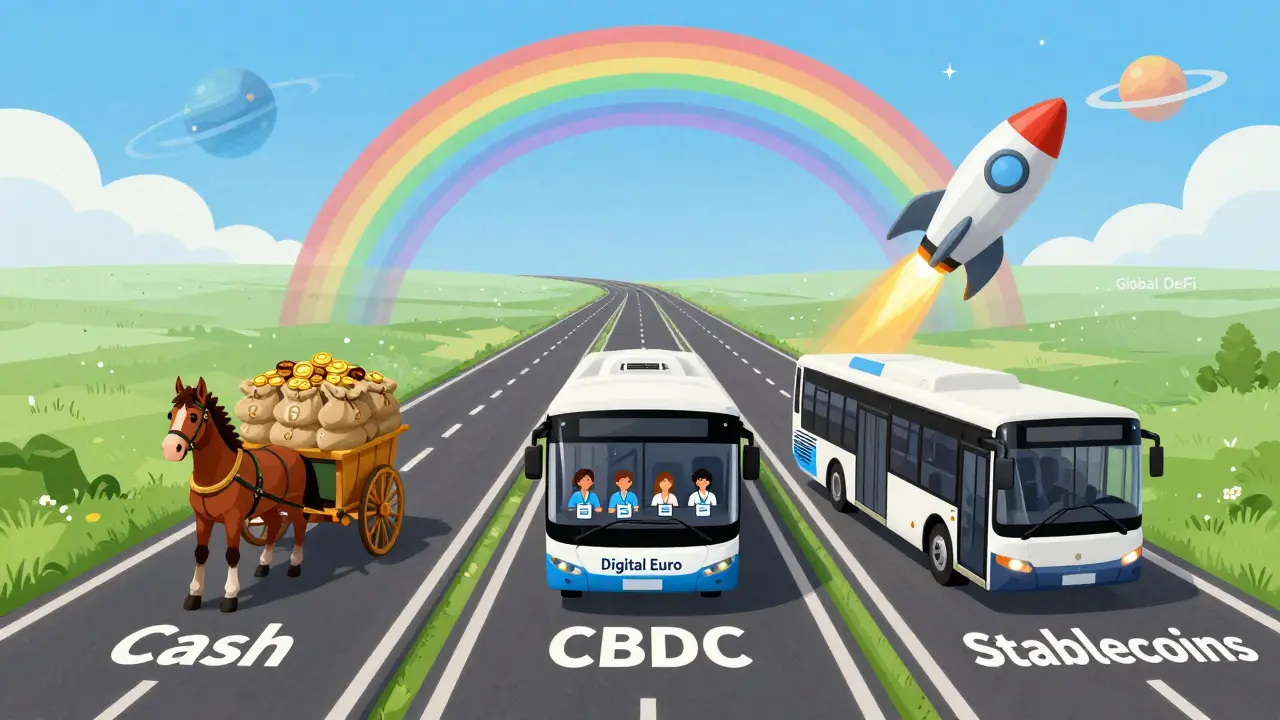
The idea that CBDCs will replace cash and crypto is a myth. The future is layered:
- Cash will survive for privacy, emergencies, and the unbanked.
- CBDCs will handle everyday government-backed payments - payroll, taxes, benefits, and regulated spending.
- Stablecoins and crypto will dominate cross-border transfers, speculative trading, and decentralized finance.
Think of it like transportation. Cars didn’t kill trains. Trains didn’t kill bikes. We use all three - for different reasons. The same will happen with money.
The real question isn’t “Will CBDCs replace cash and crypto?” The real question is: Do you want your government to control every dollar you spend?
If you value privacy, speed, and freedom - you’ll keep using cash and crypto. If you value safety, stability, and government support - you’ll use CBDCs. And if you’re just trying to send money to your family overseas? You’ll use a stablecoin.
What You Should Do Now
You don’t need to pick a side. But you do need to understand your options.
- If you’re in a country with a live CBDC - try it. Use it for small payments. See how it feels.
- If you’re worried about privacy - keep some cash on hand. Don’t rely solely on digital wallets.
- If you’re sending money internationally - look at stablecoins. They’re faster and cheaper than banks.
- If you’re investing - understand that CBDCs aren’t an investment. They’re a payment tool. Bitcoin and Ethereum still are.
The money system is changing. But it’s not collapsing. It’s branching. And you have more choices than ever before.
Will CBDCs make cash obsolete?
No - not anytime soon. Cash is still growing in advanced economies, and 5.4% of U.S. households rely on it because they’re unbanked. Central banks like the Fed and ECB say they plan to keep cash available. CBDCs are meant to complement cash, not replace it - especially for older people, rural communities, and those without reliable internet.
Can CBDCs replace Bitcoin and Ethereum?
Not really. Bitcoin and Ethereum are decentralized, permissionless, and used mostly for speculation and DeFi. CBDCs are centralized, government-controlled, and built for everyday payments. They serve different purposes. People use crypto to invest and bypass banks. They use CBDCs to pay taxes and get government benefits.
Are CBDCs safer than stablecoins?
Yes - but with trade-offs. CBDCs are backed by the full power of the government, so they’re as stable as your national currency. Stablecoins like USDT are pegged to the dollar but rely on private reserves that aren’t always transparent - as shown by the TerraUSD collapse and Tether’s SEC lawsuit. CBDCs don’t have reserve risks, but they do have privacy risks.
Can I use a CBDC without a smartphone?
Yes - in some cases. Sweden’s e-krona and China’s digital yuan both support offline payments via NFC cards or basic devices. The Bank of England’s digital pound design includes offline functionality specifically for people without reliable internet. But most systems still require a phone or app, which creates a digital divide.
Will CBDCs let the government track my spending?
Almost certainly. Unlike cash, every CBDC transaction is recorded. China’s digital yuan links to your ID. The EU’s digital euro will likely require KYC verification. This allows for better fraud detection and targeted stimulus - but also raises serious privacy concerns. In Sweden, 72% of negative reviews cited “excessive monitoring.” This isn’t speculation - it’s already happening.
Is the U.S. going to launch a digital dollar?
Not yet. The Federal Reserve is still researching it under Project Hamilton, but has no launch timeline. In January 2025, President Trump signed an executive order prioritizing dollar-backed stablecoins over a CBDC, citing concerns about financial stability and privacy. The U.S. is more likely to embrace private stablecoins than a government-run digital dollar - at least for now.
What’s the biggest risk of CBDCs?
The biggest risk is concentration of power. If every transaction is tracked and programmable, governments could restrict spending - block payments to certain businesses, limit how much you can save, or even freeze accounts without court orders. The Bank for International Settlements warns this could lead to financial exclusion and loss of economic freedom. Privacy and autonomy are the real trade-offs.
Comments
Mike Pontillo
So let me get this straight - the government wants to track my coffee buys but I can’t use crypto to send money to my cousin in Nigeria? Cool. Real cool.
December 27, 2025 AT 02:25
NIKHIL CHHOKAR
People act like CBDCs are some dystopian nightmare, but honestly? If I can pay my rent with a tap and know the money went straight to my landlord without a middleman taking 3%, I’m all in. Privacy is nice, but efficiency is better. And no, I don’t want to carry cash everywhere just because some folks are scared of tech.
December 28, 2025 AT 14:48
Jordan Fowles
The real insight here isn’t about CBDCs replacing anything - it’s about how money is becoming layered. Cash for anonymity, CBDCs for trust and control, stablecoins for freedom and speed. We’re not moving to one system - we’re evolving into a multi-system ecosystem. Like how we still use horses for recreation even though cars dominate transport. The question isn’t which wins - it’s whether we’re comfortable with the trade-offs of each.
December 30, 2025 AT 09:56
Elisabeth Rigo Andrews
Let’s be real - the ECB’s digital euro is a regulatory overreach wrapped in fintech glitter. You can’t have programmable money without programmable control. And programmable control means behavioral coercion. This isn’t innovation - it’s financial authoritarianism dressed up as convenience. The moment your government can block your spending on alcohol, you’ve lost economic sovereignty. And no, ‘it’s for your own good’ doesn’t make it ethical.
December 31, 2025 AT 16:25
Mandy McDonald Hodge
i just tried the digital yuan app on my cousin’s phone in beijing and honestly?? it was so easy. no fees, instant, even worked in the subway with no internet. but then i saw the transaction history and felt kinda creeped out 😅 maybe i’m just old school but i still like cash for birthdays. anyone else feel this??
January 2, 2026 AT 11:53
prashant choudhari
Cash is still growing because people aren’t stupid. They know digital systems can fail. They know governments can change rules overnight. CBDCs are tools. Tools don’t replace needs. They serve them. If you want privacy, use cash. If you want speed, use stablecoins. If you want safety, use CBDCs. Simple. No drama.
January 3, 2026 AT 04:21
Adam Hull
It’s hilarious how people treat Bitcoin like some sacred oracle of freedom while ignoring that 73% of its transactions are pure gambling. Meanwhile, the digital yuan is quietly enabling millions of small vendors in rural China to get paid without paying 5% to PayPal equivalents. The real villain isn’t the central bank - it’s the crypto bros who think decentralization means ‘I can buy NFTs with my stimulus check.’
January 4, 2026 AT 02:33
Joydeep Malati Das
The data presented here is both accurate and nuanced. It is not the intention of central banks to eliminate cash, nor is it the goal of private actors to displace CBDCs entirely. Rather, we are witnessing a natural evolution of monetary infrastructure - one that accommodates divergent societal needs. The challenge lies not in adoption, but in governance: ensuring equitable access, protecting civil liberties, and maintaining public trust. These are not technical problems - they are profoundly human ones.
January 6, 2026 AT 00:16
Andrew Prince
Let us not be misled by the superficial allure of convenience. The Bank for International Settlements has repeatedly warned that the introduction of programmable money constitutes a fundamental reconfiguration of the social contract between citizen and state. When fiscal policy becomes embedded in the currency itself - when spending is restricted by algorithmic governance - we are no longer operating within a market economy, but within a technocratic command structure. This is not evolution. It is subjugation by proxy. The fact that 72% of Swedish users complain about surveillance is not a bug - it is a feature. And we are all complicit by our silence.
January 7, 2026 AT 13:25
Willis Shane
You all are missing the point. The real danger isn’t surveillance - it’s obsolescence. If CBDCs become the default, and cash disappears, then the unbanked - the elderly, the homeless, the undocumented - get erased from the economy. That’s not policy. That’s systemic violence. The Fed’s stance on preserving cash isn’t ‘realistic’ - it’s morally necessary. And anyone who thinks otherwise is either privileged or willfully blind.
January 8, 2026 AT 17:14
Steve Williams
In Nigeria, we have seen the eNaira struggle due to low digital literacy and infrastructure gaps. Yet, we also see how stablecoins are filling the gap for remittances. This is not a competition - it is a convergence. CBDCs can provide stability. Stablecoins can provide access. Cash can provide dignity. The path forward is not exclusivity - it is integration with empathy.
January 10, 2026 AT 02:30
Jake West
Bro… you’re all overthinking this. I just want to pay for my tacos without the government knowing I bought them. If I can’t do that with cash anymore, I’m just gonna start using Monero. And if they come for me? I’ll be the guy with the 2000 Bitcoin bag and a smile. 🤷♂️
January 11, 2026 AT 11:09
rachael deal
Y’all are acting like this is a war - but it’s not. It’s a menu. Cash for privacy, CBDCs for bills, stablecoins for global hugs. I’ve got cash in my wallet, USDT on my phone, and my paycheck on the digital dollar app. Why choose? We’re not losing money - we’re gaining options. And that’s kind of beautiful, honestly 💛
January 13, 2026 AT 06:05