

Imagine owning a piece of a company, but instead of just waiting for the stock price to go up, you actually get to vote on which products the company builds, how much they spend their budget, and who they partner with. In the world of blockchain, this isn't a futuristic dream-it's exactly what governance tokens is a type of cryptocurrency that grants holders the power to vote on the future direction and technical changes of a blockchain protocol. If you've ever felt like the "big tech" companies make decisions behind closed doors that affect you, these tokens are the antidote. They shift the power from a corporate boardroom to the people actually using the software.
For most people, holding these tokens is about more than just hoping for a price jump. It's about ownership. Whether you're holding UNI from Uniswap or AAVE from Aave, you're essentially holding a digital voting chip. But how does this actually benefit you in the long run? Let's break down the real-world advantages and the traps you need to avoid.
Getting a Seat at the Digital Table
The most immediate benefit of holding governance tokens is the ability to shape the project. In traditional finance, if you don't like how a bank handles its fees, you can't do much about it. In DeFi (Decentralized Finance), you can actually propose a change to the fee structure and vote on it. This creates a direct loop between the user's needs and the project's development.
When you hold these tokens, you can influence several critical areas:
- Treasury Management: You decide how the project's massive pile of funds (the treasury) is spent. For example, Uniswap holders famously voted to move $160 million into a Community Growth Fund to expand the ecosystem.
- Protocol Upgrades: Want a new feature? Or maybe a bug fix that's being ignored? Token holders can vote to prioritize specific technical updates.
- Fee Structures: You can vote to lower transaction costs for users or change how rewards are distributed.
- New Partnerships: You can help decide which other blockchains or services the protocol should integrate with.
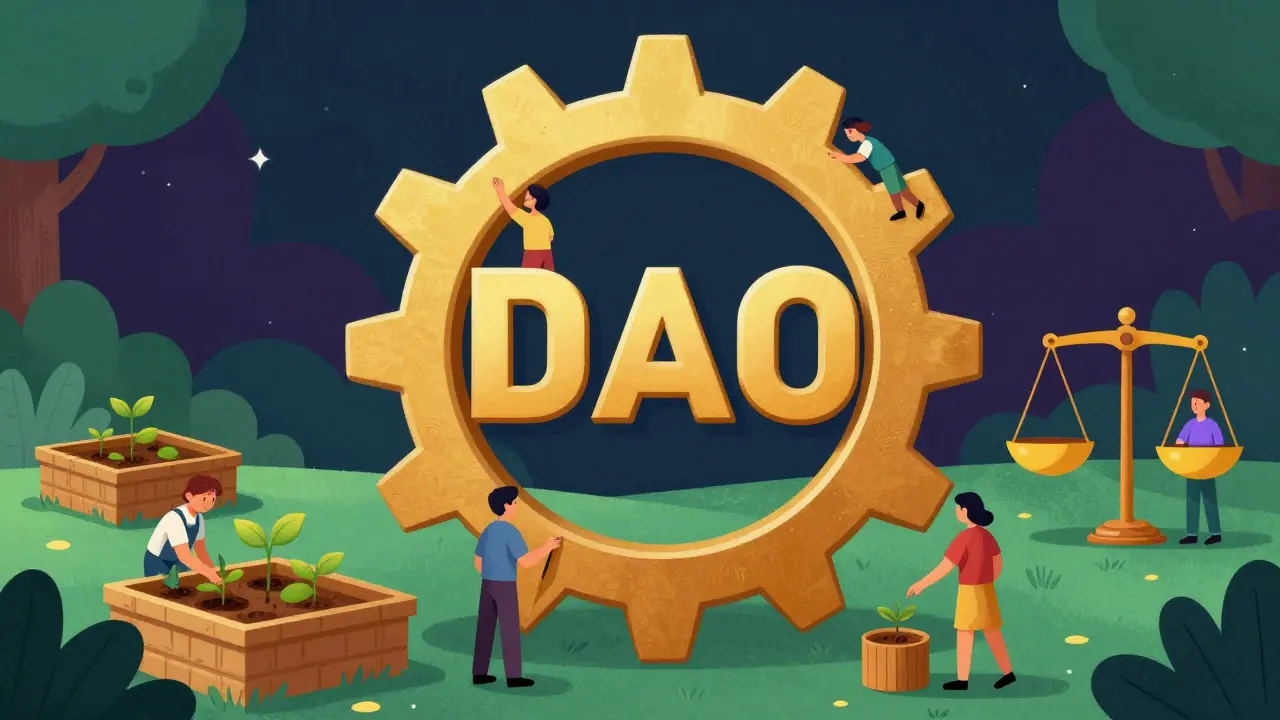
This level of control is managed by DAOs, or Decentralized Autonomous Organizations. A DAO is essentially an organization run by code and community vote rather than a CEO. By holding the token, you aren't just a customer; you're a governor.
Financial Incentives Beyond Trading
While the "power" part is exciting, the money part is what draws many in. Governance tokens aren't just for voting; they often come with economic perks that standard utility tokens don't offer. Because the protocol wants people to participate in governance, they create incentives to keep you from selling your tokens.
One of the most common benefits is staking rewards. Many protocols allow you to "lock up" or stake your governance tokens. In return for securing the network or committing your voting power for a set period, the protocol pays you in additional tokens. It's a way to earn a passive yield while maintaining your influence over the project.
Furthermore, there is the concept of incentive alignment. When the people who use a protocol also own the tokens that govern it, everyone wants the same thing: the long-term success and stability of the network. If the project grows and becomes more valuable, the token price typically follows. This transforms the user from a temporary visitor into a long-term stakeholder.
| Feature | Governance Tokens | Utility Tokens | Security Tokens |
|---|---|---|---|
| Primary Purpose | Voting & Decision Making | Access to platform features | Investment/Dividends |
| Control | Community-led (DAO) | Developer-led | Corporate/Legal board |
| Key Example | MKR (MakerDAO) | LINK (Chainlink) | Asset-backed tokens |
| Risk Profile | Governance apathy/Plutocracy | Platform failure | Regulatory compliance |
The Reality Check: Potential Pitfalls
It sounds perfect on paper, but holding governance tokens isn't without its headaches. The biggest issue is plutocracy. Since most protocols use a "one token, one vote" system, the wealthiest holders (whales) have significantly more power than the average user. If a few people own 70% of the tokens, the "decentralized" part of the project becomes a bit of a myth.
Then there's the problem of voter apathy. Many people buy tokens for the price gain but have zero interest in reading a 20-page technical proposal about liquidity curves. This leads to incredibly low turnout-sometimes below 5%-which means a tiny, motivated minority can push through changes that the majority of users might actually hate.
Finally, there's the learning curve. Participating in governance isn't as easy as clicking a "like" button. You often have to navigate complex dashboards, understand the technical implications of a proposal, and pay "gas fees" (transaction costs) to cast your vote. For someone holding a small amount of tokens, the cost of voting might actually be higher than the value of their influence.

How to Actually Participate
If you've decided to hold governance tokens, don't just let them sit in your wallet. To get the most value, you need to engage with the ecosystem. Most major projects have a dedicated governance portal where you can view active proposals and cast your votes.
- Find the Governance Forum: Before voting, head to the project's forum. This is where the real debates happen. You'll see why a proposal was created and what the counter-arguments are.
- Check the Dashboard: Use a web-based interface (like the ones provided by Aave or Uniswap) to see the current voting window and your current voting power.
- Evaluate the Proposal: Ask yourself: Does this change benefit the long-term health of the protocol, or does it only benefit a few large holders?
- Cast Your Vote: Connect your wallet and sign the transaction. Remember that some protocols require you to "lock" your tokens for a specific time to be eligible to vote.
For those who find the process overwhelming, keep an eye out for delegated voting. Some protocols allow you to give your voting power to a trusted community expert. You still own your tokens, but someone with more technical knowledge handles the voting for you.
The Future of Decentralized Power
As we move further into 2026, the way we handle governance is evolving. We're seeing a move away from pure token-weighted voting toward more sophisticated models. Some projects are experimenting with reputation-based weighting, where your vote is worth more if you've actually contributed code or provided liquidity to the project for a long time, regardless of how many tokens you own.
There is also a growing bridge between Traditional Finance (TradFi) and DeFi. As institutions enter the space, the demand for transparent, on-chain governance increases. The ability to prove exactly how a decision was made, with an immutable record on the blockchain, is something that traditional corporate boards simply cannot offer.
Whether these tokens eventually become the standard for all organizational management or remain a niche tool for crypto-natives depends on one thing: participation. Governance tokens are only as powerful as the community that uses them. If you hold them, you have the keys to the city-you just have to decide if you're ready to help build it.
Do I need to own a lot of tokens to influence a project?
In most "one token, one vote" systems, more tokens equal more weight. However, many projects are introducing delegated voting, where small holders can pool their power behind a representative, or reputation systems that reward active contributors over wealthy ones.
Are governance tokens the same as utility tokens?
Not exactly. A utility token gives you access to a service (like a ticket to a theme park). A governance token gives you a say in how the service is run (like being a member of the board that decides where the new rides go). Many tokens actually do both, but the governance aspect specifically refers to the decision-making rights.
What happens if I don't vote?
Nothing happens to your tokens; you still own them and can sell them whenever you want. However, you lose your chance to prevent changes you might disagree with. Low voter turnout often allows a small group of "whales" to pass proposals that may not be in the best interest of the wider community.
Are governance tokens legal?
It's a gray area. Regulators, such as the SEC, often look at whether a token is marketed as an investment for profit. If a token is tied too closely to a central management team, it might be classified as a security. Truly decentralized governance tokens that distribute power to the community are generally viewed differently, but regulations are still evolving.
Can I earn money just by holding these tokens?
Yes, often through staking. Many protocols reward users for locking their governance tokens to secure the network or participate in voting. This provides a passive income stream in addition to any potential increase in the token's market price.
Comments
Rob Mitchell
Staking is the real game changer here. It aligns long-term goals perfectly.
April 10, 2026 AT 13:31
Samson Selleck
The systemic fragility inherent in token-weighted voting is practically a feature for the whales. We're essentially simulating a plutocratic oligarchy under the guise of decentralization. The asymptotic approach to true governance is hindered by the concentration of capital, which creates a feedback loop of power that renders the average retail participant's vote statistically insignificant. This is fundamentally a failure of the initial incentive architecture.
April 11, 2026 AT 16:56
Surender Kumar
nice post!! i think the delegatd voting part is really cool for ppl who dont have time to read everything
April 12, 2026 AT 14:15
Alan Seiden
Typical American optimism. This entire concept is a farce because it replaces professional management with an unruly mob of speculators. British institutions have survived for centuries because they actually understand how to govern, unlike these haphazard digital experiments that crash every other Tuesday.
April 13, 2026 AT 10:04
Kieran Smith
this is such a great way to get started!! i'm realy lookin forward to seeing how reputation systems work out in the future
April 15, 2026 AT 04:08
jennelle williams
just a tool for change. keeps us humble
April 16, 2026 AT 15:44
aletheia wittman
omg why is nobody talking about how some of these protocols literally scam you with fees while you try to vote?? like its actually insannnne
April 17, 2026 AT 23:50
daniella davis
honestly i've already explained this to like ten people today. the whole 'decentralized' thing is just a buzzword for 'we don't want to be liable for the losses' lol
April 19, 2026 AT 19:32
Hope Johnson
When we consider the broader implications of shifting power from corporate entities to a distributed network of individuals, we must acknowledge that this is not merely a financial transition but a deeply philosophical shift in how we conceptualize collective agency and social contracts in the digital age. It is heartening to see more people being invited into these spaces, and I believe that as we mentor the next generation of users, we can move toward a more inclusive version of governance that prioritizes human flourishing over simple capital accumulation, ensuring that the minority voice is not drowned out by the sheer volume of wealth.
April 21, 2026 AT 06:54
Chidinma Sandra okafor
Oh sure, because letting a few rich guys in a Discord chat decide the fate of millions is just so revolutionary. Truly groundbreaking stuff here.
April 22, 2026 AT 11:01
william manes
STOP FOLLOWING THE HERD! 🤡 Real power comes from early adoption and not waiting for a 'proposal' to tell you what to do 🚀🇺🇸
April 23, 2026 AT 11:01
Omotola Balogun
Actually the DAO structure is quite rigid. Most people forget that smart contracts are immutable unless there's a hard fork, which makes the 'voting' part sometimes just a theatrical performance to appease the community. I've seen many proprosals pass that the dev team just ignored anyway.
April 24, 2026 AT 20:32
EDOZIEM MICHAEL
it is all a dance of numbers and dreams my friends
April 25, 2026 AT 11:37
Tracie and Matthew Hartley
im sure the whales care so much about ur 'voting chip' lol. they just use us for liquidity and then dump on our heads
April 25, 2026 AT 16:17
Lela Singh
Absolute fire! Use those tokens to build something legendary!
April 26, 2026 AT 17:50
7stargee Emmanuel Obani
just another way to lose money fast 🙄
April 26, 2026 AT 21:14
Kelly Cantrell
Notice how they mention the SEC. They are just trying to track every single move we make on the chain. Once the government gets their hands on these governance portals, it's game over for privacy in this country. They want us in a digital cage where every vote is logged and linked to our real identity.
April 26, 2026 AT 22:06
Terrance Hausmann
I think it's important to keep an open mind about this. While the risks are real, the potential for a fairer system is worth the effort. We should support each other in learning the ropes without getting too aggressive about the flaws.
April 28, 2026 AT 15:48
Will Dixon
just try it out and see if you like it. dont overthink it too much
April 29, 2026 AT 08:17
Carroll Foster
Oh look, another 'democratization of finance' pitch. I'm sure the gamma-squeeze on a governance token will really liberate the proletariat while we all enjoy the breathtaking UX of a 2004-era forum. Pure poetry.
April 30, 2026 AT 10:35
ssjuul z
Let's get after it! Governance is the way to go! :)
April 30, 2026 AT 14:19
Lauren Abrams
I wonder how the reputation-based weighting would actually be measured without creating another form of centralization.
May 1, 2026 AT 01:32
Akshay Gorad
I appreciate the detailed breakdown provided here. It helps in understanding the boundaries between different token types.
May 1, 2026 AT 09:13