

Imagine you have a rare sword in your favorite video game. It’s powerful, it’s yours, but you can’t take it out of that specific game to use it in another one. That’s essentially the problem Wrapped Oasys (WOAS) solves for the real world of crypto. If you’ve ever wondered how to move assets from a specialized gaming blockchain like Oasys into the broader Ethereum ecosystem, WOAS is the key. It acts as a passport, letting Oasys tokens travel across different digital borders.
But what exactly is this token? Is it safe? And why should a gamer or an investor care about it when there are thousands of other coins out there? This guide breaks down everything you need to know about WOAS, from its technical mechanics to its role in the booming play-to-earn economy.
The Core Concept: Bridging Oasys and Ethereum
To understand WOAS, you first need to understand the barrier it removes. The Oasys blockchain is a Layer 1 network built specifically for gaming. It’s fast, cheap, and designed by industry veterans from companies like Square Enix and Ubisoft. However, most of the money and trading activity in crypto happens on Ethereum or Ethereum-compatible networks. These two worlds don’t naturally speak the same language.
Wrapped Oasys (WOAS) is an ERC-20 token that represents the native OAS token of the Oasys blockchain, maintaining a 1:1 peg with the original asset. Think of it like exchanging foreign currency at an airport. You give them your local cash (OAS), and they give you equivalent dollars (WOAS) that you can spend anywhere else. When you’re done, you can swap those dollars back for your local cash.
This mechanism allows holders of the native OAS token to access decentralized finance (DeFi) applications on Ethereum. Without WOAS, your OAS tokens are stuck inside the Oasys ecosystem. With WOAS, you can lend, borrow, or trade them on major platforms like Uniswap, even if those platforms don’t directly support the Oasys chain yet.
How Does Wrapping Work?
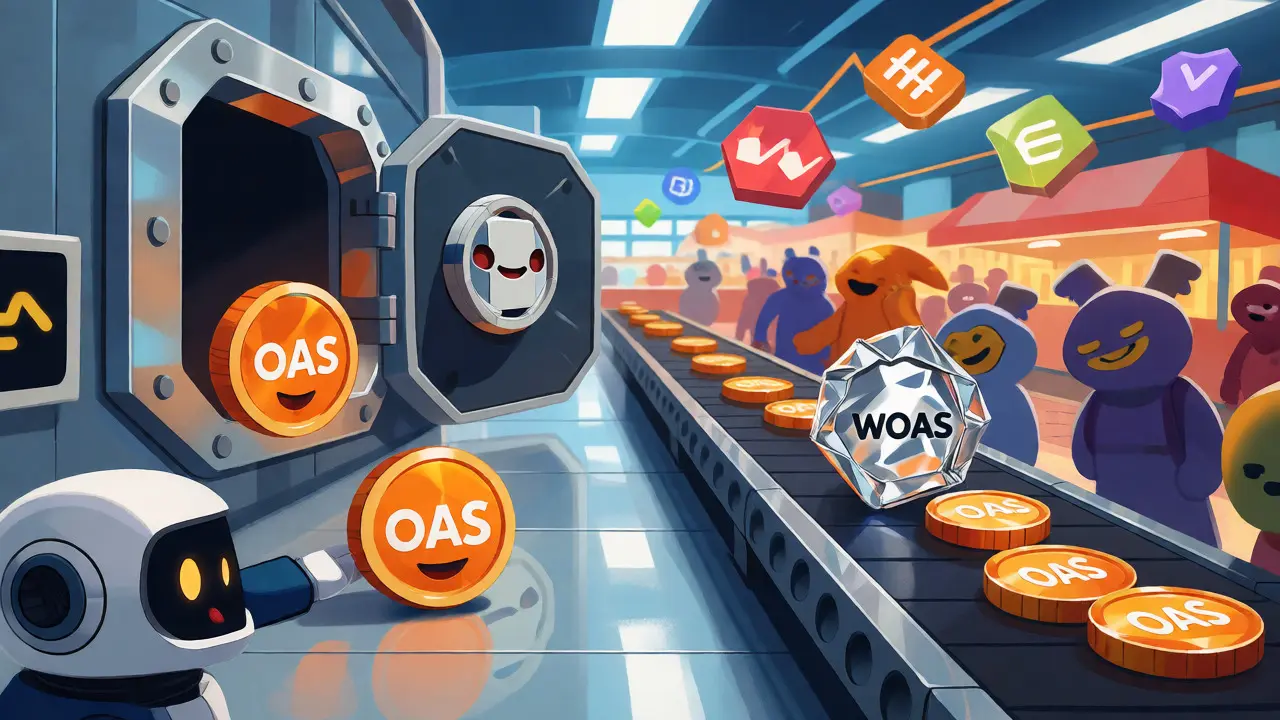
The process isn’t magic; it’s a custodial bridge. When you want to convert OAS to WOAS, you send your native tokens to a secure vault managed by a consortium of validators. In return, the smart contract mints an equal amount of WOAS tokens on the Ethereum network.
Here is the step-by-step flow:
- Deposit: You send OAS tokens to the Oasys bridge contract.
- Verification: The system waits for 12 network confirmations to ensure the transaction is final and secure.
- Minting: Once verified, the corresponding amount of WOAS is minted on Ethereum.
- Usage: You now hold WOAS, which behaves like any other ERC-20 token.
- Unwrapping: To get your OAS back, you burn the WOAS tokens, and the vault releases your original OAS.
This 1:1 peg is critical. One WOAS should always be worth one OAS. If this peg breaks, the value proposition collapses. Currently, the system relies on multi-signature wallets controlled by trusted partners, including major names in the gaming industry. While this adds a layer of trust, it also introduces centralization risks compared to fully decentralized bridges.
Why Use WOAS Instead of Native OAS?
If Oasys is faster and cheaper, why bother wrapping your tokens? The answer lies in liquidity and utility. According to data from early 2024, over 78% of DeFi liquidity resides on Ethereum-compatible networks. By staying only on Oasys, you miss out on the vast majority of trading volume and financial instruments available in crypto.
| Feature | Native OAS | Wrapped Oasys (WOAS) |
|---|---|---|
| Network | Oasys Mainnet | Ethereum (ERC-20) |
| Average Transaction Fee | ~$0.03 | ~$0.87 (varies with gas) |
| Transaction Speed | ~1.2 seconds | ~15.3 seconds |
| Primary Use Case | In-game purchases, staking | Trading, Lending, Cross-chain DeFi |
| Exchange Availability | Limited to Oasys DEXs | Available on major Ethereum DEXs |
The trade-off is clear. You pay higher fees and accept slower speeds on Ethereum to gain access to deeper liquidity. For casual gamers who just want to buy a skin or upgrade a character, native OAS is better. But for traders and investors looking to maximize returns through yield farming or arbitrage, WOAS opens doors that were previously locked.
Risks and Security Considerations
No bridge is perfect, and wrapped tokens carry specific risks. The biggest concern with WOAS is counterparty risk. Because the wrapping process is custodial, you are trusting the entities holding your OAS tokens not to lose them or go bankrupt. If the vault is compromised, the WOAS tokens could become worthless because there would be no underlying asset backing them.
History has shown us that bridges are prime targets for hackers. The Wormhole bridge hack in 2022 lost hundreds of millions of dollars. While WOAS uses a consortium model with reputable validators like Bandai Namco and CryptoZoon, it is still less decentralized than some competitors. Analysts rate the centralization risk as "medium-high" because a small group controls the signing authority.
Another factor is volatility. WOAS mirrors the price of OAS, which is tied to the performance of the Oasys gaming ecosystem. If a major game on Oasys fails or user adoption drops, both OAS and WOAS will suffer. Unlike Bitcoin-backed wrapped tokens, WOAS is exposed to the niche risks of the blockchain gaming sector.

Who Should Use WOAS?
You don’t need WOAS if you are strictly a player. If you log into a game on Oasys, earn rewards in OAS, and spend them on items within that same game, stay native. It’s cheaper and faster.
However, WOAS is ideal for three types of users:
- The DeFi Farmer: You want to lend your gaming tokens on Aave or Compound to earn interest. These protocols often require ERC-20 tokens.
- The Arbitrage Trader: You spot price differences between Oasys exchanges and Ethereum exchanges. WOAS lets you move capital quickly to capture these spreads.
- The Portfolio Diversifier: You want to hold a basket of assets on Ethereum but believe in the long-term growth of the Oasys gaming platform.
It’s also worth noting that setting up WOAS transactions requires a bit more technical know-how than standard swaps. Users report a learning curve involving network configuration in wallets like MetaMask. If you aren’t comfortable managing multiple networks, you might find the process frustrating.
The Future of WOAS and Oasys Ecosystem
The team behind Oasys is actively working to improve the experience. Recent updates have focused on reducing gas costs and expanding the number of supported games. There are plans to move toward non-custodial bridging solutions, such as integrating with Chainlink’s CCIP protocol. This shift aims to reduce the reliance on centralized validators, thereby lowering the counterparty risk associated with current wrapped models.
Market analysts predict that as blockchain gaming matures, the demand for interoperability tools like WOAS will grow. With the sector valued at billions of dollars and daily active wallets rising, the ability to move value freely between chains becomes a necessity, not a luxury. However, competition is fierce. Other gaming chains like Immutable X and Ronin have their own wrapped tokens and bridges. WOAS needs to maintain its edge through strong partnerships and seamless user experiences to survive.
For now, WOAS serves as a vital connector. It doesn’t replace the native token but complements it, creating a dual-layer economy where utility meets speculation. Whether it remains relevant depends on how well the Oasys ecosystem continues to attract high-quality games and players.
Is Wrapped Oasys (WOAS) the same as OAS?
No, they are different tokens on different blockchains. OAS is the native coin on the Oasys blockchain, while WOAS is an ERC-20 token on Ethereum that represents OAS. They are pegged 1:1 in value, but WOAS allows you to use your assets on Ethereum-based platforms.
Can I convert WOAS back to OAS?
Yes, you can unwrap WOAS back to native OAS at any time. This involves sending WOAS to the bridge contract on Ethereum, which burns the WOAS and releases the equivalent OAS on the Oasys network. Be aware that this process incurs gas fees on both sides.
Why are the fees for WOAS transactions higher than OAS?
WOAS operates on the Ethereum network, which typically has higher gas fees than the optimized Oasys blockchain. Additionally, the bridging process itself requires complex smart contract interactions that cost more to execute than simple transfers on the native chain.
Is WOAS safe to hold?
WOAS is generally considered safe due to audits and the involvement of reputable gaming companies in the validator consortium. However, all wrapped tokens carry smart contract and custodial risks. Always do your own research and consider using hardware wallets for larger amounts.
Where can I buy WOAS?
WOAS is primarily traded on decentralized exchanges (DEXs) on the Ethereum network, such as Uniswap. It may also be available on some centralized exchanges that support ERC-20 tokens, though availability can vary compared to more mainstream cryptocurrencies.