
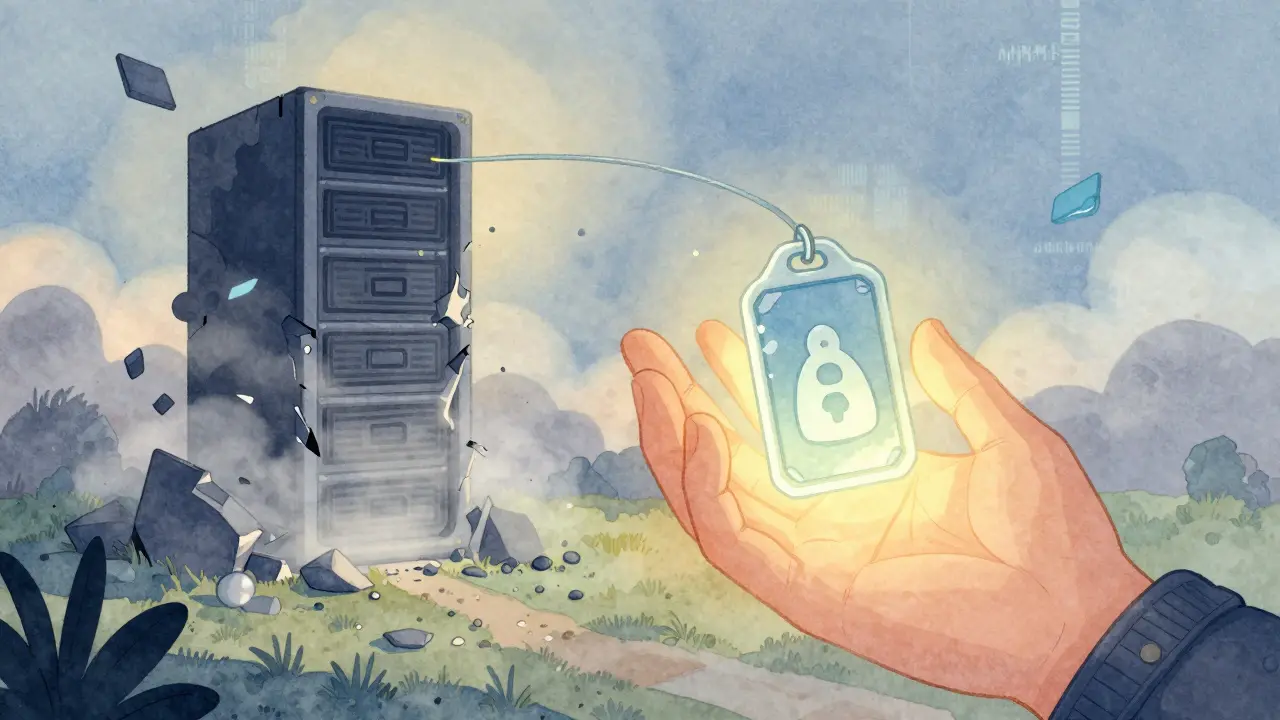
You buy a digital artwork for thousands of dollars. You hold the token in your wallet. But then, the website hosting the image goes offline. Suddenly, your expensive asset is just a blank square or a broken link. This nightmare scenario happens because people often misunderstand NFT metadata-the invisible data that actually defines what your NFT is.
Metadata isn't the art itself. It’s not the video file or the JPEG. Think of it as the ID card for your digital asset. It tells the blockchain the name, description, traits, and most importantly, where to find the actual media file. Without correct metadata, an NFT is just a number on a ledger with no visual identity. In this guide, we break down exactly how this works, why storage location matters more than you think, and how to check if your assets are safe from "link rot."
The Anatomy of NFT Metadata: What's Inside?
At its core, NFT metadata is a set of data that describes other data, specifically providing essential information about non-fungible tokens on blockchain networks. Most projects use a standard text format called JSON (JavaScript Object Notation). If you’ve ever looked at the code behind a website, JSON looks familiar-it’s a simple list of key-value pairs.
A typical metadata file contains these specific components:
- Name: The title of the NFT (e.g., "Bored Ape #3847").
- Description: A short paragraph explaining the collection or specific item.
- Image/Video/Audio Link: The URL pointing to the actual media file. This is the most critical part.
- Attributes (Traits): Specific characteristics like "Background: Blue" or "Hat: Cowboy." These define rarity.
- External URL: A link to the project’s official website or social media.
For example, if you own a CryptoPunk, the metadata doesn't contain the pixel art itself. Instead, it says: {"name": "CryptoPunk #1", "image": "ipfs://...", "attributes": [{"trait_type": "Type", "value": "Male"}]}. The blockchain stores this reference, not the heavy image file.
On-Chain vs. Off-Chain: The Storage Dilemma
Here is the technical catch: Blockchains like Ethereum are not designed to store large files. Storing a high-resolution image directly on the blockchain would cost a fortune in gas fees and slow down the network. Ethereum can only handle about 256 bytes of data per transaction efficiently. A single NFT image can range from 500KB to 5MB.
Because of this limitation, almost all NFTs store their media off-chain. This creates two main approaches:
| Storage Type | How It Works | Risk Level | Cost |
|---|---|---|---|
| Centralized Servers (AWS, Google Cloud) |
Files hosted on traditional company servers. | High: If the server shuts down or the company deletes the file, the NFT becomes a blank space. | Low initial cost, but ongoing maintenance fees. |
| Decentralized Storage (IPFS, Arweave) |
Files distributed across a global network of computers using content hashes. | Low: Data remains accessible as long as at least one node pins it. | Higher initial setup complexity; small pinning fees. |
In 2022, a study by IPFS found that 37% of NFT projects used centralized hosting. When the marketplace Nifty Gateway faced service interruptions, over 12,000 NFTs became temporarily inaccessible because their metadata links pointed to centralized AWS servers that went down. Conversely, collections like CryptoPunks, which stored metadata on IPFS (InterPlanetary File System) since 2017, maintained 100% uptime. By 2025, Gartner predicted that 65% of high-value NFTs will use decentralized storage to avoid this exact risk.
Understanding Token Standards: ERC-721 vs. ERC-1155
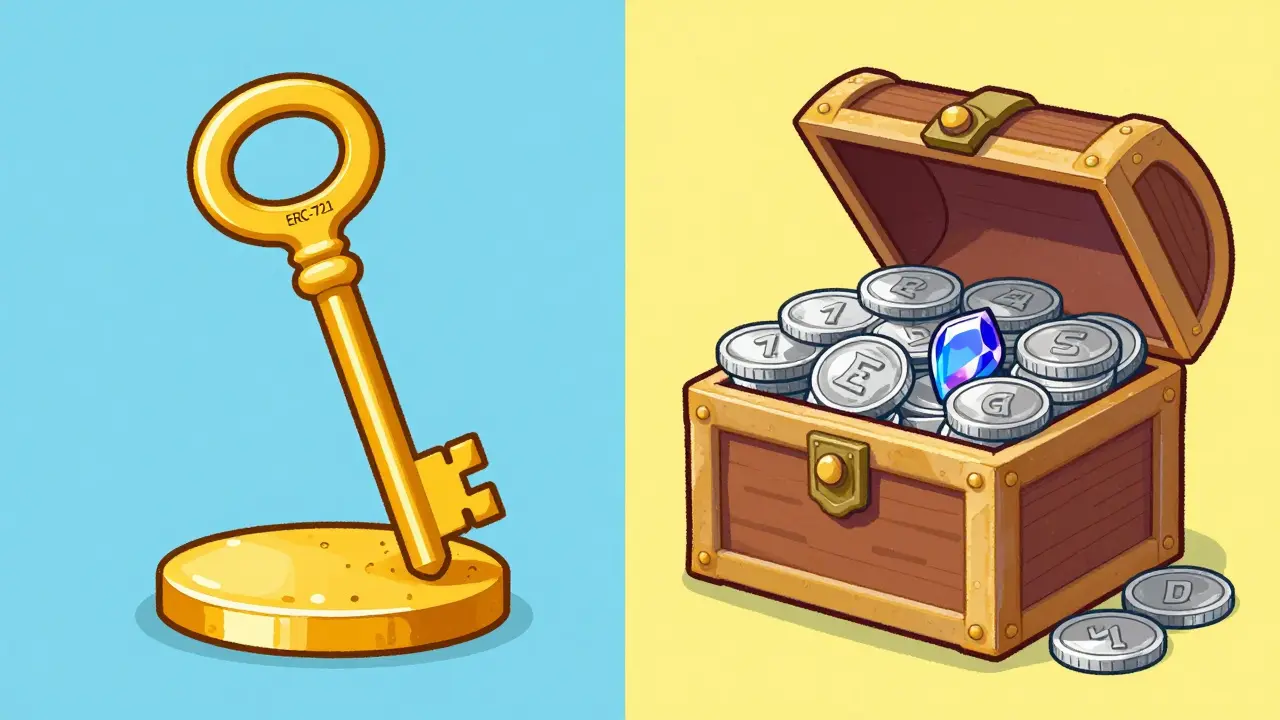
Metadata doesn't exist in a vacuum; it’s tied to the smart contract standard used to create the NFT. The most common standard is ERC-721, an Ethereum Improvement Proposal created by Dieter Shirley in 2018. As of 2023, ERC-721 accounted for 92.7% of all NFTs. It treats each token as unique, meaning every single NFT has its own distinct metadata file.
Then there is ERC-1155, a multi-token standard that allows both fungible and non-fungible tokens in one contract. This is popular for gaming assets where you might have 100 identical swords (fungible) and one legendary sword (non-fungible). ERC-1155 saves gas fees by grouping similar metadata, making it efficient for mass-minting items. However, it requires more complex coding to manage individual trait variations.
When you look at an NFT on a marketplace, the platform reads the tokenURI function from the smart contract. This function returns the web address (URL) where the JSON metadata file lives. If that URL points to a dead server, the marketplace shows nothing.
Why Metadata Quality Affects Value
It’s not just about technical stability; metadata quality directly impacts market price. A February 2024 study by NonFungible.com analyzed 1.2 million transactions and found that NFTs with complete, verified, and decentralized metadata fetched prices 22.7% higher on average.
Why? Because buyers trust permanence. If you’re spending $5,000 on a digital asset, you want proof that the image won’t vanish tomorrow. Projects that implement EIP-6454, a standardized approach to metadata verification proposed by Vitalik Buterin in August 2023, signal to buyers that they prioritize security. By late 2023, 43% of new NFT projects adopted this verification method.
Furthermore, accurate attributes drive scarcity. In generative art collections, the metadata lists traits like "Laser Eyes" or "Gold Fur." Marketplaces use this data to calculate rarity scores. If the metadata is missing or incorrect, the rarity score fails, and the secondary market value drops significantly.
Common Pitfalls and How to Avoid Them
If you are a collector or a creator, here are the specific risks associated with metadata:
- Link Rot: The URL in the metadata points to a server that no longer exists. Always check if the project uses IPFS or Arweave. You can verify this by looking at the contract address on Etherscan and checking the
tokenURIoutput. - Mutability Risks: Some contracts allow creators to update metadata after minting. While useful for fixing bugs, it also means a creator could theoretically change the image or description. Look for immutable contracts unless you explicitly trust the team’s governance.
- Centralized Pinning Dependencies: Even if a project uses IPFS, they often use a service like Pinata to "pin" (keep alive) the data. If the project stops paying Pinata, the data might disappear from fast gateways. Check if the project has multiple pinning providers.
Dr. Sarah Jamie Lewis, a cryptography researcher, warned in May 2023 that 78% of NFT metadata implementations fail to properly authenticate content, creating spoofing vulnerabilities. This means bad actors can sometimes trick wallets into displaying fake images by manipulating metadata pointers. Always view NFTs through reputable marketplaces that validate metadata signatures.
The Future: Zero-Knowledge Proofs and Interoperability
The landscape is evolving rapidly. The Ethereum Foundation accepted EIP-7617, a proposal for standardized metadata schemas to improve interoperability, in October 2023. This aims to make it easier for NFTs to move between different applications without losing their data context.
Looking ahead to 2026, Forrester predicts that 80% of NFT metadata will incorporate zero-knowledge proofs. This technology will allow users to prove ownership or specific traits (like "I own a rare item") without revealing their entire wallet history or the underlying private keys. This enhances privacy while maintaining the integrity of the metadata.
As the global NFT market continues to grow, reaching $34.11 billion in 2023, the infrastructure supporting it must mature. Metadata is no longer an afterthought; it is the foundation of digital ownership. Whether you are buying, selling, or building, understanding where your data lives and how it is structured is the difference between owning a valuable asset and holding a broken link.
What happens if NFT metadata is deleted?
If the metadata file is deleted from its host server, the NFT remains on the blockchain, but the visual representation (image/video) disappears. Wallets and marketplaces will show a blank space or an error message because they cannot retrieve the link defined in the metadata. This is known as "link rot."
Is NFT metadata stored on the blockchain?
Technically, only a pointer (a URL or hash) to the metadata is stored on the blockchain. The actual metadata file (JSON) and the media assets are usually stored off-chain due to size and cost constraints. However, some newer standards and smaller chains allow for more on-chain storage.
What is the difference between ERC-721 and ERC-1155 metadata?
ERC-721 assigns a unique metadata file to each individual token, making it ideal for unique art. ERC-1155 allows multiple tokens to share the same metadata structure, which is more efficient for games or collections with many identical items (semi-fungible tokens).
How do I check if my NFT uses IPFS?
You can check by viewing the NFT's contract on a block explorer like Etherscan. Look for the tokenURI function. If the resulting URL starts with ipfs:// or arweave.net, it is decentralized. If it points to a standard domain like www.example.com, it is likely centralized.
Can NFT metadata be changed after minting?
It depends on the smart contract. Many contracts are immutable, meaning metadata cannot be changed once set. Others include an "upgradeable" feature that allows the creator to update the metadata URL. Buyers should check the contract documentation to know if the artist can alter the description or image link later.
Comments
Natalie Lucas
omg yes!! i had no idea that my expensive ape was just a link to a server that could die at any moment 😱 thank you for breaking it down so simply! feels like learning magic spells but for digital art ✨
July 11, 2026 AT 17:01
Curtis Johnson
it is truly fascinating how something so technical can have such emotional weight for collectors. i remember when i first bought an nft and thought i owned the file itself. realizing later it was just a pointer felt like finding out your house deed was actually just a post-it note on a door. we need more education on this front because ignorance really is bliss until the server crashes 💔
July 12, 2026 AT 23:17
Steven Briggs
ipfs is the only way. always check the uri.
July 14, 2026 AT 04:43
Hamza k
the sheer audacity of these centralized servers holding our digital souls hostage is absolutely mind-blowing! it’s like renting a locker in a burning building and hoping the firemen don’t take your keys. decentralized storage isn’t just tech, it’s survival of the fittest in the wild west of web3 🐎🔥
July 15, 2026 AT 17:17
Jackie D
i always wondered why some projects seem more 'legit' than others. turns out it's literally about where the data lives. makes me want to go back and audit all my old purchases. scary stuff indeed 🕵️♀️
July 17, 2026 AT 16:20
Winston Lacewing
you people are so naive thinking ipfs saves you. the nodes go offline too if the incentives dry up. nothing is permanent except entropy and bad code. stop pretending you own anything on the internet 🤡💀
July 18, 2026 AT 19:25
Andrew Schneider
actually erc-1155 is superior for everything. why would anyone use 721 unless they are stuck in the past? gas fees are a joke compared to efficiency. wake up sheeple 🐑⚡
July 19, 2026 AT 06:55
Eric Braddock
of course the mainstream narrative pushes ipfs while the deep state controls the pinning services. look at who funds the ethereum foundation. it’s all a surveillance grid waiting to snap shut on your metadata. zero-knowledge proofs are just a distraction from the fact that they already have your biometric data linked to your wallet address via quantum decryption algorithms developed in 2019 🧬👁️
July 20, 2026 AT 04:43
Nick G
one must consider the broader cultural implications of metadata immutability versus mutability. while the technical aspects are crucial, the philosophical underpinning of what constitutes 'ownership' in a digital realm requires a nuanced approach. perhaps we should view these tokens not as property but as participatory certificates in a global artistic dialogue, thereby shifting the focus from preservation to engagement and community validation rather than mere file retention.
July 22, 2026 AT 00:39
Nick Wengel
good info. i just check if it says ipfs before buying now. simple as that.
July 22, 2026 AT 22:30
Alicia Hull
This article is decent but lacks depth on EIP-7617 implementation details. You cannot simply gloss over interoperability standards without addressing the specific schema conflicts between Solana and Ethereum metadata structures. It is unacceptable to provide such a superficial overview to retail investors who rely on accurate technical due diligence. Fix your content or lose credibility.
July 23, 2026 AT 22:27
Johan Otto
bro this is basic stuff. everyone knows aws sucks. why are we still talking about this in 2024? 🙄
July 25, 2026 AT 05:07
Anuj Kashyap
the irony of storing 'permanent' digital art on ephemeral servers is not lost on me. we build cathedrals of code on foundations of sand. yet here we are, arguing over json keys while the house burns down. fascinatingly tragic 🎭📜
July 25, 2026 AT 18:09
Tracy Marshall
i don't trust any of this blockchain nonsense. they will change the metadata whenever they want and you won't know until its too late. the government is watching every transaction through these 'decentralized' networks anyway. stay safe folks 🛡️
July 26, 2026 AT 21:36
Guy Davis
typo in paragraph 3. also nfts are a scam. end of story.
July 27, 2026 AT 11:07
Kim Kay
i tried to check my contract once and got confused by all the code. maybe there should be a simpler tool for non-techies to verify ipfs links? it feels like we are leaving half the community behind with all this jargon 🤷♀️
July 28, 2026 AT 13:59
Brad Semp
It is quite amusing to observe the general populace struggling to comprehend the fundamental architecture of distributed ledger technology. One would assume that individuals investing significant capital would possess the intellectual capacity to understand JSON structures. Alas, the barrier to entry remains cognitive rather than financial. Perhaps remedial computer science courses should be mandatory before minting.
July 29, 2026 AT 05:49
Korn Arrieta
Let’s cut the fluff. If your metadata isn’t on Arweave, you’re gambling. IPFS is fine for now but Arweave is the only true permanent solution. Stop accepting mediocrity in your portfolio. Weak projects get weak storage. Simple cause and effect.
July 30, 2026 AT 22:29
Ruth Williams
The author fails to adequately emphasize the critical importance of provenance verification beyond mere storage location. A sophisticated collector understands that metadata integrity is paramount to asset valuation. This guide is merely a primer for the uninitiated masses who lack the discernment required for high-tier digital asset acquisition.
July 31, 2026 AT 20:37
Sophie Nakasako
I love how this breaks down the 'why' behind the tech! It makes me feel smarter just reading it. Does anyone else think the future of ZK-proofs sounds like sci-fi coming to life? Can't wait to see how privacy plays out in the next few years! 🚀✨
August 2, 2026 AT 01:38
Kristy Morrow
metadata is just a construct of control. we pretend these traits matter but rarity is manufactured scarcity designed to exploit human greed. the whole system is a pyramid scheme dressed up in cryptography. wake up 🌀
August 2, 2026 AT 05:17
John Harman
look guys im not a dev but ive been around since 2017. if it aint on chain its not real. ipfs is better than aws but still relies on pinning services which are basically central points of failure. arweave is the only thing that matters. stop listening to influencers and read the whitepapers yourself. its free information.
August 3, 2026 AT 17:48