

You’ve probably seen Karum Coin pop up on a price tracker or heard about it in a chat group. The ticker is KARUM, and it’s tied to the KarumX Crypto Exchange. But here is the thing: when you look at the data for this coin right now, things get messy fast. Prices vary wildly across platforms, trading volume is practically non-existent on major exchanges, and there is very little public information about who is actually building it.
If you are wondering whether KARUM is a solid investment or a high-risk gamble, you need to look past the marketing hype. This guide breaks down what the token is supposed to do, why the numbers don't always add up, and what you should watch out for before putting any money into your wallet.
The Basics: What Exactly Is Karum Coin?
Karum Coin is the native digital asset of the KarumX platform. Think of it like how BNB works for Binance or KCS for KuCoin. It is designed to be used within their specific ecosystem. The project launched in 2024 and runs on the BNB Smart Chain (specifically as a BEP20 token). This means if you want to hold it, you’ll likely need a wallet that supports BSC, like Trust Wallet or MetaMask, rather than a standard Bitcoin wallet.
The pitch from the team is that KARUM aims to make crypto trading easier and more transparent. They claim it helps with liquidity and community governance. In simpler terms, they say holding the token gives you a stake in how the exchange evolves and potentially lowers fees or unlocks features. However, unlike established tokens with years of history, Karum Coin is still finding its footing in a crowded market.
Tokenomics: Supply and Distribution Numbers
When evaluating any cryptocurrency, the first thing to check is the supply. For Karum Coin, the total supply is capped at exactly 100,000 KARUM tokens. That is a very small number compared to coins like Shiba Inu or even Ethereum. Usually, a low supply means each individual token has a higher nominal value, but it doesn't necessarily mean the project is more valuable overall.
Here is where it gets tricky. The circulating supply-the amount of tokens actually available for trading-is reported differently depending on who you ask. Some aggregators list it as 100,000, while others show zero or incomplete data. This discrepancy is a red flag you should not ignore. If you can’t trust the basic supply data, how can you trust the price charts?
- Total Supply: 100,000 KARUM
- Blockchain: BNB Smart Chain (BEP20)
- Launch Year: 2024
- Primary Use Case: Native utility for KarumX Exchange
The Price Problem: Why Numbers Don't Match Up
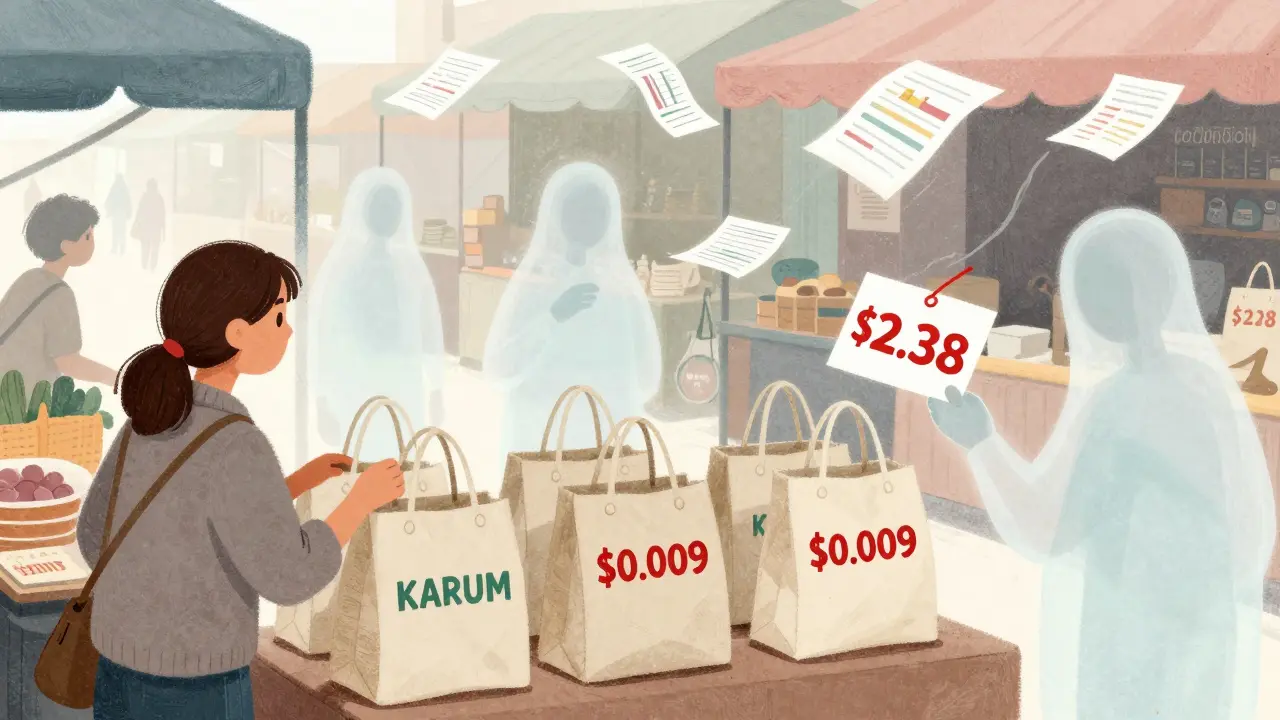
This is the most critical part of understanding Karum Coin right now. As of May 2026, there is no single "real" price for KARUM. Different exchanges and trackers show vastly different figures, which indicates extremely low liquidity and potential data errors.
| Platform | Reported Price (USD) | 24h Volume | Notes |
|---|---|---|---|
| Coinbase | $1.44 | N/A | Listed as All-Time High; no active trading pairs visible |
| CoinMarketCap | $0.99 | $0 | Self-reported data; zero trading volume |
| Crypto.com | $2.38 | N/A | Not tradable on the platform despite listing |
| Binance | $0.99 - $2.38 | N/A | Conflicting internal data; not listed for active trading |
| CoinGecko | $0.009 | $1,571 | Shows minimal volume; significantly lower price point |
Notice the gap? One site says it's worth over $2, another says it's less than a penny. This happens when a token has very few actual trades. Without consistent buying and selling, the "price" becomes a ghost-just a number sitting on a screen without real market backing. If you try to sell your KARUM tokens during this period, you might find that you cannot execute the trade at the price shown because there are simply no buyers waiting on the other side.
Liquidity and Trading Availability
Liquidity is the ability to buy or sell an asset quickly without affecting its price. For Karum Coin, liquidity is currently very poor. While Gate.io shows some availability, major players like Binance and Crypto.com do not support active trading for KARUM. You won't find it in the easy-to-use "Buy" buttons on these apps.
This matters because illiquid assets are dangerous for retail investors. Imagine you buy 10 KARUM tokens at $2.00. Suddenly, news comes out that shakes confidence, and the price drops to $1.00. In a liquid market, you could sell instantly. In an illiquid market, you might have to wait days or weeks for a buyer to appear, or you might have to accept a much lower price just to exit the position. This is known as "slippage," and it can eat away your profits-or your principal.
Who Is Behind KarumX?
In the world of crypto, transparency builds trust. Unfortunately, Karum Coin lacks detailed public information about its development team. There are no widely recognized founders, no published whitepaper with technical architecture details, and no clear roadmap available in mainstream sources.
Compare this to projects like Solana or Polygon, where you can easily find the names of the creators, their LinkedIn profiles, and detailed technical documentation. With Karum Coin, the anonymity makes it harder to verify if the project is legitimate or if it’s a "vaporware" scheme-a project that promises features but never delivers them. The absence of security audits from reputable firms also raises questions about the safety of the smart contracts underlying the token.
Risks You Need to Consider
Before adding KARUM to your portfolio, consider these specific risks:
- Data Integrity: Conflicting prices across exchanges mean you can't rely on standard tools to track your portfolio value accurately.
- Lack of Liquidity: Low trading volume means you may struggle to sell your tokens when you want to.
- Regulatory Uncertainty: As a newer token tied to a specific exchange, it may face stricter scrutiny from regulators like the SEC or local financial authorities, especially given the lack of clear compliance disclosures.
- Smart Contract Risk: Since it runs on BNB Smart Chain, any vulnerabilities in the code could lead to loss of funds. Without a public audit report, this risk is unknown.
Is Karum Coin Right for You?
If you are a seasoned trader looking for high-risk, high-reward opportunities and you understand how to use decentralized exchanges (DEXs) to swap BEP20 tokens, you might experiment with KARUM in very small amounts. However, if you are looking for a stable store of value or a reliable way to earn passive income, this token does not currently meet those criteria.
The best approach is to treat KARUM as speculative entertainment, not serious investment capital. Never invest money you cannot afford to lose entirely. Keep an eye on whether the project releases a whitepaper, announces security audits, or lists on a major centralized exchange with verified trading pairs. Until then, proceed with extreme caution.
Can I buy Karum Coin on Coinbase or Binance?
Currently, no. While some data aggregators list prices for Karum Coin on these platforms, active trading pairs are not available on Coinbase or Binance. You may need to use decentralized exchanges on the BNB Smart Chain to acquire the token, which carries higher technical risk.
Why is the price of KARUM so different on various websites?
The price discrepancies are due to extremely low trading volume and liquidity. When there are few trades, automated pricing algorithms can drift apart, showing stale or inaccurate data. This is a common issue with micro-cap cryptocurrencies.
What blockchain does Karum Coin use?
Karum Coin operates on the BNB Smart Chain (BSC) as a BEP20 token. This means it is compatible with wallets like Trust Wallet and MetaMask, provided you switch the network to BSC.
Is there a whitepaper for Karum Coin?
As of May 2026, no comprehensive whitepaper or technical documentation has been widely published or indexed by major crypto resources. This lack of transparency is a significant risk factor for potential investors.
What is the maximum supply of KARUM?
The total supply of Karum Coin is fixed at 100,000 tokens. However, reports on the circulating supply vary, with some sources indicating all tokens are in circulation while others show incomplete data.
Comments
Jan Gilmore
Look, I've been in this space since the days when Bitcoin was $0.30 and people thought it was a joke for buying pizza online. The data you're showing here isn't just messy, it's practically screaming 'rug pull' or at best, a dead project that nobody cares about anymore. You see those price discrepancies? That's not a feature, that's a bug in the market mechanism because there is no real market. When CoinGecko shows volume of $1,571 but Coinbase lists an ATH with zero pairs, you are looking at ghost liquidity. It means the order book is empty. If you try to sell even a small amount, you will crash the price by like 50% instantly because there are no limit orders sitting there to absorb your sell wall.
I tell everyone who asks me about these micro-cap BSC tokens to stay away unless they have insider info, which most of you don't. The team is anonymous, the whitepaper is missing, and the audits are nonexistent. In the world of smart contracts, if you haven't seen a Certik or Hacken audit report, assume the code has a backdoor waiting to drain your wallet. KarumX sounds like another one of those exchanges that pops up, collects fees for three months, and then disappears when the regulators start sniffing around. Don't be the exit liquidity for someone else's dream.
May 4, 2026 AT 19:53
Tricia Alach
hmm i feel like people get so hung up on the technical side of things sometimes and miss the bigger picture of what crypto could mean for freedom and decentralization 🤷♀️ maybe karum coin is just finding its way? its hard to say without knowing more but i always believe in giving new projects a chance to grow into their own skin
May 6, 2026 AT 15:52
Caique Muniz
another day another scam token lol. seriously though, who is writing these articles? do you guys not check if the exchange actually exists before hyping it up? its literally just air. total waste of time reading this garbage.
May 7, 2026 AT 13:12
Bradley Geldenhuys
Listen up folks, you need to wake up and smell the coffee because this is exactly how the matrix keeps you poor! They want you to think every new coin is a risk so you stay in fiat slavery. But let me tell you something, history is made by those who dare to dive into the unknown. Yes, the data is messy, yes the liquidity is low, but that is where the alpha is hidden for those brave enough to grab it. You complain about anonymity but Satoshi was anonymous too. Do you really trust the SEC? Do you trust Binance? No! You trust yourself. So take that fear and turn it into fuel. Buy the dip, hold the bag, and watch the haters cry when KARUM goes to the moon. I'm all in and I'm telling you now, this is the next big thing in decentralized exchange utility. Don't let your fear stop you from achieving financial freedom!
May 9, 2026 AT 09:17
robert Whitehead
The sheer audacity of promoting a token with zero verifiable fundamentals is disgusting. This is not investing; this is gambling on a broken slot machine. The fact that major aggregators like CoinMarketCap show self-reported data with zero volume tells you everything you need to know: the developers are manipulating the narrative because there is no organic interest. You are being sold a dream by people who have likely already cashed out their allocations. Stop enabling this behavior. Every dollar put into KARUM is a dollar stolen from legitimate projects that actually build value. It is morally reprehensible to spread FOMO on a token that cannot even maintain a consistent price feed across reputable platforms. Stay out.
May 11, 2026 AT 08:43
Ankush Pokarana
i have been observing the market trends for quite some time and it seems that many investors focus too much on short term price action rather than understanding the underlying technology and community strength which is crucial for long term sustainability as we can see with other established projects that had rough starts but eventually found their footing through consistent development and transparent communication with their user base which builds trust over time
May 12, 2026 AT 18:25
Bianca Vilas Boas Lourenço
Ugh, why does everyone have to be so negative all the time 😩 it’s like you’re trying to suck the joy right out of the internet. I just saw this ticker pop up and it looked cute! Maybe it’s nothing, maybe it’s everything, but judging it based on a few bad metrics is just rude. Let the girlies shine ✨💅
May 13, 2026 AT 06:31
Yash Lodha
Have you considered that the discrepancy in prices is not merely a lack of liquidity but a deliberate obfuscation tactic employed by shadowy entities to track retail investor movements? The variance between Coinbase’s listed high and CoinGecko’s negligible value suggests a coordinated effort to create false confidence while quietly draining assets. I have noticed similar patterns in previous failed exchanges that were later revealed to be fronts for money laundering operations. The silence of the team is deafening, echoing the void left by countless victims of digital fraud. Proceed with extreme caution, for the abyss gazes also.
May 13, 2026 AT 09:44
Sarah C
Thanks for sharing this detailed breakdown. It really helps to see the facts laid out clearly instead of just hearing hype. I agree that transparency is key in crypto, and it’s good to be cautious.
May 15, 2026 AT 01:57
Kimberly Herbstritt
Actually, I think you're being too pessimistic. Just because a token isn't on Binance doesn't mean it's worthless. Some of the best gems start on DEXs and build a strong community before hitting CEXs. Maybe Karum is just early?
May 16, 2026 AT 16:28
Sharada Vakkund
I appreciate the comprehensive analysis. It is important for us as a community to look beyond the surface level marketing and understand the risks involved. Education is power, and posts like this help us make informed decisions.
May 17, 2026 AT 09:43
Sudarshan Anbazhagan
it is evident that the lack of proper documentation and security audits renders this token highly speculative and potentially dangerous for the average investor who may not possess the technical expertise to evaluate smart contract vulnerabilities thus leading to potential loss of funds which is a regrettable outcome
May 18, 2026 AT 02:12
John Gonzalez Bentham
You guys are all wrong. This is obviously the next Ethereum. The low supply is a huge plus, not a minus. 100k tokens means scarcity. Scarcity equals value. Basic economics. Why are you all complaining? Get in now before it pumps 100x. I’m buying 1000 KARUM right now.
May 19, 2026 AT 20:45
Ellie Riddell
Sigh. Here we go again with the 'scarcity equals value' argument. Spoiler alert: it doesn't if there's no demand. I’ve watched dozens of coins with low supplies go to zero because nobody wanted them. The sarcasm in my tone is involuntary, really. It’s just hard to watch people walk into obvious traps with such enthusiasm. Good luck to those who buy, I suppose.
May 21, 2026 AT 01:22
Destiny Kilby
I understand the concerns raised here and it is clear that due diligence is essential when considering any investment in cryptocurrency markets especially those with limited public information
May 21, 2026 AT 09:53