
When you hear Dogs of Elon (DOE), you might think it’s just another Dogecoin copycat. And honestly? That’s not wrong. But there’s more to it than that. DOE isn’t just a meme coin with a cute dog logo. It’s tied to an NFT collection, offers staking rewards in other cryptos, and claims to be deflationary - all while sitting in one of the most crowded, chaotic corners of the crypto market. So what’s real? What’s hype? And should you even touch it?
What Exactly Is Dogs of Elon (DOE)?
Dogs of Elon (DOE) is a cryptocurrency token built on the Ethereum blockchain as an ERC-20 standard. It was launched in early 2025 as the official currency for the Dogs Of Elon NFT collection, a set of 10,000 unique digital dog-themed artworks. Unlike Dogecoin or Shiba Inu, DOE doesn’t have a corporate backer or celebrity endorsement. Its entire identity is built around community, memes, and a promise of passive income through staking.
The token has a fixed supply of exactly 1 billion DOE. No more will ever be created. That’s a big deal in a world where most meme coins keep printing new tokens. The developers also renounced ownership of the staking contracts after locking in rewards. That means they can’t change the rules, freeze your funds, or dump their holdings secretly. It’s a rare move - and one that gives DOE a small edge over other projects with anonymous teams.
How DOE Works: Staking, NFTs, and Rewards
DOE’s main utility isn’t buying coffee or paying for Tesla merchandise. It’s staking. If you hold DOE tokens in a compatible wallet - like MetaMask or Trust Wallet - you can lock them into the official staking pool. In return, you earn rewards in three different tokens: more DOE, renDOGE, and SHIBA. Yes, you read that right. You’re not just earning one coin. You’re getting a mix of the three biggest dog-themed cryptos.
This is where DOE tries to stand out. It’s not just a standalone coin. It’s a bridge between communities. If you’re into Dogecoin, you get DOGE rewards. If you like Shiba Inu, you get SHIB. And if you believe in DOE’s long-term vision, you get more DOE. It’s a clever way to keep users engaged across multiple ecosystems.
But here’s the catch: staking only works if the project actually has users. As of October 2025, only around 8,400 unique wallets held DOE. That’s tiny. For comparison, Shiba Inu has over 1.2 million holders. Without enough people staking, the rewards pool can dry up fast. And if no one’s buying DOE to stake, the price doesn’t have a reason to go up.
Market Performance and Volatility
As of October 2025, DOE traded at $0.0001381. That sounds cheap - and it is. But low price doesn’t mean low risk. DOE had a 11.29% daily volatility rate, meaning its price swung wildly on almost every trading day. In the past 30 days, only 12 days ended in green. That’s a 40% win rate. Not terrible for crypto - but not great either.
The technical indicators aren’t cheering either. The 50-day moving average was $0.0001803. The 200-day was $0.0001660. The current price was below both. That’s a classic bearish signal. Traders call this a "death cross" when the short-term average dips below the long-term one. It suggests the momentum is falling.
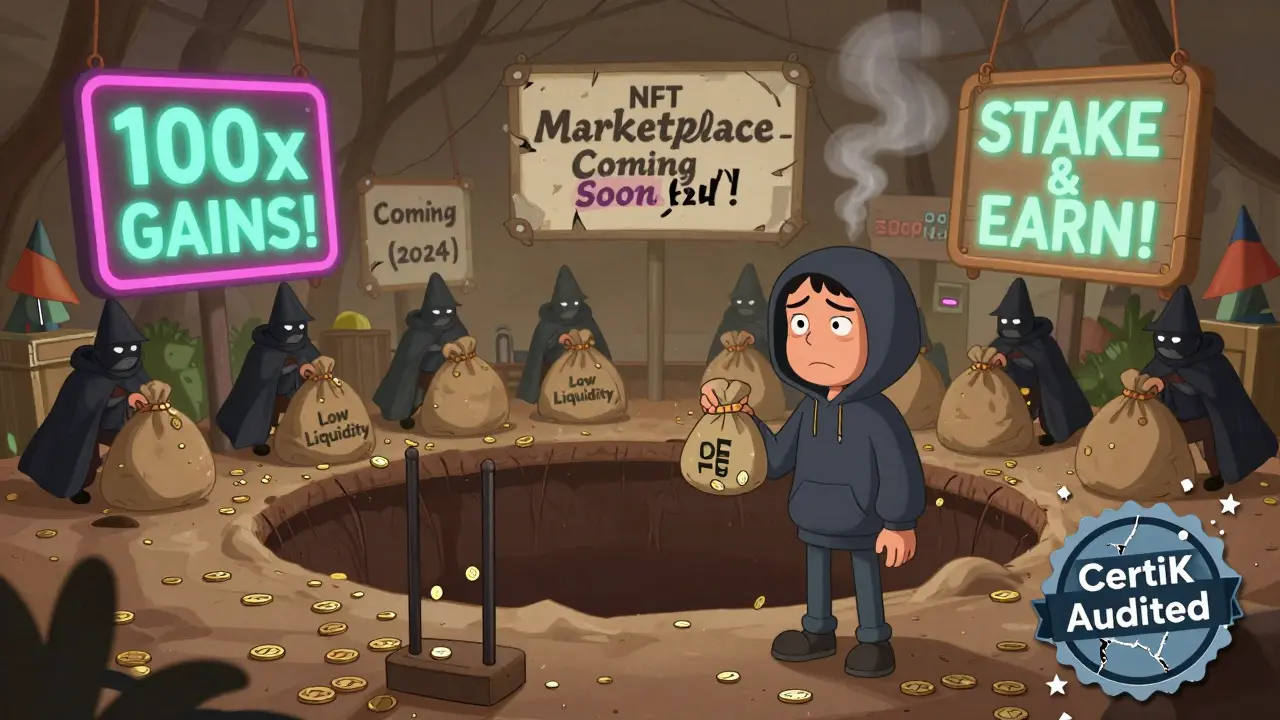
And then there’s the volume. DOE’s 24-hour trading volume hovered around $1.2 million. Shiba Inu? $1.8 billion. That’s over 1,500 times more. Low volume means slippage - when your trade gets filled at a much worse price than expected. One Reddit user said they tried selling 50,000 DOE and the order book vanished. That’s not a glitch. That’s a liquidity crisis.
How to Buy DOE - And Why It’s a Pain
You won’t find DOE on Coinbase, Kraken, or Binance. Not even on their advanced trading platforms. To buy DOE, you need to use a decentralized exchange (DEX) like Uniswap or PancakeSwap. That means:
- Setting up a wallet like MetaMask
- Buying Ethereum (ETH) on a centralized exchange
- Transferring ETH to your wallet
- Connecting your wallet to a DEX
- Swapping ETH for DOE
For someone who’s never touched crypto before? That’s a 2- to 3-hour learning curve. And even after all that, you’ll face high gas fees. Ethereum transactions cost an average of $3.27 as of late 2025. If you’re only buying $50 worth of DOE, you’re paying over 6% in fees just to get in. That’s not sustainable.
Is DOE Safe? The Audit and the Risks
The DOE team had its smart contract audited by CertiK in March 2025. That’s good. CertiK is one of the most respected blockchain security firms. Their report confirmed no backdoors, no mint functions, and no hidden ways for the devs to steal funds.
But audits don’t guarantee success. They just mean the code isn’t broken. They don’t tell you if the project has users, if the NFTs are valuable, or if the staking rewards are sustainable. And here’s the scary part: DOE’s entire value depends on speculation. There’s no real product. No app. No service. Just a token, some NFTs, and a Discord server with over 12,000 members.
Regulators are watching. The SEC has been cracking down on tokens that offer staking rewards as "investment contracts." If DOE’s rewards are seen as promising returns without clear utility, it could get flagged under the Howey Test. That’s not a theoretical risk - it’s a real one. Perkins Coie LLP warned in July 2025 that tokens like DOE are increasingly under scrutiny.
What Do Users Really Say?
Reddit and Trustpilot tell a mixed story. On one side, users praise the staking process. "Easy to set up," said one. "I earned 1.2 DOE in 30 days," wrote another.
On the other side? The complaints are loud and clear:
- "Low liquidity - I couldn’t sell without losing 15% of my value."
- "Marketing says 100x potential. Reality? No one’s buying."
- "Discord support takes 47 minutes to respond."
- "The NFT marketplace never launched."
Twitter sentiment analysis from October 2025 showed 63% negative sentiment. The most common complaint? "Another meme coin without real use case."
How DOE Compares to Dogecoin and Shiba Inu
| Feature | Dogs of Elon (DOE) | Dogecoin (DOGE) | Shiba Inu (SHIB) |
|---|---|---|---|
| Market Cap (Oct 2025) | $138 million | $23.5 billion | $11.8 billion |
| Supply | 1 billion (fixed) | Unlimited (5B new/year) | 589 trillion (fixed) |
| Staking Rewards | DOE, renDOGE, SHIB | No staking | SHIB, LEASH, BONE |
| Merchant Adoption | None | Tesla, SpaceX, AMC | Some small retailers |
| 24-Hour Volume | $1.2 million | $890 million | $1.8 billion |
| Primary Use | NFT ecosystem, staking | Payments, tipping | Staking, DEX, gaming |
DOE’s biggest advantage? Fixed supply. Dogecoin keeps printing new coins. That’s inflation. DOE doesn’t. But that’s not enough. Dogecoin has real-world use. Shiba Inu has a whole ecosystem. DOE? It’s still just a promise.
Future Roadmap: Hype or Hope?
The DOE team says they’re building a marketplace for their NFTs. They promised a governance token for Q1 2026. They even mentioned Layer 2 integration to cut gas fees. But here’s the problem: they missed their Q4 2024 mobile wallet launch. And they haven’t shared any code, updates, or progress reports since September 2025.
Messari analyst Ryan Selkis said it best: "Memecoins without strong utility or community backing typically have 18-24 month lifespans." DOE launched in early 2025. That means it’s already halfway through its potential life. CryptoRank’s model gives it a 34.7% chance of surviving past 2028. That’s not a vote of confidence. It’s a coin flip.
Should You Buy DOE?
Here’s the truth: DOE isn’t a bad project. It’s just not a good one. It’s got a solid contract. It’s got a clever reward structure. It’s got a passionate Discord community.
But it lacks:
- Real adoption
- Clear utility beyond speculation
- Liquidity
- Track record
If you’re a seasoned crypto trader with a high-risk tolerance and $100 you’re okay losing? Maybe you’ll buy a small amount. Maybe you’ll stake it. Maybe you’ll get lucky.
But if you’re new to crypto? If you’re hoping DOE will make you rich? If you’re putting in your rent money? Walk away.
There are hundreds of meme coins. Most die within a year. DOE might be one of them. Or it might surprise us. But betting on it isn’t investing. It’s gambling.
Is Dogs of Elon (DOE) a scam?
No, DOE isn’t a scam in the technical sense. Its smart contract has been audited by CertiK, the supply is fixed, and the team renounced ownership. But it’s a high-risk speculative asset with no real-world use case. Many users lose money because they overestimate its potential. It’s not fraudulent - it’s just unlikely to succeed.
Can I stake DOE on Binance or Coinbase?
No. DOE is not listed on any major centralized exchange. You can only stake it through the official decentralized staking platform using a wallet like MetaMask. This requires you to buy Ethereum first, transfer it to your wallet, and interact with a DEX - which can be confusing for beginners.
Why is DOE’s price so volatile?
DOE has extremely low trading volume - only $1.2 million per day. When a few large holders (whales) buy or sell even a small amount, it moves the price dramatically. Low liquidity means even small trades cause big price swings. That’s why volatility is over 11% daily.
What’s the difference between DOE and Dogecoin?
Dogecoin (DOGE) is older, has a massive user base, and is accepted by real companies like Tesla. DOE is newer, has no merchant adoption, and exists mostly as a staking token tied to NFTs. DOGE has inflation (5 billion new coins yearly). DOE has a fixed supply. DOGE is a currency. DOE is a speculative asset.
Is DOE a good long-term investment?
Based on current data, no. DOE lacks adoption, liquidity, and proven utility. While some predict it could hit $0.02 by 2026, those forecasts are based on hype, not fundamentals. Analysts like Dr. Elena Rodriguez warn that tokens without real use cases rarely survive beyond two years. DOE’s survival probability is estimated at just 34.7% past 2028.
Can I sell DOE easily if I need cash?
Not easily. Due to low liquidity, selling more than $500 worth of DOE often results in slippage of over 8%. That means you’ll get significantly less than the listed price. Many users report their sell orders disappearing because there aren’t enough buyers. Only small amounts can be sold without major price impact.
Comments
aryan danial
DOE isn't even a meme coin anymore it's a philosophical statement on the collapse of speculative capitalism
Fixed supply? Sure. But so does Bitcoin. The difference is Bitcoin has network effects DOE has a Discord server with 12k members who think they're part of a revolution
Staking rewards in three tokens? That's not utility that's financial acrobatics
And don't get me started on the NFT marketplace that never launched
People treat this like a startup when it's just a liquidity trap wrapped in a doggo avatar
February 8, 2026 AT 01:40
Kyle Pearce-O'Brien
Bro this is peak post-modern crypto 🤡
Fixed supply =/= value
Renounced ownership =/= trust
Staking rewards =/= utility
It's like buying a ticket to a concert where the band never shows up but you still have to pay for parking
And the merch is NFTs of dogs wearing sunglasses
We're not investing we're performing existential theater
Also I staked 500 DOE and got 0.3 renDOGE... congrats I'm rich in a currency no one wants 💸🐕
February 9, 2026 AT 22:50
Matthew Ryan
I've held DOE since launch. Not because I think it'll moon but because I like the idea of supporting something that's transparent. No rug pull. No hidden mint function. That counts for something in this space. The liquidity is trash, sure. But if you're in crypto for the long game, sometimes you hold the quiet ones.
February 11, 2026 AT 02:44
Nathaniel Okubule
If you're new to crypto, don't touch DOE. If you're experienced and have money to lose, fine. But don't confuse a token with a business. There's no product, no roadmap, no team updates. Just a contract and a dream. That's not investing. That's hoping.
February 12, 2026 AT 07:57
Jacque Istok
Oh sweet Jesus another 'realistic look' that's just a thinly veiled FUD post
You spent 2000 words explaining why DOE sucks and then ended with 'maybe you'll get lucky'
So which is it? Is it a scam or a hidden gem?
Also your 'comparison table' ignores that DOGE's entire value is based on memes too
At least DOE has a fixed supply and audited contracts
But sure, keep pretending you're Warren Buffett with a crypto blog
February 13, 2026 AT 14:29
Jesse Pasichnyk
USA made Bitcoin. China made Ethereum. Now India's making meme coins and we're supposed to bow down?
DOE is trash. But at least it's not another Chinese blockchain scam
Staking? Fine. NFTs? Whatever. But if you're buying DOE because you think it'll replace the dollar you're delusional
Still better than some of the shit coming out of Asia
Buy low, sell higher, and don't cry when it drops 80%
February 14, 2026 AT 01:23
Jordan Axtell
You call this a 'realistic look'? Bro this is just another crypto shill pretending to be a critic
Look at the numbers: 8400 wallets. 1.2M volume. 11% daily volatility
That's not a coin, that's a pump-and-dump waiting to explode
And the fact that you're even giving this a 'roadmap' makes me sick
They missed their mobile wallet launch. They haven't posted since September. And you're still giving them a chance?
Wake up. This isn't innovation. It's desperation.
February 14, 2026 AT 11:38
James Harris
I'm just here to say: if you're holding DOE, you're not alone. I've been in this since day one. The community is weird but real. We chat, we meme, we help each other with wallet setups. It's not about the price. It's about the people. And yeah, the liquidity is trash. But we're building something here. Slowly. Quietly. Maybe it'll be nothing. Maybe it'll be everything. Either way, I'm proud to be part of it.
February 14, 2026 AT 17:40
Alex Garnett
DOE is the epitome of crypto degeneracy. No utility. No adoption. No vision. Just a bunch of idiots staking a token with a dog logo because they think it'll 'moon' before they pay their rent.
It's not a project. It's a social experiment on how far you can push gullibility.
And you? You're the enabler. Writing this 'realistic' post like it's a legitimate asset? Pathetic.
February 15, 2026 AT 16:25
Danica Cheney
doe is a meme coin like doge is a meme coin its not about utility its about community and vibes if you dont get that then you dont get crypto
February 16, 2026 AT 00:37
Shruti Sharma
lmao this article is so cringe like yeah doe has low volume but so what its not meant to be a big coin its for the meme community and if you dont like it dont buy it dont be mad bc ur not rich
February 16, 2026 AT 09:37
Robin Ødis
You claim DOE has no real use case but you completely ignore the fact that staking rewards are a form of utility. They incentivize long-term holding. That’s not speculation, that’s economic design. And yes, the NFT marketplace didn’t launch-but that doesn’t mean it’s dead. It’s delayed. Projects take time. The audit is clean. The supply is fixed. The team renounced ownership. That’s more than 90% of these coins can say.
Stop conflating liquidity with legitimacy. A token doesn’t need to be on Binance to be valid. It just needs to serve its purpose. DOE serves its purpose: to be a community-driven, deflationary asset with cross-ecosystem rewards. That’s revolutionary. And you? You’re just mad it’s not a VC-funded Ponzi.
February 16, 2026 AT 16:17
Brittany Novak
SEC is watching. That’s not a rumor. That’s fact. They’ve already flagged staking rewards as securities under the Howey Test. DOE is a time bomb. The moment they investigate, the whole thing collapses. The audit doesn’t matter. The fixed supply doesn’t matter. If the SEC says it’s an unregistered security, the price goes to zero. You think the devs will fight it? They renounced ownership. They’re gone. You’re holding a digital ghost. Don’t be the last one holding the bag.
February 17, 2026 AT 03:09
Joshua Herder
They say DOE is just hype. But what if the hype is the point?
What if the entire value isn't in the token, but in the collective belief that it matters?
Isn't that what money always was? A shared hallucination?
DOE is a mirror. It reflects the absurdity of crypto. The desperation. The hope. The delusion.
And maybe... just maybe... that’s the most honest thing in this space.
Not every project needs to build a product. Some just need to be a feeling.
And right now? DOE feels real.
February 17, 2026 AT 18:11
Brittany Coleman
I don’t know if DOE will survive. I don’t know if it’s smart to hold it. But I also don’t think we should dismiss it just because it’s weird.
Maybe the future of crypto isn’t in the big exchanges or the billion-dollar market caps.
Maybe it’s in small, passionate communities who believe in something simple-a fixed supply, a staking pool, a dog with sunglasses.
Not everything has to be a business. Sometimes, it’s enough to be a symbol.
And maybe that’s okay.
February 18, 2026 AT 05:33
laura mundy
Look, I’ve been in crypto since 2017. I’ve seen 1000 coins rise and die.
DOE is the same as every other meme coin: low volume, no adoption, fake roadmap, Discord bots pretending to be devs.
But here’s what nobody says: the real scam isn’t the token.
It’s the people who write ‘realistic’ articles like this one to make themselves look smart while quietly buying the dip.
You’re not educating anyone. You’re gaslighting the newbies.
And you’re the reason this ecosystem is rotting from the inside.
February 19, 2026 AT 08:34
David Bain
The fixed supply of DOE is statistically significant in an environment saturated with inflationary tokens. The renunciation of ownership constitutes a novel governance mechanism that reduces counterparty risk. The multi-token staking rewards create a non-linear incentive alignment across three distinct ecosystems, which is an emergent property rarely observed in DeFi primitives. Furthermore, the lack of centralized exchange listing is not a flaw-it is a feature of composability and sovereignty. The real issue is not DOE’s utility, but the cognitive dissonance of users who conflate liquidity with legitimacy. The market will correct. It always does.
February 19, 2026 AT 15:34
Michael Sullivan
DOE: 11% volatility. $1.2M volume. 8,400 holders.
DOGE: 3% volatility. $890M volume. 1.2M holders.
SHIB: 5% volatility. $1.8B volume. 3.1M holders.
So why is DOE even here? Because people are stupid.
And you? You’re one of them.
Go stake your rent money. I’ll be here laughing.
🚀🐕
February 20, 2026 AT 13:53