
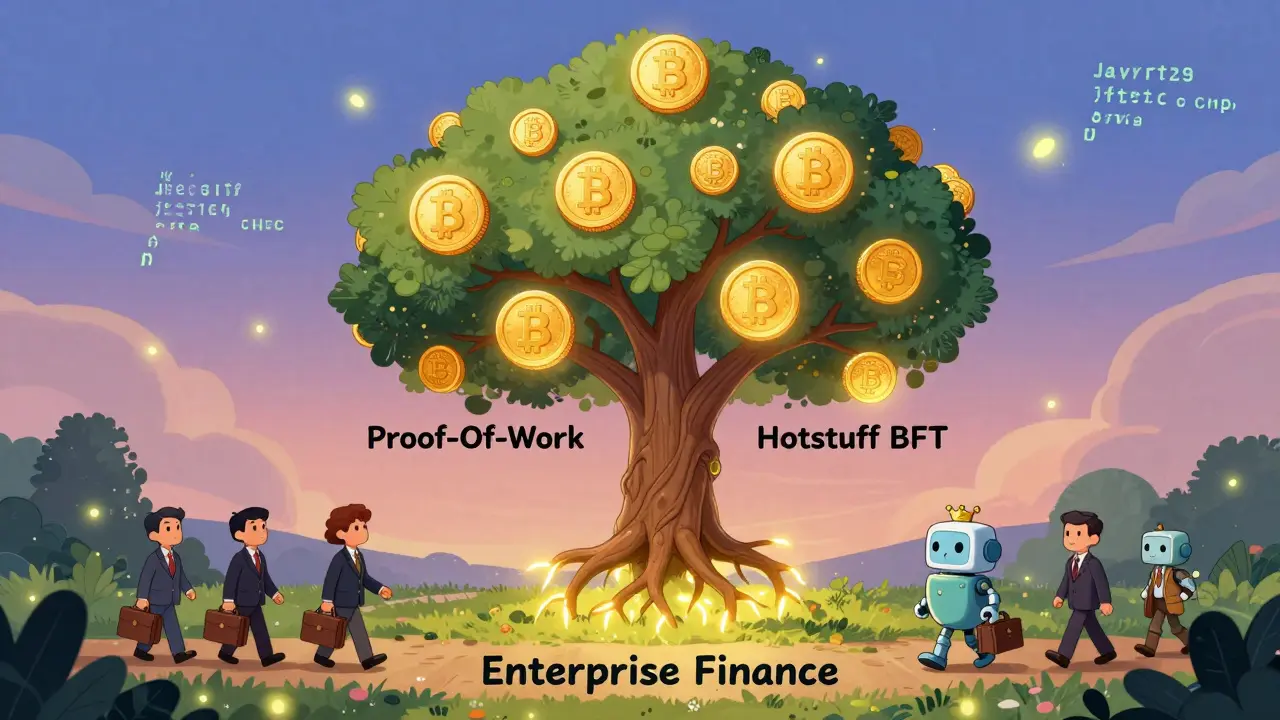
Cypherium (CPH) is a layer 1 blockchain built to connect traditional finance with crypto. Unlike most coins that chase hype or speculative trading, Cypherium was designed for institutions, banks, and governments looking to move money on-chain without ditching their existing systems. It’s not another Ethereum clone. It’s not a meme coin. It’s a niche project trying to solve a real problem: how do you make digital money work for central banks and enterprises when they’re stuck with old tech?
How Cypherium Works: Hybrid Consensus Explained
Cypherium doesn’t use just one consensus method. It uses two: Proof-of-Work (PoW) and HotStuff BFT. That’s unusual. Most blockchains pick one. Bitcoin uses PoW. Solana uses Proof-of-Stake. Cypherium combines them to get the best of both.
PoW keeps it decentralized. Miners secure the network by solving math problems, just like Bitcoin. But PoW alone is slow. That’s where HotStuff BFT comes in. It’s a Byzantine Fault Tolerance algorithm that lets nodes agree on transactions in under a second. This combo gives Cypherium what it calls “sub-second finality” - meaning once a transaction is confirmed, it’s done. No waiting for 6 confirmations like on Bitcoin. No risk of reorgs like on some other chains.
This matters because banks and governments can’t afford delays. If you’re processing a cross-border payment or settling a trade, waiting minutes or hours isn’t an option. Cypherium claims it can handle enterprise-grade workloads without sacrificing decentralization. That’s the pitch, anyway.
Java Smart Contracts: The Big Differentiator
Most blockchains use Solidity for smart contracts. That’s the language behind Ethereum, the most popular platform for dApps. But Cypherium lets developers write smart contracts in Java - the same language used by 9 million developers worldwide, according to Oracle’s 2023 stats.
Why is this a big deal? Because Java powers 90% of Fortune 500 company backends. Banks, insurance firms, and logistics companies already have teams of Java engineers. They don’t need to learn Solidity. They don’t need to hire new devs. They can use what they already know. That’s a huge advantage if you’re trying to get institutions to adopt blockchain.
Cypherium also supports Solidity, so Ethereum developers aren’t locked out. But the real target isn’t crypto natives. It’s corporate IT departments. The idea is simple: if you can run Java on your server, you can run it on Cypherium. No new skills needed.
Market Data: Price, Supply, and Liquidity Reality Check
As of January 2026, Cypherium (CPH) trades around $0.0053. That’s down over 97% from its all-time high of $0.1968 in late 2021. It’s not a new coin - it’s been around since 2018 - but it’s lost almost all of its early momentum.
Supply numbers are messy. CoinGecko says 540 million CPH are in circulation. TradingView says 6.83 billion. Investing.com says 382 million. The maximum supply is listed as 8.428 billion across platforms. This inconsistency isn’t normal. It suggests unclear tokenomics or unreliable reporting.
Market cap hovers around $2.8 million. That’s tiny. For comparison, Ethereum’s market cap is over $200 billion. Even small altcoins like Chainlink or Polygon sit at $5 billion+. Cypherium is in the bottom 5% of all tracked cryptocurrencies by market value.
Liquidity is even worse. Daily trading volume is under $100,000 on most exchanges. That means if you want to buy or sell a large amount of CPH, you’ll likely move the price hard. Low volume + low market cap = high risk of manipulation. This isn’t a coin you trade casually.

Partnerships: Google, IBM, AWS, Microsoft - But What Do They Actually Do?
Cypherium’s website and CoinMarketCap list big names: Google, IBM, Amazon Web Services, Microsoft. That sounds impressive. But here’s the catch: none of these companies have publicly announced a partnership with Cypherium. There are no press releases. No case studies. No GitHub integrations. No job postings for Cypherium developers at these firms.
The same goes for OMFIF’s Digital Monetary Institute. Yes, OMFIF works with central banks on digital currency projects. But there’s no public evidence that Cypherium is actively building anything with them. The same is true for the MoU with Suzhou City in China. A memorandum of understanding is not a contract. It’s a handshake. It doesn’t mean anything is live.
These claims feel like marketing noise. They’re meant to build credibility, but without proof, they don’t hold weight. If you’re a bank considering Cypherium, you need more than a logo on a slide deck. You need a working API, a testnet, and a pilot project.
The Digital Currency Interoperability Framework (DCIF)
Cypherium’s most interesting piece is its DCIF - a system designed to let different digital assets talk to each other. Think Central Bank Digital Currencies (CBDCs), stablecoins, and private tokens all moving on the same chain.
This is where Cypherium’s real potential lies. Over 130 countries are exploring CBDCs, according to the Atlantic Council. China’s digital yuan, the ECB’s digital euro, and the Fed’s research into a digital dollar are all moving forward. But these systems don’t talk to each other. They’re siloed.
If Cypherium could become the bridge between them - allowing a Chinese CBDC payment to settle in euros, for example - it would be huge. But there’s zero public data showing DCIF is live. No demos. No test transactions. No third-party audits. It’s still a concept on a whitepaper.

Why Cypherium Hasn’t Taken Off
Let’s be honest. The crypto space is full of projects that sound great on paper but fail in practice. Cypherium is one of them.
It has a solid technical idea: hybrid consensus + Java smart contracts. But execution is weak. The community is tiny. Reddit has fewer than 50 monthly mentions. Twitter is quiet. Discord servers are barely active. No major exchange lists CPH as a top trading pair. Even CoinGecko and CoinMarketCap rank it below #1400.
Compare that to Solana or Ethereum. They have thousands of developers, hundreds of dApps, and millions of users. Cypherium has… what? A few hundred wallets? A handful of developers? No one knows.
The biggest red flag? No clear roadmap. No upcoming updates. No product launches announced in the last two years. The website hasn’t changed much since 2022. That’s not a sign of a thriving project. It’s a sign of stagnation.
Is Cypherium Worth It?
If you’re looking to invest in CPH as a speculative asset - don’t. The price is too volatile, the volume too low, and the fundamentals too weak. You’re gambling on a coin that’s been dead in the water for years.
If you’re a Java developer curious about blockchain - maybe explore it. Set up a test node. Read the docs. See if the Java integration actually works. But don’t expect to build a dApp that anyone uses.
If you’re a financial institution or government agency looking for a CBDC solution - Cypherium’s DCIF is an interesting idea. But until you see a working prototype, a live pilot, or a published audit, treat it as theory, not technology.
Cypherium isn’t a scam. It’s not a Ponzi. But it’s also not a breakthrough. It’s a project that had a good idea, failed to execute, and now floats in the shadows of bigger chains. It’s a cautionary tale about how great tech doesn’t always win - execution does.
What’s Next for Cypherium?
There’s no public roadmap. No team updates. No new features announced. The only hope is that one of its rumored enterprise partners actually starts using it. If IBM or AWS quietly integrates Cypherium into a backend system, that could change everything.
But until then, it’s a coin stuck in time. Its price reflects that. Its community reflects that. Its lack of activity reflects that.
If you’re curious, keep an eye on it. But don’t put money in it. Don’t build on it. Don’t bet on it. It’s not dead - but it’s not alive either. It’s just… there.
Comments
Kevin Pivko
This is just another vaporware coin with a PowerPoint deck and zero traction. Java smart contracts? Lol. If it were real, we’d see at least one bank using it. We don’t. It’s dead. 🤡
January 26, 2026 AT 10:42
Chidimma Catherine
I appreciate the detailed breakdown but I’m still confused about the tokenomics. Why do different sources show such wildly different circulating supplies? Is this intentional obfuscation or just poor reporting? I’m trying to understand if this is a technical issue or something more concerning.
January 28, 2026 AT 05:57
Jessica Boling
So let me get this straight - they’re trying to sell blockchain to banks by saying ‘hey, use Java!’ like that’s magic dust? Meanwhile the whole thing has less market cap than my monthly coffee budget. 😂
January 30, 2026 AT 00:58
Andy Simms
The Java angle is actually smart if you think about it. Enterprises don’t want to retrain teams. If you can plug into existing Java infrastructure, adoption becomes way easier. The problem isn’t the tech - it’s the complete lack of transparency and real-world proof. No testnet. No API docs. No case studies. Just buzzwords.
January 30, 2026 AT 06:50
Jen Allanson
It is deeply irresponsible to promote a project with such ambiguous tokenomics and zero verifiable partnerships. This is not innovation - it is financial misdirection dressed in technical jargon. Investors deserve better than speculative fairy tales.
January 30, 2026 AT 15:19
Darrell Cole
You call this a breakdown? This is a eulogy. And yet people still buy it. The market is a joke. If you think a coin with $2.8M cap and 100k daily volume isn’t a pump-and-dump waiting to happen, you’re not just naive - you’re part of the problem. The real scam is believing this has any future.
February 1, 2026 AT 08:51
Dave Ellender
I’ve worked with enterprise blockchain systems. What’s missing here isn’t the tech - it’s the trust. No one in finance will touch a chain without third-party audits, public testnets, and documented pilots. This reads like a grad student’s thesis with a website.
February 3, 2026 AT 01:36
Barbara Rousseau-Osborn
Java? Seriously? You think banks are going to trust a blockchain that lets devs write smart contracts in a language that’s been around since 1995? They’ll laugh you out of the boardroom. And don’t even get me started on those fake partnerships. 🤡
February 3, 2026 AT 08:08
Arnaud Landry
I’ve been following this since 2019. The team keeps promising ‘enterprise integrations’ but never delivers. I think they’re being quietly funded by a shadow entity to keep retail investors distracted while the insiders dump. The DCIF? Pure fiction. They’re not building a bridge - they’re selling tickets to a ghost train.
February 3, 2026 AT 09:03
David Zinger
USA and EU are moving toward CBDCs. China already has its digital yuan. But you think some obscure coin with no team updates and a 97% price crash is going to be the global bridge? Wake up. This isn’t innovation - it’s American delusion wrapped in a Java hoodie.
February 4, 2026 AT 03:16
Catherine Hays
Low volume + fake partnerships + no roadmap = exit scam in slow motion. Why are people still talking about this? It’s not even a dead coin - it’s a ghost. And ghosts don’t pay dividends.
February 6, 2026 AT 03:15
MOHAN KUMAR
Java is good for banks but no one uses it for blockchain. Everyone uses Solidity. Why? Because it works. This project is trying to force a square peg into a round hole. It will fail.
February 7, 2026 AT 10:08
Abdulahi Oluwasegun Fagbayi
I’ve read a lot of crypto whitepapers. This one feels like it was written by someone who understands tech but not people. The idea is good. The execution? Barely there. It’s like building a Ferrari with a bicycle chain - elegant on paper, useless in motion.
February 7, 2026 AT 22:57
Ashok Sharma
For beginners, this is a good example of how not to launch a blockchain project. Strong concept, weak execution. Focus on building real partnerships and publishing audits before chasing price. Patience and transparency matter more than hype.
February 9, 2026 AT 05:03
Tselane Sebatane
Let me tell you something - I’ve seen dozens of projects like this. They all start with big dreams and end with silence. Cypherium isn’t special. It’s just another casualty of the crypto graveyard. The hybrid consensus? Clever. The community? Nonexistent. The roadmap? Nonexistent. The price? A tombstone. And yet people still buy it. Why? Because hope is cheaper than research.
February 10, 2026 AT 13:58
Brenda Platt
Honestly? The Java thing is genius if they can make it work. Imagine a Fortune 500 dev just cloning a repo and deploying a smart contract without learning a new language. That’s a game-changer. But yeah… where’s the proof? Where’s the testnet? Where’s the dev docs? Without those, it’s just a PowerPoint slide with a ticker symbol. 💔
February 10, 2026 AT 14:20
Mark Estareja
The DCIF framework is the only remotely interesting part here. Interoperability between CBDCs is the holy grail. But without open-source code, public audits, or a working demo, it’s just a buzzword. They’re leveraging institutional FOMO without delivering anything tangible. Classic.
February 12, 2026 AT 08:05
Athena Mantle
I mean… if you think this is going to replace Ethereum or even Solana, you’re not just wrong - you’re delusional. This isn’t blockchain. It’s a PowerPoint presentation with a wallet address attached. And the fact that people still buy it? That’s the real tragedy.
February 13, 2026 AT 23:01
carol johnson
They listed Google and IBM on their site? 😭 I’ve worked in enterprise tech. Those companies don’t just slap their logos on random projects. If they were partners, we’d see press releases, GitHub repos, and job postings. This isn’t marketing - it’s fraud.
February 14, 2026 AT 20:21
Paru Somashekar
This analysis is thorough and accurate. Cypherium’s technical architecture is sound in theory, but without transparency, community engagement, and verifiable progress, even the best ideas fail. Investors must demand public documentation, not promises.
February 15, 2026 AT 21:28