
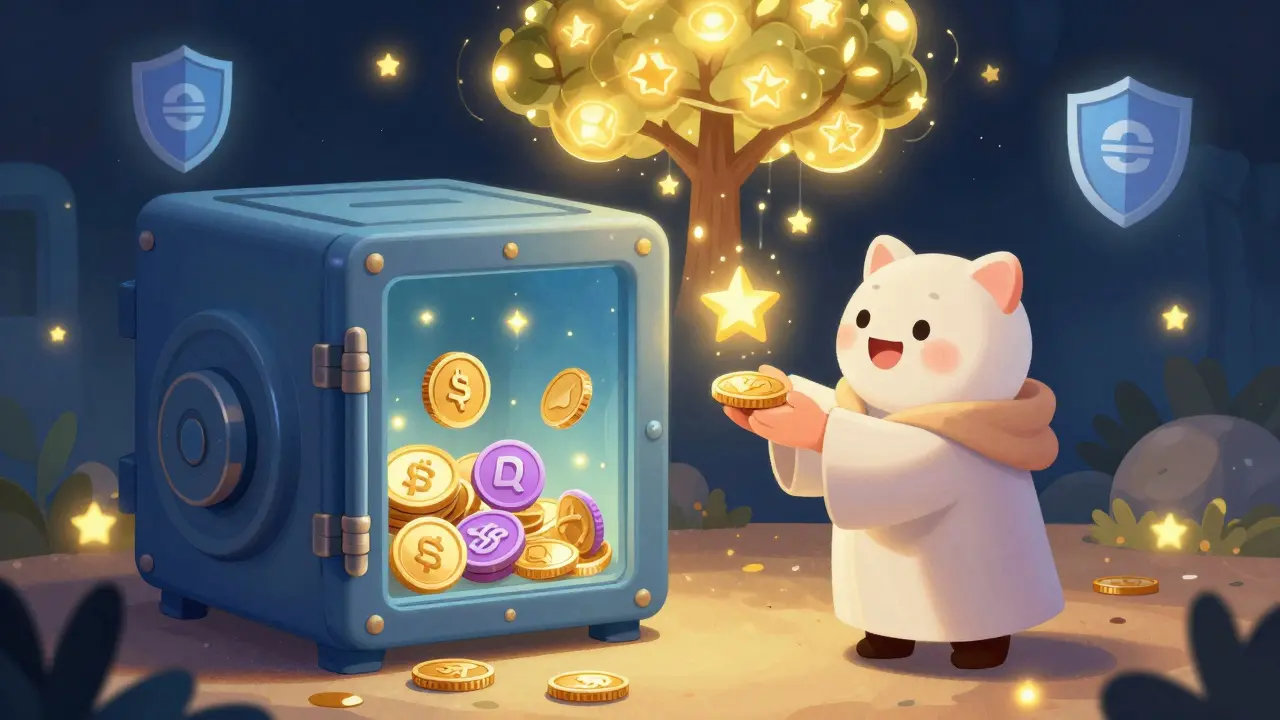
Imagine putting your crypto coins in a digital savings account that pays you interest - but instead of a bank, the network itself pays you. That’s cryptocurrency staking. No mining rigs, no crazy electricity bills, just locking up your coins to help keep a blockchain secure and getting paid for it.
How Staking Works (No Tech Jargon)
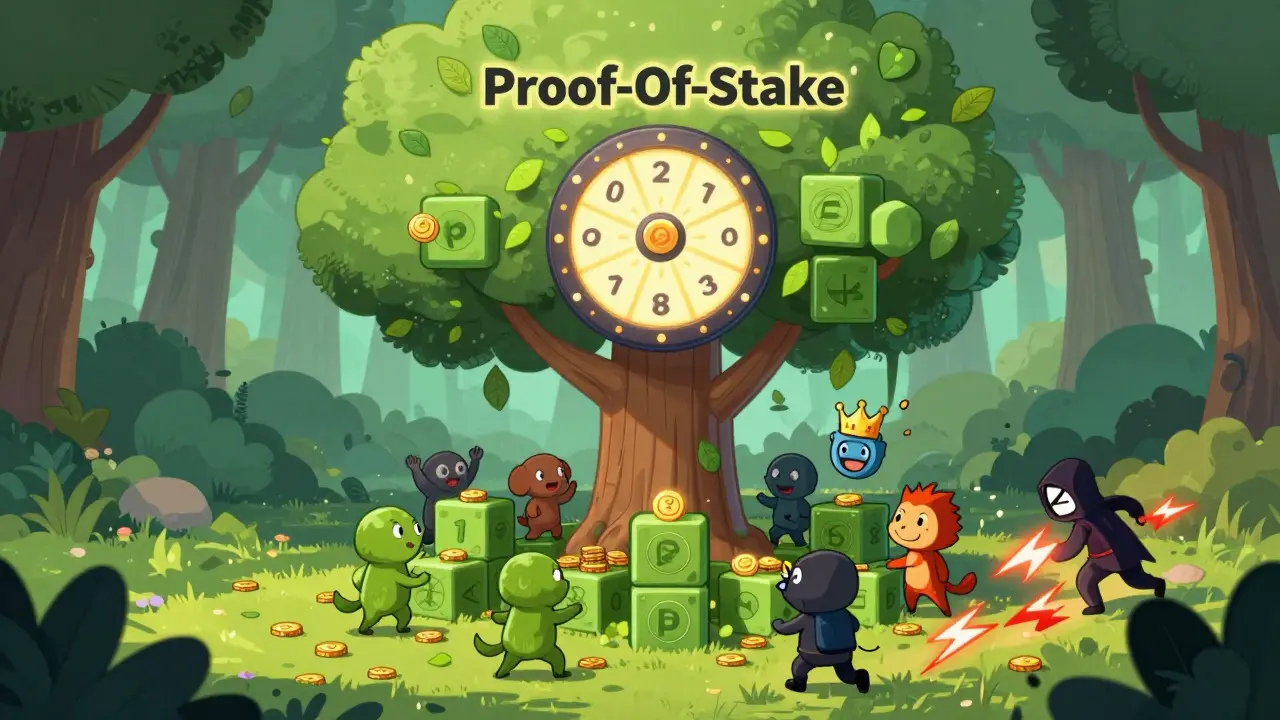
Cryptocurrency staking is how some blockchains decide who gets to add the next block of transactions. Instead of using massive computers to solve math puzzles (like Bitcoin does), proof-of-stake blockchains pick validators based on how many coins they’re willing to lock up - or "stake." Think of it like a lottery where your chances of winning go up the more tickets you buy. If you stake 100 ETH, you’re more likely to be chosen to validate a block than someone who stakes 5 ETH. But the system isn’t just about wealth - randomness is built in so even small stakers have a fair shot.When you’re picked, you verify transactions, bundle them into a block, and add it to the chain. Other validators check your work. If you do it right, you earn rewards. If you try to cheat - say, approving a fake transaction - you lose part of your staked coins. That’s called "slashing." It’s the blockchain’s way of saying, "Don’t mess with us."
Why Do Networks Use Staking?
Before staking, most blockchains relied on proof-of-work, which needed tons of energy. Bitcoin miners use more electricity than some countries. Proof-of-stake cuts that energy use by over 99%. Ethereum switched to staking in 2022 and slashed its carbon footprint overnight.Staking also makes networks more secure. To attack a proof-of-stake chain, you’d need to own over half of all the coins in circulation. That’s not just expensive - it’s self-defeating. If you own 51% of ETH and try to break the network, you’d destroy the value of your own holdings. So honesty pays. Literally.
How Much Can You Earn?
Rewards vary by network. As of early 2026:- Ethereum: 3.5%-4.5% annual return
- Solana: 5%-7%
- Cardano: 4%-5%
- Polygon: 6%-8%
These aren’t fixed. They change based on how many people are staking. If everyone jumps in, rewards go down. If fewer people stake, rewards go up to attract more. It’s supply and demand - but for crypto security.
Let’s say you stake 100 ADA (Cardano). At 4.5% annual yield, you’d earn about 4.5 ADA after a year. That’s not a fortune, but it’s free money you didn’t have to trade or sell for. And since you’re helping secure the network, you’re not just earning - you’re contributing.
How to Start Staking (No Tech Skills Needed)
You don’t need to run a server or understand smart contracts to start. Most people use exchanges. Here’s how:- Buy a coin that supports staking - ETH, SOL, ADA, DOT, etc.
- Deposit it into your account on Coinbase, Kraken, Binance, or another major exchange.
- Click "Stake" - that’s it.
The exchange handles everything: validation, rewards, slashing protection. You get payouts weekly or monthly, usually in the same coin you staked.
If you want more control - and more risk - you can become a validator yourself. That means running a node, keeping your computer online 24/7, and securing your private keys. Most people skip this. It’s like choosing to run your own bank instead of using a savings account.
Staking Pools: The Middle Ground
What if you only have 5 ETH? Not enough to be a solo validator on Ethereum (you need 32 ETH). That’s where staking pools come in.Staking pools let you combine your coins with others. You still earn your share of the rewards, but you don’t need the full 32 ETH. Pool operators handle the technical side and take a small fee - usually 5% to 15% of your rewards.
Popular pools include Lido, Rocket Pool, and Coinbase’s own pooled staking. They’re safe, easy, and great for small investors. Just make sure the pool is reputable. A bad operator could get slashed - and you’d lose part of your stake.

The Risks You Can’t Ignore
Staking isn’t risk-free. Here’s what can go wrong:- Slashing: If your validator node goes offline or signs a bad block, you lose part of your stake. This rarely happens on exchanges, but it’s real if you run your own node.
- Price drops: Your 100 SOL might earn you 6% a year - but if SOL crashes 30%, you’re still down. Staking doesn’t protect you from market volatility.
- Lockup periods: Some chains lock your coins for days or weeks before you can withdraw. You can’t sell if the market spikes. That’s opportunity cost.
- Exchange risk: If the platform you stake on gets hacked or shuts down, you could lose access. Stick to well-known exchanges with insurance.
Staking isn’t gambling. But it’s not a bank deposit either. Treat it like a long-term investment - not a quick cash grab.
What’s Next for Staking?
Liquid staking is the next big thing. It lets you stake your ETH and still use it - like borrowing against your savings. You get a token (like stETH) that represents your staked coins and can trade it, lend it, or use it in DeFi apps.That means you can earn staking rewards AND use your crypto in other ways. It’s like having a savings account that also lets you write checks. Platforms like Lido and Coinbase offer this now.
Regulators are watching. The SEC and EU are debating whether staking rewards count as securities or income. In the U.S., you may owe taxes on rewards even if you don’t sell. Keep records.
Staking is here to stay. More blockchains are switching to proof-of-stake. More people are using it. And as the tech gets smoother, it’ll become as normal as earning interest on a checking account.
Final Thought: Is Staking Worth It?
If you already hold crypto and plan to keep it for months or years, staking makes sense. You’re not selling. You’re not timing the market. You’re just letting your coins work for you.Start small. Pick one coin you trust. Use a major exchange. Don’t chase 20% yields - those usually come with big risks. And never stake more than you’re comfortable losing.
Staking turns passive holdings into active participation. You’re not just a holder anymore. You’re part of the network. And that’s worth something.
Comments
Lori Quarles
Staking is literally free money while you sleep 🚀 I staked my ADA last year and got more than my rent refund. No hustle, no stress. Just let the blockchain do the work. Why are people still trading like it's 2017?
January 28, 2026 AT 02:21
Jeremy Dayde
I’ve been staking ETH since the merge and honestly it’s changed how I think about crypto entirely like before I was just buying and hoping but now I feel like I’m actually part of something building the future you know like I’m not just holding a digital asset I’m helping secure a decentralized network and that gives me this weird sense of purpose like I’m not just a speculator anymore it’s deeper than that and the rewards are steady even if the price dips and that’s huge because it gives you breathing room to wait it out without panicking
January 28, 2026 AT 21:00
Steven Dilla
Anyone who says staking is 'risk free' is lying to you 😤 Slashing is real. I know a guy who lost 12% of his stake because his node went down for 3 hours. Don't be lazy. Use a reputable pool. Lido or Coinbase. Don't be that guy.
January 30, 2026 AT 09:00
Akhil Mathew
Staking is the future. In India, we’re seeing more people move from trading to staking because it’s less stressful. Even small investors with 5-10 tokens can join pools. The real win? You’re not gambling-you’re contributing. And the energy savings? Massive. We need more of this.
January 31, 2026 AT 15:36
Aaron Poole
Staking is the closest thing crypto has to a savings account-and it’s actually better because you’re not just earning interest, you’re helping keep the system honest. The key is to start small, use a trusted exchange, and never stake more than you’re okay losing. And please, don’t chase 20% yields. If it sounds too good to be true, it’s probably a rug pull with a fancy whitepaper.
February 1, 2026 AT 17:41
Nickole Fennell
WAIT. So you’re telling me I can just sit on my crypto and get PAID?!?!?! I’ve been FOMO trading for 3 years and I could’ve been earning passive income this whole time?!?!?! 😭 I’m crying. I’m so mad I didn’t know sooner. Someone please hold my hand through this. I need to stake everything now. 🥺
February 2, 2026 AT 01:43
Edward Drawde
Staking is just a tax trap. IRS already said rewards are income. You think you're earning free money? Nah. You're just getting taxed on paper gains. And if your coin drops? You're still on the hook for taxes. Don't be fooled.
February 2, 2026 AT 03:53
Gustavo Gonzalez
Let’s be real. Staking rewards are inflated because the networks need to attract liquidity. Once everyone’s staked, the yields will collapse. And liquid staking? That’s just DeFi leverage with extra steps. You think stETH is safe? What happens when Lido gets hacked or the peg breaks? You’re not earning yield-you’re gambling on a fragile system. And don’t even get me started on how exchanges control the validator keys. You don’t own your crypto if you stake on Coinbase. You’re just a tenant.
February 2, 2026 AT 07:16
Mark Ganim
Staking… it’s not just about economics, is it? It’s about alignment. You’re choosing to believe in a system that rewards patience over greed. In a world where everything is optimized for extraction, staking is a quiet rebellion. You’re saying: I don’t need to sell. I don’t need to trade. I don’t need to chase. I’ll lock it in. I’ll trust the math. I’ll be part of the consensus. And in doing so… you’re not just earning coins. You’re affirming a new way of being. That’s profound. And beautiful. And terrifying. Because it means you’re betting on humanity… not just on blockchain.
February 2, 2026 AT 16:44
mary irons
Staking? Yeah… I’ve heard this before. Remember when the government said 'buy gold' and then froze accounts? What if the SEC comes in and says 'all staking is unregistered securities' and shuts it down overnight? And what if they freeze your coins? You think your 'decentralized' network can stop them? They control the banks. They control the servers. They control the laws. You’re not safe. You’re just being lulled into a false sense of security.
February 3, 2026 AT 17:56
Wayne mutunga
I’ve been staking ETH on Kraken for 18 months. Never had an issue. Rewards show up every week. No drama. I don’t even think about it anymore. It’s just… there. Like a quiet little dividend. I like that.
February 4, 2026 AT 20:07
Gavin Francis
Staking is the best thing to happen to crypto since the whitepaper 🙌 I started with 0.5 SOL on Binance and now I get paid every Friday. It’s not life-changing money… but it’s *real* money. And I didn’t do anything. Just held. That’s the magic. Keep it simple. Keep it safe. Keep staking. 💪
February 5, 2026 AT 00:02
Brandon Vaidyanathan
Ugh. Everyone’s acting like staking is some genius move. Bro, you’re just giving your coins to a company that might get hacked or get regulated out of existence. And if you use a pool? You’re trusting some guy in a hoodie who runs a server in Romania. You think you’re safe? You’re just one bad validator away from losing half your stack. Stop drinking the Kool-Aid.
February 6, 2026 AT 04:18
Gareth Fitzjohn
Interesting read. Staking does seem more sustainable than mining. I wonder how long it will take for governments to regulate the rewards as taxable income globally. The energy savings are undeniable though.
February 6, 2026 AT 09:16
Dylan Morrison
I staked my first 5 ADA and got 0.23 ADA back last month. It’s not much… but it felt like magic. Like the internet paid me for doing nothing. 🌱 I showed my grandma. She said, 'So it’s like interest, but on the computer?' I said, 'Yeah, but cooler.' She nodded. She gets it. Maybe we’re all just learning to trust machines now.
February 8, 2026 AT 00:35