

Brainedge (LEARN) is a cryptocurrency built around the idea of using blockchain and AI to transform online learning. On paper, it sounds promising: reward students with tokens for completing courses, cut content creation costs, and break down language barriers using AI. But behind the hype, the reality is far less impressive. As of March 2026, Brainedge (LEARN) remains one of the most obscure tokens in the crypto space-with little to no real-world use, questionable data, and almost no community support.
What Brainedge (LEARN) Claims to Do
Brainedge says it’s creating a decentralized learning platform where users earn LEARN tokens for studying, teaching, or creating educational content. The idea is simple: instead of paying for courses upfront, you get paid in crypto to learn. AI tools are supposed to help translate lessons, personalize learning paths, and automate grading. The project claims to solve three big problems in e-learning: low engagement, high costs, and language gaps.
But here’s the catch: there’s no working platform. No app. No website with live courses. No sign of AI tools being used. The entire project seems to exist only as a token on a few exchanges, with no proof it’s ever been used to pay for or deliver education.
The Token Basics: Supply, Price, and Trading
Brainedge has a fixed supply of 1 billion LEARN tokens. That’s a lot. But here’s where things get weird: different crypto tracking sites report wildly different numbers.
- CryptoRank says only 6 million LEARN are in circulation.
- Coinranking claims nearly 1 billion are circulating-almost the full supply.
This isn’t a small mismatch. It’s a 167x difference. That kind of inconsistency raises serious red flags. If even basic supply data is unreliable, how can you trust anything else about the project?
Price data is just as messy:
- CoinCarp: $0.0398 per LEARN
- MEXC: $0.01733
- Coinbase: $0.0157
Why the gap? It could mean the token is traded on only a few exchanges with low volume, or worse-it might not be traded at all on some platforms. The 24-hour trading volume hovers around $133,000, which is tiny for a token with a $40 million market cap. That means if you tried to sell even $1,000 worth of LEARN, the price could crash because there aren’t enough buyers.
Market Performance: A Token in Freefall
Brainedge hit its all-time high of $0.0511 on June 9, 2025. Since then, it’s lost over 20% of its value. Some platforms report even steeper drops. The token’s entire rise came from hype around its IDO (Initial DEX Offering) in late March 2025. Early buyers saw returns of 2x to 3x, which sounds great-until you realize those gains were from a token with no real utility.
Right now, Brainedge is stuck in a death spiral: low trading volume → low liquidity → hard to buy or sell → fewer people care → price drops further. Coinranking explicitly warns that Brainedge meets multiple ranking penalties: low volume, limited exchange listings, and unverified supply. That’s not a minor issue-it’s a death sentence for any crypto project trying to gain traction.

Who’s Behind Brainedge? No One Knows
Here’s one of the biggest problems: no one knows who created Brainedge. No team names. No LinkedIn profiles. No GitHub repositories. No whitepaper with technical details. No public roadmap. Not even a Twitter account with real updates.
In crypto, anonymity isn’t always bad-Bitcoin’s creator is still unknown. But Bitcoin had a clear, public protocol. Brainedge has nothing. No code. No technical documentation. No audits. Just a token with a story.
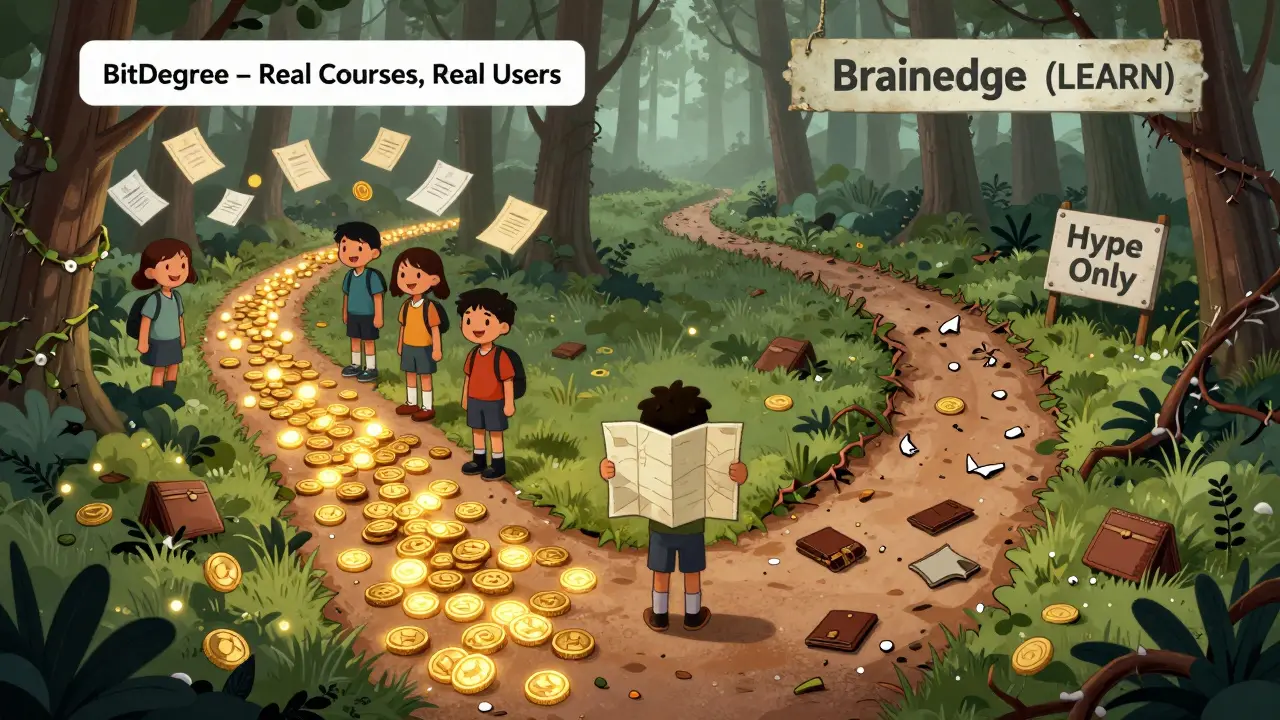
Compare that to BitDegree (BDG), another education-focused crypto. BitDegree has a known team, live courses, partnerships with universities, and a working platform. Brainedge has none of that. It’s a token with a dream, but no execution.
Is Brainedge an AI Crypto Project? Not Really
Brainedge markets itself as an “AI-powered” learning platform. But AI doesn’t mean much if it’s not actually being used. There are no examples of AI translating lessons. No proof of automated grading. No user testimonials about AI tutors helping them learn.
The term “AI crypto” has become a buzzword used to inflate valuations. Projects like Fetch.ai, SingularityNET, and Ocean Protocol have real AI models running on their networks. Brainedge? It’s just a token with “AI” slapped on the website.
If Brainedge had even one working AI feature-say, a demo where you upload a video and it gets auto-translated into five languages-it might have a chance. But it doesn’t. And that makes it a classic case of vaporware.
Why This Matters: The Bigger Picture
Brainedge isn’t just a failed project-it’s a warning sign. The crypto space is full of tokens that promise to fix real problems: education, healthcare, supply chains. But most never deliver. They raise money from early buyers, hype their whitepaper, and vanish when the price drops.
The educational crypto sector is especially risky. Projects that don’t have real users-people actually taking courses and paying with the token-will fail. According to Messari’s 2025 Utility Token Survival Report, 87-92% of similar tokens lose most of their value within a year of launch if they lack usage metrics. Brainedge has none.
Regulators are watching too. The EU’s MiCA rules and the U.S. SEC are cracking down on utility tokens with no real-world application. If Brainedge ever tries to operate as a learning platform, it could face legal action for misleading investors.
Should You Buy Brainedge (LEARN)?
Short answer: no.
If you’re looking to invest in crypto for education, there are better options. BitDegree has a live platform, real partnerships, and a proven track record. Even if you’re just speculating, Brainedge’s data inconsistencies, lack of transparency, and near-zero community make it one of the riskiest tokens on the market.
Some people might say, “It’s cheap-why not buy a few?” But low price doesn’t mean low risk. In fact, it often means the opposite. When a token is this obscure, it’s usually because no one believes in it anymore. And when that happens, the only people left holding it are the ones who bought at the top-and now can’t sell.
Brainedge (LEARN) isn’t a revolution in education. It’s a speculative bet with no foundation. And in crypto, that’s the most dangerous kind of bet there is.
Is Brainedge (LEARN) a scam?
Brainedge isn’t officially labeled a scam, but it has nearly every red flag associated with one: no verified team, inconsistent supply data, zero community engagement, no working platform, and no third-party audits. It’s not a scam in the legal sense-but it’s also not a legitimate project. It’s a high-risk speculation with little to no substance.
Can I stake LEARN tokens?
Some sources mention LEARN staking, but no details exist. There’s no official website, no staking dashboard, and no clear reward structure. If staking is available, it’s likely only on MEXC-and even there, the terms are unclear. Proceed with extreme caution.
Where can I buy Brainedge (LEARN)?
LEARN is listed on MEXC and a few smaller exchanges, but it’s not available on major platforms like Binance, Coinbase, or Kraken. Even on MEXC, trading volume is extremely low. Buying LEARN means accepting high slippage, low liquidity, and the risk that the token could vanish from exchanges at any time.
Does Brainedge have a working learning platform?
No. Despite claims of being an AI-powered learning platform, there is no functional website, app, or course library linked to Brainedge. All evidence suggests the platform exists only in marketing materials.
Why do different sites show different prices for LEARN?
Because LEARN trades on very few exchanges with minimal volume, prices vary widely between platforms. Some may be outdated, others may be manipulated. The lack of consistent pricing is a sign of low market depth and high risk of price manipulation.
What to Do Instead
If you believe in blockchain for education, look at projects with real usage. BitDegree offers actual courses, verified certificates, and a working token economy. Other alternatives include EduCoin (EUC) and Learn2Earn platforms with verified user bases.
Don’t chase tokens with flashy names and vague promises. Wait for projects that show you their code, their team, and their users-not just their whitepaper.
Comments
Christina Young
Brainedge isn't a scam-it's a ghost town with a whitepaper. No team, no code, no users. Just a token floating in a vacuum with 167x supply discrepancies. If your investment thesis relies on 'AI-powered learning' but there's no AI and no learning, you're not investing-you're gambling on a PowerPoint slide.
March 6, 2026 AT 08:51
nalini jeyapalan
Look, I know people love to dunk on obscure coins, but this is next level. I checked MEXC, CoinRanking, CryptoRank-all three show conflicting numbers. That’s not a glitch, that’s a red flag with a spotlight. And the price gap between MEXC and Coinbase? That’s not market inefficiency, that’s manipulation. Someone’s pumping this to dump on the gullible.
Also, no one’s talking about this on Twitter or Reddit. Zero community. Zero transparency. If you can’t even find a Discord with 50 people, it’s not a project-it’s a honeypot.
March 6, 2026 AT 22:48
Josh Moorcroft-Jones
Let’s be real here-the entire premise of Brainedge is built on a fantasy that assumes two things: first, that students would rather earn crypto than get graded, and second, that AI can somehow replace human educators without any infrastructure to support it. Neither of those assumptions holds water. Students don’t care about tokens-they care about grades, certifications, and job prospects. And AI? You can’t just slap ‘AI-powered’ on a landing page and expect people to believe you’re doing anything more than running a basic chatbot.
Also, the trading volume is $133k? On a $40M market cap? That’s a liquidity trap waiting to implode. If you try to sell $1000 worth, you’ll be lucky to get half your money back. This isn’t a ‘buy the dip’ situation-it’s a ‘run for the exits’ situation. And the fact that no one’s audited the smart contract? That’s not negligence. That’s criminal.
And don’t even get me started on the ‘AI translation’ claims. If they had a single demo video, I’d give them the benefit of the doubt. But they don’t. Zero. Zip. Nada. This isn’t vaporware-it’s vapor fiction.
Compare this to BitDegree, which has actual courses, actual students, actual certificates, and actual partnerships with real universities. Brainedge? It’s a meme with a token. And memes don’t pay bills.
Bottom line: if you’re holding LEARN, you’re not an investor. You’re a footnote in a cautionary tale.
March 8, 2026 AT 19:47
Nancy Jewer
The structural failure here isn’t just the lack of utility-it’s the absence of measurable engagement metrics. In any legitimate Web3 education project, you’d see on-chain data: token transfers for course completions, smart contract interactions for credentialing, staking pools for content creators. Brainedge has none. It’s a static token with no on-chain activity. That’s not a bug-it’s a feature of a project that never intended to ship.
The term ‘utility token’ has been weaponized. Real utility tokens have users. Brainedge has investors who think they’re early. They’re not. They’re last.
March 10, 2026 AT 02:48
Drago Fila
I get it-you’re frustrated. I’ve seen so many projects promise to ‘fix education’ and vanish. But here’s the thing: the idea behind Brainedge? It’s not dumb. Rewarding learning with crypto? That’s actually kind of cool. The problem isn’t the vision-it’s the execution. Or lack thereof.
If you’re into blockchain for education, don’t give up. Just pivot. Look at BitDegree. They’ve got real courses. Real certificates. Real people learning. That’s what matters. Brainedge is a ghost. Don’t bury your money with it.
There’s still hope for crypto in education. We just have to stop funding ghosts and start backing builders.
March 11, 2026 AT 00:14
Austin King
Low price + no volume = death spiral. This is basic crypto 101. If you can’t trade it without moving the market, it’s not an asset. It’s a liability.
March 11, 2026 AT 05:44
Bryanna Barnett
So let me get this straight-someone built a crypto for learning, but there’s no learning? No platform? No team? Just a token with a name and a dream? And we’re supposed to believe this isn’t a pump-and-dump? Please. I’ve seen better whitepapers from high schoolers doing their ‘future of tech’ project.
March 12, 2026 AT 06:04
Rachel Rowland
People keep saying ‘don’t invest’ but nobody’s saying what to do instead. The answer is simple: support projects with proof. Not promises. Proof of users. Proof of code. Proof of partnerships. BitDegree has all three. Brainedge has none. End of story.
March 13, 2026 AT 01:05
Bonnie Jenkins-Hodges
AMERICA IS BEING SCAMMED BY THESE FAKE CRYPTO GHOSTS. WHY DO WE LET FOREIGN DEVELOPERS LAUNCH PROJECTS WITH NO TEAM AND NO AUDIT? THIS IS WHY WE CAN’T HAVE NICE THINGS. WE NEED TO BAN THESE TOKENS. THEY’RE NOT INNOVATION-THEY’RE DIGITAL FRAUD.
March 14, 2026 AT 00:03
Leah Dallaire
What if the entire thing is a honeypot to collect wallet addresses? What if the ‘1 billion supply’ is fake because they’re just creating phantom tokens to inflate metrics? What if the ‘AI’ is just a bot that replies to comments with pre-written responses? What if the whole thing is a front for a surveillance operation? I’m not saying it is-but I’m not saying it isn’t either.
March 15, 2026 AT 15:58
Cerissa Kimball
It is imperative to note that the absence of third-party audits combined with inconsistent supply reporting across data aggregators constitutes a material risk factor that undermines the foundational integrity of any asset claiming utility value. Furthermore, the lack of verifiable on-chain activity suggests non-compliance with emerging regulatory frameworks such as MiCA, which mandate transparency in tokenomics and operational functionality. This is not merely speculative-it is structurally unsound.
March 17, 2026 AT 02:40
James Burke
I’ve seen this movie before. Token drops, hype cycles, zero product. The only thing real here is the wallet drain. Don’t chase cheap tokens. Chase real products. BitDegree’s got a working app. Brainedge? I can’t even find a website that loads.
March 17, 2026 AT 17:44
Julie Potter
Someone please tell me why this isn’t a rug pull? Because if it is, I want to know who’s behind it. And if it’s not, I want to know why anyone’s still talking about it. This is the definition of a zombie coin-walking, but dead.
March 18, 2026 AT 20:04
Steven Lefebvre
What’s wild is how many people still think ‘cheap = good’. This token is $0.015? So what? If it’s got zero liquidity and no future, it’s still worth zero. You can’t buy hope. You can only lose money hoping.
Instead of asking ‘should I buy?’, ask ‘why does this exist?’. If the answer is ‘because someone thought they could make a quick buck’, then walk away. Fast.
March 18, 2026 AT 21:57
prasanna tripathy
India has dozens of real ed-tech startups using blockchain for certificates and micro-credentials. They’re not shouting ‘AI’ or ‘crypto revolution’. They’re just building. No hype. No token. Just real students getting real value. Brainedge? It’s the opposite. It’s noise with a token. And noise doesn’t teach.
March 19, 2026 AT 11:12