
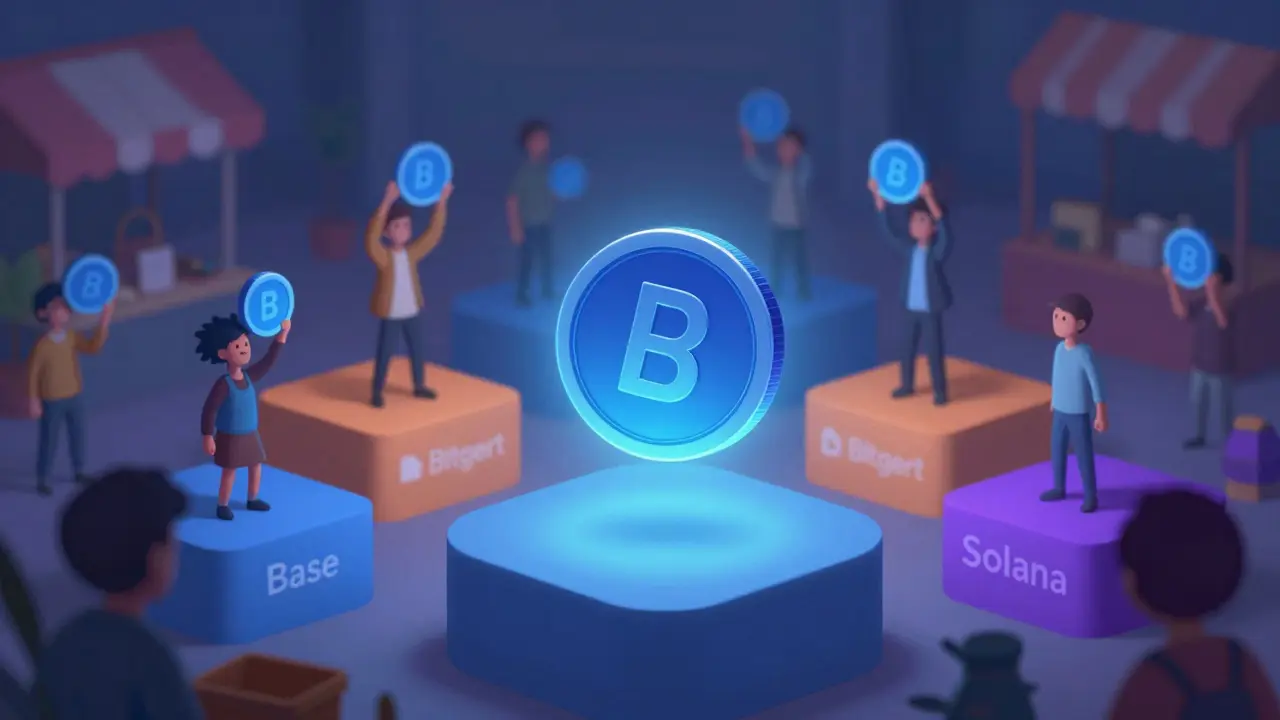
Have you seen BaseRise (BRISE) pop up in your feed or on a small exchange? It promises automated buybacks, deflationary mechanics, and "exponential growth." But if you look closer at the numbers, things get messy. Prices don't match across platforms. Liquidity is thin. And there’s another coin with the same ticker running on a completely different blockchain.
This isn’t just about one token. It’s about how easy it is to get confused in the world of micro-cap cryptocurrencies. Before you send any money, let’s break down what BaseRise actually is, where the data comes from, and why you should probably think twice before buying.
The Core Identity: What Is BaseRise?
BaseRise is a decentralized finance (DeFi) token primarily built on the Base blockchain. The project markets itself as a next-generation asset designed to redefine how value moves in DeFi. Its main selling point? A built-in tax structure that automatically buys back tokens from the market.
Here’s how the math works according to their documentation:
- Total Transaction Tax: 5%
- Automated Buybacks: 3% of every trade goes into a fund that buys BRISE from the open market.
- Growth Fund: 2% supports marketing, partnerships, and ecosystem expansion.
The goal is simple: create constant upward price pressure by removing supply from circulation. This is called a "deflationary" model. In theory, fewer tokens available means higher prices. In practice, this only works if there are enough buyers to sustain the volume.
Tokenomics: Supply, Circulation, and Inflation
To understand if a token has long-term potential, you need to look at its supply dynamics. For BaseRise, the numbers tell a specific story.
| Metric | Value |
|---|---|
| Maximum Supply | 1,000,000,000 (1 Billion) BRISE |
| Total Current Supply | 942,100,000 BRISE |
| Circulating Supply | 843,220,000 BRISE |
| Inflation Model | Zero Inflation / Deflationary via Buybacks |
About 99.4 million tokens remain unminted or held in reserve. While zero inflation sounds attractive, remember that the 5% transaction tax acts as a friction cost for traders. If you’re trying to flip the token quickly, those fees add up fast.
The Price Problem: Why Data Doesn't Match
If you check the price of BaseRise today, you might see three different answers. That’s not a glitch; it’s a feature of low-liquidity markets.
- CoinMarketCap: Reports prices around $0.00003402, but sometimes shows $0 due to lack of recent trades.
- Alternative Aggregators: Some list it as low as $0.00001134.
- Bitget Web3 Swap: Shows pricing near $0.00000625.
Why such a huge gap? Because there isn’t enough trading volume to set a single "true" price. With only about $1,881 in 24-hour trading volume, a single large sell order could crash the price by 50% or more. This is known as slippage risk. When you buy, you might pay significantly more than the listed price because there aren’t enough sellers at that level.
The market capitalization sits below $30,000 USD. To put that in perspective, many established startups raise millions in their first round. BaseRise represents less than 0.01% of the total crypto market cap. It is, by definition, a micro-cap asset.
Confusion Alert: The Other BRISE Tokens
Here is where most people make a mistake. They assume all coins with the ticker "BRISE" are the same. They are not.
Bitgert operates a separate BRISE token on the Bitgert Chain. This is a distinct blockchain network claiming over 100,000 transactions per second (TPS) and zero gas fees. Bitgert's BRISE is used to pay for transaction fees and staking on its own native chain.
There is also a third version running on the Solana blockchain, described as a Web3 coin leveraging Solana's high-speed infrastructure.
If you try to buy "BRISE" on an exchange like CoinSwitch, you might find buying restricted due to liquidity issues, even though selling is allowed. Always check the contract address. Never trust the ticker symbol alone. Sending funds to the wrong chain means losing them forever.
Risk Assessment: Is BaseRise Safe?
Let’s be direct. BaseRise carries extreme risk. Here is why:
- Liquidity Trap: With under $2,000 in daily volume, exiting a position can be difficult. You might not find a buyer when you want to sell.
- Exchange Absence: BaseRise is not listed on major tier-one exchanges like Binance, Coinbase, or Kraken. This limits access and adds credibility questions.
- Speculative Nature: The value relies entirely on community hype and the promise of future buybacks. There is no underlying revenue stream or utility driving organic demand yet.
- Data Fragmentation: Inconsistent price reporting makes it hard to track real performance.
Projects that rely heavily on "automated buybacks" often struggle once the initial excitement fades. Without new users entering the system, the buyback fund runs dry, and the price support disappears.

How to Verify BaseRise Yourself
If you still want to explore BaseRise, follow these steps to protect yourself:
- Check the Contract Address: Go to Etherscan (for Base/ERC-20 versions) or Solscan (for Solana). Verify the contract matches official project links.
- Look at Liquidity Pools: On DEXs like Uniswap or PancakeSwap, check the depth of the pool. If the pool is small, expect high slippage.
- Monitor Social Channels: Look for active development updates, not just price pumps. Are they building? Or just marketing?
- Start Small: Only invest what you can afford to lose completely. Treat it as entertainment, not investment.
Alternatives to Consider
If you are interested in DeFi tokens with buyback mechanisms or low-fee chains, consider looking at more established projects:
- Shiba Inu (SHIB): Also features burn mechanisms and has massive liquidity.
- Solana (SOL): Offers high speed and low costs without the micro-cap risk.
- Aave or Compound: Established DeFi protocols with real usage and revenue.
These assets have deeper markets, better transparency, and stronger community backing. They won’t give you 100x returns overnight, but they are far less likely to vanish.
Is BaseRise (BRISE) a scam?
There is no definitive proof that BaseRise is a scam, but it exhibits many red flags common in high-risk micro-cap projects. These include extremely low liquidity, inconsistent price data, and absence from major exchanges. Always do your own research and never invest more than you can afford to lose.
What is the difference between BaseRise and Bitgert BRISE?
They are completely different tokens on different blockchains. BaseRise is a DeFi token on the Base network focused on buybacks. Bitgert BRISE is the native token of the Bitgert Chain, used for transaction fees and staking. Confusing them can lead to lost funds.
Where can I buy BaseRise (BRISE)?
BaseRise is not available on major centralized exchanges like Binance or Coinbase. You may find it on decentralized exchanges (DEXs) or smaller platforms like Bitget Web3 swap. Be cautious of fake listings and always verify contract addresses.
Why does the price of BaseRise vary so much between sites?
The variation is due to low liquidity. With very few trades happening, each platform calculates the "last traded price" differently. One site might show a trade from hours ago, while another shows a stale quote. This fragmentation is typical for micro-cap tokens.
Is BaseRise a good long-term investment?
Based on current data, BaseRise poses significant long-term risks. The lack of utility, minimal market cap, and reliance on speculative buybacks make it unsuitable for conservative investors. Most experts recommend avoiding micro-caps unless you fully understand the risks.