
Imagine owning a piece of a digital company - not just as an investor, but as someone who actually gets to vote on its future. That’s what governance tokens do in crypto. They’re not meant to be traded like Bitcoin or used to pay fees like BNB. Instead, they give you a say in how a decentralized protocol runs. If you’ve ever wondered how projects like Uniswap, Aave, or MakerDAO make decisions without a CEO or board of directors, the answer is simple: governance tokens.
How Governance Tokens Work
Governance tokens are digital keys that unlock voting rights inside decentralized protocols. Every time a new rule is proposed - like changing interest rates on loans, moving treasury funds, or upgrading the code - token holders get to vote. The more tokens you hold, the more voting power you have. It’s not one person, one vote. It’s one token, one vote. That’s called token-weighted voting.This system started with MakerDAO in late 2017, when they launched MKR. Back then, no one knew if it would work. Could a group of strangers on the internet really manage a financial system without a company behind it? Turns out, yes - but not without problems.
Today, over 200 protocols use governance tokens. Most of them run on Ethereum using the ERC-20 standard, but others like Solana and Avalanche have built their own versions. The voting happens either on-chain (directly on the blockchain) or off-chain (using tools like Snapshot.org), with most projects using a mix of both. Off-chain voting is cheaper and faster, while on-chain voting is more secure but costs gas fees.
Who Uses Governance Tokens?
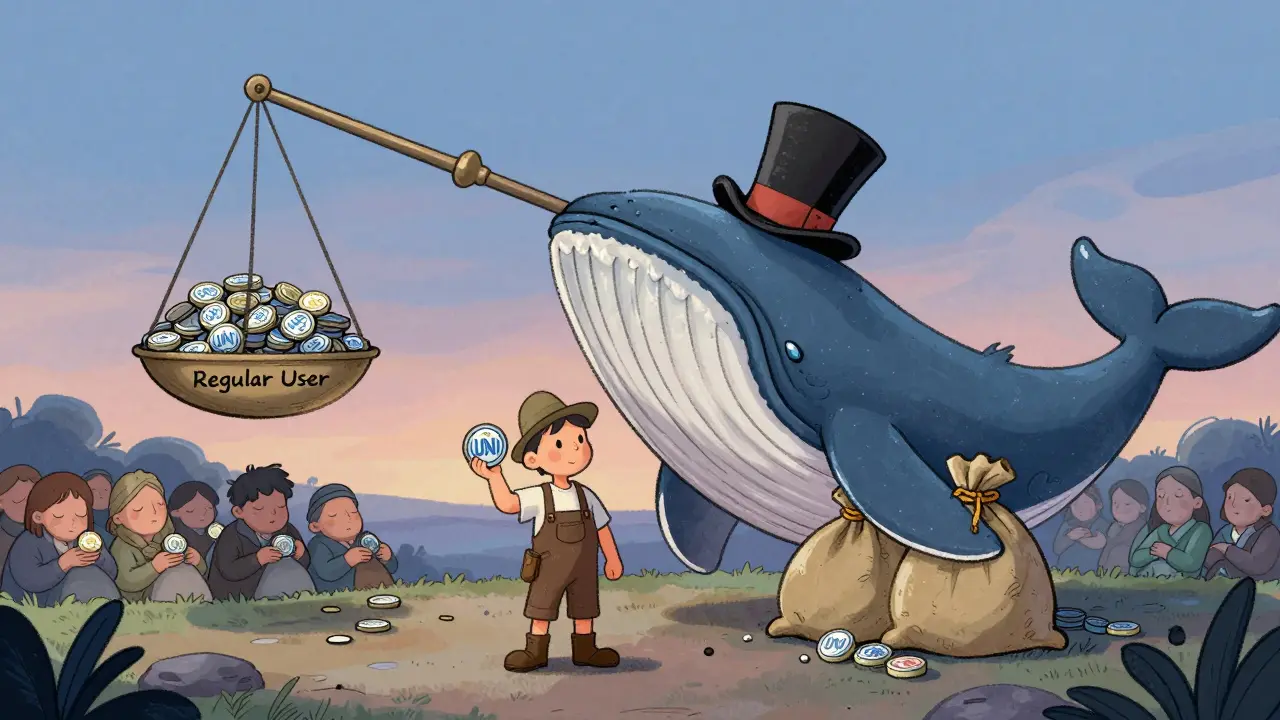
You don’t need to be a developer or a millionaire to use them. Anyone who holds the token can vote. But in practice, it’s not that simple.Take Uniswap (UNI). It has 1 billion tokens total. 60% were distributed to users and developers over time. But as of 2023, the top 100 UNI holders controlled nearly half of all voting power. That’s not democracy - it’s a wealth-weighted system. The same pattern shows up with COMP (Compound) and AAVE (Aave). The people who bought early, or got big airdrops, hold most of the power.
That’s why some call it a “plutocracy.” A small group of wallets - often called “whales” - can push through proposals even if 95% of holders don’t care or don’t vote. In 2021, Yearn.finance passed a proposal allocating $10 million to a partner with only 0.8% voter turnout. That’s not community control. That’s a glitch in the system.
Why Governance Tokens Matter
Despite the flaws, governance tokens changed crypto forever. Before them, protocol updates were controlled by core teams. If you didn’t like a change, you had no say. Now, you can vote to stop a bad upgrade, redirect funds, or even shut down a risky feature.During the 2020 “Black Thursday” crash, MakerDAO’s community voted within 72 hours to freeze certain collateral types and lower debt limits. That move saved DAI’s peg to the dollar. Without governance tokens, that response would’ve taken weeks - if it happened at all.
Uniswap’s community now controls a $4.8 billion treasury. They’ve voted to fund developers, pay for marketing, and even support other DAOs. That’s real power. No Wall Street firm or Silicon Valley startup lets users decide how to spend billions.
How They’re Different From Other Tokens
Not all crypto tokens are the same. Here’s how governance tokens stand out:- Utility tokens (like BNB or MATIC) give you discounts or access to services. They don’t let you vote.
- Currency tokens (like Bitcoin or Litecoin) are meant for payments and store of value. No voting here.
- Security tokens represent ownership in a company and are regulated like stocks. Some governance tokens are being investigated for this.
- Governance tokens are purely for decision-making. They’re not meant to be speculation vehicles - even though people treat them like them.
That’s a big problem. Most people buy UNI or COMP hoping the price will go up, not to vote. And because voting is complicated, most don’t even try. Only 2.3% of token holders actively vote across all major protocols. MakerDAO leads with 5.7%. Many smaller ones hover under 0.5%.
The Big Problems
Governance tokens sound great on paper. But in reality, they face serious issues:- Low participation: Most voters are whales. Regular users feel their vote doesn’t matter.
- Slow decisions: MakerDAO takes 17 days on average to implement a vote. A centralized team could do it in hours.
- Vote buying: In 12% of protocols, big holders pay others to vote their way. It’s legal - but unethical.
- Complex interfaces: Many governance platforms are clunky. Beginners spend over 8 hours just to cast their first vote.
- Regulatory risk: The SEC is watching. In 2023, they sued Uniswap Labs, arguing UNI tokens are unregistered securities. If courts agree, governance tokens could be forced to comply with securities law.
A 2023 study from the University of Cambridge found that protocols with high inequality in token distribution (Gini coefficient above 0.85) had 40% fewer proposals successfully implemented. The more uneven the ownership, the less effective the governance.
What’s Changing?
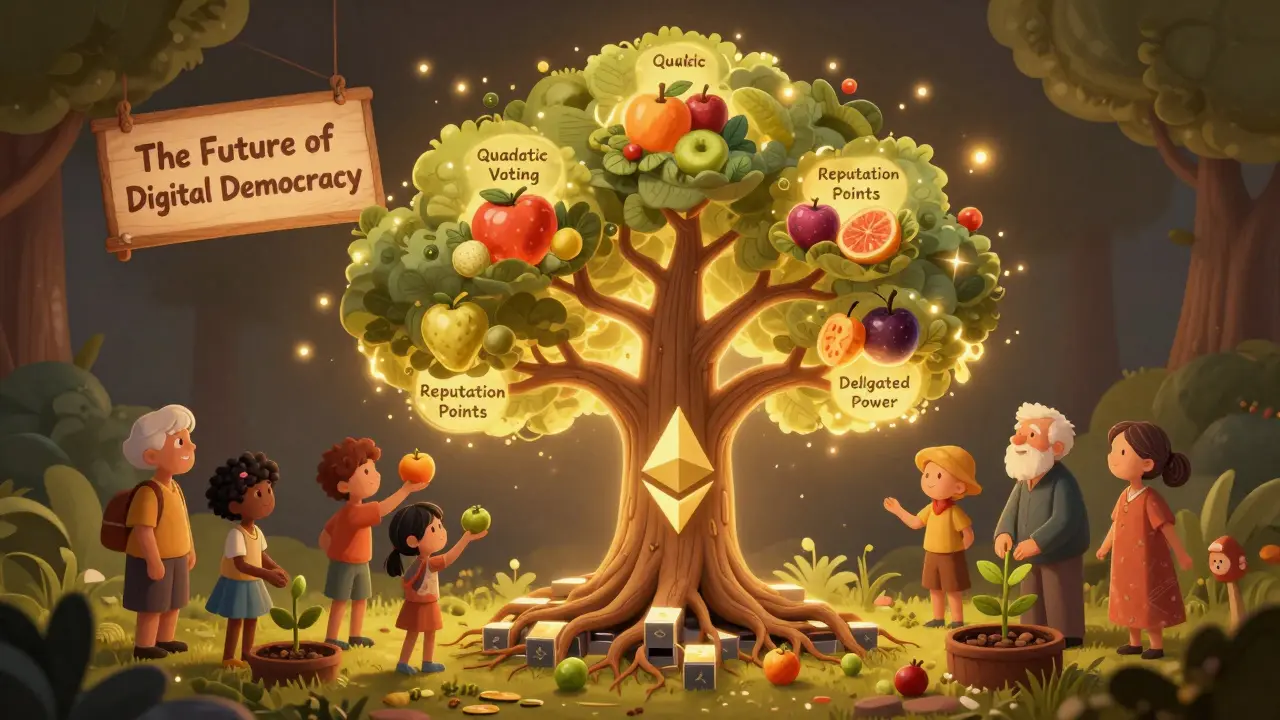
The crypto world knows governance tokens aren’t perfect. So people are testing fixes:- Quadratic voting: Instead of 1 token = 1 vote, you get √tokens. So 100 tokens = 10 votes, not 100. This reduces whale power. Balancer and Gitcoin are testing it.
- Reputation systems: What if your vote weight came from how long you’ve contributed, not how many tokens you hold? Some DAOs are experimenting with this.
- Delegated voting: You can assign your vote to someone you trust - like a community leader or expert. Uniswap’s upcoming v4 upgrade will include this.
- Lower quorums: Right now, many protocols need only 1.5% of tokens to vote to pass a proposal. That’s too low. Some are pushing for 5-10%.
By 2026, experts predict 65% of governance systems will blend token weight with reputation, activity, or time-in-community. That could make governance more fair - and more human.
How to Get Started
If you want to start voting:- Buy a governance token. You can get UNI, COMP, or MKR on Coinbase, Kraken, or Uniswap.
- Connect your wallet (like MetaMask) to the project’s governance portal. Most use Snapshot.org for off-chain voting.
- Read the proposal. Look at the discussion thread on Discord or the project’s forum. Don’t just vote - understand why.
- Cast your vote. You’ll need a small amount of ETH (or the chain’s native token) to pay for on-chain votes.
It takes 2-3 hours to learn the basics. But if you care about where a protocol is headed, it’s worth it. You’re not just holding a token - you’re helping shape a digital institution.
Final Thoughts
Governance tokens are the closest thing crypto has to digital democracy. They’re messy, slow, and often dominated by the rich. But they’re also revolutionary. For the first time, users aren’t just customers - they’re co-owners.Will they survive? Only if they fix their flaws. If they stay as wealth-weighted voting systems, they’ll keep failing. But if they evolve into multi-dimensional systems that reward participation over pocket size, they could become the foundation of the next internet - one built by communities, not corporations.
Are governance tokens the same as Bitcoin?
No. Bitcoin is a digital currency designed for peer-to-peer payments. Governance tokens don’t focus on transactions - they’re for voting on protocol changes. You can’t pay for coffee with UNI or COMP. But you can vote on whether Uniswap should expand to a new blockchain.
Can I lose money by holding governance tokens?
Yes. If a proposal you vote for fails or harms the protocol, the token’s price can drop. Also, if the community approves a bad upgrade or drains the treasury, your tokens could lose value. Holding them isn’t just an investment - it’s a responsibility.
Do I need to stake my tokens to vote?
Usually not. Unlike staking tokens (like ETH or SOL), governance tokens don’t need to be locked up to vote. You just need to hold them in your wallet. Some platforms let you delegate your vote without transferring ownership.
Why do some governance tokens have a fixed supply?
Fixed supplies prevent inflation and make voting power predictable. Uniswap’s UNI has a fixed cap of 1 billion. MakerDAO’s MKR is also capped. This ensures that new tokens can’t be created to dilute your vote. Some projects, like Aave, have inflationary models to reward early participants, but that can reduce long-term voting power.
Are governance tokens regulated?
They’re under increasing scrutiny. The SEC has sued Uniswap, arguing UNI is a security because it grants rights similar to stock ownership - including voting and profit-sharing. If courts agree, governance tokens may need to comply with securities laws, which could limit who can buy them and how they’re distributed.
How can I know if a governance proposal is worth voting on?
Check the proposal’s description, discussion threads on Discord or forums, and community sentiment. Look for third-party analysis - many independent analysts break down proposals. Avoid voting if you don’t understand the impact. Many bad decisions happen because people vote without reading.
What’s the difference between on-chain and off-chain voting?
On-chain voting happens directly on the blockchain and is immutable - once you vote, it’s final and recorded forever. It costs gas fees. Off-chain voting uses platforms like Snapshot.org and doesn’t cost money. But it’s not legally binding - the team still has to manually implement the result. Most projects use off-chain for speed and cost, then switch to on-chain for final approval.
Can I delegate my vote to someone else?
Yes, and it’s becoming more common. You can assign your voting power to a trusted community member, a DAO representative, or even a bot that follows your preferences. This helps if you don’t have time to research every proposal. Uniswap’s upcoming v4 upgrade will make delegation easier and more secure.
Comments
Janet Combs
So basically we’re trusting a bunch of rich people with crypto wallets to run the internet now? Cool. I just wanted to buy some UNI because it looked cool on my portfolio. Now I’m supposed to read 20-page proposals and understand quadratic voting? I didn’t sign up for this.
December 22, 2025 AT 03:20
roxanne nott
Governance tokens are just securities dressed up as activism. The SEC’s gonna shut this down. Mark my words. You think voting matters? It doesn’t. The whales already own the outcome.
December 24, 2025 AT 02:49
Charles Freitas
Oh wow, so the people who bought in early get to boss everyone around? Shocking. I guess the free market doesn’t care about equality. Just like capitalism. Just like life. Welcome to crypto, where the rich get richer and the rest of us get to vote on whether our money should be used to fund a guy’s yacht.
December 25, 2025 AT 16:30
Alison Fenske
I just want to feel like I’m part of something bigger, you know? Like I’m not just holding a digital token, I’m helping build the future. Even if I only vote once a year, it still means something. It’s not about power-it’s about belonging.
December 26, 2025 AT 23:52
Amit Kumar
Man, in India we have a saying: ‘The rich vote with money, the poor vote with silence.’ This is exactly that. But hey, at least the system is transparent. You know who’s in charge. In traditional finance? You don’t even know who’s pulling the strings.
December 28, 2025 AT 06:23
chris yusunas
Let’s be real-most people don’t care. I’ve got 12 UNI. I don’t even know how to vote. I just watch the price. If it goes up, I smile. If it goes down, I shrug. This whole thing feels like a school project where the teacher lets everyone vote but only the nerds show up.
December 30, 2025 AT 01:57
Helen Pieracacos
Quadratic voting sounds nice until you realize it’s still just math. Who’s to say √tokens is fairer than 1 token = 1 vote? It’s still weighted. It’s still rigged. The only thing that’s fair is if everyone gets one vote, period.
December 31, 2025 AT 07:45
Collin Crawford
Anyone who thinks governance tokens are democratic is delusional. The entire system is designed to concentrate power. It’s not a flaw-it’s the feature. This isn’t Web3. It’s WebPlutocracy. And the architects are laughing all the way to the bank.
December 31, 2025 AT 21:35
Radha Reddy
As someone from India, I find this fascinating. In our democracy, voter turnout is low too-but we still try. Maybe the answer isn’t to abandon governance tokens, but to simplify them. Make voting as easy as swiping left on a dating app. Then maybe more people will care.
December 31, 2025 AT 22:00
Mmathapelo Ndlovu
I used to think crypto was about freedom. Now I see it’s just a new kind of hierarchy. But I still believe in it. Because even broken systems can be fixed-if people show up. So I’m learning. I’m reading. I’m voting. Maybe I’m small, but I’m here.
January 2, 2026 AT 16:10
Grace Simmons
Let’s not pretend this is anything but an American tech fantasy. You think decentralized governance works in a country where half the population can’t afford a smartphone? This isn’t innovation-it’s colonialism with a blockchain.
January 4, 2026 AT 05:56
Shubham Singh
Y’all are overcomplicating this. Governance tokens = voting rights. Whales = majority control. Low participation = inevitable. The real question isn’t ‘how to fix it’-it’s ‘why are we surprised?’ This is capitalism. Always has been. Always will be.
January 5, 2026 AT 13:28
Sheila Ayu
Wait-so if I buy a ton of MKR, I can vote to make the protocol pay me $50 million? And no one can stop me? That’s not governance. That’s a heist with a whitepaper. And you’re all just sitting here debating quadratic voting like it’s a TED Talk?!
January 7, 2026 AT 00:26
Sarah Glaser
What if we stopped thinking of governance as a voting system and started thinking of it as a conversation? Maybe instead of forcing everyone to vote on every proposal, we create forums where people can propose, debate, and refine ideas-then let the community signal support, not just cast a binary yes/no.
January 8, 2026 AT 05:15
Dusty Rogers
My wallet’s got 3 UNI. I’ve voted once. I didn’t even know what I was voting on. But I read the comments. I learned. Now I check Snapshot every week. It’s not perfect-but it’s mine. And that’s enough.
January 9, 2026 AT 01:45
Dustin Bright
the fact that you need eth to vote is wild. like… if i dont have gas, i cant have a say? that’s not democracy. that’s pay-to-play. 😔
January 11, 2026 AT 00:53
Melissa Black
Token-weighted voting is the only mechanism that scales with economic contribution. Any other system ignores market signals. The real problem isn’t whales-it’s that most users don’t understand the value of their participation. Education, not structural overhaul, is the solution.
January 12, 2026 AT 19:20
Naman Modi
LOL imagine voting on a proposal and then your token gets dumped because the whales knew you were voting ‘no’. That’s not democracy. That’s a casino with a whitepaper. 🤡
January 14, 2026 AT 12:41
Kevin Karpiak
Let’s be honest-this whole thing is a PR stunt. No one wants real decentralization. They want the illusion of it so they can sell more tokens. The moment a DAO tries to make a real decision, the core team pulls the plug. We all know it.
January 16, 2026 AT 00:27
Dan Dellechiaie
You’re all missing the forest for the trees. Governance tokens aren’t broken-they’re evolving. We’re in the 1995 of decentralized governance. Back then, websites had tables and blinking text. Now? We have AI assistants and blockchain-based DAOs. The interface sucks. The participation is low. But the potential? Infinite. Stop complaining. Start building.
January 16, 2026 AT 11:06