

Imagine buying a coffee in Hanoi with Bitcoin. You hand over your phone, the barista scans a QR code, and you walk away feeling like a pioneer of the digital age. Then, a month later, you get a letter from the State Bank of Vietnam (SBV). It’s not a thank-you note for innovation; it’s a fine notification for up to 200 million VND (roughly $8,900 USD). For many, this seems absurd. Why would a country that ranks among the top globally for cryptocurrency adoption slap such heavy fines on using the very technology its citizens love? The answer lies in a strict interpretation of monetary sovereignty.
The Core Rule: Asset vs. Currency
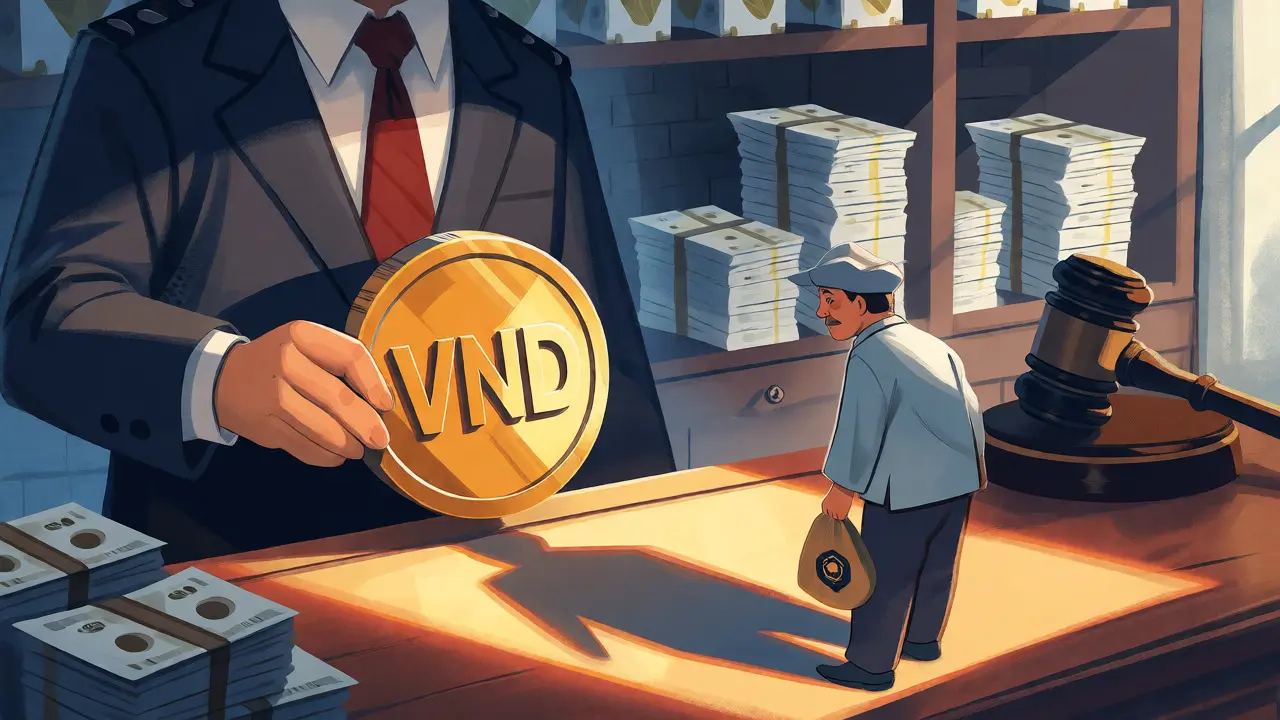
To understand the fines, you have to stop thinking about Bitcoin as "money" in the eyes of Vietnamese law. Under current regulations, specifically Decree No. 96/2014/ND-CP, cryptocurrencies are not banned outright. You can hold them. You can trade them. You can even treat them as assets. But you cannot use them to pay for goods or services. The law draws a hard line between holding an asset and using a means of payment. When you try to buy lunch with ETH, you aren't just exchanging value; you are attempting to issue a payment instrument that the state hasn't approved. That specific act triggers the penalty.
This distinction is crucial. If you sell Bitcoin for Dong at an exchange, you’re likely safe because you’re converting an asset into fiat currency. But if you directly transfer Bitcoin to a merchant who accepts it as settlement for a debt, you’ve stepped into the prohibited zone. The SBV has been clear since January 1, 2018: the issuance, supply, and use of virtual currencies as means of payment are illegal activities. This isn’t a gray area anymore; it’s a black-and-white regulatory wall designed to keep the Vietnamese Dong as the sole sovereign currency.
Why So High? The Logic Behind the Fine
Why 150 to 200 million VND? It’s not a random number. In the context of Vietnam’s economy, this amount represents a significant deterrent for individuals and small businesses. For a large corporation, it might be a rounding error, but for a local shop owner accepting crypto to attract tourists, it’s a business-ending risk. The government’s rationale, articulated by experts like Le Truong Tung, president of FTP University, centers on control. They argue that allowing Bitcoin as payment complicates economic monitoring, opens doors for tax evasion, and undermines the central bank’s ability to manage money supply.
Think of it this way: if every cafe started pricing lattes in Bitcoin, how would the tax authority calculate VAT? How would they track inflation when prices fluctuate wildly based on global market sentiment rather than domestic policy? The fine is essentially a premium you pay for bypassing the state’s financial infrastructure. It’s a message that says, "We want you to innovate, but only within our sandbox."
| Country | Legal Status of Payment | Primary Regulatory Body | Key Restriction |
|---|---|---|---|
| Vietnam | Prohibited as payment method | State Bank of Vietnam (SBV) | Fines up to 200M VND for direct payments |
| Thailand | Restricted; exchanges licensed | Securities and Exchange Commission (SEC) | Banned for retail payments initially, evolving framework |
| Singapore | Permitted under licensing | Monetary Authority of Singapore (MAS) | Strict AML/KYC compliance required |
Enforcement Reality vs. Legal Theory
Here is where things get interesting. While the law is strict, enforcement has been selective. You won’t see police raiding cafes every time someone pays with Bitcoin. Instead, authorities tend to focus on high-profile cases or organized efforts to normalize crypto payments. For instance, when a university attempted to accept Bitcoin for tuition fees, the SBV intervened immediately, forcing them to back down. This sets a precedent: institutional acceptance is the primary target.
Peer-to-peer transactions often fly under the radar. If you send Bitcoin to a friend to split a dinner bill, you’re technically violating the rule, but the cost of enforcing it against millions of micro-transactions outweighs the benefit. However, if you run a tourism agency accepting Bitcoin packages from foreign clients, you are visible. You are creating a parallel economy that the state can’t easily tax or monitor. That visibility makes you a target. The General Department of Vietnam Customs has noted rapid growth in user numbers, suggesting that while formal merchant adoption is suppressed, underground usage remains robust.

The Paradox of Adoption
Vietnam presents a fascinating contradiction. According to Chainalysis’ Global Crypto Adoption Index, Vietnam consistently ranks in the top ten worldwide. People here are tech-savvy, young, and eager to adopt new financial tools. Yet, the legal framework treats these users as potential offenders. This creates a cognitive dissonance for investors. You can own Bitcoin legally, but you can’t spend it legally. Most users resolve this by keeping crypto purely as an investment vehicle, selling it back into VND whenever they need to make a purchase. It turns out that for most Vietnamese users, Bitcoin is digital gold, not digital cash.
This approach also impacts the broader fintech landscape. The SBV encourages digital banking and non-cash payments through traditional channels like MoMo or ZaloPay. These apps are growing rapidly, supported by state-sanctioned infrastructure. By banning crypto payments, the government effectively protects these local fintech giants from competition. It’s a strategic move to ensure that the shift toward a cashless society happens on terms controlled by the state, not by decentralized protocols.
What Does This Mean for Investors?
If you are investing in crypto in Vietnam, your strategy needs to account for this regulatory ceiling. You cannot rely on utility spending to drive demand locally. Your exit liquidity must flow through compliant exchanges that convert assets to VND. Avoid trying to build a business model around direct crypto acceptance unless you are prepared to navigate complex legal workarounds, such as structuring transactions as service contracts rather than sales.
Furthermore, keep an eye on legislative updates. There have been drafts, like the 2021 Draft Decree on Management of Virtual Assets, suggesting a future where crypto is recognized more clearly as a taxable asset. While the payment ban remains firm, the recognition of crypto as property could lead to clearer taxation rules, reducing some uncertainty for long-term holders. Until then, treat the 150-200 million VND fine as a real operational risk for any business touching crypto directly.
Is owning Bitcoin illegal in Vietnam?
No, owning Bitcoin is not illegal. You can buy, hold, and trade cryptocurrencies as assets. The prohibition applies specifically to using them as a means of payment for goods and services.
How much is the fine for paying with crypto in Vietnam?
The administrative fine ranges from 150 million to 200 million VND (approximately $6,500 to $8,900 USD) for issuing, supplying, or using virtual currencies as a means of payment.
Can I pay my rent with Bitcoin in Ho Chi Minh City?
Technically, no. Paying rent directly with Bitcoin violates the regulation against using crypto as a payment instrument. Both tenant and landlord face potential fines, though enforcement is currently focused on larger commercial entities.
Does the ban apply to stablecoins like USDT?
Yes. The State Bank of Vietnam defines "virtual currencies" broadly, which includes stablecoins. Using USDT to settle a transaction is considered using an illegal means of payment.
Are there any exceptions for foreign tourists?
There are no explicit exemptions for foreign tourists in the current decree. While enforcement against individual tourists making small purchases is rare, the legal basis for fining remains applicable to anyone conducting a transaction in Vietnam.