

You want to trade crypto without handing your keys to a centralized company. You open a decentralized exchange (DEX). But which one do you pick? The two giants of the space are Uniswap, the original protocol that started it all, and SushiSwap, the community-driven fork that promised more rewards. It is 2026, and the landscape has settled. The hype cycle has cooled, leaving clear winners for specific types of traders. One is better for pure efficiency and volume. The other is better for yield farming and multi-chain flexibility. Knowing the difference saves you money on fees and helps you avoid unnecessary complexity.
The Core Difference: Simplicity vs. Incentives
To understand why these two platforms feel so different, you have to look at their origins. Uniswap was launched in 2018 by Hayden Adams. It pioneered the Automated Market Maker (AMM) model, replacing order books with liquidity pools. Its philosophy is clean code, minimal friction, and maximum reliability. It does not try to be everything to everyone. It is a swap engine, optimized for speed and trustlessness.
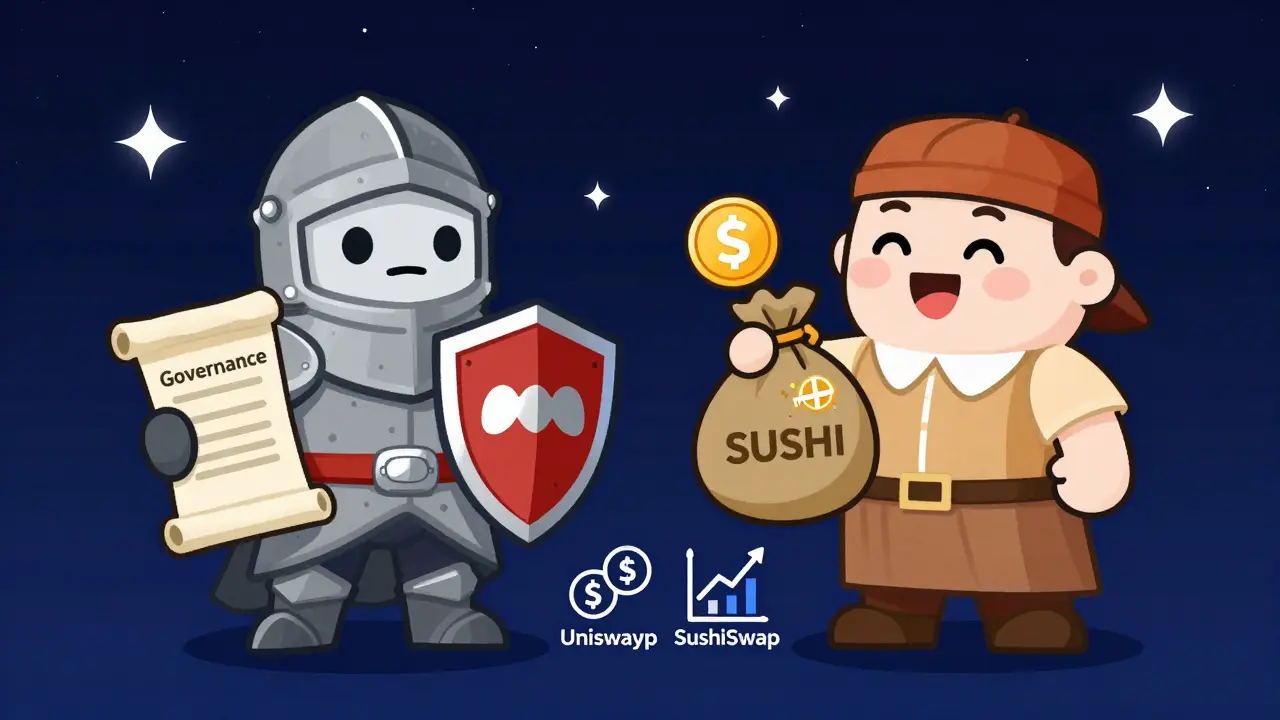
SushiSwap began as a hard fork of Uniswap in 2020. It took the same underlying technology but added a layer of financial incentives on top. From day one, SushiSwap focused on rewarding its users. If you provide liquidity or hold their token, you get paid. This created a fundamentally different user experience. Uniswap asks you to trade. SushiSwap asks you to participate in its ecosystem.
This distinction matters because it dictates who should use which platform. If you just want to swap ETH for USDC quickly and leave, Uniswap is likely the smoother path. If you want to earn passive income from your idle assets while trading, SushiSwap offers more tools out of the box.
Liquidity and Volume: The Scale Gap
In decentralized finance, liquidity is king. Without deep liquidity, you suffer from high slippage-meaning you get fewer tokens than expected when you trade large amounts. Here, the numbers tell a stark story about market dominance.
| Metric | Uniswap | SushiSwap |
|---|---|---|
| Total Value Locked (TVL) | ~$4 Billion | ~$400 Million |
| Daily Trading Volume | $1 - $2 Billion | $50 - $150 Million |
| Primary Chains | Ethereum, Arbitrum, Base, Polygon, Optimism, BNB Chain | 14+ Chains including Avalanche, Fantom, Harmony, Ethereum |
| Fee Structure | Variable (0.05%, 0.3%, 1%) | Fixed (0.3%) |
Uniswap holds roughly ten times the TVL of SushiSwap. Why does this matter to you? Because deeper pools mean tighter spreads. When you trade a large amount on Uniswap, the price impact is lower. For institutional traders or whales moving millions of dollars, Uniswap is often the only viable option due to its depth. SushiSwap’s smaller pool sizes can lead to higher slippage on significant trades, though it remains perfectly adequate for retail-sized swaps under $10,000.
However, SushiSwap compensates for lower volume with broader chain support. While Uniswap focuses heavily on EVM-compatible chains with high throughput like Arbitrum and Base, SushiSwap has expanded to 14+ networks, including older favorites like Fantom and Harmony. If you are holding tokens on a niche chain, SushiSwap might be the only place to swap them efficiently.
Fee Structures: Variable vs. Fixed
Fees are where the technical differences become personal. Uniswap V3 introduced concentrated liquidity and variable fee tiers. This allows traders to choose a fee tier based on the volatility of the pair they are trading.
- 0.05% Tier: Designed for stablecoin pairs (e.g., USDC/USDT) or highly correlated assets. These trades have low risk of impermanent loss and require tight spreads.
- 0.3% Tier: The standard rate for most major trading pairs (e.g., ETH/USDC).
- 1% Tier: Used for exotic pairs or new tokens with high volatility and low liquidity.
This flexibility benefits sophisticated liquidity providers who can optimize their capital efficiency. For regular traders, it means you pay less when swapping stablecoins. SushiSwap, by contrast, maintains a fixed 0.3% fee across the board. This simplicity is easier to understand but can be expensive if you are frequently swapping stablecoins. On the flip side, SushiSwap distributes 0.25% of that fee to liquidity providers and 0.05% to xSUSHI stakers. Uniswap sends 100% of the trading fees directly to liquidity providers, with no portion going to token holders.

Tokenomics: Governance Only vs. Revenue Sharing
The utility of the native tokens-UNI and SUSHI-is perhaps the biggest differentiator for long-term investors. The UNI token serves purely as a governance instrument. Holding UNI gives you a voice in protocol upgrades, but it does not entitle you to any share of the revenue generated by the platform. The max supply is 1 billion tokens. Its value is derived entirely from speculation and perceived network effects.
SUSHI token operates differently. It functions as both a governance token and a revenue-sharing mechanism. Users can stake their SUSHI to receive xSUSHI. Holders of xSUSHI earn a direct cut of the trading fees generated across the entire SushiSwap ecosystem. With a max supply of 250 million tokens, SUSHI has a stronger deflationary pressure potential if buybacks or burns are implemented, though currently, the primary incentive is the steady stream of fee revenue. This aligns the interests of token holders with the success of the platform. If SushiSwap grows, xSUSHI holders profit directly.
User Experience: Beginner-Friendly vs. Feature-Rich
If you are new to DeFi, the interface matters. Uniswap is renowned for its cleanliness. Connect your wallet, select the tokens, and swap. The documentation is straightforward, and the mobile app integration is seamless. There are no hidden menus or complex dashboards to confuse you. It is designed to get in and out.
SushiSwap is denser. The interface includes tabs for swapping, earning, lending, and limit orders. While powerful, this can overwhelm a beginner. You need to understand concepts like impermanent loss, yield farming APYs, and cross-chain bridging to use SushiSwap effectively. However, for experienced DeFi users, these features are gold. SushiSwap offers limit orders, allowing you to set target prices for future trades-a feature Uniswap lacks natively. It also integrates lending services, letting you borrow against your collateral directly within the dApp.
Expert consensus suggests starting with Uniswap to learn the basics of wallet connections and slippage tolerance. Once you are comfortable, explore SushiSwap to leverage its advanced earning opportunities.
Security and Trust
Both protocols are battle-tested. Uniswap has been running since 2018, handling billions in daily volume without a major critical exploit affecting user funds. Its codebase is one of the most audited in the industry. SushiSwap, despite its turbulent early days involving governance disputes, has stabilized significantly. Its smart contracts are also extensively audited. However, Uniswap’s longer track record provides a psychological safety net for risk-averse users. When dealing with life savings, many prefer the status quo of the market leader.
Which One Should You Choose?
Your choice depends on your primary goal.
Choose Uniswap if:
- You prioritize deep liquidity and low slippage for large trades.
- You want the simplest possible user interface.
- You are trading on Ethereum, Arbitrum, or Base and want the best execution.
- You do not care about token rewards and just want to swap assets efficiently.
Choose SushiSwap if:
- You want to earn passive income through liquidity mining or xSUSHI staking.
- You trade on alternative chains like Avalanche, Fantom, or Harmony.
- You need advanced features like limit orders or integrated lending.
- You believe in the revenue-sharing model and want economic alignment with the protocol.
In 2026, these are not competitors fighting for the same user; they are specialized tools for different jobs. Use Uniswap for precision and scale. Use SushiSwap for yield and versatility.
Is Uniswap safer than SushiSwap?
Both platforms are highly secure and have undergone extensive audits. Uniswap has a longer operational history since 2018, which provides greater confidence in its stability. However, SushiSwap has also proven robust over several years. Neither has suffered a catastrophic hack compromising user funds in recent years. Safety in DeFi also depends on your own practices, such as verifying contract addresses and using hardware wallets.
Can I use Uniswap on Binance Smart Chain?
Yes, Uniswap supports BNB Chain. However, its liquidity on BNB Chain is significantly lower than on Ethereum or Arbitrum. For trading on BNB Chain, you might find better liquidity on PancakeSwap, another leading DEX on that network. SushiSwap also supports BNB Chain, offering an alternative if you prefer its reward structure.
Do I need to buy UNI or SUSHI tokens to trade?
No. You do not need to hold UNI or SUSHI tokens to perform basic swaps on either platform. You only need the cryptocurrency you wish to trade and enough gas fees (ETH, MATIC, etc.) to cover transaction costs. Buying the native tokens is optional and only necessary if you want to participate in governance or earn staking rewards.
What is impermanent loss?
Impermanent loss is a risk faced by liquidity providers. It occurs when the price of the deposited tokens changes compared to when they were deposited. If one token rises significantly in value relative to the other, the liquidity provider ends up with less value than if they had simply held the tokens in their wallet. Both Uniswap and SushiSwap expose LPs to this risk, though SushiSwap’s token rewards often aim to compensate for it.
Which platform has lower fees for stablecoin swaps?
Uniswap generally offers lower fees for stablecoin swaps. It provides a 0.05% fee tier specifically for stable pairs. SushiSwap charges a flat 0.3% fee regardless of the asset type. Therefore, if you frequently swap between stablecoins like USDC and USDT, Uniswap will cost you six times less in trading fees.
Comments
Jay Sharma
the whole dex narrative is just a distraction from the fact that centralized exchanges are quietly consolidating all real liquidity while we play with these fragmented pools. they want you thinking about slippage on sushi while they adjust fees on binance in the background. wake up.
June 28, 2026 AT 16:31
Scott Miller
stop being so negative man. uniswap v3 is literally the gold standard for efficiency right now. if you know what you are doing you save massive amounts on stablecoin swaps with that 0.05 tier. its not even close compared to paying 0.3 flat on sushi every time. get with the program and optimize your trades instead of crying about conspiracy theories.
June 28, 2026 AT 22:57
Rebecca Shoniker
Oh, please. You clearly do not understand the fundamental mechanics of automated market makers. The variable fee structure on Uniswap is merely a sophisticated way to extract value from retail traders who lack the technical expertise to manage concentrated liquidity ranges properly. Meanwhile, SushiSwap’s fixed model provides a transparent, albeit slightly more expensive, framework for those of us who actually comprehend the nuances of yield farming and impermanent loss mitigation strategies. It is quite amusing how many people confuse simplicity with intelligence.
June 29, 2026 AT 14:17
nancy jarecki
boring analysis. everyone knows sushi is dead weight now. the tvl gap is embarrassing and the governance drama never really ended it just went underground. uniswap is the only serious player left unless you are trading some obscure shitcoin on fantom that no one else wants. stop pretending there is a choice here.
June 30, 2026 AT 02:45
Abby Martin
actually nancy you are wrong because sushi has limit orders which uniswap still doesnt have natively and thats huge for anyone who cares about execution price. also the revenue sharing with xsushi is a legitimate economic incentive that uni completely ignores. holding uni is like holding a voting token for a club that doesnt pay dividends. i mean come on. its obvious who wins for long term holders.
June 30, 2026 AT 12:45
Mélanie Boulay
I suppose that while the arguments regarding the immediate utility of limit orders on SushiSwap hold merit, one must consider the broader implications of platform stability and user retention over extended periods, particularly when observing how the initial hype surrounding decentralized governance mechanisms tends to dissipate once the novelty wears off and users are forced to confront the reality of complex interfaces versus the streamlined, almost minimalist approach adopted by Uniswap, which prioritizes transactional speed and reliability above all else, thereby creating a different but perhaps more sustainable ecosystem for the average participant who does not wish to engage in constant monitoring of their positions.
July 1, 2026 AT 07:28
Melissa L
i just use whatever has less gas fees at the time lol
July 2, 2026 AT 21:05
Robert Hundley
hey melissa! gas fees are important but dont forget about slippage too. if you are moving big amounts uniswap is way better. sushi is cool for small stuff though. keep learning!
July 3, 2026 AT 08:21
Maurice Flynn
it is interesting how we frame this as a competition when they serve entirely different philosophical purposes. uniswap is a tool. sushi is an experiment in community ownership. neither is objectively better. it depends on whether you view crypto as a technology stack or a social movement. most people miss that distinction.
July 4, 2026 AT 23:49
Jon Milton
you are missing the point maurice. the market decides. and the market voted for uniswap with 4 billion tvl vs 400 million. thats not philosophy thats capitalism. if you want to be part of a failing experiment go ahead but dont expect profits. the numbers dont lie.
July 5, 2026 AT 19:47
Sajjad Ghorbani Moghaddam
look jon calm down. both platforms have their place. if you are new start with uniswap. if you want to farm yields look at sushi. its not about winning or losing its about using the right tool for the job. lets help each other learn instead of fighting.
July 7, 2026 AT 04:20
Nicole Woessner
i love how diverse the options are now. back in the day everything was just ethereum mainnet and high fees. now having choices like base or arbitrum on uniswap or multi-chain support on sushi makes me feel empowered. its great to see the space maturing into something usable for regular people.
July 7, 2026 AT 19:22
Rob Morton
nicole makes a good point about accessibility. the barrier to entry has dropped significantly. however i wonder if the complexity of sushi swap still alienates beginners despite the features. maybe the industry needs a middle ground where advanced features are optional rather than prominent. what do you think about hybrid interfaces?
July 9, 2026 AT 06:22