

When you look at a DeFi protocol like Aave or Uniswap, what tells you if it’s actually gaining real traction? It’s not just how many people are talking about it on Twitter. The real signal is in the numbers - specifically, TVL, or Total Value Locked. This metric doesn’t lie. It shows you exactly how much money users have locked into a protocol’s smart contracts. And it changes every single day - sometimes by millions, sometimes by billions.
What TVL Really Measures
TVL is the total value of all crypto assets locked in a DeFi protocol. That includes ETH, USDT, WBTC, or any other token deposited into lending pools, liquidity pools, or staking contracts. If you lend your USDC on Aave, or add liquidity to a Uniswap pair, that money gets counted in the protocol’s TVL. The value is calculated in real time using current market prices. So if ETH drops 10%, your locked ETH is worth less - and TVL drops, even if nobody touched their deposit.
It’s not just about deposits. TVL also reflects trust. When users lock up their assets, they’re saying: "I believe this protocol won’t get hacked, won’t rug, and will deliver on its promise." That’s why TVL is such a powerful indicator of adoption. A protocol with $5 billion in TVL has more credibility than one with $50 million - even if both have similar features.
How TVL Is Calculated (And Why It’s Often Wrong)
Most TVL numbers you see on CoinGecko or DeFiLlama come from automated scripts that scan blockchain data. But here’s the problem: not all protocols report their data the same way. Some use custom smart contracts. Others rely on off-chain servers to report balances. Researchers from the Bank for International Settlements looked at nearly 1,000 DeFi projects and found something shocking: 10.5% of them depend on external servers that aren’t on-chain. That means their TVL could be faked, outdated, or manipulated.
Even worse, there are over 68 different ways to calculate token balances across protocols. One might count wrapped tokens differently than another. Some include governance tokens that aren’t even meant to be staked. Others double-count assets across multiple platforms. This lack of standardization means the TVL number you see might not reflect reality.
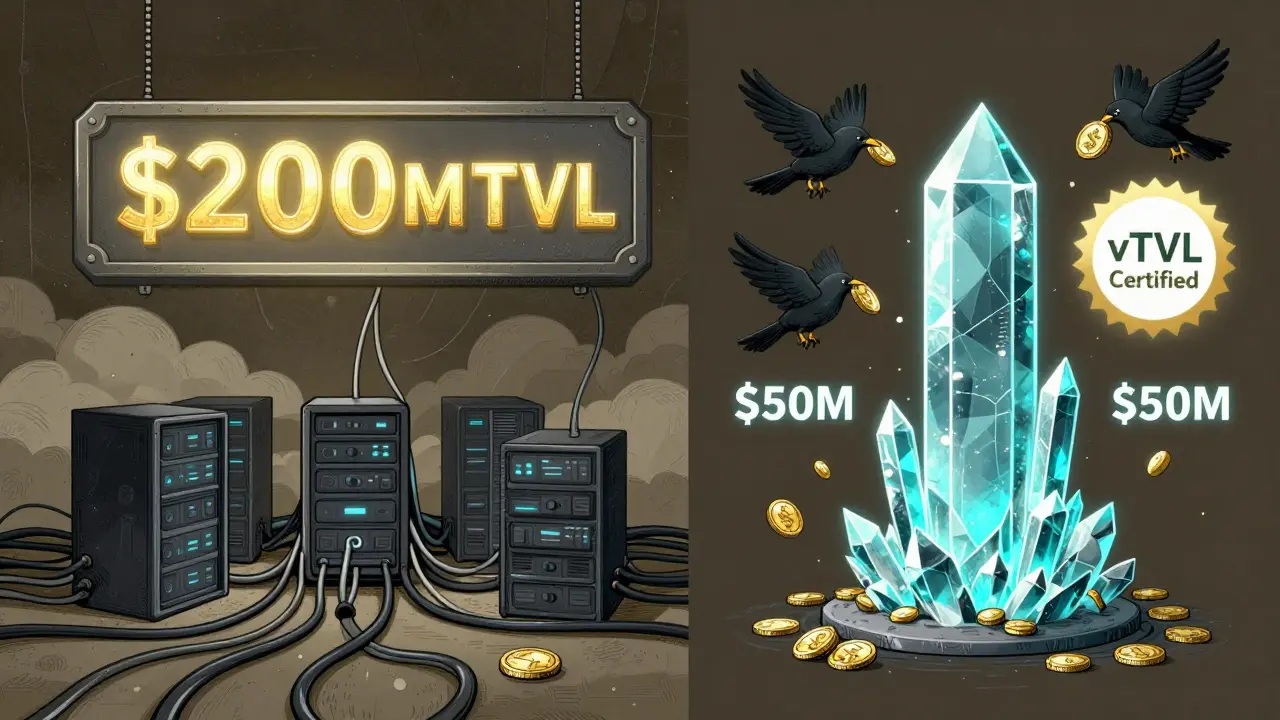
That’s why a new metric is emerging: verifiable TVL, or vTVL. This version only counts assets that can be confirmed directly on-chain using standard balance queries. No custom logic. No off-chain reports. Just raw, transparent data. A study of 400 protocols showed that vTVL matched published TVL for only 46.5% of them. In other words, more than half of the TVL numbers you’re seeing could be inflated - or just plain wrong.
What Makes TVL Go Up or Down
TVL doesn’t move randomly. It reacts to real events in the market.
- Market volatility: When Bitcoin or Ethereum surges, TVL climbs because locked assets are worth more. When prices crash, TVL falls - even if no one withdrew.
- Protocol updates: A new yield strategy, a better interest rate, or a security audit can trigger massive inflows. For example, when EigenLayer launched its restaking feature, its TVL jumped from $0 to over $10 billion in weeks.
- Competition: If a new Layer-2 chain offers lower fees and higher rewards, users pull money out of Ethereum and move it over. That’s why TVL on Arbitrum and Base has grown while Ethereum’s share has slowly declined.
- Regulation: If a major jurisdiction cracks down on DeFi, users panic and pull out. That’s what happened in 2024 when the U.S. SEC targeted certain stablecoin issuers - TVL on platforms using those tokens dropped sharply.
TVL also reflects sentiment. If users start leaving a protocol, it’s rarely because they just got bored. It’s because they lost confidence - maybe after a hack, a failed upgrade, or a sudden drop in yields. When TVL drops 30% in a week, it’s usually a red flag.
Why TVL Matters for Investors and Users
If you’re using DeFi, TVL should be your first checkpoint. Before you deposit into a new lending protocol, check its TVL. A TVL under $10 million is risky. A TVL over $1 billion suggests broader adoption and more eyes watching for exploits.
TVL also helps you compare chains. Ethereum still leads with over $70 billion locked, but its dominance has slipped. Solana’s TVL hit $15 billion in early 2026 after its upgrade, while Cosmos has climbed past $8 billion thanks to its interoperability focus. These numbers tell you where capital is flowing - and where innovation is happening.
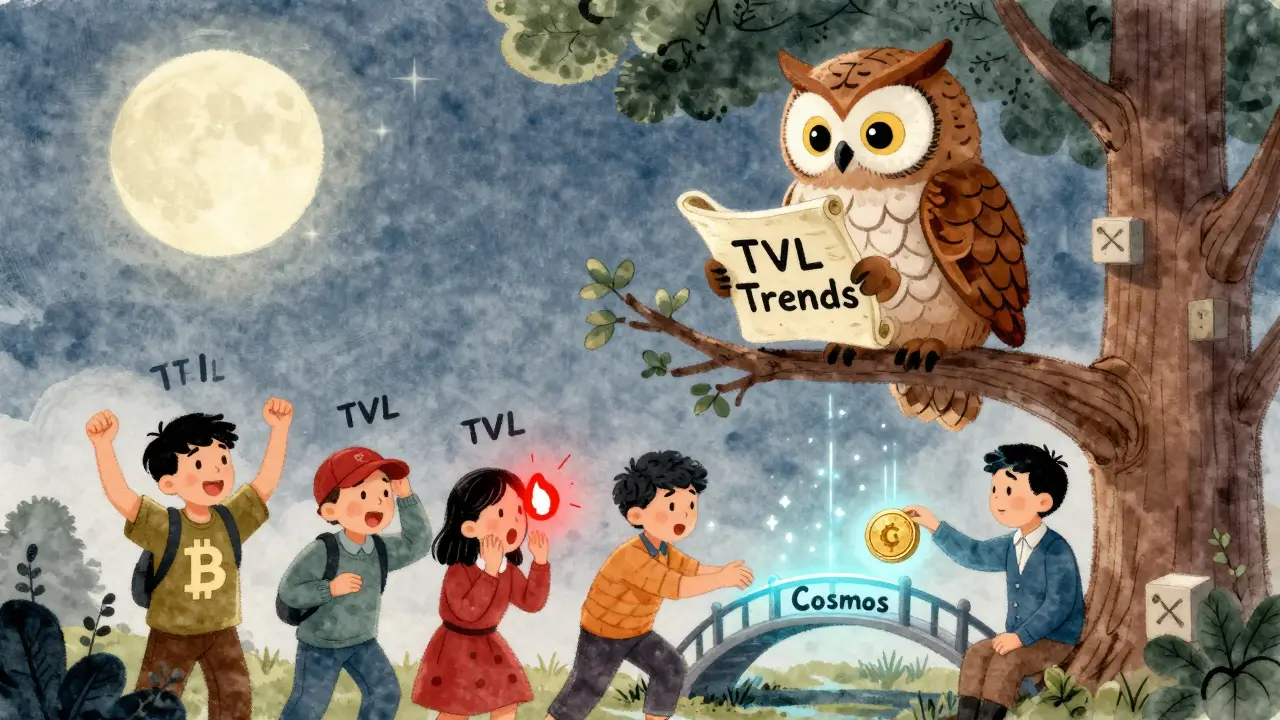
For traders, TVL trends can signal opportunity. A sudden spike in TVL on a new DeFi platform might mean it’s gaining momentum before the price pumps. A slow, steady decline might mean it’s losing relevance - even if the team is still marketing hard.
The Future of TVL: More Transparency, Less Guesswork
The DeFi world is waking up to the fact that TVL can’t be trusted as-is. That’s why projects are starting to adopt vTVL standards. Some, like L2BEAT, already show both traditional TVL and vTVL side by side. This lets you see the gap - and decide for yourself if a protocol’s numbers hold up.
Future tools will likely include automated verification badges - like a "vTVL Certified" label - for protocols that meet strict on-chain reporting standards. Imagine seeing a protocol with $200 million in TVL, but next to it, a smaller $50 million one with a "vTVL Verified" tag. Which one would you trust more?
Academics are also pushing for standardized data formats. Instead of every protocol inventing its own way to report balances, future smart contracts may be required to use a universal query interface. This won’t happen overnight. But the pressure is building. Users are demanding transparency. Regulators are asking questions. And investors are getting tired of being misled.
What You Should Do Today
Don’t just look at TVL numbers. Ask questions:
- Is the TVL from a reputable source like DeFiLlama or L2BEAT?
- Does the protocol show its vTVL? If not, why?
- Has TVL been stable over the last 30 days - or is it spiking and crashing?
- Are the assets locked mostly stablecoins, or volatile tokens? Stablecoin-heavy TVL is more reliable.
- Is the protocol on a major chain (Ethereum, Solana) or a niche one? New chains often have inflated TVL due to incentives.
TVL is a powerful tool - but only if you understand what’s behind the number. The best investors don’t just chase high TVL. They dig into why it’s high, and whether it’s real.
What does TVL stand for in DeFi?
TVL stands for Total Value Locked. It measures the total amount of cryptocurrency deposited into a DeFi protocol’s smart contracts - including lending pools, liquidity pools, and staking contracts. It’s usually expressed in U.S. dollars and reflects both the quantity of assets locked and their current market value.
Is a high TVL always a good sign?
Not always. A high TVL can mean strong adoption, but it can also be inflated by short-term yield farming incentives, fake liquidity, or inaccurate reporting. Always check if the TVL is verifiable (vTVL), whether assets are mostly stablecoins, and whether the protocol has a history of stability. A TVL that spikes then crashes is often a red flag.
Can TVL be manipulated?
Yes. Some protocols use off-chain servers to report balances, or count tokens that aren’t actually locked (like governance tokens). Others borrow liquidity from other protocols to temporarily inflate numbers. These tricks are called "TVL farming" and are common in new or low-trust projects. Always look for vTVL data or third-party verification.
How is vTVL different from regular TVL?
vTVL, or verifiable TVL, only includes assets that can be confirmed directly on-chain using standard balance queries. It ignores custom logic, off-chain reports, and non-standard token types. Regular TVL often includes those, which can lead to inflated or misleading numbers. vTVL is more reliable but currently only covers about half of all DeFi protocols.
Why does TVL change even if no one deposits or withdraws?
TVL is calculated using current market prices. If ETH goes from $3,000 to $3,300, the value of locked ETH increases - even if no one touched their deposit. Similarly, if a stablecoin depegs slightly, TVL drops. So TVL reflects both user activity and market volatility.
Which blockchain has the highest TVL as of 2026?
As of early 2026, Ethereum leads with over $70 billion in TVL, followed by Solana at around $15 billion and Bitcoin Layer-2s like Lightning Network and Rootstock at roughly $12 billion combined. However, TVL distribution is shifting as new chains like Cosmos and Arbitrum gain traction with better scalability and lower fees.
Comments
Anthony Marshall
TVL is the only metric that actually matters. If money isn't locked in, the whole thing is just a meme. I've seen projects with 10k Twitter followers and zero TVL - guess what? They died in a week. Real money talks. Stop chasing hype and start checking DeFiLlama every morning. Period.
March 12, 2026 AT 21:48
Lindsay Girvan
TVL doesn't lie - but the people reporting it do. I don't trust any number that isn't vTVL. If you're using a protocol that doesn't show verifiable on-chain data, you're gambling. Not investing. Gambling.
March 13, 2026 AT 16:06
Douglas Anderson
There's a lot of nuance here that gets lost. TVL is useful, but context is everything. A $50M TVL on a new chain with 90% stablecoins and no incentives? That's real. A $200M TVL on a chain with 60% volatile tokens and a 200% APY farm? That's a house of cards. Always check composition, not just the headline number.
March 15, 2026 AT 02:50
Tina Keller
It's funny how we treat TVL like it's some divine oracle, when really it's just a mirror reflecting our collective greed and fear. When the market screams, TVL screams back. When trust evaporates, the numbers vanish. It's not a measure of innovation - it's a measure of mood. And moods change faster than smart contracts can audit themselves.
March 16, 2026 AT 00:05
vasantharaj Rajagopal
The lack of standardization in TVL calculation is a systemic risk. Most retail users don't realize that protocols use non-standard token mappings, off-chain oracles, and custom aggregators. The BIS study is critical - 10.5% reliance on off-chain infrastructure means we're building DeFi on sand. We need on-chain verifiable data as a baseline, not an opt-in.
March 16, 2026 AT 05:02
William Montgomery
If your TVL is over $100M and you're not showing vTVL, you're hiding something. Period. No excuses. If you're a dev, publish your on-chain queries. If you're a user, walk away. This isn't finance - it's a carnival with rigged numbers.
March 17, 2026 AT 15:05
Adam Ashworth
I’ve watched TVL drop 40% in 48 hours after a single audit report. Not because of a hack - because users panicked. TVL isn’t just about money - it’s about psychology. The moment people feel unsafe, they pull out. That’s why stablecoin-heavy TVL is more resilient. Fear doesn’t depeg USDC.
March 19, 2026 AT 09:33
Tom Jewell
The real tragedy is that we’re still treating TVL like a single number. It’s a mosaic. Who’s locking? What tokens? From which chains? For how long? A protocol with $1B in ETH locked for 6+ months is fundamentally different from one with $1B in newly minted governance tokens from a 3-week-old farm. We need layered metrics - not just a headline.
March 20, 2026 AT 14:23
karan narware
Oh wow. So we're now supposed to trust vTVL? Because clearly, the people who built DeFi didn't think about this. Let me guess - next they'll tell us to check if the devs have a LinkedIn. How quaint.
March 20, 2026 AT 15:24
vishnu mr
vTVL is the future 🚀 but we need tools to make it easy. Imagine a browser extension that auto-highlights protocols with vTVL badges. No more digging through 10 tabs. Just green checkmark = go. Red flag = run. I’d use it daily.
March 21, 2026 AT 23:39
Zephora Zonum
TVL is just another Wall Street metric repackaged for crypto bros. You think a number tells you anything about trust? That’s like judging a person by their bank balance. The real value is in code, in community, in decentralization. Not in some dollar figure that moves with Bitcoin’s mood swings.
March 23, 2026 AT 19:31
ann neumann
They’re lying. All of them. The SEC is already monitoring TVL data. They’re building databases to track which protocols are inflating. You think they don’t know about off-chain servers? They’ve been watching since 2021. And when they strike? All those inflated numbers will vanish overnight. You think you’re safe? You’re not. They’re coming.
March 24, 2026 AT 16:07
Mara Alves Mariano
Ethereum’s TVL is a scam. They’re just counting every single wrapped BTC and stETH and LRT and fake liquidity from Binance and Coinbase. Real DeFi is on Solana and Cosmos. Ethereum is just a tax haven for old money. Wake up. The future is not in L2s that still use ERC-20s. It’s in chains that actually work.
March 25, 2026 AT 07:33