

Imagine waking up to find that your paycheck was suddenly cut in half, but you're still expected to do the exact same amount of work. For most of us, that would be a nightmare. For cryptocurrency miners, it's a scheduled event called the halving. While it sounds like a disaster for the people securing the network, the Litecoin halving is actually a carefully planned economic tool designed to stop the coin from becoming worthless over time.
| Feature | Litecoin (LTC) | Bitcoin (BTC) |
|---|---|---|
| Block Time | ~2.5 Minutes | ~10 Minutes |
| Halving Interval | 840,000 Blocks | 210,000 Blocks |
| Mining Algorithm | Scrypt | SHA-256 |
| Approx. Cycle | Every 4 Years | Every 4 Years |
What Exactly is a Crypto Halving?
At its core, a halving is a pre-programmed event that reduces the number of new coins entering the market. In the world of Litecoin, this happens every 840,000 blocks. Think of it as a digital central bank that can't be bribed or changed by politicians; the code is the law.
When Litecoin launched back in 2011, miners were rewarded with 50 LTC for every block they successfully processed. Every few years, that reward gets sliced in half. This creates a a predictable supply curve. By limiting the flow of new coins, the network tries to fight inflation. If the demand for the coin stays the same or grows while the supply of new coins drops, the price theoretically should go up. It's basic supply and demand, baked right into the blockchain.
The Technical Side: Scrypt and Block Speed
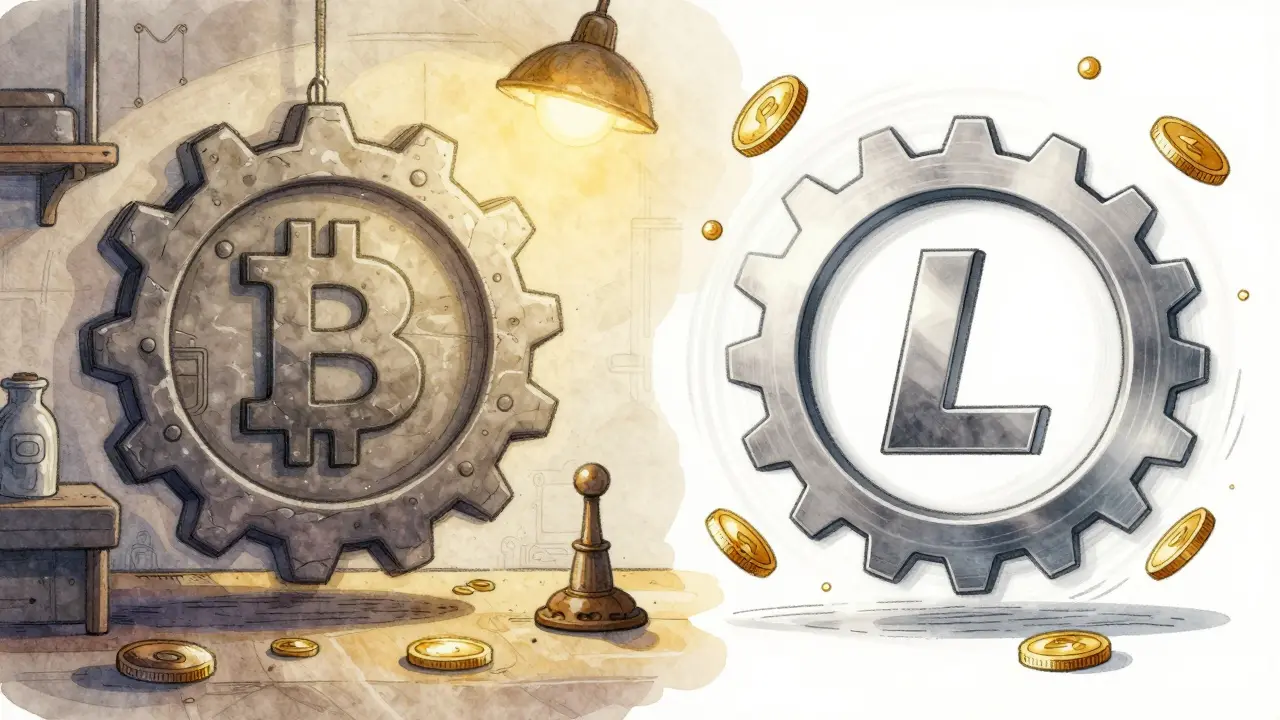
You can't talk about Litecoin's halving without mentioning how it actually works under the hood. Unlike Bitcoin, which uses a heavy-duty algorithm called SHA-256, Litecoin uses the Scrypt algorithm. This is a crucial distinction because Scrypt is designed to be more memory-intensive and less reliant on raw computing power. This makes the network more flexible and accessible.
Because the Scrypt algorithm allows for much faster processing, Litecoin blocks are generated every 2.5 minutes. Compare that to Bitcoin's 10-minute wait. Because blocks come so much faster, Litecoin needs a much larger number of blocks (840,000) to reach the same four-year halving window that Bitcoin hits in only 210,000 blocks. This speed is why many people prefer Litecoin for daily payments-it's simply faster to confirm.
Tracking the Reward Drop: The Math of Scarcity
The reward reduction isn't random; it's a mathematical certainty. Since 2011, we've seen a steady decline in what miners earn per block. This process won't stop until the very last Litecoin is mined, which isn't expected to happen until roughly the year 2142.
- Launch (2011): 50 LTC per block.
- First Halving (2015): Reward dropped to 25 LTC.
- Second Halving (2019): Reward dropped to 12.5 LTC.
- Third Halving (August 2, 2023): Reward dropped to 6.25 LTC.
Every time this happens, exactly 1% of the total maximum supply of coins is reached. For an investor, this is the "scarcity engine." For a miner, it's a moment of truth. If your electricity costs are too high or your hardware is outdated, a halving can suddenly turn your profitable mining rig into a very expensive space heater.
How Halvings Affect the Market and Miners
There's always a lot of hype leading up to a halving. Traders often gamble on a "post-halving pump," where the price spikes because the supply has tightened. However, real-world data is a bit messier. Market sentiment, global economic shifts, and investor behavior usually have a bigger impact on the price than the halving event itself.
For those actually running the hardware, the impact is immediate. When the reward drops from 12.5 to 6.25 LTC, the revenue per block is cut by 50% instantly. Research from groups like TokenMetrics suggests this creates a natural selection process. Inefficient miners-those using old gear or expensive power-get pushed out of the network. This leaves behind the most dedicated, efficient operators, which can actually make the overall network more stable and secure over the long run.
Interestingly, some might think miners would panic-sell their coins to cover costs after a halving. But according to SpectroCoin research, miners often do the opposite. They tend to hold (or "HODL") their rewards, betting that the scarcity created by the halving will eventually push the price higher, making their reduced rewards more valuable in the future.

Litecoin vs. Other Crypto Halvings
While Litecoin is a prime example, it's not alone. Many coins based on the Proof-of-Work model use similar schedules. The big difference usually lies in the timing and the algorithm. Bitcoin is the "gold standard" for this model, focusing on extreme security and slow, steady growth. Litecoin positions itself as the "silver"-faster, more agile, and better for smaller, frequent transactions.
The predictability of these events is their greatest strength. In traditional finance, a central bank might decide to print trillions of dollars overnight, which eats away at your purchasing power. With crypto halvings, the rules are written in the code. No one can decide to "print more" Litecoin to bail out a failing project. This transparency is exactly why institutional investors are becoming more interested in these digital assets; they can model the supply for the next decade with 100% accuracy.
Preparing for Future Cycles
If you're looking ahead, the next big Litecoin event is expected around 2027. If you're a miner, the strategy is simple: efficiency is everything. You need to monitor your hash rate and power consumption constantly. If you're an investor, the key is to ignore the short-term noise. The halving is a long-term macroeconomic tool, not a magic button for instant profits.
Understanding these cycles requires a bit of a learning curve. You have to wrap your head around mining economics and how supply-demand curves work in a digital environment. But once you get it, the entire map of the cryptocurrency market starts to make sense. It's not just random price swings; it's a series of programmed economic shifts designed to ensure the network lasts for centuries.
Does every crypto halving guarantee a price increase?
No. While the theory says lower supply should lead to higher prices, it only works if demand stays the same or increases. If the overall market is in a crash or people lose interest in the coin, the price can drop even after a halving. It's a factor in the price, not the only driver.
What happens when there are no more coins to mine?
Once the maximum supply is reached (around 2142 for Litecoin), miners will no longer receive newly minted coins. Instead, they will be compensated entirely through transaction fees paid by users. This ensures the network stays secure even after the inflation phase ends.
Why does Litecoin halve every 840,000 blocks instead of 210,000?
Because Litecoin produces blocks much faster (every 2.5 minutes) than Bitcoin (every 10 minutes). If Litecoin used 210,000 blocks, it would halve every year instead of every four years. The higher block count keeps the four-year cycle consistent with Bitcoin.
Is Litecoin mining still profitable after the 2023 halving?
It depends on your hardware and electricity costs. For those with high-efficiency Scrypt miners and cheap power, it remains profitable. However, smaller operations with older gear likely saw their margins disappear, forcing them to upgrade or shut down.
What is the difference between a halving and a burn?
A halving slows down the creation of new coins (reducing inflation). A "burn" is when existing coins are intentionally sent to an inaccessible address to remove them from circulation entirely (reducing total supply). Halving is about production; burning is about destruction.
Comments
Gloris Young
Super helpful breakdown of how the cycle works!
April 22, 2026 AT 14:30
Greg Reynolds
The comparison between BTC and LTC is a bit simplistic. People forget that network effects matter far more than the block time or the specific algorithm used. While the math is certain, the utility of Litecoin as 'silver' is a narrative pushed by marketers, not an organic economic reality.
April 22, 2026 AT 22:17
Candace Sherrard
It's fascinating to think about the long-term trajectory of these systems and how we are essentially trusting a mathematical blueprint designed over a decade ago to govern the future of value, which really makes you wonder if the human element of volatility will ever truly be superseded by the elegance of the code.
April 24, 2026 AT 17:45
Robert Mosolygo
Of course the article ignores the obvious fact that these halving events are perfectly timed to allow whales to shake out the retail investors. The scarcity is artificial and designed to keep the masses in a cycle of hope and despair while the institutional players manage the liquidity behind the scenes. It's all a game of musical chairs.
April 25, 2026 AT 18:01
Benjamin Forg
who do u think actually controls the hash rate anyway its probably all run by the same three shadow companies pretending to be competitors just to lure us into a fake scarcity trap
April 26, 2026 AT 08:50
Yvette P
Oh honey, let's get real about the 'scarcity engine' here. While the author is painting a rosy picture of supply and demand, they're totally glossing over the hash rate volatility and the brutal reality of Scrypt's ASIC dominance. It's not just 'old gear' getting pushed out; it's the total annihilation of the small-time hobbyist by industrial-scale mining farms that optimize every single milliwatt of power. The 'democratic' nature of the early days is long gone, replaced by a hyper-efficient corporate oligarchy that laughs at your little home rig. But sure, let's just call it 'natural selection' and pretend the market is this magical, fair machine that rewards the 'dedicated' operator instead of just the one with the biggest electricity contract in a province with subsidized power. Absolute comedy.
April 27, 2026 AT 07:18
Jennifer Taylor
They want us to believe the rules are set in stone so we don't look at who owns the most coins. It is all a trick to make us feel safe with the code.
April 28, 2026 AT 12:27
Hannah Rubia
I believe it is important to emphasize that for those new to the space, understanding the difference between inflation and the issuance rate is paramount. The halving doesn't necessarily stop inflation in the traditional sense, but it does ensure that the new supply of coins diminishes over time, which is a sophisticated way to manage the asset's longevity.
April 30, 2026 AT 01:24
Jagdish Sutar
This is a great way to explain these concepts to beginners. I always tell my students that the beauty of blockchain is this kind of transparency.
May 1, 2026 AT 01:11
Alex Wan
Oh my goodness, this is such a marvelous explnation!! I am absolutly thrilled to see such clairy on a complex topic. We must all embrase this technolgy together as a community to ensure no one is left behid in the digital revolution! It is truly a dramatic shift in how we perceive money!!
May 1, 2026 AT 20:57
Mike Krasner
lol imagine thinking a 2.5 min block time is actually a big deal when you consider the latency of the rest of the web totally irrelevant
May 3, 2026 AT 09:55
Mary Tawfall
I love how predictable the cycle is. It gives a sense of stability to an otherwise chaotic market.
May 3, 2026 AT 17:06
debashish sahu
The comparison to gold and silver is very interesting and helps in understanding the positioning of these coins in a global context.
May 3, 2026 AT 23:08
Gary Lingrel
Everyone just chasing pumps is so sad :( it's about the ethics of decentralized money not the price chart
May 4, 2026 AT 17:45
Tara Aman
Let's keep the positive energy going! This knowledge is exactly what we need to stay ahead of the curve!
May 5, 2026 AT 21:14
Eric Raines
I've seen this cycle a dozen times and it's always the same people thinking they've found a loophole. The math doesn't lie, but people do. If you think the halving is a 'magic button' for profit, you're exactly the kind of exit liquidity the whales are looking for.
May 7, 2026 AT 01:22
Alex Hunter
It's worth mentioning that the shift to transaction fees as the primary reward in 2142 will require a very high volume of network activity to keep miners incentivized. It's a bold bet on the future utility of the coin.
May 7, 2026 AT 12:42
Sarah Fisher
There is a certain poetic beauty in the idea of a system that slowly winds down its own creation process. It mirrors the natural lifecycle of many things in the universe, moving from a burst of initial growth to a steady state of maintenance. It suggests that the ultimate goal isn't endless expansion, but rather a sustainable equilibrium where the network exists for its own sake rather than for the reward of those who build it.
May 8, 2026 AT 22:57