
Ever tried sending Ethereum and got hit with a $50 fee for a $10 swap? You’re not alone. Ethereum gas fees have frustrated users since day one - and for good reason. They’re the price you pay to get your transaction processed on the network, but most people don’t know how they’re calculated, why they spike, or how to avoid overpaying. The good news? It’s not magic. It’s math. And once you understand it, you can save money, avoid failed transactions, and move with confidence.
What Exactly Are Ethereum Gas Fees?
Ethereum gas fees are payments made in ETH to validators who process and secure your transactions. Think of them like tolls on a highway - every time you want to move something on the Ethereum network - whether it’s sending ETH, swapping tokens, or interacting with a smart contract - you need to pay for the computational work involved.
These fees weren’t always this way. Before August 2021, Ethereum used a first-price auction system. Users would bid against each other, hoping their higher fee would get their transaction included first. That led to wild swings - fees jumped from $1 to $50 overnight during NFT drops or DeFi rushes. People were paying more in fees than the value of their transaction.
The London Hard Fork, also known as EIP-1559, changed all that. It introduced a new structure: a base fee and an optional priority fee. The base fee is automatically calculated by the network based on demand. It’s burned - destroyed - which reduces the total supply of ETH over time. As of May 2025, over 2.7 million ETH (worth roughly $5.4 billion at $2,000 per ETH) have been burned thanks to this system.
How Gas Fees Are Calculated
The formula is simple: (Base fee + Priority fee) × Gas limit = Total fee.
- Base fee: This adjusts every block. If the network is busy, it goes up by up to 12.5%. If it’s quiet, it drops by the same amount. The target is 30 million gas per block. When blocks are full, the base fee rises. When they’re empty, it falls. You can’t control it - the network does.
- Priority fee (also called a tip): This is what you add to get your transaction processed faster. During normal times, 1-5 gwei is enough. During a busy NFT mint, you might need 150+ gwei. Validators get this money - it’s their incentive to include your transaction.
- Gas limit: This is the maximum amount of computational work your transaction is allowed to use. A simple ETH transfer uses 21,000 gas. A DeFi swap? Maybe 100,000. A complex NFT mint? Could be 300,000 or more. If you set it too low, your transaction fails and you still pay the fee. If you set it too high, you only pay for what’s used.
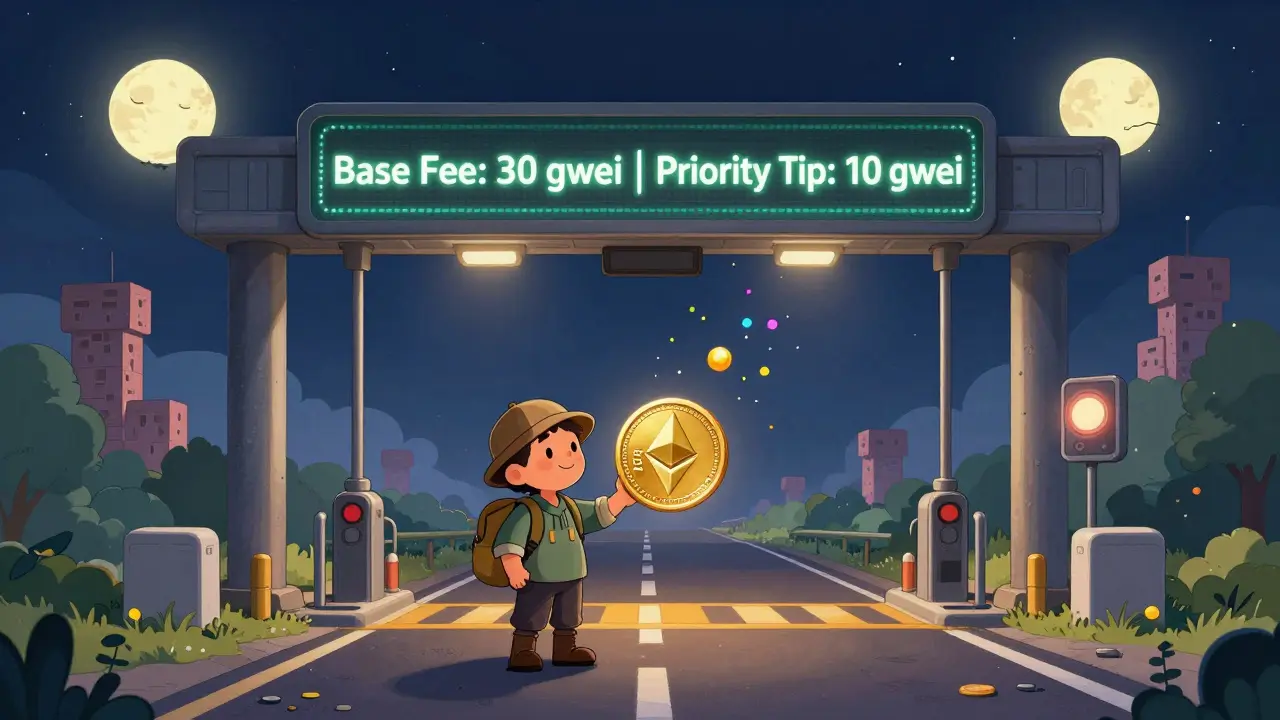
Example: You send 0.5 ETH. Base fee = 30 gwei. Priority fee = 10 gwei. Gas limit = 21,000.
Total fee = (30 + 10) × 21,000 = 840,000 gwei = 0.00084 ETH. At $2,000 per ETH, that’s about $1.68.
Important: Even if your transaction fails - say, you try to swap a token you don’t own - you still pay the full gas fee. That’s by design. It stops people from spamming the network with fake transactions.
Why Gas Fees Still Spike - Even After EIP-1559
EIP-1559 made things better, but it didn’t fix everything. During peak events, like the 2023 NFT minting frenzy, gas fees hit 350 gwei. At $2,000 ETH, that meant a simple transfer cost $7. On Reddit, users reported paying $47 in fees for a $30 token swap during an NFT drop. That’s not a bug - it’s a feature of demand.
The base fee can’t rise beyond a certain point without causing blocks to empty out. But when demand overwhelms the system, the priority fee becomes the only way to get through. That’s why you still see people scrambling to set high tips.
Experts agree: EIP-1559 reduced the mental burden of gas estimation by about 90% for average users. But during extreme congestion, the system still feels broken. Ethereum co-founder Vitalik Buterin said in 2023 that the system now feels “predictable,” but protocol fellow Tim Beiko admitted in early 2024 that fee dynamics during spikes still need work.

How to Pay Less - Real Strategies
You don’t have to overpay. Here’s how to cut your gas costs:
- Time your transactions. The busiest hours are 12:00-18:00 UTC (when Europe and the US overlap). The quietest? 2:00-8:00 UTC. A study of 2.1 million transactions in early 2025 showed fees dropped 35-60% during off-peak hours.
- Use gas trackers. Etherscan’s Gas Tracker, Blocknative, or ETH Gas Watch give real-time data. Don’t guess. Check before you send.
- Let your wallet estimate. MetaMask, Trust Wallet, and others auto-calculate fees. Consensys found their estimates are accurate 82-89% of the time in early 2025. You can adjust the priority fee manually if you’re in a hurry.
- Use Layer 2s. Platforms like Optimism, Arbitrum, and Polygon process transactions off Ethereum’s main chain. Fees there? Usually $0.01-$0.05. That’s 97-99% cheaper than mainnet. Most DeFi apps now support them. Switching is as easy as connecting a different network in your wallet.
- Use gas tokens (advanced). Tokens like CHI or GST2 let you buy gas when it’s cheap and use it later when it’s expensive. You lock in a discount. This is for experienced users - it’s complex, but can save 20-35% on high-volume activity.
One user on Christmas Day 2024 paid just $0.08 to send ETH. That’s the power of timing.
What’s Next? The Road to Cheaper Fees
Ethereum isn’t done improving. The Prague hard fork, expected in Q3 2025, will introduce EIP-4844 - also called “blob transactions.” This will let Layer 2s bundle data more efficiently, slashing their costs by 10 to 100 times. That means even cheaper swaps, NFT mints, and DeFi trades.
Looking ahead, Ethereum’s roadmap includes sharding - splitting the network into 64 parallel chains - expected in 2026. That could reduce mainnet fees by 90%. By 2027, analysts predict 80% of Ethereum transactions will happen on Layer 2s, making mainnet fees a rare concern.
But there’s a risk. If fees drop too low, validators might earn too little to stay secure. Ethereum researcher Danny Ryan warned in early 2025 that a “tragedy of the commons” could happen if the network becomes too cheap to maintain. The system must balance affordability with security.

Why Ethereum Still Wins - Even With High Fees
Yes, Solana and Polygon charge pennies. But Ethereum still holds 63% of all value locked in DeFi and 58% of developer activity. Why? Because it’s the most secure, most battle-tested smart contract platform. People pay more for reliability.
Regulators agree. In March 2024, the SEC clarified that gas fees are “network maintenance costs,” not investment contracts. That gave institutions the green light to build on Ethereum without legal risk.
Most users still complain - 63% of Reddit comments from January 2024 to March 2025 were negative about gas fees. But among users with two or more years of experience, 41% say EIP-1559 made things noticeably better. The pain is real, but the progress is real too.
Final Thoughts: Gas Fees Are a Feature, Not a Bug
Ethereum gas fees aren’t broken. They’re working exactly as designed. They protect the network. They fund security. They prevent spam. And now, thanks to EIP-1559, they’re far more predictable than ever.
The goal isn’t to eliminate fees - it’s to make them fair, transparent, and manageable. With Layer 2s, better timing, and upcoming upgrades, you can now interact with Ethereum without fear of a $50 surprise.
Next time you send ETH, check the gas tracker. Wait for a quiet hour. Use a Layer 2 if you can. You’ll save money - and you’ll understand the system better than 90% of users.
Why do I have to pay gas fees even if my transaction fails?
Gas fees cover the computational work done by validators to process your transaction - even if it fails. This prevents malicious actors from flooding the network with fake or broken transactions. If you didn’t pay for failed attempts, attackers could crash the network for free. Paying for failure is a security feature.
What’s the difference between base fee and priority fee?
The base fee is set by the network and changes every block based on demand. It’s burned, not given to validators. The priority fee is a tip you add to encourage validators to include your transaction faster. You control the priority fee; the network controls the base fee.
Can I avoid Ethereum gas fees entirely?
Not on Ethereum’s main chain - but you can avoid them on Layer 2 networks like Optimism, Arbitrum, or Polygon. These platforms handle transactions off the main Ethereum chain and then settle them in batches. Fees on Layer 2s are often less than $0.05. Most wallets and DeFi apps now support them.
Is it better to set a high gas limit?
Setting a high gas limit doesn’t make your transaction faster - it just means you might pay more if you overestimate. Your wallet will only charge you for the gas actually used. But if your limit is too low, your transaction will fail and you’ll still lose the fee. Let your wallet estimate, or check the average gas usage for similar transactions on Etherscan.
How do I know if my gas fee is too high?
Compare your estimated fee to real-time data from Etherscan’s Gas Tracker or Blocknative. If your priority fee is over 50 gwei during normal hours, you’re probably overpaying. If it’s under 5 gwei and the network isn’t busy, you’re likely fine. During NFT mints or major events, higher fees are normal.
Will Ethereum gas fees ever disappear?
No - and they shouldn’t. Gas fees are the economic engine that keeps Ethereum secure. Without them, there’s no incentive for validators to process transactions or protect the network. But they’re getting cheaper. Layer 2s and future upgrades like sharding will make them so low that most users won’t notice them.
Next Steps
If you’re new to Ethereum, start by using a Layer 2 like Arbitrum or Optimism for your daily swaps. It’s faster, cheaper, and just as secure. Use MetaMask’s built-in gas estimator - don’t guess. Check Etherscan’s Gas Tracker before sending anything. And if you’re doing a big transaction, wait until 3:00 AM UTC - you’ll thank yourself.
Experienced users should explore gas tokens and timing strategies. But remember: the goal isn’t to beat the system. It’s to work with it. Ethereum’s fee market is evolving - and you’re now equipped to move with it.
Comments
Deepu Verma
Really solid breakdown! I used to panic every time I sent ETH, but now I just check Etherscan before I hit send. Been saving like $3-4 per transaction just by waiting till 4 AM UTC. Game changer.
January 22, 2026 AT 14:34
MOHAN KUMAR
Layer 2s are the real win here. I do all my swaps on Polygon now. Fees are like 1 cent. Why pay $2 on mainnet when you can do it for free? Simple math.
January 23, 2026 AT 20:20
MICHELLE REICHARD
Let me guess-you people think EIP-1559 'fixed' gas fees? Please. It just made the system look cleaner while the rich still front-run everyone. Burned ETH? Cute. The real winners are the validators who still get tipped by desperate users. This is capitalism with a blockchain veneer.
January 23, 2026 AT 20:55
tim ang
Yessss! I just learned this last week and my wallet’s thanking me. I used to set gas limit to 500k like a dummy. Now I let MetaMask do it and save like 80% on swaps. Also, 3am is my new best friend. 😎
January 25, 2026 AT 08:33
Julene Soria Marqués
Wait… you’re telling me I’m supposed to *wait*? Like, for hours? And check a website? And not just slam send? That’s… a lot of effort. I thought crypto was supposed to be easy. This feels like a job.
January 25, 2026 AT 13:35
Bonnie Sands
They’re lying. The whole gas fee thing is a scam. They burn ETH to make it seem like supply is dropping, but they’re just hiding the real inflation-because the devs are printing more ETH behind the scenes. I’ve seen the leaks. Trust me, this is a central bank in disguise.
January 26, 2026 AT 22:12
Jennifer Duke
Interesting. But honestly, if you’re still using Ethereum when Solana does the same thing for $0.001, you’re just emotionally attached to a dying system. America used to lead tech. Now we’re clinging to legacy infrastructure while the world moves on.
January 27, 2026 AT 04:27
Abdulahi Oluwasegun Fagbayi
Gas fees are the heartbeat of the network. Without cost, chaos. Without structure, collapse. The system is not broken. It is learning. We are learning with it. Patience is the first smart contract.
January 27, 2026 AT 17:54
Andy Marsland
Okay, let’s be real here. You people are all missing the forest for the trees. EIP-1559 didn’t fix gas fees-it just moved the pain from the front end to the back end. The base fee is still volatile, and the priority fee? That’s just a bribe system with a fancy name. And don’t even get me started on how Layer 2s are just centralized proxies with fake decentralization. You think Arbitrum is safe? It’s backed by a VC fund. The real Ethereum is the one with the highest security, the one with the most miners-wait, validators-uh, the one that’s actually decentralized. And guess what? It’s not the one with the lowest fees. It’s the one that still makes you sweat. And that’s the one worth using. If you’re not uncomfortable, you’re not doing it right.
January 29, 2026 AT 15:08
Anna Topping
It’s funny how we treat gas like a tax, but really it’s just the universe charging us for existing on the blockchain. Like paying rent to the digital gods. I don’t know why I keep doing this. But I do. Because it feels… meaningful. Even when I lose $5 on a failed swap.
January 30, 2026 AT 03:02
Jeffrey Dufoe
Thanks for this. I didn’t know about the off-peak hours. Just tried it and paid $0.22 instead of $3.50. That’s a win.
January 30, 2026 AT 06:42
Arielle Hernandez
While the technical breakdown is accurate, I must emphasize the broader socio-economic implications. The normalization of gas fees as a ‘necessary evil’ reinforces a neoliberal paradigm wherein users are expected to self-optimize for systemic inefficiencies. The burden of transactional literacy is disproportionately placed on retail participants, while institutional actors exploit MEV and front-running with algorithmic precision. The promotion of Layer 2s as a panacea obscures the centralization risks inherent in rollup operators-many of whom are venture-backed entities with opaque governance. True decentralization cannot be achieved when users are incentivized to migrate away from the base layer in search of affordability. The solution is not individual optimization, but collective re-engineering of the incentive structure to prioritize equitable access over technical elegance.
January 30, 2026 AT 19:34
katie gibson
OMG I just realized I’ve been paying $20 to send ETH for a year?? I thought that was just how it was. Like, I thought my wallet was broken or something. I feel so dumb. I’m gonna cry now. And also… I’m switching to Polygon. Bye, Ethereum. I’m not mad. Just disappointed.
January 31, 2026 AT 10:42