
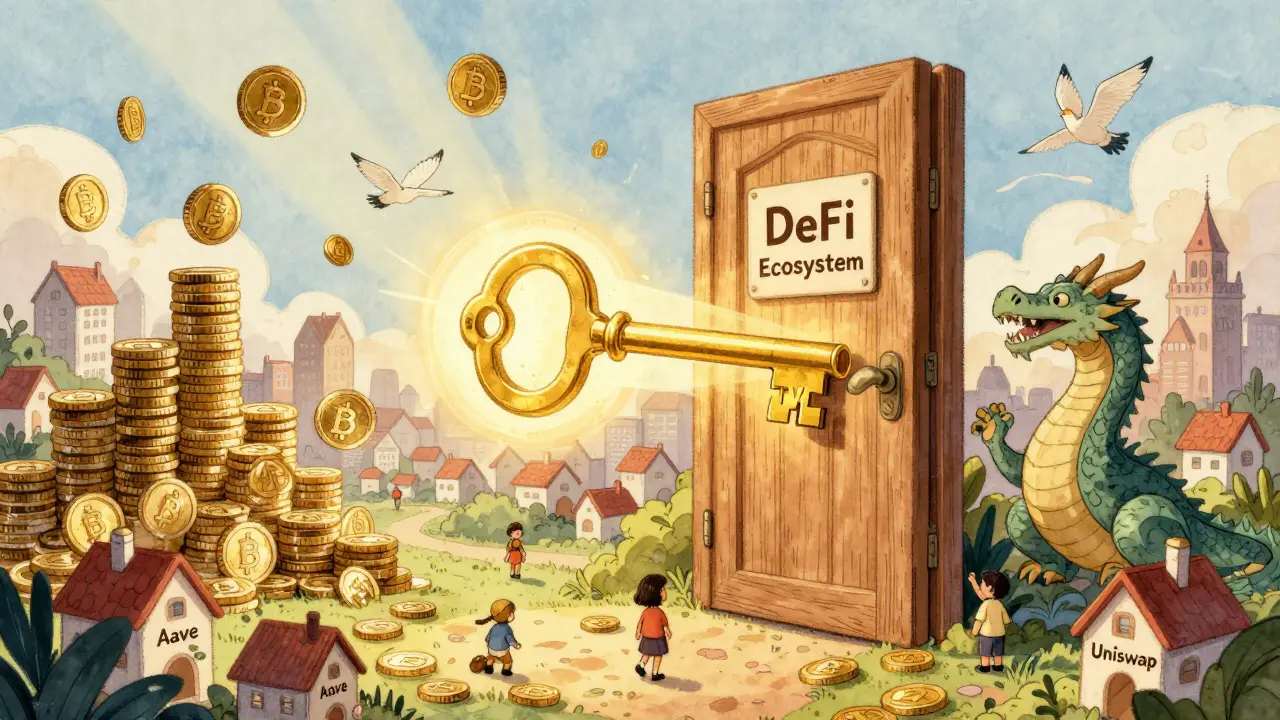
When you hear "Top DeFi protocols," what comes to mind? Probably big names like Uniswap or Aave. But behind those names is a number that actually tells the real story: Total Value Locked (TVL). TVL isn’t just a buzzword - it’s the heartbeat of DeFi. It shows how much money real users have put into protocols to earn yield, borrow, trade, or stake. As of March 2026, the entire DeFi ecosystem holds around $158 billion in TVL, up from $142 billion just six months ago. That’s not growth - that’s momentum. And the top five protocols account for nearly half of it.
Why TVL Matters More Than You Think
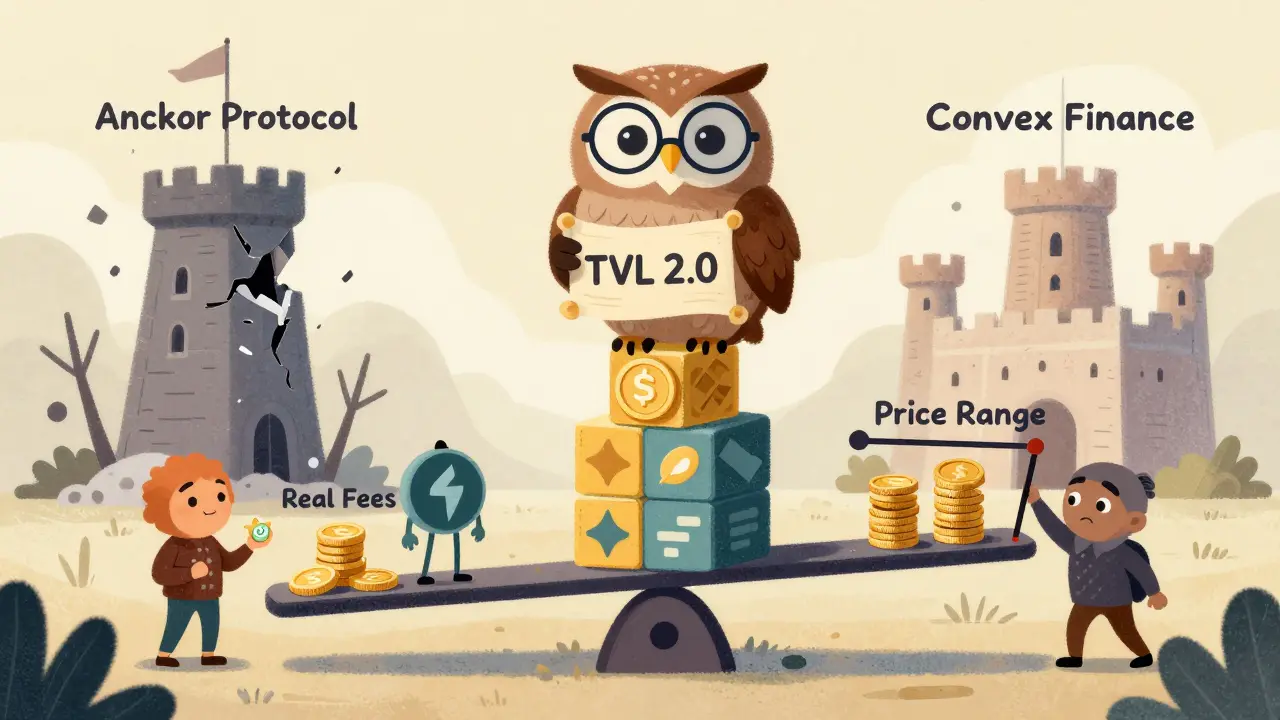
TVL measures the total value of crypto assets locked in smart contracts. Think of it like a bank deposit, but instead of a bank, it’s a piece of code running on a blockchain. When you stake ETH on Lido, deposit USDC on Aave, or provide liquidity on Uniswap, that money gets counted in TVL. It’s not about speculation - it’s about active use. A protocol with $10 billion in TVL has more real users, more trust, and more economic activity than one with $100 million.But TVL isn’t perfect. It doesn’t tell you if the money is earning real fees or just chasing temporary rewards. In 2024, Anchor Protocol’s TVL spiked to $4 billion because it offered 20% APY - unsustainable, and it collapsed within months. Today, smart users look beyond TVL. They ask: Is this protocol generating real revenue? Is the capital locked long-term? Are the security audits solid?
Lido: The Liquid Staking Giant
Lido leads the pack with $14.7 billion in TVL as of March 2026. That’s more than the entire Binance Smart Chain ecosystem. How? It solved a major problem: staking ETH used to mean locking your coins for months, with no way to use them elsewhere. Lido changed that. When you stake ETH with Lido, you get stETH - a token that represents your staked ETH and can be traded, lent, or used in other DeFi protocols.Over 32% of all ETH staked on Ethereum now flows through Lido. That’s not luck - it’s design. Lido works across Ethereum, Polygon, and Solana, and its fee structure is simple: just 10% of staking rewards go to operators, with the rest going to users. After Ethereum’s Pectra upgrade in May 2025, staking fees dropped 37%, making Lido even more attractive. Users give it a 4.6/5 rating on DeFiYield, praising how easy it is to get started. But there’s a catch: stETH isn’t always pegged 1:1 to ETH. During the March 2024 banking crisis, it briefly dropped 4% below parity. That scared some users, but most stayed because the long-term upside outweighed the risk.
Aave: The Lending Powerhouse
Aave sits at $5.1 billion in TVL, making it the second-largest lending protocol. Unlike older platforms like Compound, Aave doesn’t just let you lend and borrow. It lets you delegate credit - meaning someone else can borrow using your collateral without touching your funds. This feature alone cut bad debt by 78% during the 2024 market crash, according to DeFi Safety’s audit.Aave runs on nine blockchains, from Ethereum to Base and Arbitrum. Its v4 upgrade, rolling out in late 2026, will unify all these pools into one system, reducing capital fragmentation. Users appreciate the flexibility - you can deposit USDC and borrow ETH, or deposit WBTC and earn interest in DAI. The downside? Gas fees on Ethereum can be steep. On average, Aave users pay 21% more in transaction costs than Compound. That’s why many now use Aave on Layer 2 chains like Polygon, where fees are pennies.
MakerDAO: The Stablecoin Engine
MakerDAO’s Sky protocol holds $5.3 billion in TVL, mostly from users locking collateral to mint DAI - the world’s first decentralized stablecoin. DAI is pegged to the US dollar and used everywhere: as collateral, as a payment tool, as a hedge against volatility. MakerDAO doesn’t just create DAI - it manages it. Its governance system adjusts borrowing rates dynamically. Right now, the rate is 5.8% annually, which is low compared to centralized lenders.But using MakerDAO isn’t for beginners. If ETH drops 35% in a day - like it did in January 2025 - your collateral can get liquidated if you didn’t set up enough buffer. Reddit’s r/MakerDAO has over 287,000 members, and 41% of them have lost funds due to poor risk management. The protocol’s documentation is solid, but the interface still feels clunky. If you want to use DAI, you need to understand collateral ratios, liquidation thresholds, and stability fees. It’s not magic - it’s math.
Uniswap: The Decentralized Exchange Leader
Uniswap V3 has $3.4 billion in TVL. That’s not because people are holding tokens there - it’s because they’re providing liquidity. Uniswap lets users become market makers. You deposit two tokens - say, ETH and USDC - and earn fees every time someone trades between them. Uniswap’s "concentrated liquidity" model lets you focus your capital within a price range, making it 40x more efficient than older versions.It processes $18.7 billion in trading volume every month. That’s more than most centralized exchanges. But here’s the catch: 68% of new users fail to set their price ranges correctly. If the market moves outside your range, your liquidity stops earning fees. Reddit’s r/Uniswap community has thousands of posts from users who lost money because they didn’t understand how to set ranges. It’s powerful, but it’s not beginner-friendly. Professionals love it. Beginners? They often get burned.
Curve Finance: The Stablecoin Swap Specialist
Curve holds $2.3 billion in TVL, and it’s all about one thing: swapping stablecoins with minimal slippage. If you need to turn USDC into DAI or FRAX into USDT, Curve is the go-to. Its fees are just 0.04%, compared to Uniswap’s 0.3%. It’s designed for efficiency, not speculation.Curve’s secret sauce? Convex Finance. Over 73% of Curve’s revenue comes from Convex, which lets users lock their Curve tokens to earn extra rewards. This creates a feedback loop: more liquidity → more fees → more rewards → more liquidity. But users complain. Trustpilot reviews show Curve has the lowest rating among top DeFi protocols at 3.8/5. Why? "Impermanent loss" confusion. Many don’t understand that when prices move, their deposited assets can lose value - even if they’re earning fees. Curve’s documentation is full of math equations, not plain English. It’s a pro tool, not a casual one.

What’s Missing from the Top 5
You won’t find EigenLayer here - yet. It’s at $3.8 billion and growing fast. EigenLayer lets stakers "restake" their ETH to secure other protocols, like Oracles or Bridges. It’s like letting your staked ETH do double duty. But it’s risky. The Ethereum Foundation warned in Q1 2025 that restaking introduces new slashing risks - if one protocol fails, your entire stake could be penalized. It’s innovation with teeth.JustLend on Tron? It had $3.7 billion in TVL last year. Now it’s at $1.1 billion. Why? Tron’s USDT depegged in 2024. Users fled. It’s a lesson: don’t put all your money on one chain.
How to Use This Info
Don’t just chase the highest TVL. Ask yourself:- Is this protocol earning real fees, or just handing out tokens?
- Is my money locked on one chain - and what happens if that chain crashes?
- Do I understand the risks? (Liquidations? Impermanent loss? Oracle failures?)
Use tools like Zapper.fi to see your total exposure across all protocols. It’s the easiest way to avoid overexposure. And never stake more than you can afford to lose - especially in restaking or leveraged positions.
The Future of TVL
TVL is evolving. In 2026, platforms like DefiLlama and CoinGecko now include "TVL 2.0" scores - which measure revenue, user growth, and security spending. The top 14 protocols are trading below their intrinsic value because they generate more fees than they pay out. But 69% of all protocols still burn more than they earn. That’s a red flag.Regulation is tightening. The SEC classified 12 DeFi protocols as unregistered exchanges in early 2025. That caused $18.3 billion to shift to non-custodial platforms. Institutional money is coming in - BlackRock’s BUIDL fund now holds $10.2 billion in tokenized assets. That’s 7.2% of DeFi’s total TVL.
By 2027, liquid staking could make up half of all TVL. But if yields drop and users stop earning, the whole house of cards could wobble. The next big test? Sustainability. Not size.
What does TVL mean in DeFi?
TVL stands for Total Value Locked. It’s the total amount of cryptocurrency deposited into a DeFi protocol’s smart contracts. This includes assets used for lending, staking, liquidity pools, and more. TVL is measured in USD and updated in real-time using price oracles from Chainlink or Pyth Network. It’s the most common metric to measure how popular and trusted a DeFi protocol is.
Is a higher TVL always better?
Not always. A high TVL means lots of money is locked in, but it doesn’t mean the protocol is safe or sustainable. Some protocols artificially inflate TVL by offering unsustainable rewards - like Anchor Protocol did in 2023. Smart users look beyond TVL to see if the protocol earns real fees, has strong security audits, and keeps capital locked long-term. TVL is a starting point, not the whole story.
Which DeFi protocol has the highest TVL in 2026?
As of March 2026, Lido leads with $14.7 billion in TVL. It dominates because it allows users to stake Ethereum (ETH) and receive stETH, a liquid token that can be used in other DeFi apps. Lido’s cross-chain support and low fees make it the most popular staking option on Ethereum and beyond.
Why is Aave’s TVL lower than Lido’s?
Aave’s TVL is lower because it’s a lending protocol, not a staking one. Lido benefits from Ethereum’s massive user base and the demand for liquid staking. Aave’s $5.1 billion TVL still makes it the second-largest lending protocol, but lending requires more active management - users need to deposit collateral and manage interest rates. Staking is simpler, so more people choose it.
Can TVL be manipulated?
Yes. TVL can be inflated by short-term yield farming campaigns where users deposit assets just to earn bonus tokens, then withdraw them immediately. This is called "mercenary capital." Some protocols also use fake oracles to overstate asset prices. That’s why reputable platforms like DefiLlama now use multi-oracle validation and track revenue over time. Always check if a protocol’s TVL is supported by real usage, not just temporary rewards.
Should I invest based on TVL alone?
No. TVL tells you how much money is in a protocol, but not whether it’s safe, sustainable, or well-managed. Always check: Has it been audited? Are fees higher than costs? Is the team transparent? Does it have a clear roadmap? Many high-TVL protocols collapsed in 2022-2024 because they didn’t earn enough to cover expenses. TVL is a signal - not a guarantee.
Comments
Lorna Gornik
Lido's stETH is wild 🤯 I mean, who knew staking could be this chill? I started with 2 ETH and now I'm using it in 5 different protocols. It's like giving your crypto a vacation and a side hustle.
Also, Curve's 0.04% fee? That's cheaper than my coffee. Why are people still using Uniswap? 😅
March 22, 2026 AT 03:53
Mike Yobra
TVL is just a vanity metric wrapped in blockchain glitter.
Remember when Anchor Protocol had $4B and everyone called it "the future"? Then it imploded like a soggy soufflé.
People treat TVL like it's GDP. Nah. It's more like a high school popularity contest where the kid with the most snacks gets crowned king.
Real value? That's revenue. Security audits. User retention. Not how many mercenaries show up for a 100% APY buffet.
March 22, 2026 AT 08:52
Dheeraj Singh
Lido? Please. You think it's safe? What happens when Ethereum goes full centralization? Lido's got 32% of all staked ETH. That's not decentralization - that's a single point of failure with a fancy UI.
And don't even get me started on stETH not being pegged. That's not a bug - it's a feature of the whole system being a house of cards.
Real DeFi isn't about staking your ETH and calling it a day. It's about owning your keys, not trusting some DAO with a Discord mod.
March 23, 2026 AT 23:47
manoj kumar
You guys act like TVL is some holy grail. Bro. Look at MakerDAO. $5.3B TVL and 41% of Reddit users have lost money.
That's not a protocol - that's a financial trap with a whitepaper.
And Curve? They charge less than Uniswap? Yeah, because they're not trying to make money - they're trying to make you lose money through impermanent loss while you think you're "earning fees."
Real DeFi users don't chase TVL. They chase revenue. They check audits. They read the docs. Most of you? You just copy-paste from DeFiLlama and pray.
March 25, 2026 AT 10:40
John Alde
I appreciate the breakdown - especially the note about TVL 2.0 metrics. Most people don't realize that a protocol generating $200M in fees with $1B TVL is far more sustainable than one with $3B TVL and $5M in fees.
Also, the point about Layer 2 usage for Aave is critical. Gas fees on Ethereum are still a massive friction point. The fact that 60% of Aave’s volume now happens on Arbitrum and Polygon? That’s where the future is.
And MakerDAO’s interface? Yeah. It’s like using a 2008 Windows XP computer built by engineers who hate humans. But the underlying mechanism? Brilliant. Just needs UX love.
March 25, 2026 AT 23:25
Mansoor ahamed
Aave v4 unifying pools? That’s huge. Fragmented capital is the silent killer of DeFi.
Same with EigenLayer - restaking is the next frontier. It’s not about staking ETH anymore. It’s about staking ETH to secure *other* protocols. That’s like renting out your house to host 10 different businesses.
But yeah, slashing risk is real. One bad oracle, one buggy bridge, and your whole stake gets wiped. No safety net.
DeFi isn’t banking. It’s frontier law. You gotta read the fine print. Always.
March 26, 2026 AT 08:08
vu phung
Curve's Convex feedback loop is genius. It’s not just liquidity - it’s liquidity + incentives + governance power all in one.
And honestly? The "impermanent loss" confusion? That’s on the user. It’s not a flaw in Curve - it’s a flaw in DeFi education.
Most people think "stablecoin swap" means "no risk." Nope. It means "low risk, but still risk."
Same with Uniswap V3. If you don’t understand concentrated liquidity, you’re not a market maker - you’re a liquidity donor.
March 26, 2026 AT 17:37
Andrew Midwood
I’ve been using Lido since 2023. stETH dipped 4% once? I didn’t panic. I just kept holding. Now it’s 1.012 ETH.
And I use it in Aave to borrow DAI. Then I use that DAI on MakerDAO to mint more DAI. Then I deposit it back into Curve.
It’s not magic. It’s math. And it’s working.
Stop chasing hype. Start building systems. That’s real DeFi.
March 28, 2026 AT 07:44
Jenni Moss
Y'ALL. I JUST MADE MY FIRST DEFI TRADE AND I'M SO PROUD!!! 🥹💖
I deposited USDC on Aave, borrowed ETH, and staked it on Lido. Now I'm earning on BOTH sides!!!
My wallet went from $100 to $118 in 3 days. I'm basically a crypto genius now.
Who else is doing this?? Let's form a club!! 💫✨
March 29, 2026 AT 00:13
Annette Gilbert
Jenni, sweetie, you just did what 90% of new users do - and you’re lucky you didn’t get liquidated.
That 18% return? That’s not yield - that’s a trap. You’re earning interest on borrowed money, while your collateral sits in a protocol that could get slashed tomorrow.
DeFi isn’t a game show. It’s a battlefield. And you just walked in wearing flip-flops.
March 29, 2026 AT 19:29
Tammy Stevens
I love how everyone’s acting like DeFi is this complicated beast. It’s just money, but with more steps.
Use Zapper. Use Ledger. Don’t put all your eggs in one basket.
And if you’re using Curve or Uniswap? Read the docs. Actually read them. Not the Reddit summary. The real docs.
It’s not hard. It’s just… new. And new things scare people. But you don’t have to be scared. You just have to be careful.
March 30, 2026 AT 21:08
Joshua T Berglan
I’ve been in DeFi since 2021. I’ve lost money. I’ve made money. I’ve cried. I’ve celebrated.
The real win? Not TVL. Not APY. It’s learning. Understanding.
Every time I mess up, I learn. Every time I profit, I double-check.
DeFi isn’t about getting rich. It’s about becoming financially literate in a world that’s changing faster than your grandma’s Wi-Fi password.
March 30, 2026 AT 23:52
Kevion Daley
Lido? The most "decentralized" protocol that’s basically run by one VC-backed team with a 10-person DAO.
And Aave? Still on Ethereum. When L2s finally take over, Aave’s gonna look like a dinosaur with a credit card.
TVL is a mirror - it shows you what’s popular. Not what’s smart.
Real innovation? It’s happening on Solana. On Polygon. On Base. Not on the Ethereum graveyard.
April 1, 2026 AT 18:31
Florence Pardo
I just want to say - thank you for writing this. I’m not a coder. I don’t understand smart contracts. But I read this whole thing. Twice.
I used to think DeFi was just gambling with crypto. Now I see it as… a new kind of financial infrastructure.
It’s messy. It’s risky. But it’s also… real.
I’m still scared. But I’m learning. And that’s enough for now.
April 3, 2026 AT 05:40
Kevin Da silva
TVL is just a number. The real question: who controls the protocol?
Lido? DAO. Aave? DAO. MakerDAO? DAO.
But DAOs are just people. And people make mistakes.
Don’t worship the metric. Question the actors.
April 5, 2026 AT 00:53
Kayla Thompson
Of course Lido’s on top. It’s the only one that lets you stake without owning ETH. That’s not innovation - that’s financial cosplay.
And you people are drinking the kool-aid like it’s free water.
Wake up. This isn’t finance. It’s a cult with a whitepaper. The SEC’s coming. And when they do, all these "high TVL" protocols will vanish like smoke.
April 5, 2026 AT 12:16
Brijendra Kumar
You think Curve is bad? Try using EigenLayer.
Restaking means your ETH is now exposed to 17 different protocols. One oracle fails. One bridge gets hacked. Your entire stake gets slashed.
And guess what? No one warns you. The Discord is full of "YOLO" posts.
TVL is a lie. The real metric? How many people are about to lose everything tomorrow.
April 5, 2026 AT 23:48
Ananya Sharma
I don’t understand why people panic about stETH depegging.
It’s not supposed to be 1:1. It’s a derivative. Like a futures contract.
As long as Lido’s staking rewards are consistent and ETH’s value holds? It’ll normalize.
Most users treat DeFi like a stock market. It’s not. It’s a system. Systems have friction. That’s okay.
April 6, 2026 AT 20:48
Jeannie LaCroix
I’m a Black woman from Atlanta. I didn’t know crypto existed until 2022.
I read this whole thing. Took notes. Asked questions.
Now I have 0.5 ETH staked on Lido. I use DAI to pay my rent. I swap USDC for FRAX on Curve.
This isn’t just tech. It’s liberation.
To everyone who says "DeFi is too complicated" - you’re right. But so was learning to drive. So was learning to file taxes.
Don’t quit. Just learn.
April 7, 2026 AT 17:10
Justin Credible
just wanna say i started with 500 bucks and now i have 2 eth staked and i dont even know how but its kinda cool lol
April 8, 2026 AT 08:24
Nicolette Lutzi
TVL? LOL.
Who’s behind Lido? BlackRock?
Who’s behind MakerDAO? The Fed?
DeFi is a front. The same banks are just using blockchain to keep control.
You think you’re free? You’re just a pawn in a new game.
They want you to think you’re investing. You’re just feeding the machine.
April 8, 2026 AT 17:07
JOHN NGEH
I’ve been reading this whole thread. I’m quiet. I don’t comment often.
But I want to say - thank you.
To the people who are scared. To the people who are excited. To the people who are skeptical.
This isn’t about money. It’s about choice.
For the first time in history, someone in India can lend money to someone in Canada without a bank.
That’s not magic. It’s human.
And that’s worth protecting.
April 9, 2026 AT 00:54
Alicia Speas
I come from a country where banking is inaccessible to 60% of the population.
DeFi isn’t perfect. But it’s the first time I’ve seen technology give real financial power to people without papers, without IDs, without banks.
Yes, there are risks. Yes, there are scams.
But the alternative? Nothing.
This? This is progress.
April 9, 2026 AT 14:23
vu phung
I just want to add - if you’re using Zapper.fi, make sure you’re also checking the underlying protocols.
One of my positions looked "safe" on Zapper. Turned out, the liquidity pool was 80% a token that had no market cap.
TVL doesn’t tell you that.
Always trace the asset. Always ask: where is this money really going?
April 10, 2026 AT 15:14