
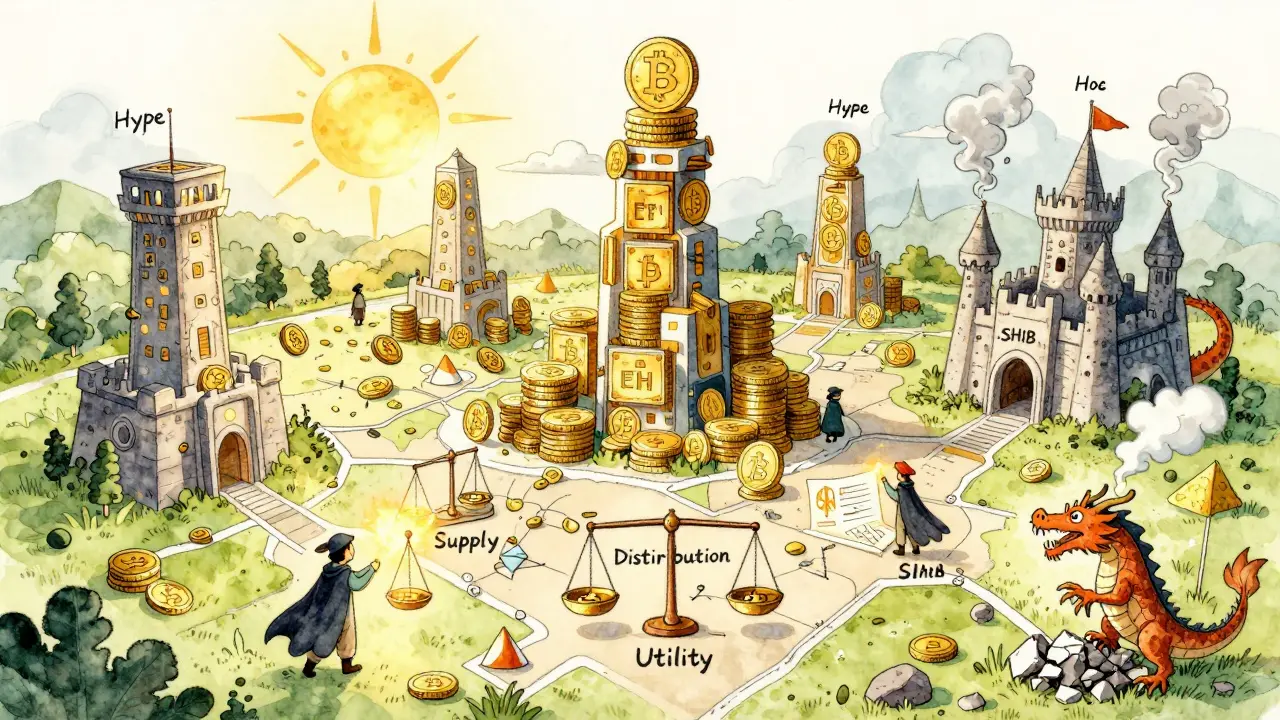
When you look at a cryptocurrency price chart, it’s easy to get caught up in the noise-up 20% today, down 15% tomorrow. But if you want to know whether a coin has real staying power, you need to look past the price and into its tokenomics. Tokenomics isn’t just a buzzword. It’s the economic engine behind every crypto project. It answers the question: Why does this token have value? And more importantly, will that value last?
What Exactly Is Tokenomics?
Tokenomics is short for "token economics." It’s the study of how a cryptocurrency’s supply, distribution, utility, and incentives are designed to create and sustain value. Think of it like analyzing a company’s financial statements before buying its stock. You don’t just look at the stock price-you check revenue, profit margins, debt, and cash flow. Tokenomics does the same for crypto, but instead of earnings reports, you’re examining blockchain data: how many tokens exist, who holds them, how they’re used, and what happens to them over time.There’s no single person who invented tokenomics. It evolved naturally as crypto projects moved beyond simple peer-to-peer payments. By 2018, hundreds of new tokens were launching every month, and investors started asking: "What’s the point of this coin? Why should I hold it?" Tokenomics became the framework to answer those questions.
Key Components of Tokenomics
Not all tokens are built the same. To evaluate them properly, you need to break them down into five core parts:- Total Supply: The maximum number of tokens that will ever exist. Bitcoin’s is fixed at 21 million. Ethereum has no hard cap, but its issuance rate dropped after the Merge.
- Circulating Supply: The number of tokens currently available to the public. This matters because it affects market cap. For example, Solana had 283 million tokens in circulation out of a 505 million max in late 2023.
- Market Capitalization: Price multiplied by circulating supply. A high market cap doesn’t mean much if the token is over-supplied. Shiba Inu has a $12 billion market cap, but with 589 trillion tokens in circulation, each one is worth less than a penny.
- Distribution: Who owns the tokens? If a project gives 40% to its team with no vesting, that’s a red flag. If 70% goes to community stakers and miners, that’s more sustainable.
- Utility: What can you do with the token? Does it pay for gas on the network? Can you stake it for rewards? Can you vote on governance? If it’s just a speculative asset with no real use, its value is fragile.
These five elements together tell you whether a token is built to last-or if it’s a house of cards.
Supply Dynamics: Scarcity vs. Inflation
One of the most powerful forces in tokenomics is supply control. Scarcity drives value. But not all scarcity is created equal.Bitcoin’s model is simple: 21 million coins, with mining rewards cutting in half every four years. The last Bitcoin won’t be mined until around 2140. This predictable, decreasing supply creates a deflationary pressure that many investors trust.
Ethereum took a different path. After the Merge in 2022, it started burning more ETH than it issued. In 2022 alone, over 3.3 million ETH were destroyed-equivalent to 1.4% of the total supply. That made Ethereum effectively deflationary for much of that year. By 2023, it had burned over 5 million ETH total. This isn’t just theory-it’s happening in real time, and it’s changing how people value ETH.
On the other side, Dogecoin has no supply cap. It adds 5 billion new coins every year. That’s inflation on steroids. Yet Dogecoin still trades at over $10 billion in market cap. Why? Because hype and community can override economics-for a while. But history shows that without utility or scarcity, hype fades fast.
Distribution: Who Really Owns the Tokens?
A token’s distribution is often the biggest clue to its future.Projects that give more than 25% of tokens to private investors with no vesting period have a 73% failure rate, according to Token Terminal’s 2020-2022 data. Why? Because when those investors cash out, they flood the market with sell pressure. You’ve seen this happen dozens of times: a token launches, pumps 300% in a week, then crashes 80% as early backers dump their coins.
Compare that to Aave. It allocated 30% of its tokens to its community treasury, 15% to its team with a four-year vesting schedule, and 10% to early users. The result? Aave’s token has held its value better than 80% of DeFi tokens since 2020.
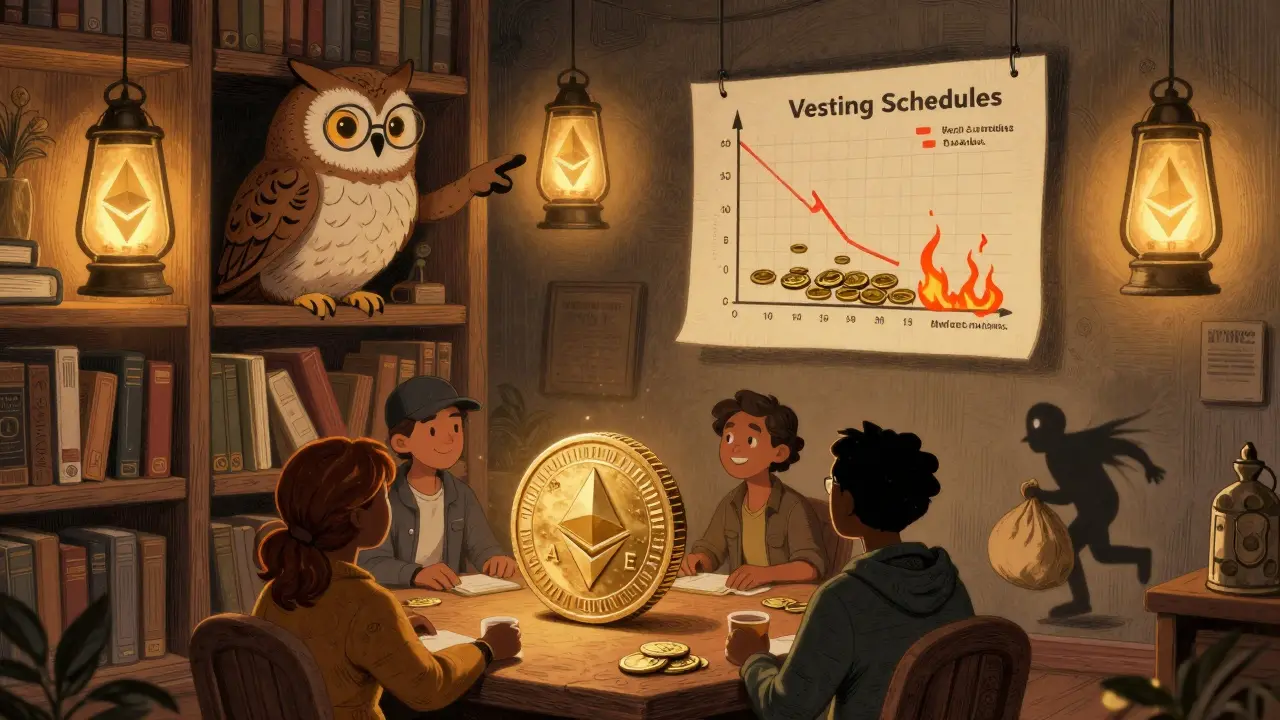
Even more telling: Coinbase’s 2023 research found that tokens with team allocations under 20% and vesting longer than two years had a 68% higher chance of surviving bear markets. That’s not luck. That’s design.
Utility: The Real Reason to Hold
A token without utility is just a digital collectible. Utility is what turns speculation into adoption.Ethereum’s utility is clear: you need ETH to pay for transactions on its network. In 2022, Ethereum processed $11.7 trillion in value through its smart contracts. That’s not just trading-it’s real economic activity.
Chainlink’s LINK token is used to pay node operators who provide real-world data to smart contracts. In 2022, those operators earned $487 million in fees. That’s not a bonus-it’s the core business model.
Uniswap’s UNI token lets holders vote on protocol upgrades. Over 117 governance proposals were voted on through September 2023. That’s decentralized decision-making in action.
Compare that to meme coins with zero utility. They rely entirely on social media hype. When the trend dies, so does the price. Tokenomics tells you which projects are building real systems-and which are just selling dreams.
Tokenomics in Action: Real Examples
Let’s look at three very different tokens and how their tokenomics shaped their fate:| Token | Total Supply | Circulating Supply (% of Total) | Supply Mechanism | Primary Utility | Team Allocation |
|---|---|---|---|---|---|
| Bitcoin (BTC) | 21 million | 94% | Fixed, halving every 4 years | Store of value, peer-to-peer payments | 0% (mined, not allocated) |
| Ethereum (ETH) | No cap | 98% | Deflationary (burning > issuance since 2022) | Gas fees, staking, smart contracts | 12% (vested over 4 years) |
| Shiba Inu (SHIB) | 589 trillion | 99.9% | Constant inflation (no burn) | None (speculative) | 45% to founders (no vesting) |
| Aave (AAVE) | 16 million | 95% | Deflationary (burn mechanism) | Governance, staking, lending | 15% (4-year vesting) |
| Chainlink (LINK) | 1 billion | 92% | Fixed, 15% annual staking rewards | Oracle network payments | 12% (4-year vesting) |
Notice the pattern? The most stable tokens have controlled supply, clear utility, and team allocations with long vesting. The weakest ones? High supply, no utility, and early dumps.
Red Flags in Tokenomics
Here are five warning signs that a token’s economics are broken:- Team gets more than 20% of tokens with less than two years of vesting.
- FDV (Fully Diluted Valuation) is over 10x the current market cap. That means almost all tokens haven’t been released yet-and when they are, they’ll crash the price.
- No burn mechanism and no supply cap. If tokens can be created forever, scarcity doesn’t exist.
- Utility is vague. "We’re building a metaverse" isn’t a use case. "We pay node operators in this token to deliver weather data" is.
- Over 15% of supply unlocks in the next 90 days. That’s a flood of sell pressure waiting to happen.
These aren’t opinions. They’re patterns backed by data from Token Terminal, Messari, and CoinGecko.
How to Analyze Tokenomics Yourself
You don’t need a finance degree to do this. Here’s a simple 3-step process:- Check the whitepaper. Look for sections on token allocation, inflation, and utility. If it’s missing, walk away.
- Use CoinGecko or CoinMarketCap. Look at circulating supply, FDV, and vesting schedules. If FDV is 12x the market cap, assume 80% of the price will drop when the rest of the tokens unlock.
- Verify utility. Go to the project’s blockchain explorer. Are people actually using the token? For Ethereum, check Etherscan. For DeFi projects, check how many transactions happen daily. If it’s under 10,000 per day, it’s not gaining traction.
Experienced analysts say it takes 8-12 weeks to get good at this. Start small. Pick one project. Study it. Then move to the next.
Why Tokenomics Matters More Than Ever
In 2021, people bought crypto because it was going up. In 2023, institutions started using tokenomics as a core part of their investment strategy. According to Messari’s 2023 report, 87% of professional crypto funds now have formal tokenomics reviews built into their process. That’s up from just 42% in 2020.Regulators are catching up too. The SEC’s crackdowns in 2023 forced projects to limit private sales to under 20% of total supply to avoid being classified as unregistered securities. That’s pushing projects toward fairer, more transparent models.
And retail investors? CoinGecko’s 2023 survey showed 63% now check token distribution before buying-up from 29% in 2021. People are learning. The era of blindly buying whatever pumps is ending.
The Future of Tokenomics
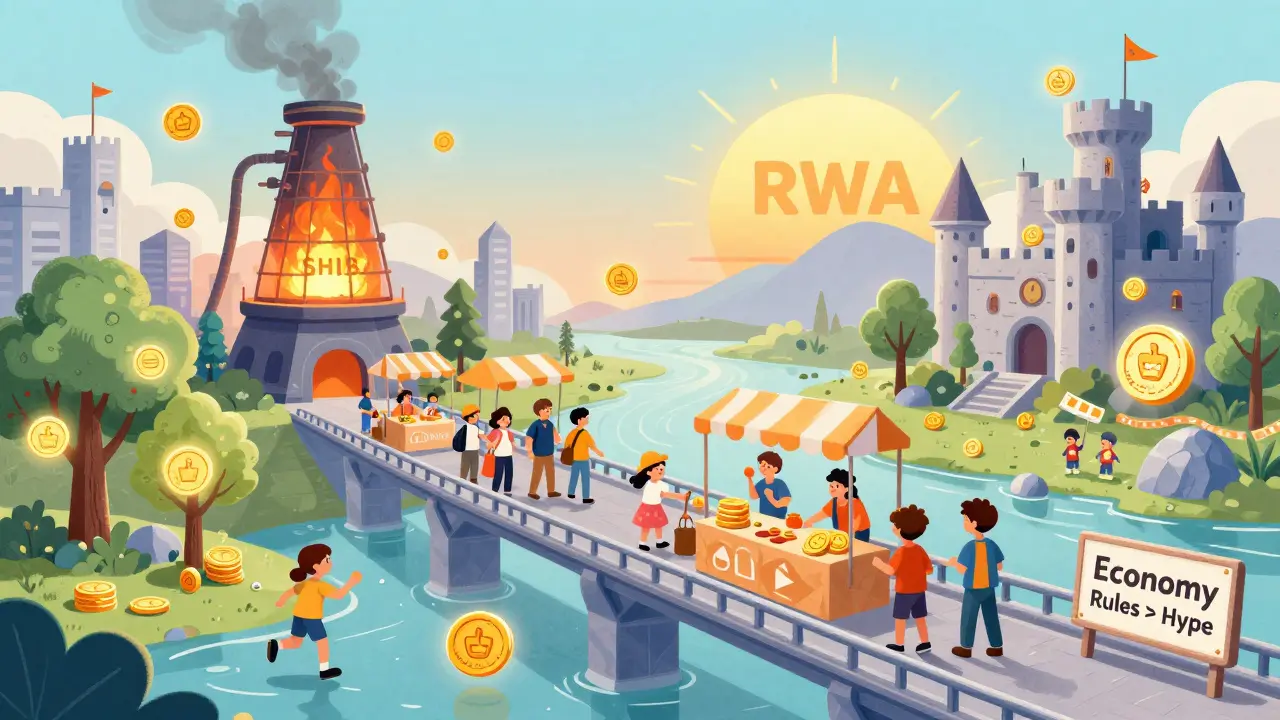
Tokenomics is evolving. New models are emerging:- Real-World Asset (RWA) tokens like BlackRock’s BUIDL token, which represents ownership in U.S. Treasury bonds. These tokens don’t just exist on a blockchain-they’re backed by real financial assets.
- Dynamic tokenomics like Aavegotchi’s "Tokenomics 3.0," which automatically adjusts supply based on user activity. More usage = more scarcity.
- Regulatory alignment. With MiCA in the EU taking effect in 2024, token designs will need to meet clear standards-no more "we’ll figure it out later."
The best projects aren’t just building blockchains. They’re building economies. And just like central banks manage money, tokenomics designs the rules of a digital economy.
Forget price charts. If you want to know which crypto will survive the next crash, look at its tokenomics. The numbers don’t lie.
What is the most important part of tokenomics?
There’s no single "most important" part, but utility and distribution are the top two. A token with no real use case-even if it’s scarce-won’t hold value long. And if the team holds too many tokens with no vesting, they’ll sell when the price rises, crashing the market. The best tokenomics balances utility, controlled supply, and fair distribution.
Can a token with high inflation still be valuable?
Yes-but only if utility is strong enough to offset the inflation. Dogecoin is an example: it has infinite supply and 5 billion new coins added yearly, yet it still trades at over $10 billion because of its community and meme status. But that’s rare. Most high-inflation tokens lose value over time because there’s no economic pressure to hold them. Inflation without utility is just dilution.
How do I find vesting schedules for a crypto project?
Check the project’s official website, whitepaper, or blockchain explorer. Many use platforms like TokenUnlocks or CoinGecko’s "Tokenomics" tab, which show exactly when tokens will unlock. If the info isn’t public, that’s a red flag. Legitimate projects are transparent about their supply.
Is tokenomics the same as a token’s price?
No. Tokenomics explains why a token has value. Price is what the market is willing to pay right now. A token can have perfect tokenomics but still crash if the market is bearish. Conversely, a token with terrible tokenomics can pump temporarily due to hype. Tokenomics helps you separate short-term noise from long-term potential.
Do all cryptocurrencies need tokenomics?
Yes-even Bitcoin has tokenomics. It’s just simple: fixed supply, mining rewards, halving events. Every blockchain that issues a token has an economic model, whether it’s written down or not. The difference is whether that model is intentional and well-designed-or accidental and broken.
Tokenomics isn’t a magic formula. But it’s the closest thing we have to a compass in the wild world of crypto. If you’re serious about investing, learn it. Study it. Use it. The market rewards those who understand the rules-not just the price.
Comments
Aileen Rothstein
Tokenomics is the real deal. I used to chase pumps, but after losing my shirt on a coin with 45% team allocation and no vesting, I learned the hard way. Now I check supply, distribution, and utility before even looking at the chart. It’s not sexy, but it’s the only thing that keeps me from getting rekt.
Found a project last month with 12% team, 4-year vesting, and real staking rewards. Been holding for 60 days. Up 37%. No hype, just solid design.
February 16, 2026 AT 08:23
JJ White
Oh please. You think tokenomics matters? Bitcoin’s tokenomics is a joke-21 million? That’s not scarcity, that’s delusion. It’s a digital tulip with a cult following. Meanwhile, Dogecoin has infinite supply and a billion users who actually USE it to tip each other. You’re valuing math over community. That’s why you’re broke.
February 16, 2026 AT 12:38
Nicole Stewart
Utility is the only metric that matters. Everything else is noise. If it doesn’t do something useful on chain, it’s worthless. Stop overcomplicating.
February 17, 2026 AT 08:01
Alan Enfield
Agreed with the utility point. But distribution is equally critical. If the team holds 30% with no vesting, it’s a rug pull waiting to happen. I’ve seen too many projects launch, pump 5x, then dump. The numbers don’t lie. Check TokenUnlocks. Always.
February 18, 2026 AT 16:52
Lisa Parker
Ugh I hate when people act like tokenomics is some deep secret. It’s just economics. If you can’t grasp supply and demand, maybe crypto isn’t for you. Also, why do we even care about Shiba Inu? It’s a meme. A joke. A dog. Not a currency.
February 18, 2026 AT 19:43
Nova Meristiana
Tokenomics? More like token-oh-my-god-this-is-a-scam. You think Ethereum’s burn mechanism is genius? Nah. It’s just a Band-Aid on a bullet wound. The real power is in the miners and validators who get paid in ETH. That’s where the value is-hidden in plain sight. Everyone’s looking at the wrong thing.
February 19, 2026 AT 04:02
Jennifer Riddalls
Love this breakdown. Seriously. I started learning tokenomics after my first loss-bought a coin because it had a cool logo. Big mistake.
Now I spend 20 minutes on every new project. Check the whitepaper, go to the blockchain explorer, see if people are actually transacting. It’s not glamorous, but it’s saved me thousands.
You don’t need to be a genius. Just patient.
February 20, 2026 AT 10:31
Ian Plunkett
Let’s be real: 90% of these "tokenomics analyses" are just PR fluff. The real story is who funded the project. VC-backed tokens with 20%+ team allocation? They’re engineered to pump and dump. The numbers are rigged. The blockchain is just the stage. The actors? Hedge funds. The audience? Retail sheep.
February 20, 2026 AT 11:47
Avantika Mann
This is so helpful! I’m new to crypto and was overwhelmed. Your breakdown made it click. I checked my last purchase-Shiba Inu-and realized the team had 45% with no vesting. I sold immediately. Thank you for making this clear. I feel less scared now. 💪
February 21, 2026 AT 22:59
yogesh negi
Yes! Yes! Yes! I’ve been saying this for years! Tokenomics is not optional-it’s foundational. You can’t build a house without a foundation. Same with crypto. Look at Aave. Look at Chainlink. They didn’t just create a token-they built a system. And systems last. Meme coins? They’re firecrackers. Flashy. Loud. Gone in seconds.
February 22, 2026 AT 04:10
Nikki Howard
While I appreciate the structural analysis, I must note that the implicit assumption of market rationality is fundamentally flawed. Behavioral economics demonstrates that sentiment, herd behavior, and narrative dominance often override quantitative metrics. The persistence of Dogecoin’s valuation, despite its inflationary model, is not an anomaly-it is a systemic feature of decentralized speculative markets.
February 23, 2026 AT 00:54
Tarun Krishnakumar
Tokenomics? Ha. You think this is about economics? Nah. This is all a Fed-backed operation. The burn mechanisms? Fake. The vesting schedules? Doctored. The blockchain explorers? Controlled. The real value is in the off-chain deals-private sales, whale wallets, and CEX liquidity pools. You’re all being played. The government and the big banks are using crypto to quietly devalue fiat. They want you to focus on "utility" so you don’t notice the money printing behind the curtain. Wake up. This isn’t finance. It’s psychological warfare.
February 24, 2026 AT 16:23
jennifer jean
Love this! I used to scroll through charts all day. Now I just check one thing: does this token do something real? If yes, I hold. If no, I skip. Simple. 🌱
February 25, 2026 AT 05:13
Sasha Wynnters
Tokenomics is the new alchemy. We’re not just trading digital assets-we’re betting on the architecture of future economies. Bitcoin is the gold standard. Ethereum is the electric grid. The rest? Experimental reactors. Some will fuse. Most will fizzle. But the ones that work? They’ll rewrite the rules of money. And you? You’ll either be coding the system… or begging for scraps.
February 27, 2026 AT 03:58
george chehwane
Let’s be honest-most of you are just regurgitating TokenTerminal’s 2022 report like it’s scripture. The truth? Tokenomics is a narrative tool. The market doesn’t care about your "distribution" charts. It cares about influencers, Twitter trends, and Elon’s tweets. You’re analyzing the map instead of the territory.
March 1, 2026 AT 00:32
Scott McCrossan
Tokenomics is a scam invented by VCs to make retail investors feel smart while they get rekt. The only thing that matters is liquidity. If the pair has deep order books and high volume, you’re golden. The rest? Just PowerPoint slides with fancy graphs.
March 1, 2026 AT 10:42
Beth Erickson
Why are we even talking about this? America’s the only country with real crypto innovation. Europe? They’re regulating it into oblivion. China? Banned. India? Taxing it to death. The future belongs to US-based projects with clean tokenomics. The rest are just crypto tourism.
March 1, 2026 AT 11:32
Jenn Estes
If you’re still asking about tokenomics, you’re not ready. Real investors don’t read whitepapers. They read the whispers. They watch the whales. They smell the money before it’s even printed. You’re still looking for rules. The game has no rules.
March 1, 2026 AT 14:33
Anandaraj Br
Tokenomics? Bro, I bought a coin because it had a tiger logo. It went up 2000%. I sold. I’m rich. You’re overthinking. Just buy the hype. Sell the panic. Profit. Simple.
March 3, 2026 AT 12:21
Angela Henderson
I’m not smart enough to understand all this. But I do know this: if a coin has a team allocation over 20% and no vesting, I don’t touch it. I don’t need to know the rest. Just that rule has saved me from 3 rug pulls already. Sometimes simple beats smart.
March 4, 2026 AT 15:11
Geet Kulkarni
While the structural analysis presented herein is commendable in its taxonomical precision, it remains fundamentally ahistorical in its ontological framing. The emergent properties of decentralized economic systems cannot be adequately modeled through static supply curves or vesting schedules. One must instead interrogate the epistemic foundations of trust, consensus, and symbolic value within post-capitalist paradigms. Dogecoin, for instance, functions not as a currency, but as a cultural meme-state-its valuation arising not from economic utility, but from collective intersubjective affirmation.
March 5, 2026 AT 03:21
Sarah Shergold
Tokenomics? More like token-oh-why-is-this-so-boring. I just buy what’s trending. Doge. Shiba. Pepe. If it’s on Twitter, I’m in. The numbers? Who cares. The vibes? That’s what matters. 🐶🔥
March 7, 2026 AT 03:14
Andrew Edmark
Just wanted to say thank you. This post helped me stop chasing pumps. I started studying one project a week. Now I feel confident. Not rich… but at least not broke. 😊
March 8, 2026 AT 01:21
Dominica Anderson
Tokenomics is a Western construct. China and India are building decentralized systems without this nonsense. They don’t care about "utility" or "distribution." They care about adoption. Scale. Speed. Your metrics are colonial. The future is pluralistic.
March 8, 2026 AT 15:28
sruthi magesh
Tokenomics? That’s the bait. The real game is the CEXs. They’re the ones controlling the liquidity, the order books, the whale wallets. They’re the ones who decide what "utility" means. You think you’re analyzing the blockchain? You’re just reading their script. Wake up. The blockchain is just the theater. The real power? Behind the curtain.
March 9, 2026 AT 08:09