

Most people look at a cryptocurrency’s price chart and jump in. They see green candles, hear hype on social media, and buy. But price is just the shadow cast by something much deeper: the economic engine driving that asset. If you want to separate sustainable projects from short-lived scams, you need to understand tokenomics. It is not just a buzzword; it is the blueprint of how value is created, distributed, and sustained within a blockchain ecosystem.
Think of tokenomics as the financial DNA of a project. It answers critical questions: Who owns the tokens? How are they released into the market? What do these tokens actually *do*? And most importantly, does the system reward long-term holders or incentivize quick dumping? In this guide, we will break down the tokenomics analysis framework into actionable steps so you can evaluate any crypto project with confidence.
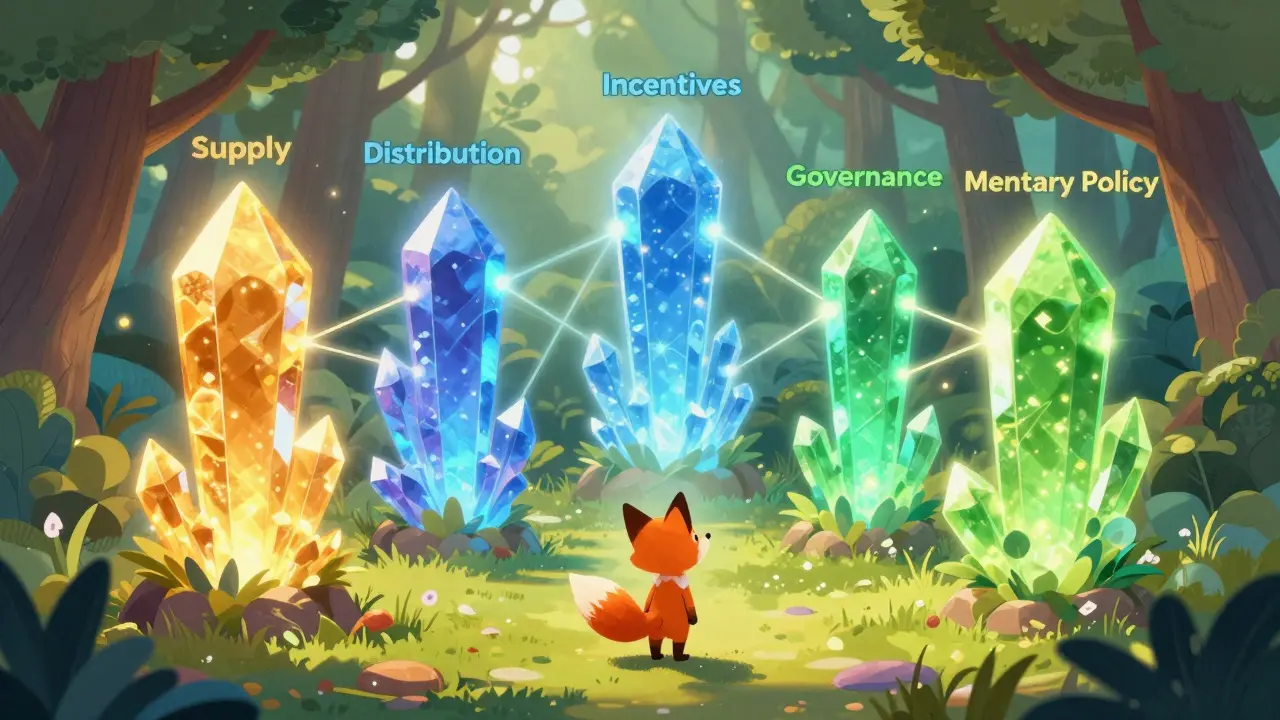
The Six Pillars of Tokenomics
To analyze a project effectively, you cannot look at one metric in isolation. You must examine six interconnected components. Missing even one can lead to a catastrophic investment decision.
- Fixed Supply: A hard cap on total tokens (like Bitcoin’s 21 million). This creates scarcity but can limit adaptability if the network needs more liquidity for growth.
- Inflationary Supply: New tokens are minted over time to reward validators or users. This supports network activity but risks diluting value if issuance outpaces demand.
- Dynamic Supply: Algorithms adjust supply based on network usage. This is complex but aims for equilibrium.
Ask yourself: Is the issuance schedule predictable? What is the projected inflation rate in year one versus year five? High initial inflation often leads to price crashes as early sellers flood the market.
2. Distribution Mechanisms
How tokens reach the public matters immensely. Unequal distribution often leads to centralized control and market manipulation.
- Fair Launch: No pre-mine. Everyone starts mining or buying at the same time. This builds trust but lacks initial funding for development.
- Pre-Mine/ICO: Tokens are sold before launch to raise capital. While efficient for funding, it concentrates ownership among early investors and teams.
- Airdrops: Free distribution to existing users or wallet holders. This boosts decentralization but can attract "sybil" attackers creating fake wallets to claim rewards.
3. Utility Definition
A token without utility is just a speculative bet. Real utility means the token is required to access services, pay fees, or govern the protocol. For example, Ether (ETH) is needed to pay gas fees on Ethereum, while Axie Infinity Shards (AXS) grant governance rights in a gaming ecosystem. Forced utility-where a token is artificially integrated into unrelated services-is a red flag.
4. Incentive Structures
Good tokenomics align user behavior with network health. Do rewards encourage holding and staking, or do they tempt users to sell immediately after claiming? Unsustainable yield farming rates often collapse when new capital dries up.
5. Governance Rights
Does holding the token give you a voice? Decentralized Autonomous Organizations (DAOs) allow token holders to vote on upgrades, treasury spending, and parameter changes. Check if voting power is proportional to holdings and if participation is active or dormant.
6. Monetary Policy
This encompasses burn mechanisms (permanently removing tokens from circulation) and vesting schedules. Binance Coin (BNB), for instance, uses quarterly burns to reduce supply, potentially increasing scarcity. Vesting periods for team and investor tokens prevent sudden dumps; standard vesting is 2-4 years.
Utility vs. Security Tokens: Know the Difference
Not all tokens are created equal legally. The distinction between utility and security tokens affects regulatory risk and investor protection.
| Feature | Utility Token | Security Token |
|---|---|---|
| Purpose | Access to products/services | Ownership/profit sharing |
| Regulation | Often unregulated or lightly regulated | Subject to securities laws (e.g., SEC) |
| Value Driver | Network adoption and usage | Underlying asset performance |
| Risk Profile | High volatility, speculative | Lower volatility, income-focused |
Utility tokens provide access. Security tokens represent equity, debt, or real-world assets. If a project promises guaranteed returns or dividends, it is likely a security token and carries different legal implications. Always check the project’s whitepaper for legal disclaimers.
Step-by-Step Due Diligence Checklist
Applying the framework requires systematic investigation. Use this checklist before allocating capital to any new project.
- Analyze the Whitepaper: Look for clear explanations of the problem solved, technical infrastructure, and economic model. Vague language is a warning sign.
- Examine Team Allocation: Standard team allocation is 10-20%. Higher percentages suggest centralization. Verify vesting schedules via block explorers or official announcements.
- Investigate Private Sales: Early investors often get tokens at steep discounts. Compare their entry price to the public offering. If private investors can dump cheaply acquired tokens, retail buyers suffer.
- Validate Utility: Are there real partnerships? Is the token used in live applications? Or is it merely a "governance token" with no immediate use case?
- Check Audit Reports: Smart contract vulnerabilities can drain treasuries. Reputable firms like CertiK or OpenZeppelin should audit the code.
- Assess Community Engagement: Active Discord, Telegram, and GitHub repositories indicate genuine interest. Ghost towns often precede rug pulls.
Common Pitfalls to Avoid
Even experienced analysts fall into traps. Here are three common mistakes:
- Ignoring Circulating vs. Total Supply: A project might have a low circulating supply but massive reserves locked in vesting contracts. This hidden supply creates future selling pressure.
- Overvaluing Hype: Marketing budgets can inflate prices temporarily. Focus on fundamental metrics like daily active users and transaction volume.
- Assuming All Deflationary Models Work: Burning tokens reduces supply, but if demand drops faster than supply, price still falls. Burn mechanisms alone do not guarantee appreciation.

Native Cryptocurrencies vs. Platform Tokens
Understanding the hierarchy of blockchain assets helps refine your analysis. Native cryptocurrencies (like Bitcoin or Ethereum) secure their own networks. Their value derives from network security and consensus mechanisms. Platform tokens (like ERC-20 tokens on Ethereum) rely on the underlying chain for security but offer specific utilities within apps built on top. Analyzing native coins requires assessing hash rate, validator count, and protocol upgrades. Analyzing platform tokens focuses on app adoption, user retention, and revenue generation.
Future Trends in Tokenomics
As the industry matures, token designs are becoming more sophisticated. We see increased use of dynamic supply algorithms that adjust issuance based on network congestion. Cross-chain interoperability introduces complexity, as tokens may exist across multiple blockchains simultaneously. Regulatory clarity will force more projects toward compliance, potentially blurring lines between utility and security tokens. Investors who adapt their frameworks to account for these nuances will gain an edge.
Remember, no single model is perfect. Fixed supply offers scarcity but lacks flexibility. Inflationary models support growth but risk dilution. Your job is to weigh trade-offs against your investment horizon and risk tolerance. By applying this structured approach, you move beyond speculation and into informed analysis.
What is the most important factor in tokenomics?
There is no single most important factor, but utility combined with fair distribution is crucial. A token with strong real-world use cases and equitable ownership tends to sustain value better than those relying solely on scarcity or hype.
How do I find a project's token vesting schedule?
Check the project's official website, whitepaper, or documentation hub. Tools like TokenUnlocks.app also track vesting timelines for major projects, showing when large batches of tokens become liquid.
Is a fixed supply always better than inflationary?
Not necessarily. Fixed supply creates scarcity but may hinder network scaling if liquidity is insufficient. Inflationary supplies can incentivize validators and users, supporting network growth, provided inflation is controlled and predictable.
What is a "fair launch" in crypto?
A fair launch means no tokens were pre-mined or allocated to founders/investors before public availability. Everyone participates equally from day one, promoting decentralization but lacking initial development funds.
How does token burning affect price?
Burning reduces total supply, which can increase scarcity and potentially drive up price if demand remains constant or grows. However, burning alone cannot offset declining demand or poor utility.