
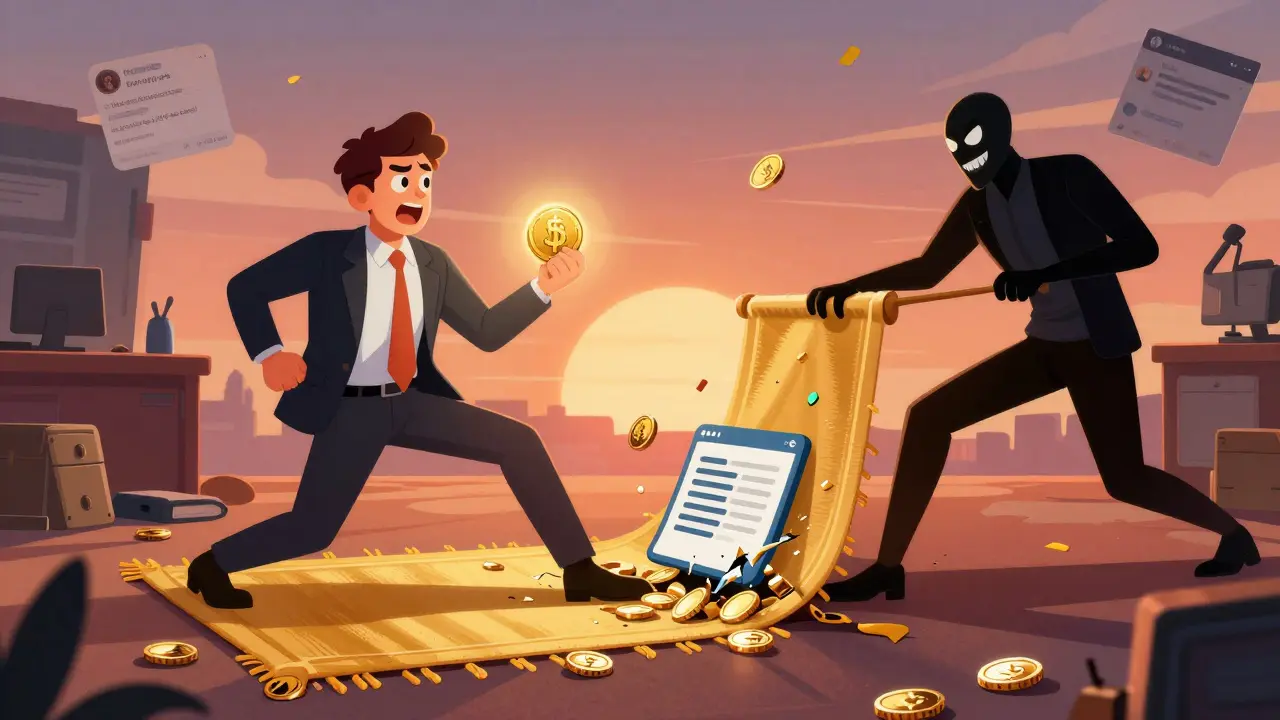
When you hear "rug pull," you might picture someone yanking a carpet out from under you. In crypto, it’s exactly that-but instead of a rug, it’s your money, your NFT, or your trust. And it happens faster than you think. Two main types of rug pulls dominate the blockchain world: token rug pulls and NFT rug pulls. They look similar on the surface-both promise big returns, vanish overnight, and leave victims with nothing. But underneath, they operate in completely different ways. Understanding the difference isn’t just useful-it could save you thousands.
How Token Rug Pulls Work
Token rug pulls target fungible tokens-like ERC-20 or BEP-20 coins-that you can trade, send, or stake. These scams are fast, brutal, and often rely on smart contract tricks you can’t see until it’s too late.
The most common method? Liquidity pool draining. Here’s how it goes: scammers create a new token, pair it with ETH or BNB on a decentralized exchange like Uniswap or PancakeSwap, and then flood social media with hype. They’ll post fake testimonials, pay influencers, and use bots to create fake trading volume. Once enough people buy in and lock their funds into the liquidity pool, the devs pull the plug. They withdraw all the ETH or BNB that was backing the token, leaving the token itself worthless. One minute it’s trading at $0.50, the next it’s $0.0001-and no one can sell.
Another classic move is hidden sell restrictions. Some contracts are coded so you can buy the token, but you can’t sell it. That’s called a honeypot. You think you’re investing-you’re actually trapped. Solidus Labs found that 62% of token rug pulls in 2023 used this trick. Even worse, some contracts have hidden functions that let devs mint unlimited new tokens, diluting your holdings to nothing.
Take the Squid Game token (SQUID) in November 2021. It surged 2,400% in a day after going viral on TikTok. Then, in under four hours, the devs drained $3.3 million from the liquidity pool and disappeared. The token dropped to zero. No warning. No notice. Just silence.
How NFT Rug Pulls Are Different
NFT rug pulls don’t rely on smart contract traps. They rely on broken promises.
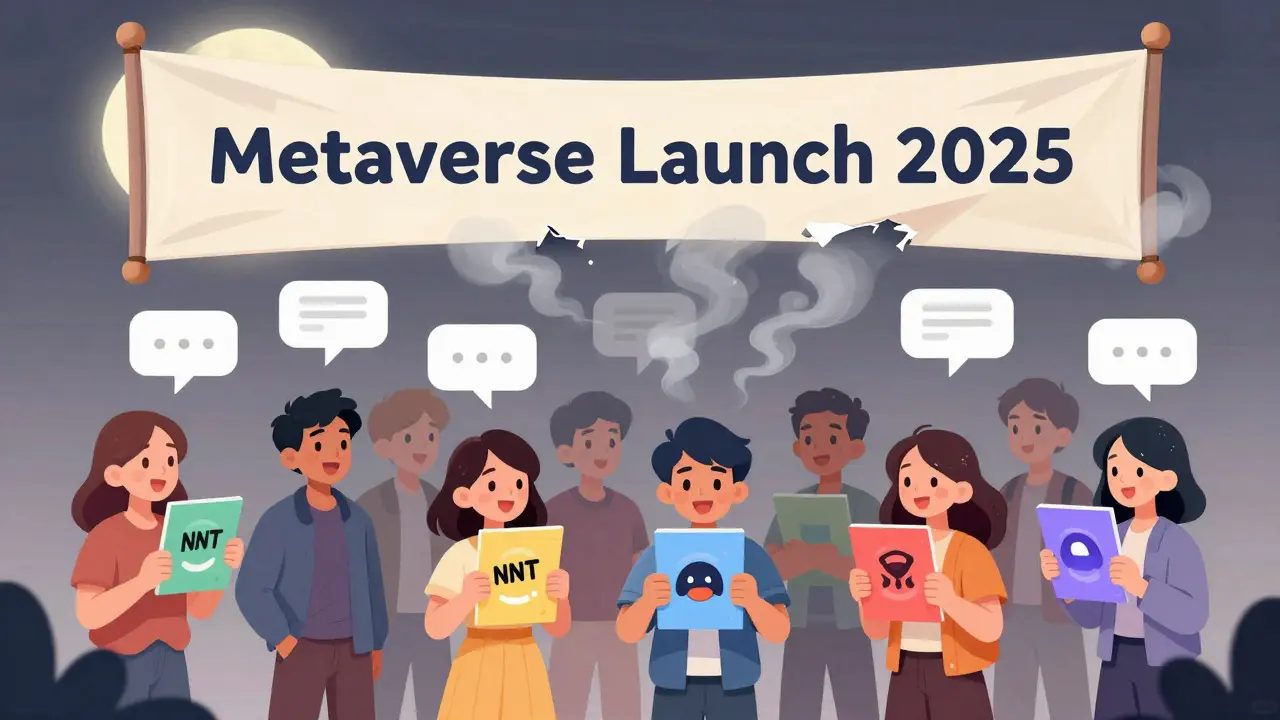
Instead of draining liquidity, NFT scammers build hype around a collection-often a Bored Ape clone-with flashy art, a roadmap full of promises, and a Discord community that feels alive. They’ll say: "We’re building a metaverse game," "You’ll get exclusive access to a real-world event," or "Your NFT will unlock a staking reward." Then, they disappear.
The timeline is slower than token rug pulls. While a token scam can collapse in hours, NFT rug pulls usually take 30 to 90 days. Why? Because they need time to build trust. They’ll post daily updates, host AMAs, and even release a few early features-just enough to make you believe the project is real. Then, around day 60, the Discord admins vanish. The website goes dark. The Twitter account stops posting. The roadmap? Never updated again.
The Blur Finance incident in March 2023 is a textbook example. The team raised $600,000 in ETH from NFT sales, promising a yield aggregator for NFT holders. They launched, collected fees, and then deleted all social media. No one saw it coming-because they’d been so convincing.
Unlike token rug pulls, NFT scams rarely involve code exploits. Instead, they exploit psychology. You’re not just buying a JPEG-you’re buying into a community, a future, a lifestyle. And that’s harder to detect.
Key Differences Between the Two
Here’s the real breakdown:
| Feature | Token Rug Pull | NFT Rug Pull |
|---|---|---|
| Primary Mechanism | Liquidity pool draining, hidden smart contract functions | Broken promises, abandoned roadmaps |
| Typical Timeline | 1-7 days from launch to collapse | 30-90 days to build trust, then vanish |
| Detection Difficulty | Easier to detect with automated tools (RPHunter, RugDoc.io) | Harder to detect-relies on human judgment |
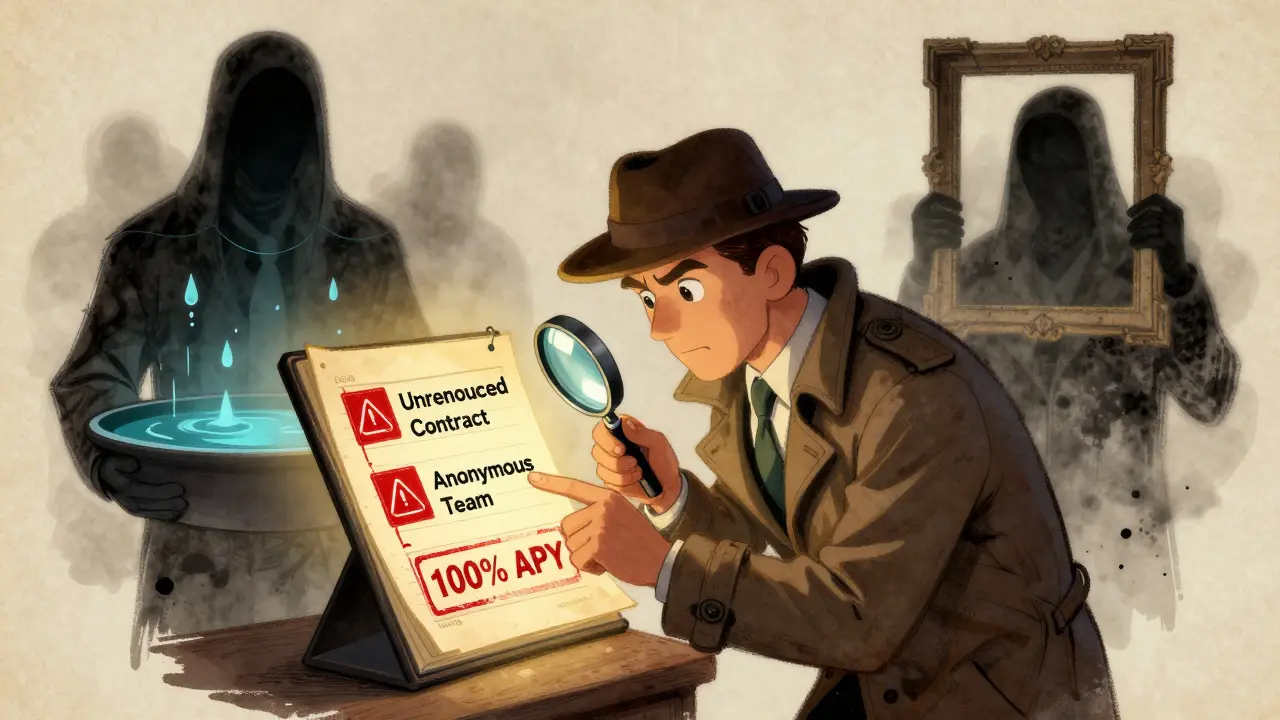
| Common Red Flags | Unrenounced ownership, max sell limits, hidden mints | Anonymous team, no code audit, unrealistic roadmap |
| Value Loss Speed | 95-100% within hours | Gradual drop-85% over 30 days |
| Recovery Chance | Near zero | Small chance via community action |
Token rug pulls are like a bank heist-fast, violent, and over before you know it. NFT rug pulls are more like a con artist building a fake charity. They gain your trust, take your money, and then vanish-leaving you wondering if you were just naive.
How to Spot a Rug Pull Before It Happens
There’s no foolproof way to avoid rug pulls-but you can drastically reduce your risk.
For Token Investors:
- Check if the contract is renounced. If the devs still control the contract, they can change the rules anytime. Use Etherscan or BscScan to verify ownership.
- Look for locked liquidity. Projects that lock liquidity for 6+ months on platforms like Unicrypt are less likely to rug.
- Use detection tools. RugDoc.io and RPHunter scan contracts for hidden traps. They’re not perfect, but they catch 90% of obvious scams.
- Watch for unusual tokenomics. If 30%+ of tokens are held by one address, or if there’s a 100% sell tax, run.
For NFT Buyers:
- Check the team. Anonymous teams? Red flag. Real teams have LinkedIn profiles, past projects, and public identities. If they’re hiding behind a pseudonym, they’re hiding something.
- Read the roadmap. If it says "launch metaverse game in 2025" with no milestones, it’s vaporware. Look for quarterly deliverables.
- Join the Discord. Are the mods active? Do they answer questions? Or do they delete critical comments? Silence is a warning.
- Compare to blue-chips. If the NFT looks like a Bored Ape clone but costs 1/10th the price, it’s probably a copycat.
Why Recovery Is Almost Impossible
Most people think: "If I get scammed, I’ll report it." But crypto doesn’t work like that. There’s no central authority. No customer service line. No refund policy.
Token rug pulls leave zero traceable funds. The devs drain liquidity into mixers like Tornado Cash or send it across chains to obscure the trail. Chainalysis found that 40% of rug pull funds now move through cross-chain bridges to avoid detection.
NFT rug pulls are even trickier. Since NFTs are unique, there’s no standard way to prove fraud. You can’t prove a team lied about a "metaverse game" unless they said it in writing-and even then, courts rarely intervene.
According to Trustpilot data, only 8% of token rug pull victims recover any funds. For NFTs, it’s 23%. Why? Because NFT communities sometimes band together to track down devs or pressure them publicly. But even then, you’re lucky if you get 5% back.
The Future of Rug Pulls
Scammers are getting smarter. In Q1 2024, Kaspersky found that 17% of token rug pulls used AI-generated marketing videos and fake team bios. NFT scams are now using deepfake videos of "founders" to livestream fake updates.
Worse, hybrid rug pulls are emerging-projects that combine token and NFT elements. Imagine buying an NFT that gives you access to a token that then gets rug pulled. These are harder to detect because they mix two scam types.
Regulators are catching up. The SEC has filed 12 cases against token rug pulls since 2022, including the Squid Game settlement. But NFTs? Only 3 cases. That’s changing. SEC Commissioner Hester Peirce warned in May 2024 that "NFT rug pulls will face increased scrutiny in 2025."
For now, the best defense is awareness. Don’t chase hype. Don’t trust influencers. Don’t assume a project is real because it has a fancy website. Do your homework. Check the code. Verify the team. Ask hard questions.
If it sounds too good to be true-it is. And in crypto, that’s not just a saying. It’s a survival rule.
Can you recover money after a token rug pull?
Recovery is extremely rare. Once liquidity is drained and funds are moved through mixers or cross-chain bridges, there’s no way to reverse the transaction. Blockchain transactions are irreversible by design. Most victims lose 100% of their investment. Tools like RPHunter can help prevent losses before they happen, but once the rug is pulled, there’s no undo button.
Are NFT rug pulls more dangerous than token rug pulls?
They’re not more dangerous-they’re just different. Token rug pulls are faster and wipe out funds instantly. NFT rug pulls are slower but more psychologically manipulative. You’re not just losing money-you’re losing trust in a community you believed in. That emotional damage can be harder to recover from. Both types are equally destructive financially.
Do audits prevent rug pulls?
Audits help, but they’re not foolproof. Many audits only check for obvious bugs, not malicious intent. A contract can pass an audit and still have a hidden function that lets devs drain liquidity. The best audits look for intentional traps, but even those can be bypassed by skilled developers. Always pair audits with other checks-like locked liquidity and team transparency.
Is it safe to invest in new tokens with high APY?
High APY is one of the biggest red flags. In legitimate DeFi, APY rarely exceeds 20-30% sustainably. If a new token offers 100% or 500% APY, it’s likely a liquidity farming scam designed to attract quick cash before the rug pull. High returns are a lure, not a promise.
Why do NFT rug pulls take longer to execute?
NFT rug pulls need time to build credibility. Unlike tokens, which can be listed on DEXs instantly, NFTs rely on community trust. Scammers spend weeks posting updates, hosting AMAs, and releasing "early access" features to make the project feel real. Only after they’ve convinced enough buyers do they vanish. It’s a slow burn-but it works.
Comments
precious Ncube
This is why I never touch anything with 'high APY' or 'exclusive NFT access.' If it sounds like a lottery ticket, it is one. You're not investing-you're gambling with your life savings. And don't even get me started on influencers. They're all paid shills. Wake up, people.
February 21, 2026 AT 08:02
Amita Pandey
The fundamental flaw in decentralized finance lies not in the technology, but in the anthropological assumption that human beings are rational actors. We are not. We are emotional, suggestible, and easily seduced by narratives of wealth. The rug pull is not a bug-it is a feature of human nature.
February 21, 2026 AT 13:17
Jan Czuchaj
I've spent years studying behavioral economics in crypto, and what's really fascinating is how NFT rug pulls exploit our need for belonging. We don't buy JPEGs-we buy identity. We buy the fantasy of being part of an elite club. That's why these scams last longer. The emotional investment is deeper. It's not just money lost. It's dignity. It's trust in community. And that's harder to rebuild than a wallet. I've seen people quit crypto entirely after an NFT scam. Not because they lost funds-but because they felt betrayed by people they thought were friends.
February 22, 2026 AT 13:15
Tracy Peterson
Stop being naive. If you're not reading the smart contract, you're not an investor-you're a donation. And if you're trusting a Discord mod who deletes your questions? You're not part of a community. You're prey. Get educated or get out. There's no sympathy here.
February 22, 2026 AT 15:32
George Suggs
I just check if the team has a GitHub. If they do, and they're active, I give it a shot. If not, I scroll on. Simple.
February 23, 2026 AT 20:12
Dianna Bethea
A lot of people don't realize that locked liquidity isn't just a technical detail-it's a promise. When devs lock liquidity for 6 months, they're saying 'I believe in this long enough to risk my own money.' That's huge. And if they renounce ownership? Even better. You're not trusting a person-you're trusting code. And code doesn't lie. I always check Etherscan before I even look at the token price. The rest is noise.
February 24, 2026 AT 00:27
Phillip Marson
They're all scams but some are more artistic. Token rug pulls are like a mugger with a knife-fast brutal. NFT ones? That's a cult leader with incense and a TED Talk. You're not losing money-you're losing your soul to a guy named 'CryptoBro420' who said he'd build a metaverse. And you believed him. Pathetic.
February 24, 2026 AT 23:01
Tracy Whetsel
I used to lose money all the time until I started asking one question: 'Would I still do this if no one else was doing it?' If the answer is no... I walk away. Also 💔🔥🙏
February 24, 2026 AT 23:06
Alyssa Herndon
I think it's important to remember that most people aren't trying to scam. They're just desperate. The system is rigged. The real rug pull is the whole economy. We're all just trying to survive. I still invest but I set a max loss limit. And I never put in more than I can afford to lose. It's not about winning. It's about staying in the game.
February 25, 2026 AT 21:39
Ifeanyi Uche
Africans get scammed the most because we dont have access to proper tools. But we still try. I read every whitepaper even if i dont understand it. I ask questions on twitter. I dont have a degree but i got common sense. You think its easy to be poor and still believe in crypto? It takes courage.
February 26, 2026 AT 00:13
Jeff French
The liquidity pool drain mechanism is essentially a front-running attack on social proof. The contract doesn't need to be malicious-it just needs to be structurally exploitable. Most audits don't test for incentive alignment. They test for overflow bugs. That's like checking a car's brakes but not the gas pedal. The real vulnerability is human psychology. The code just enables it.
February 26, 2026 AT 22:08
Elana Vorspan
I used to think rug pulls were just about money. Now I see them as emotional trauma. I lost $12k on an NFT project that promised a real-world concert. We had a whole Discord group. We made memes. We thought we were building something. Then poof. I still cry sometimes. But I learned. Now I ask: 'Who benefits if this fails?' And if the answer is 'everyone except me'... I don't invest. 🤍
February 26, 2026 AT 22:49
Kenneth Genodiala
The fact that you're even asking how to 'avoid' rug pulls reveals your fundamental misunderstanding of blockchain. Decentralization isn't a feature-it's a featureless void. The rug pull is the natural state of crypto. Any attempt to 'protect' yourself is just a performance of false security. You're not investing. You're roleplaying as an investor.
February 26, 2026 AT 23:58
Michael Rozputniy
You think this is about scams? No. This is about the deep state. The SEC, the Fed, the banks-they all profit from chaos. They want you to lose money so you keep coming back. They fund the 'tools' like RugDoc to keep you distracted. The real rug pull is the entire financial system. Blockchain is just the stage. The actors? All of them. Even you.
February 27, 2026 AT 15:53
Danny Kim
So let me get this straight... You're telling me the guy who made a TikTok dance for a token called 'Squid Game' is now living in Bali with $3M... while I'm eating ramen and Googling 'how to delete crypto wallet'? I'm not mad. I'm impressed. That's next-level hustle.
February 27, 2026 AT 17:21
Cathy Sunshine
I read your entire post. And I'm sorry. You clearly don't understand the depth of this. It's not about smart contracts or liquidity pools. It's about the collapse of meaning. We used to believe in progress. Now we believe in memes. And memes don't have ethics. They have virality. The rug pull is just the final act of a culture that stopped believing in anything real. You're not losing money. You're losing your capacity for hope.
February 28, 2026 AT 00:51