

Imagine a world where you cast your vote from your living room, and instead of hoping the officials count it correctly, you can actually prove it yourself. No one can change your vote, no one can delete it, and the final tally is mathematically guaranteed. This isn't science fiction; it's the promise of blockchain electoral systems is a digital voting framework that uses distributed ledger technology to create transparent, immutable, and auditable election records. But while the idea sounds like a democratic dream, the reality of moving from paper ballots to code is incredibly messy.
The Core Problem: Why Move to the Blockchain?
Traditional voting systems, whether they are old-school paper slips or Electronic Voting Machines (EVMs), suffer from a central point of failure. If a database is hacked or a ballot box is stuffed, the integrity of the entire election vanishes. Blockchain changes the game by distributing the record across thousands of computers. If one node is compromised, the other nodes simply reject the fake data.
For those of us tired of hearing about "election irregularities," blockchain offers three specific fixes: cryptographic verification (proving your vote exists), voter anonymity (hiding who you voted for while proving you're eligible), and public transparency (allowing anyone to audit the count without seeing individual choices). It's a shift from trusting a small group of people to trusting a mathematical protocol.
How the Tech Actually Works
A modern blockchain voting setup isn't just one piece of software; it's a stack of different technologies working together. Most current research prototypes lean on Ethereum because of its ability to run Smart Contracts. These are self-executing pieces of code written in Solidity that act as the digital "election official," automatically verifying that a voter is registered and that they haven't already voted.
To make this work without compromising privacy, developers use Zero-Knowledge Proofs. This is a cryptographic method where you can prove you possess a certain piece of information (like a valid voter ID) without actually revealing that information to the system. It's like proving you're over 21 to a bouncer by showing a green light, rather than handing over your full ID and revealing your home address.
The technical requirements for a node running such a system aren't trivial. An Ethereum node typically needs at least 4GB of RAM and 100GB of storage to keep the ledger synced. While this is easy for a server, it's a hurdle for the decentralized scale needed for a national election.

Blockchain vs. Traditional E-Voting
It's easy to confuse blockchain voting with standard internet voting. However, they are fundamentally different. Standard e-voting usually relies on a centralized server. If that server goes down or is breached, the election is over. Blockchain spreads that risk. Research from AIP Publishing suggests that distributing verification across multiple nodes can reduce the attack surface by about 73% compared to centralized databases.
| Feature | Blockchain Voting | Internet Voting (Centralized) | Electronic Voting Machines (EVMs) |
|---|---|---|---|
| Trust Model | Decentralized / Math | Central Authority | Physical Hardware/Officials |
| Immutability | 100% (Cryptographic) | High (but editable by admin) | Moderate (depends on audit trail) |
| Transparency | Publicly Verifiable | Internal Audit Only | Limited / Manual Recounts |
| Implementation Cost | High ($500k - $2M pilots) | Moderate (~$200k) | High (Hardware costs) |
The Reality Check: Why Aren't We Doing This Yet?
If it's so much better, why are we still using paper? The biggest hurdle is scalability. The Ethereum mainnet can handle roughly 15 transactions per second. In a national election with millions of voters hitting the "submit" button at the same time, you need 10,000+ transactions per second. When West Virginia tried a mobile voting pilot in 2020, it only processed 144 votes across two counties-a stark reminder that the tech isn't ready for prime time.
Then there's the human element. Dr. Jane Smith from MIT's Cryptography Lab has pointed out that while the code might be secure, "social engineering" is still a threat. Blockchain can't stop someone from standing over a voter's shoulder and forcing them to vote for a specific candidate. This is the "coercion problem," and it's the Achilles' heel of any remote voting system, regardless of the tech used.
There's also a massive digital divide. In a Sierra Leone blockchain trial, nearly 63% of participants struggled with the technical barriers. If a voting system requires a high level of digital literacy, it's no longer a democratic system-it's an exclusive club.
Case Studies: From Estonia to the Corporate Boardroom
We can look to Estonia for the gold standard. While their i-Voting system isn't a "pure" blockchain implementation, it's the closest the world has come to a national digital system. In their 2019 parliamentary elections, about 44% of the votes were cast digitally. The key to their success wasn't just the software, but a national digital identity infrastructure that everyone trusted.
Where blockchain is actually winning today is in corporate governance. Companies use it for shareholder voting because the stakes are lower than a national presidency and the voters are generally more tech-savvy. Nasdaq's Linq platform has been processing over 10,000 blockchain votes annually since 2015, proving that for niche, high-transparency needs, the tech works perfectly.
The Road to 2030: What's Next?
The future likely isn't a total replacement of paper, but a hybrid model. We're seeing a move toward "end-to-end verifiable" systems. In this setup, you might still cast a physical ballot, but a blockchain-based receipt allows you to verify that your specific vote was counted correctly without revealing your choice to the public.
The regulatory landscape is also shifting. The EU's eIDAS 2.0 framework, coming into effect in June 2026, is creating the first real certification standards for these systems. This will likely trigger a wave of adoption across Europe, as governments finally have a rulebook to follow.
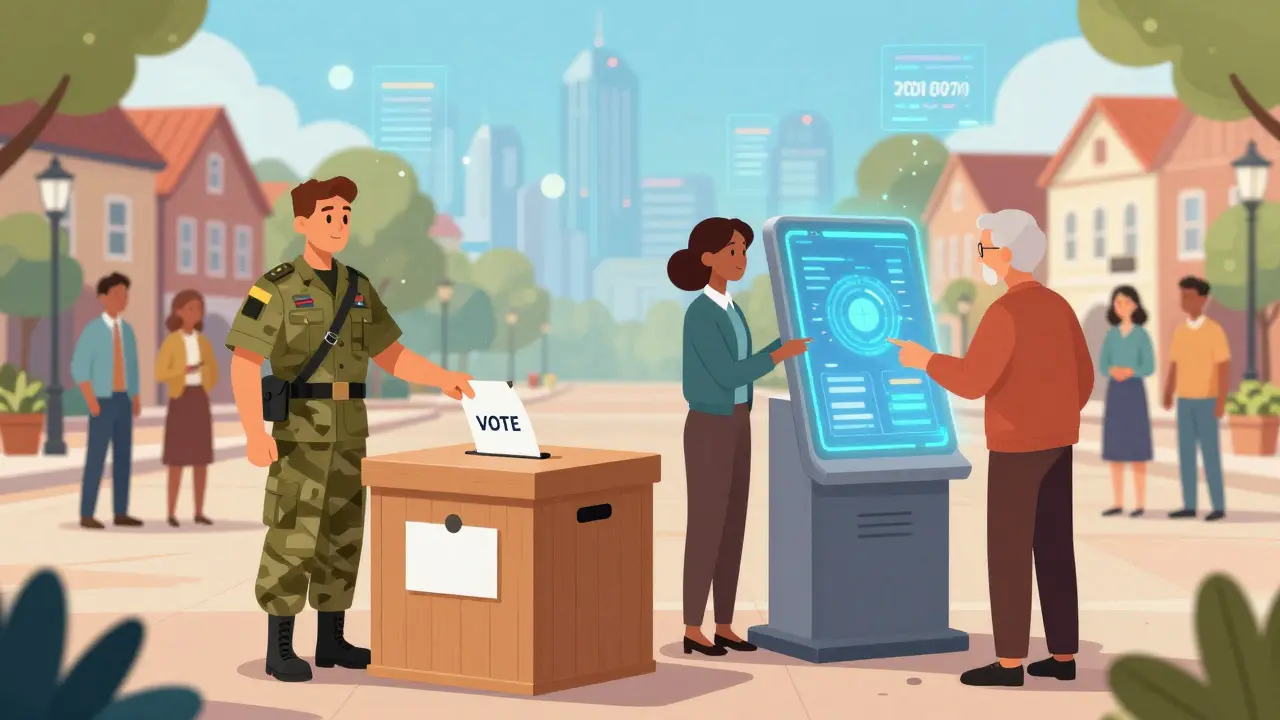
Industry projections suggest a massive growth spurt, with some analysts predicting a 44.3% CAGR for the blockchain voting market. Gartner expects that by 2030, 15% of national elections will use blockchain components. The transition will probably start with military and absentee voters-people who are already voting remotely and for whom the technical complexity is a fair trade-off for accessibility.
Can a blockchain vote be hacked?
While the blockchain ledger itself is nearly impossible to hack due to its decentralized nature, the "endpoints" are vulnerable. This means the app on your phone or the website you use to vote could be compromised by malware or phishing, which is why multi-factor authentication and secure digital IDs are critical.
Does blockchain voting protect voter privacy?
Yes, through the use of cryptographic mixing protocols and Zero-Knowledge Proofs. These tools allow the system to verify that a person is a registered voter and that their vote is valid without ever linking the specific vote to the voter's identity on the public ledger.
Why is it so expensive to implement?
Costs range from $500,000 to $2 million for national pilots because it requires a complete overhaul of voter registries, the creation of secure digital certificates, and extensive training for election officials who must spend 80-100 hours learning the system.
Is blockchain voting environmentally friendly?
It is much more so now. Since Ethereum moved to Proof-of-Stake in September 2022, energy consumption dropped by 99.95%. The massive carbon footprint associated with early blockchain tech is largely a thing of the past.
Will we ever stop using paper ballots?
Probably not in the near future. Most experts advocate for a hybrid system where blockchain provides the audit trail, but a physical paper backup remains the ultimate fail-safe against catastrophic software bugs or total network outages.
Comments
Yuhan Mo
The transition to a decentralized consensus mechanism for voting is a massive paradigm shift, but the throughput issues on the mainnet are a real bottleneck. We're basically talking about a Layer 1 scalability problem that needs a Layer 2 solution, like ZK-rollups, to actually handle millions of concurrent transactions without the gas fees skyrocketing or the network grinding to a halt. It's a fascinating technical challenge for the current infrastructure.
April 16, 2026 AT 13:29
Sean Mitchell
Absolutely tragic that we're even discussing this as a viable solution when the basic hardware requirements for a node are practically an insult to the average citizen's capabilities. It is a sheer farce to call this decentralized if only the elite with server racks can actually verify the ledger.
April 17, 2026 AT 18:05
Vicky Duffala
I love the energy of this transition! 🚀 Imagine the global unity we could achieve if every person felt their voice was mathematically protected. It's not just about the code, it's about the philosophy of trust and moving toward a more transparent existence for all of us!
April 17, 2026 AT 22:47
Thomas Jewett
this is exactly why we need to stop lissening to these globalist tech giants who want to move our sacred voting process into some cloud where it can be manipulated by foreign actors who dont care about our national sovereinty!! the only way to ensure a true American election is with paper and ink that can be seen by real people not some fancy code written by people in california who hate this country and its values!
April 18, 2026 AT 22:28
Evan Iacoboni
The coercion problem is the real deal-breaker here. If I'm voting from home, how does the system know my spouse or a local gang leader isn't standing over my shoulder forcing me to click a specific candidate?
April 20, 2026 AT 03:20
Andrew Southgate
I think it's really important to look at the long-term trajectory here because while the initial hurdles like the digital divide are significant, we've seen similar resistance to the adoption of basic computers and the internet decades ago. If we implement this gradually, perhaps starting with smaller municipal votes or specialized groups as mentioned, we can build the necessary digital literacy and infrastructure over time to make a national rollout actually feasible and inclusive for everyone involved.
April 20, 2026 AT 23:10
Trudy Morse
Trusting math is just another form of faith.
April 21, 2026 AT 22:59
Prachi Bhadarge
Oh sure, because we totally trust the people writing the Solidity contracts to not leave a backdoor open for the highest bidder. Classic.
April 22, 2026 AT 03:30
Joshua Salwen
Wait, you're telling me 15 TPS is the limit?? ARE YOU KIDDING ME?? How is this even a serious conversation if the network crashes the moment a few thousand people try to use it? This is a total disaster waiting to happen and honestly a joke of a system!!
April 22, 2026 AT 13:44
Mark Pfeifer
I'm curious if the eIDAS 2.0 framework includes specific protocols for recovery if a user loses their private key, because in a national election, a lost password can't mean a lost vote.
April 23, 2026 AT 11:51
Keri Pommerenk
totally agree with the hybrid approach it feels like a safe middle ground for everyone
April 24, 2026 AT 10:55
Sandeep Bhoir
The idea that blockchain solves corruption is adorable. It just moves the corruption from the ballot box to the software developer's office.
April 24, 2026 AT 16:41
Sean Douglas
The sheer audacity of proposing a system where a digital glitch could essentially erase the will of a people is simply breathtaking. It is a symphony of errors masquerading as progress, and I find the optimism regarding 'mathematical guarantees' to be utterly delusional and frankly, offensive to the concept of actual security.
April 24, 2026 AT 21:04
Michelle Stanish
Paper is better.
April 26, 2026 AT 11:12
Jeff Barlett
Why is everyone acting like this is the future? It's just a way for tech bros to make more money off government contracts while the actual voting process becomes a nightmare for anyone over sixty.
April 28, 2026 AT 06:53
Adedamola Oyebo
ZK-Proofs are the key here!!! Truly revolutionary!!!
April 29, 2026 AT 13:59
Abhinav Chaubey
The Indian market is way ahead of this regardless of what the West thinks. Our digital infrastructure is practically light-years beyond the clumsy systems they use in the US, and once we integrate blockchain into our electoral process, the world will finally see what real efficiency looks like.
May 1, 2026 AT 07:45
siddharth narula
One must contemplate the metaphysical implications of delegating the democratic will to an algorithmic entity. Is the spirit of the vote preserved when it is reduced to a hash on a ledger? 🕉️
May 2, 2026 AT 11:51
Ian Chait
Its all a setup by the globalists to track your every move through a digitil ID. Once they got you on the chain, they can just delete your identity if you dont comply with the new world order. Its a trap, plain and simple, and the 'transparency' is just a smokescreen for total surveillance.
May 3, 2026 AT 21:18
Saurav Bhattarai
Imagine thinking a $2 million pilot is 'expensive'. In the real world, where we actually build things that work, that's pocket change. But please, continue pretending that your little 'research prototypes' are actually revolutionary.
May 5, 2026 AT 19:04
Ankit Sindhu
Let's keep the conversation positive. There are definitely flaws, but the intent is to make things fairer for those who can't reach a polling station. We can work through the bugs together.
May 6, 2026 AT 18:46
Nishant Goyal
Small steps are best.
May 7, 2026 AT 12:02
Kevin Lư
I'm just gonna be honest, I'd probably forget my private key in a week and just lose my right to vote lol. But hey, at least the code is honest, right?
May 7, 2026 AT 12:58
Yuhan Mo
That's exactly why we need social recovery wallets for this specific use case so a centralized authority can't reset it but a quorum of trusted peers can.
May 7, 2026 AT 23:44