
When you trade crypto on a decentralized exchange, you’re not just swapping tokens-you’re betting on the system itself. SushiSwap V3 (Core) isn’t just another DEX. It’s a platform built to reward you for participating, not just using. Launched in 2023 as a major upgrade to its predecessor, SushiSwap V3 brings concentrated liquidity, fee splits, and advanced trading tools to Ethereum and Polygon. But does it actually deliver better returns than Uniswap? And is it still worth your time in early 2026?
How SushiSwap V3 Works (Without the Jargon)
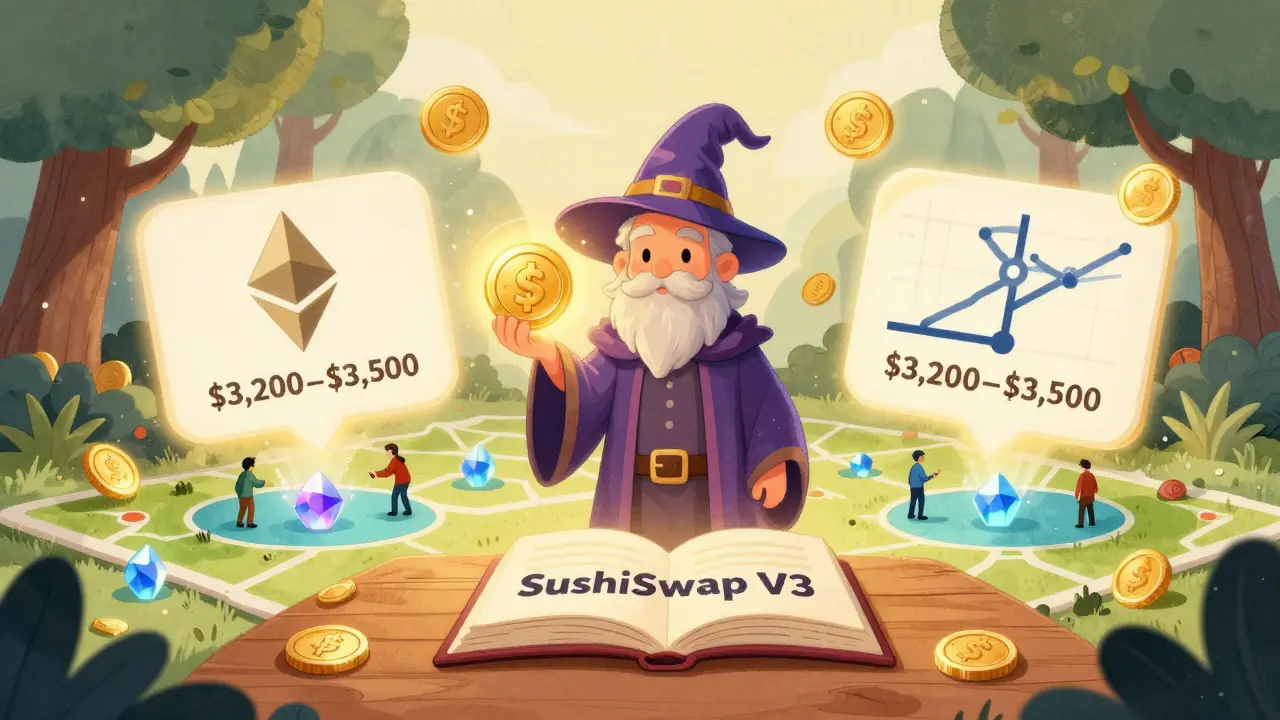
SushiSwap V3 operates as an Automated Market Maker (AMM). That means there’s no order book. Instead, users trade against pools of tokens locked in smart contracts. What makes V3 different? Concentrated liquidity. Unlike V2, where your funds are spread evenly across all price ranges, V3 lets you choose exactly where your liquidity works. If you think ETH will stay between $3,200 and $3,500, you put all your capital in that range. That means higher returns when the price stays put-but bigger losses if it moves outside your range.
This isn’t for beginners who just want to swap ETH for USDC. It’s for users who understand price ranges, gas costs, and impermanent loss. But SushiSwap didn’t ignore newcomers. The basic swap function is still simple: connect your wallet, pick tokens, click swap. It’s clean, fast, and works even if you’ve never heard of a liquidity pool.
Fees and Rewards: Who Gets Paid?
On Uniswap V3, 100% of trading fees go to liquidity providers. On SushiSwap V3, it’s split: 0.25% to liquidity providers, 0.05% to xSUSHI stakers. That’s not a small detail-it’s the whole business model. If you hold SUSHI tokens and stake them as xSUSHI, you earn a cut of every trade on the platform. That’s rare. Most DeFi projects give rewards only to liquidity providers, not token holders.
As of October 2025, the SUSHI token trades at $0.6881. Staking it as xSUSHI gives you ongoing fee shares, not just more tokens. That’s a direct financial incentive to stick around. Compare that to Uniswap, where holding UNI doesn’t earn you anything unless you’re providing liquidity.
Then there’s the Onsen Program. If you add liquidity to a newly listed token, you get bonus SUSHI rewards on top of trading fees. This keeps new projects alive and gives early supporters a real edge. It’s not just a gimmick-it’s how SushiSwap stays competitive in a crowded DeFi space.
What You Can Trade (And What You Can’t)
SushiSwap V3 supports 3 coins across 5 trading pairs. That’s it. ETH, USDC, and SUSHI. No Solana, no Dogecoin, no meme coins. That’s a limitation. If you want to trade obscure tokens, you’ll need another platform. But that’s also a strength. Fewer tokens mean deeper liquidity in the pairs they do support. The average bid-ask spread is 0.634%, which is competitive for a DEX. For comparison, many centralized exchanges charge 0.1%-0.5% in fees, but they also hold your keys. SushiSwap doesn’t.
The platform is multichain. You can use it on Ethereum, but if gas fees spike, you can switch to Polygon. The same wallet, same SUSHI tokens, same rewards. That’s smart design. Polygon offers near-zero fees and instant trades, making it ideal for small swaps or frequent liquidity adjustments.

Advanced Tools: Limit Orders and DCA
In July 2025, SushiSwap rolled out two major upgrades: Limit Orders and Dollar Cost Averaging (DCA). These aren’t minor tweaks-they’re game-changers for retail traders.
- Limit Orders let you set a price to buy or sell without watching the market. You can schedule a buy at $3,100 ETH or a sell at $0.75 SUSHI. The trade executes automatically when the price hits your target.
- DCA lets you automate purchases. Set $50 to buy ETH every Monday. SushiSwap handles it. No need to remember, no emotional trading.
These features used to be exclusive to centralized exchanges like Binance or Coinbase. Now, they’re live on a decentralized platform with no middleman. That’s a huge win for users who want control without sacrificing convenience.
Wallets, Security, and Learning Curve
You need a crypto wallet to use SushiSwap. The platform supports six: MetaMask, WalletConnect, Coinbase Wallet, Phantom, Rainbow, and Argent. No KYC. No identity checks. That’s freedom-but also risk. If you lose your seed phrase, your funds are gone. There’s no customer service to call.
There’s no demo account. You can’t test the interface with fake money. That’s a problem for new users. You learn by doing-and you pay for mistakes. Gas fees on Ethereum can eat small trades. A $20 swap might cost $5 in gas. On Polygon? $0.02. Always check the network before you trade.
Sushi Academy, the platform’s educational hub, helps. It’s not perfect, but it covers wallet setup, liquidity provision, and how to read price ticks. For someone new to DeFi, it’s better than most platforms offer.

SushiSwap vs. Uniswap: The Real Difference
Both are AMMs. Both run on Ethereum. Both have concentrated liquidity. But here’s where they diverge:
| Feature | SushiSwap V3 | Uniswap V3 |
|---|---|---|
| Trading Fees to LPs | 0.25% | 0.30% |
| Fee Share to Token Holders | 0.05% to xSUSHI stakers | 0% |
| New Token Incentives | Onsen Program (bonus SUSHI) | No direct rewards |
| Advanced Tools | Limit Orders + DCA (since July 2025) | Limit Orders only (no DCA) |
| Supported Chains | Ethereum, Polygon | Ethereum, Arbitrum, Optimism |
| Token Utility | Staking earns fee shares | Only governance |
If you care about earning passive income from holding tokens, SushiSwap wins. If you want the most liquidity and widest token selection, Uniswap still leads. But SushiSwap is closing the gap-with real features, not just promises.
Who Is This For?
SushiSwap V3 is perfect for:
- Traders who want to automate buys and sells with DCA or limit orders
- Liquidity providers who understand price ranges and want extra rewards
- SUSHI token holders who want to earn from platform fees
- Users who prefer Polygon for low-cost swaps
It’s not for:
- People who want to trade hundreds of altcoins
- Those who need customer support or insurance on lost funds
- Beginners who don’t want to learn about impermanent loss or gas fees
The platform doesn’t try to be everything. It’s focused. It rewards participation. And it’s still growing.
Final Thoughts: Is It Worth It?
In October 2025, SushiSwap had over $3.99 billion locked in its pools and $69.32 billion in total trading volume. That’s not small. It’s not Uniswap-level, but it’s enough to be taken seriously. The platform isn’t just surviving-it’s evolving. Limit orders, DCA, Onsen rewards, fee-sharing for token holders-these aren’t copy-paste features. They’re intentional upgrades designed to keep users engaged.
The trade-off? Simplicity. You won’t find a one-click, foolproof experience. But if you’re willing to learn, you get more control, lower fees, and real financial incentives. That’s rare in crypto.
Is SushiSwap V3 the best DEX? Not for everyone. But for those who want to earn while they trade, it’s one of the few that actually pays you for showing up.
Does SushiSwap V3 support fiat deposits?
Yes. SushiSwap allows fiat-to-crypto deposits through bank transfers and Apple Pay via integrated on-ramps. You can buy ETH or USDC directly with your credit card or bank account before swapping on the platform. This removes the need to use a centralized exchange first, making it easier for newcomers to enter DeFi.
Is SushiSwap safe to use?
SushiSwap is as safe as your wallet. The code is open-source and has been audited, but there’s no insurance or recovery option. If you send funds to the wrong address or lose your private key, there’s no way to get them back. Never share your seed phrase. Always double-check contract addresses. Use hardware wallets like Ledger or Trezor for larger amounts.
How do I earn rewards on SushiSwap?
You earn rewards in two ways. First, by providing liquidity to trading pairs-you get 0.25% of all trading fees on that pair. Second, by staking SUSHI as xSUSHI-you get 0.05% of all platform fees. You can also join the Onsen Program to earn bonus SUSHI tokens when you add liquidity to new projects. All rewards are automatic and paid in SUSHI.
What’s the difference between SUSHI and xSUSHI?
SUSHI is the native token of the platform. You can trade it, stake it, or use it for governance. xSUSHI is what you get when you lock your SUSHI in the SushiBar. For every SUSHI you stake, you receive one xSUSHI. xSUSHI can’t be traded, but it gives you a share of platform fees. The longer you lock, the more fees you earn. It’s a way to align long-term incentives with the platform’s success.
Why is liquidity concentrated in V3?
In V2, your funds were spread across every possible price, which meant low capital efficiency. In V3, you choose a price range. If you put all your ETH-USDC liquidity between $3,000 and $3,400, your capital works harder when the price is in that zone. That means higher returns-but you risk losing your position if the price moves outside your range. It’s like options trading: higher potential reward, higher risk if you misjudge the market.
Can I use SushiSwap on my phone?
Yes. You can access SushiSwap through mobile wallets like MetaMask, Rainbow, or Coinbase Wallet. The interface is responsive and works on both iOS and Android. However, advanced features like setting price ranges or using limit orders are easier on desktop. For beginners, mobile is fine for simple swaps. For serious liquidity provision, use a computer.
What are the gas fees like on SushiSwap?
On Ethereum, gas fees can range from $2 to $20, depending on network congestion. For small swaps under $100, this can make trading uneconomical. That’s why SushiSwap recommends using Polygon, where gas fees are under $0.05. You can bridge your assets from Ethereum to Polygon in minutes. Most users who trade frequently or provide liquidity stick to Polygon for cost savings.
Is SushiSwap better than Uniswap for beginners?
For pure swapping, they’re similar. But SushiSwap has a slight edge for beginners because of its educational content and fiat on-ramps. Uniswap assumes you already know how to use a wallet. SushiSwap tries to guide you. However, if you’re just swapping ETH for USDC and don’t care about rewards, Uniswap’s interface is slightly cleaner. For anyone interested in earning passive income from DeFi, SushiSwap is the better choice.
Comments
Freddy Wiryadi
man i just swapped some eth for usdc on polygon and it was smoother than butter on a hot pancake 🥞. no gas drama, no stress. sushiswap’s vibe is actually chill now.
February 1, 2026 AT 20:26
christal Rodriguez
If you need a tutorial to use a DEX, you shouldn’t be trading.
February 3, 2026 AT 18:36
Christopher Michael
I’ve been using SushiSwap V3 since mid-2024, and honestly? The xSUSHI fee share is the only reason I haven’t switched to Uniswap. I’m not even providing liquidity-I just stake my SUSHI, and I get paid every time someone swaps. It’s like passive income with a side of blockchain. And don’t even get me started on the Onsen Program-those early rewards on new tokens? Pure gold. I made more in one week on a new memecoin pool than I did in three months staking ETH on Lido.
February 4, 2026 AT 08:49
Brianne Hurley
Oh wow, so now we’re supposed to be impressed that a DeFi project finally caught up to what centralized exchanges did years ago? Limit orders? DCA? Please. This isn’t innovation-it’s desperation. And the fact that they only support three coins? That’s not focus, that’s fear. If you’re not trading 200+ tokens, you’re not serious.
February 4, 2026 AT 12:54
Brandon Vaidyanathan
I love how people act like SushiSwap is some revolutionary genius, but honestly? It’s just Uniswap with a loyalty program. And the ‘fee share’ thing? Yeah, but only if you already own SUSHI. So you’re basically paying to play. Meanwhile, I’m over here on Uniswap getting better liquidity and zero token risk. Just sayin’.
February 5, 2026 AT 18:20
Mark Ganim
The fact that SushiSwap lets you stake SUSHI and earn a slice of every trade… it’s not just smart-it’s poetic. It’s capitalism with soul. You’re not just a user-you’re a co-owner. And when you think about it, that’s the entire promise of DeFi, right? Not just decentralization… but *participation*. The system doesn’t just exist to be used-it exists to be *lived in*. And that’s beautiful. 🌌
February 7, 2026 AT 17:48
Rob Duber
yo i tried the DCA feature and it literally saved me from my own dumbass self. i set it to buy 50 bucks of eth every monday and now i’m not panic-selling when the price dips. also, the interface on mobile? so clean. no more fumbling around like i’m trying to defuse a bomb. 10/10 would automate again.
February 8, 2026 AT 01:18
Lori Quarles
If you’re still using Uniswap because you’re scared of learning something new, that’s not a preference-that’s a limitation. SushiSwap is giving you tools to earn, not just spend. Stop being lazy and start building your wealth. You got this! 💪🔥
February 8, 2026 AT 06:30
Jeremy Dayde
I’ve been in crypto since 2017 and I’ve seen a lot of platforms come and go but what I really appreciate about SushiSwap V3 is how they’ve managed to keep the simplicity of the basic swap function while layering in all these advanced tools without making the UI feel cluttered or overwhelming. It’s rare to find something that caters to both the guy who just wants to swap usdc for eth and the guy who’s optimizing liquidity ranges across three different price ticks and using limit orders to time his entries. And the fact that they didn’t just copy Uniswap but actually added meaningful value like fee sharing for token holders and the Onsen Program? That shows they’re thinking long term. I’ve been on Polygon for months now and my gas fees are basically zero which means I can adjust my positions daily without breaking the bank. It’s not perfect but it’s one of the few platforms that actually feels like it’s trying to serve the user instead of just extracting value from them.
February 9, 2026 AT 20:00
Tom Sheppard
bro i just used the fiat on ramp to buy eth with my apple pay and it was like 3 clicks and done. no coinbase, no kraken, no waiting 3 days. straight into sushiswap. game changer for my mom who just got into crypto. she’s already staking xsushi and thinks she’s a ‘blockchain billionaire’ 😂
February 10, 2026 AT 17:05
Devyn Ranere-Carleton
wait so if i stake xsushi do i get paid even if i dont provide liquidity? i thought you had to be in a pool to earn?
February 11, 2026 AT 03:11
Kevin Thomas
You’re asking if you get paid just by staking xSUSHI? Yes. That’s the whole point. You’re not just holding a token-you’re owning a piece of the fee engine. Uniswap users are just spectators. SushiSwap users are stakeholders. If you’re not stacking xSUSHI, you’re leaving money on the table. And if you’re still using Ethereum for small swaps? You’re literally burning cash. Switch to Polygon. Do it now.
February 11, 2026 AT 16:04
Gary Gately
i used to think sushiswap was just a copycat but then i started using the limit orders and now i dont even check my phone anymore. its like having a robot trader that dont get emotional. also the onsen rewards on that new ai token last month? made my month. 1000% return. still holding.
February 13, 2026 AT 06:09
Robert Mills
DCA + xSUSHI = my new morning coffee ritual ☕️🚀
February 14, 2026 AT 12:52
Gustavo Gonzalez
Let’s be real-this whole ‘fee sharing’ thing is a marketing gimmick wrapped in DeFi jargon. The 0.05% fee share? That’s pennies unless you’re staking millions. And the Onsen Program? It’s just a liquidity mining trap to inflate volume before the team dumps. The real winners here are the early investors who dumped SUSHI at $3. Everyone else is just paying gas fees to fund someone else’s exit. Don’t be fooled by the pretty charts.
February 14, 2026 AT 19:51