

Imagine locking up your digital assets to help secure a network and watching them grow without lifting a finger. That is the promise of staking. But how much will you actually earn? The answer isn't as simple as looking at a single percentage on a website. Staking rewards calculation is the mathematical framework used to determine compensation for participants in proof-of-stake blockchain networks. It involves inflation rates, validator performance, and sometimes complex fees.
If you are planning to stake tokens in 2026, understanding these numbers is critical. A misleading Annual Percentage Yield (APY) can cost you real money. This guide breaks down the exact formulas, hidden variables, and platform differences that determine your final payout.
The Core Math Behind Staking Yields
To understand where your rewards come from, you need to look at the source. In most Proof-of-Stake (PoS) systems, new tokens are created to pay validators. This is essentially controlled inflation.
The base reward for a network like Ethereum is a major blockchain network that transitioned to proof-of-stake consensus in September 2022 follows a straightforward logic:
- Total Supply: The total number of tokens in existence.
- Inflation Rate: The percentage of new tokens issued annually.
- Formula: Base Reward = Total Supply × Inflation Rate.
For example, if Ethereum has a circulating supply of 100 million ETH and maintains a 4% inflation rate, the network generates 4 million new ETH per year to distribute among all active validators. Your share depends on how much you stake relative to the total staked amount.
However, raw inflation isn't the whole story. You also need to calculate your personal return using the standard financial formula for compound interest:
APY = (1 + r/n)ⁿ − 1
Here, r is the periodic rate of return, and n is the number of compounding periods per year. If a protocol compounds rewards daily (n=365), your effective yield will be higher than if it compounds monthly (n=12). Always check the compounding frequency.
Ethereum’s Multi-Layered Reward Structure
Ethereum offers one of the most sophisticated reward structures in the industry. It doesn't just rely on block emissions. Your total earnings often include three distinct components:
- Base Block Rewards: Fixed issuance from the protocol.
- Transaction Fees: Tips paid by users to prioritize their transactions.
- MEV-Boost Rewards: Extra value extracted from transaction ordering.
MEV-Boost is Maximum Extractable Value, a technique allowing validators to capture additional revenue from transaction ordering. This can add an extra 1-2% to your annual returns, but it requires specific infrastructure setup. Not all staking providers pass these MEV profits directly to you; some keep them as profit margin. Always ask: "Does this APY include MEV?"
Validator uptime is another critical variable. If your chosen validator goes offline, you don't just miss out on rewards-you risk slashing. Slashing is a penalty mechanism where a portion of your staked tokens is destroyed to punish malicious or negligent behavior. Consistent online presence ensures you receive full base rewards.

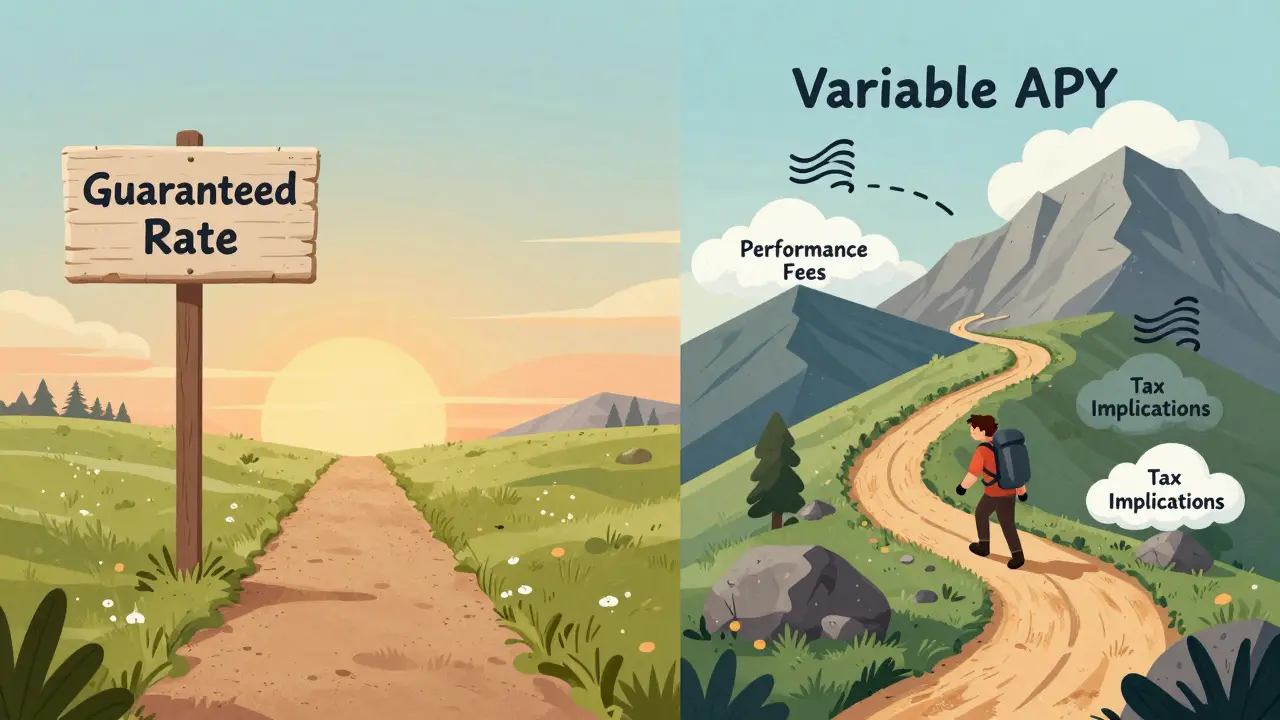
Guaranteed Rates vs. Variable Network Yields
Not all platforms calculate rewards the same way. You will generally encounter two models:
| Feature | Variable APY (Standard) | Guaranteed Rate (Fixed) |
|---|---|---|
| Predictability | Low - fluctuates with network activity | High - fixed return regardless of market |
| Source of Funds | Direct from blockchain protocol | Platform reserves or lending pools |
| Risk Profile | Protocol risk only | Counterparty/platform risk added |
| Example Provider | Lido, Rocket Pool | Coinhouse, Phemex |
Platforms like Coinhouse is a cryptocurrency exchange offering guaranteed staking rates to simplify user experience offer a "Guaranteed Rate." They might advertise a 9% APY even if the actual blockchain rate is 9.7%. They absorb the difference. This simplifies your calculation but introduces counterparty risk. If the platform fails, your guaranteed rate disappears.
In contrast, decentralized protocols like Lido or Rocket Pool show you the real-time, variable yield. One day it might be 3.5%, the next 4.2%. This reflects true market conditions but requires more monitoring.
Hidden Costs That Reduce Your Net Yield
The advertised APY is rarely what you take home. Several factors eat into your profits:
- Performance Fees: Many liquid staking derivatives charge a 10% performance fee on rewards. If you earn $100 in rewards, you only get $90.
- Withdrawal Penalties: Some platforms impose fees if you unstake before a lock-up period ends.
- Tax Implications: In countries like Canada and the UK, staking rewards are treated as income, not capital gains. This means you pay tax on the gross reward, not just your profit.
For instance, if you stake $10,000 at a 5% APY, you earn $500. If there is a 10% performance fee, your net reward is $450. If your local tax rate on income is 20%, you owe $90 in taxes. Your true after-tax yield is significantly lower than the headline number.
Optimizing Your Staking Strategy
Expert analysis suggests that time is your biggest ally. Extending your staking duration optimizes compound growth. As noted by research teams at Figment.io is a blockchain infrastructure provider offering staking-as-a-service solutions, just a few extra months can make a substantial difference over a couple of years due to exponential compounding.
Diversification is also key. Don't put all your tokens into one validator or one platform. Spread your stake across multiple reputable providers to mitigate the risk of slashing or platform failure. For advanced users, running your own node provides maximum control and rewards but requires technical expertise and constant hardware maintenance.
Finally, always use built-in calculators provided by exchanges like Phemex is a cryptocurrency trading platform offering staking calculator tools for users to project earnings based on current rates. These tools account for current network congestion and validator counts, giving you a more realistic snapshot than static historical data.
How do I calculate my daily staking rewards?
To calculate daily rewards, divide your annual APY by 365. Then multiply that daily rate by your staked balance. For example, if you have 10 ETH staked at a 4% APY, your daily reward is approximately (0.04 / 365) * 10 = 0.00109 ETH per day. Remember to adjust for compounding if rewards are reinvested automatically.
What is the difference between APY and APR in staking?
APR (Annual Percentage Rate) calculates simple interest, ignoring compounding. APY (Annual Percentage Yield) includes the effect of compounding. If rewards are distributed and reinvested frequently, APY will be higher than APR. Always look for APY when comparing long-term staking options.
Are staking rewards taxable?
Tax laws vary by country. In many jurisdictions, including Canada and the UK, staking rewards are considered ordinary income at the time they are received. In the US, IRS guidelines are evolving, but recent court cases suggest rewards may be taxed as income. Consult a local tax professional for accurate advice.
Can I lose money while staking?
Yes. You can face slashing penalties if your validator behaves maliciously or goes offline for extended periods. Additionally, if the token's price drops significantly, the dollar value of your rewards may decrease. Platform risk also exists if you use centralized exchanges that go bankrupt.
Why does Ethereum's staking APY change daily?
Ethereum's APY fluctuates based on the total amount of ETH staked and network activity. As more people stake, the reward pool is split among more validators, lowering individual yields. Transaction fees and MEV opportunities also cause daily variations in total rewards.