

You’ve probably seen a chart that looks perfect. The trend is clear, the volume is spiking, and your gut says "buy." But then you hesitate. Why? Because deep down, you know one bad move can wipe out weeks of gains. That hesitation isn’t fear-it’s instinct telling you to check your risk-reward ratio. In the chaotic world of cryptocurrency, where Bitcoin can drop 10% in an hour without warning, this single metric is often the difference between surviving a bear market and blowing up your account.
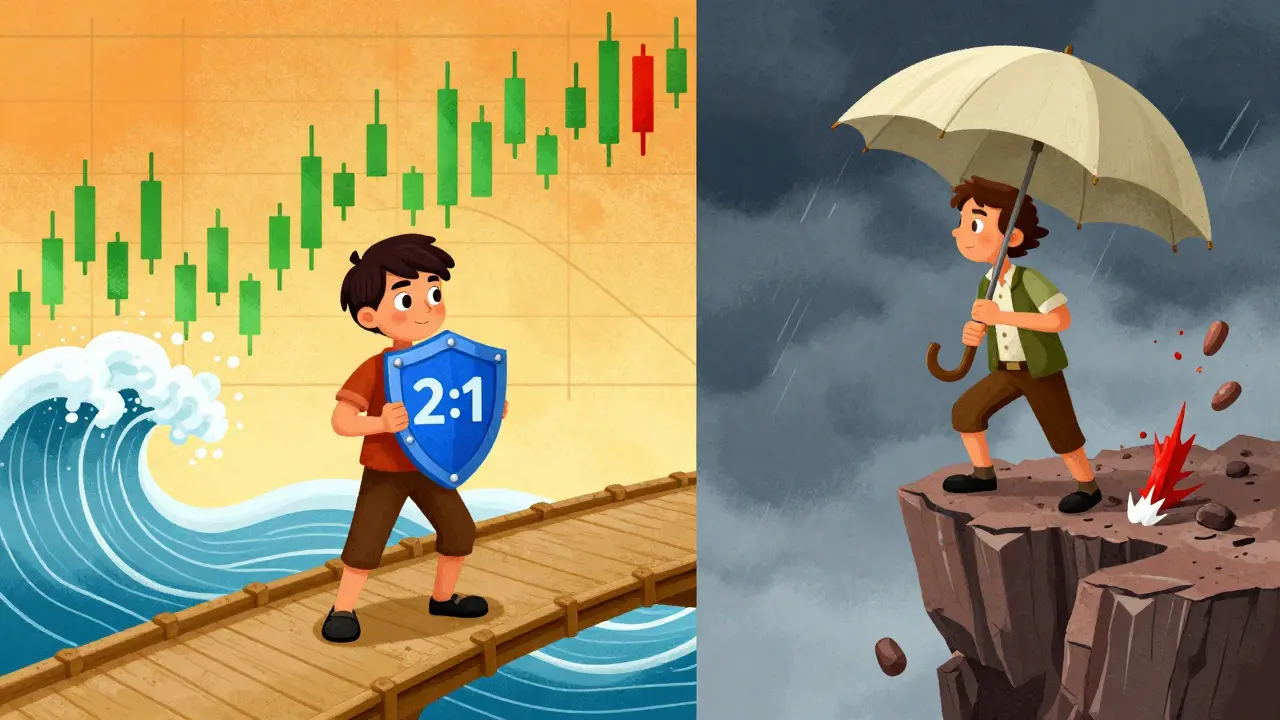
The risk-reward ratio (RRR) isn’t just a number; it’s a survival tool. It measures how much money you stand to make compared to how much you are willing to lose on a specific trade. If you’re risking $100 to potentially make $200, you have a 2:1 ratio. Simple math, right? Yet, most traders ignore it until they’re underwater. This guide will show you exactly how to calculate it, why the standard advice might be wrong for your strategy, and how to use it to stay profitable even when you’re only right half the time.
What Is the Risk-Reward Ratio?
The Risk-Reward Ratio is a financial metric used by traders to compare the potential profit of a trade against its potential loss before entering the market. It answers a simple question: "Is this trade worth the risk?"
In traditional finance, this concept has existed for decades. In crypto, it’s non-negotiable. Crypto assets like Ethereum or Solana don’t just fluctuate; they explode. A 5% move in stocks is news; a 5% move in crypto is Tuesday. Without a strict RRR, you’re gambling, not trading.
The formula is straightforward:
- Risk: The distance from your entry price to your stop-loss price.
- Reward: The distance from your entry price to your take-profit target.
- Calculation: Reward ÷ Risk = Ratio.
If you buy Bitcoin at $60,000, set a stop-loss at $58,000 (risking $2,000), and aim for a take-profit at $64,000 (gaining $4,000), your ratio is 4,000 / 2,000 = 2:1. For every dollar you risk losing, you aim to gain two dollars.
Why Most Traders Get It Wrong
The biggest mistake beginners make is focusing on the direction of the market rather than the math of the trade. You can be right about Bitcoin going up but still lose money if your risk-reward structure is poor.
Consider this scenario:
- Trader A buys BTC at $60k with a tight stop at $59.5k (risk $500) and targets $61k (reward $1,000). Ratio: 2:1.
- Trader B buys BTC at $60k with a wide stop at $57k (risk $3,000) because they "believe" in the long-term, targeting $63k (reward $3,000). Ratio: 1:1.
If Bitcoin dips to $59.8k and then rallies to $61k, Trader A makes $1,000. Trader B gets stopped out at $57k (if the dip continues) or holds through massive volatility with no edge. If the price hits $59.8k, Trader A is still in the game. Trader B might panic-sell. The ratio dictates your psychological comfort and your mathematical expectancy.
Calculating Your Ratio: Step-by-Step
To apply this effectively, you need three precise points on your chart. No guessing. Here is how to do it properly using a real-world example with Ethereum (ETH).
- Identify Entry Point: You spot support at $3,000. You decide to enter a long position here.
- Set Stop-Loss (Risk): Look below the support level. Maybe there’s a recent low at $2,900. To avoid getting stopped out by noise, you place your stop at $2,850. Your risk per unit is $3,000 - $2,850 = $150.
- Set Take-Profit (Reward): Look above for resistance. There’s a previous high at $3,450. Your potential reward is $3,450 - $3,000 = $450.
- Calculate: $450 (Reward) ÷ $150 (Risk) = 3:1.
This is a strong setup. You are risking $150 to make $450. If this trade fails, you lose $150. If it succeeds, you gain $450. You can afford to be wrong twice and still break even on the third win.
The Magic of Win Rate vs. Risk-Reward
Here is the secret that professional traders know: You don’t need to be right most of the time to be profitable.
Your profitability depends on the combination of your Win Rate (percentage of winning trades) and your Risk-Reward Ratio. Let’s look at the math over 10 trades, risking $100 per trade.
| Scenario | Win Rate | RRR | Wins ($) | Losses ($) | Net Profit/Loss |
|---|---|---|---|---|---|
| Poor Setup | 60% | 1:1 | $600 | $400 | +$200 |
| Average Setup | 40% | 2:1 | $800 | $600 | +$200 |
| Pro Setup | 30% | 3:1 | $900 | $700 | +$200 |
| Disaster | 50% | 1:2 | $500 | $1,000 | -$500 |
Notice the last row? Even with a 50% win rate, if your reward is only half your risk (1:2), you lose money. Conversely, in the "Pro Setup," you lose 7 out of 10 trades but still make the same profit as the trader who wins 6 out of 10 times. This is why chasing high win rates with low RRRs is a trap. High win rates often come from taking profits too early, capping your upside while leaving your downside exposed.
Choosing the Right Ratio for Your Strategy
There is no "perfect" ratio. The best ratio depends on your trading style and personality.
- Scalpers (1:1 to 1:2): Scalpers make many small trades quickly. They rely on high win rates (60-70%) because their targets are small. A 1:1 ratio works if you are consistently right.
- Swing Traders (2:1 to 3:1): Swing traders hold positions for days or weeks. They accept lower win rates (40-50%) but let winners run. This is the sweet spot for most retail crypto traders.
- Trend Followers (3:1+): These traders catch massive moves. They might lose 60% of their trades, but one big winner covers all losses. This requires immense patience and discipline.
If you struggle with emotional discipline, start with a minimum 2:1 ratio. It forces you to think bigger about rewards and protects you from the grind of small losses.
Position Sizing: The Missing Link
Knowing your RRR is useless if you don’t adjust your position size. This is where Position Sizing comes in. Never risk more than 1-2% of your total capital on a single trade.
Let’s say you have a $10,000 portfolio. You decide to risk 1% ($100) on a trade.
- Trade A: Your stop-loss is $50 away from entry. To risk $100, you buy 2 units ($100 risk / $50 distance).
- Trade B: Your stop-loss is $200 away from entry. To risk $100, you buy 0.5 units ($100 risk / $200 distance).
By adjusting the number of coins you buy based on the distance to your stop-loss, you ensure that every trade risks the same amount of capital, regardless of the asset’s volatility. This keeps your P&L curve smooth and prevents one bad trade from destroying your confidence.

Common Pitfalls to Avoid
Even experienced traders fall into these traps:
- Moving Stop-Losses Down: When a trade goes against you, never move your stop-loss further away to "give it room." This turns a calculated risk into a disaster. Accept the loss and move on.
- Taking Profits Too Early: Fear of losing gains causes traders to exit at 1:1 when they planned for 3:1. Trust your plan. Set limit orders for take-profits so emotions don’t interfere.
- Ignoring Market Context: A 3:1 ratio looks great on paper, but if it’s during low liquidity or major news events (like CPI data releases), slippage can ruin your execution. Always consider the broader market environment.
- Overleveraging: Leverage amplifies both risk and reward. Using 10x leverage with a 2:1 RRR doesn’t change the ratio, but it increases the chance of liquidation before the trade plays out. Keep leverage low (2-5x) to survive volatility.
Putting It Into Practice: A Checklist
Before you click "Buy" or "Sell," run through this quick checklist:
- Where is my entry point?
- Where is my invalidation point (stop-loss)?
- Where is my realistic take-profit target?
- Does the Reward exceed the Risk by at least 2x?
- Have I calculated my position size to risk only 1-2% of my portfolio?
- Are there any upcoming news events that could cause erratic movement?
If the answer to any of these is "no" or "I’m not sure," skip the trade. There will always be another opportunity. The goal isn’t to trade every day; it’s to trade well.
Advanced Tip: Asymmetric Opportunities
Sophisticated traders look for Asymmetric Risk setups. These are trades where the downside is clearly defined and limited, but the upside is potentially unlimited. For example, buying a put option on Bitcoin when you expect a crash, or buying a new altcoin at launch with a hard cap on supply. In these cases, the RRR can be 10:1 or higher. While harder to find, these trades offer the highest compounding potential over time.
Mastering the risk-reward ratio transforms trading from a game of luck into a business of probabilities. You won’t win every trade. In fact, you’ll lose many. But if your math is sound, your losses will be small, your wins will be large, and your portfolio will grow steadily despite the chaos of the crypto markets.
What is a good risk-reward ratio for crypto trading?
A generally recommended starting point is a 2:1 ratio, meaning you aim to make twice as much as you risk. However, swing traders often target 3:1, while scalpers may accept 1:1 if their win rate is high. The "best" ratio depends on your strategy and ability to execute consistently.
Can I be profitable with a low win rate?
Yes. If your risk-reward ratio is high enough, you can be profitable with a win rate as low as 30-40%. For example, with a 3:1 RRR, you only need to win 26% of your trades to break even. Profitability comes from making more on winners than you lose on losers.
How do I calculate position size based on risk?
First, decide how much capital you are willing to lose (e.g., 1% of your portfolio). Then, divide that dollar amount by the distance between your entry price and your stop-loss price. The result is the number of units you should buy. This ensures consistent risk across all trades.
Should I move my stop-loss if the trade goes against me?
No. Moving your stop-loss further away increases your risk beyond what you originally calculated. This is a common mistake that leads to large losses. If the price hits your stop-loss, accept the loss and wait for a better setup. You can, however, move your stop-loss up (to lock in profits) as the trade moves in your favor.
Does leverage affect the risk-reward ratio?
Leverage does not change the mathematical RRR of the price movement, but it drastically increases the risk of liquidation. High leverage means smaller price movements can wipe out your margin. It is safer to use low leverage (2-5x) and focus on proper position sizing and RRR rather than relying on leverage to boost returns.
Comments
Carl Hanzel
Another generic finance blog post trying to sell you the idea that math saves you from stupidity. It doesn't. You can have a perfect 10:1 ratio and still get wrecked by an exchange hack or a rug pull because you didn't read the smart contract code. Most people here treat this like a holy grail when it's just basic arithmetic that doesn't account for human error or systemic risk.
July 2, 2026 AT 06:54
Daniel J. Cox
I actually found the section on position sizing really helpful though! :) It’s easy to forget that RRR is useless if you bet too much. I’ve been using a calculator app now to figure out my entry size before I click buy. It takes the emotion out of it completely.
July 2, 2026 AT 14:53
Emma Rémond
The article simplifies asymmetric risk profiles to the point of absurdity. True alpha generation in crypto requires understanding on-chain liquidity depth and order book dynamics, not just drawing lines on a chart. The notion that a static stop-loss protects against volatility clustering is naive at best. One must consider the fractal nature of market movements rather than relying on linear regression models for exit strategies.
July 4, 2026 AT 04:48
ELNORA JEFFERSON
Boring. I just want to know which coin to buy so I can retire by next week. This math stuff makes my head hurt and I don't have time for all this reading. Just give me the ticker symbol.
July 5, 2026 AT 09:38
Carol @minaszilda
It is okay to feel overwhelmed. Many traders struggle with the emotional aspect of setting stops. Remember that protecting your capital is an act of self-care. If the math feels cold, try to view it as a way to preserve your peace of mind. You deserve to trade without anxiety.
July 6, 2026 AT 08:37
Nicole Woessner
in my experience trading forex before crypto the principles are similar but the volatility in crypto is insane. i often find myself moving my stop loss because the wicks are so long. does anyone else struggle with getting stopped out by noise before the real move happens
July 7, 2026 AT 09:41
Jon Milton
Look, nobody likes losing money, but the reality is that if you aren't tracking your win rate against your RRR, you are gambling. I used to be terrible at this, always chasing green candles. Once I started logging every trade in a spreadsheet, I realized I was winning more often but losing big on the few times I was wrong. Discipline beats talent every time.
July 7, 2026 AT 23:46
Scott Miller
THIS IS IT!!! This is the key to success!! Stop being lazy and start doing the math!! If you can't handle a 2:1 ratio then you don't deserve to make money in this market!! Get your act together and calculate your positions properly!!
July 8, 2026 AT 16:28
Abby Martin
Let's be real for a second. Most of you are going to blow up your accounts no matter what ratio you use because you lack the moral fortitude to take a small loss. You hold onto losers hoping they come back and sell winners too early because you're greedy. Fix your character first, then worry about the numbers. It's not just about strategy, it's about who you are as a person.
July 9, 2026 AT 14:47
Mélanie Boulay
While I appreciate the comprehensive breakdown of the mathematical expectations associated with various risk-reward scenarios, it is imperative to note that the psychological burden of maintaining such strict adherence to predefined parameters can often lead to decision paralysis during periods of extreme market turbulence, thereby necessitating a more flexible approach that accommodates for the inherent unpredictability of decentralized financial ecosystems.
July 10, 2026 AT 01:34
Maurice Flynn
Just chill and let the plan play out. I've been swing trading ETH for months and sticking to a 3:1 ratio has saved my ass multiple times. Don't overthink it. Trust the process and keep your emotions in check. You got this.
July 10, 2026 AT 06:58
nancy jarecki
This article reads like it was written by someone who has never actually traded a live market. The concept of 'asymmetric opportunities' is bandied about without any mention of the illiquidity risks involved in altcoin launches. Furthermore, the suggestion to use low leverage ignores the reality that many sophisticated arbitrage strategies require higher leverage to overcome funding rates and transaction costs. Typical retail fluff.
July 12, 2026 AT 02:31
Robert Hundley
Hey everyone! Great discussion here! I love how diverse the opinions are. I personally use emojis in my journal to track my mood when I trade. If I'm feeling 😊 I stick to the plan, but if I'm 😡 I step away. Has anyone tried combining psychology tracking with their RRR calculations? Let's hear it!
July 12, 2026 AT 13:04
Melissa L
i dont get why ppl make it so compicated. i just buy when its red and sell when its green. works fine for me. maybe im lucky or maybe im dumb but i dont need no fancy ratios to make a buck.
July 12, 2026 AT 16:58
Rob Morton
It is interesting to consider how our personal biases influence our perception of risk. Do we truly believe in the 2:1 rule, or do we just follow it because experts say so? I think exploring the 'why' behind our trading decisions is just as important as the math itself. What drives your confidence in a setup?
July 13, 2026 AT 21:02
Routh Middaugh
I think we can all agree that patience is key; however, one must also recognize that the market does not care about your feelings. Therefore, it is essential to remain adaptable. Perhaps we should focus less on rigid rules and more on developing a holistic understanding of market cycles. After all, isn't that what true wisdom entails?
July 15, 2026 AT 17:46
Ryan Peters
Typical soft-handed guide for the weak. In America, we understand that high risk equals high reward, and you don't need some algorithm to tell you when to sell. If you can't handle the volatility, stay out of the market. Real traders put everything on the line and win. This risk-averse mentality is exactly why our competitors are dominating the global economy.
July 16, 2026 AT 18:47
ross harris
The market is a meat grinder, churning up the bones of the hopeful. Your little ratio is a shield made of paper against a storm of steel. I see the fear in your eyes as you calculate your exits, trembling like a leaf in a hurricane. Embrace the chaos, you fools. The abyss stares back, and it laughs at your spreadsheets.
July 17, 2026 AT 16:49
Carl Belgrave
You people are wasting your time with these tiny profits. We need bold moves! Put it all on Bitcoin right now! No stops, no limits, just pure American grit! If you lose, you learn. If you win, you feast. Stop coddling yourselves with these safety nets. It's time to dominate the charts!
July 17, 2026 AT 20:05
John Curry
There is a profound irony in seeking certainty in a system designed to be uncertain. We build these structures of logic, these ratios and rules, in a desperate attempt to tame the wild beast of human greed. But perhaps the true lesson is not in the calculation, but in the acceptance of loss. To lose gracefully is to gain wisdom.
July 18, 2026 AT 07:33
Trent Erman1
Great insights here! I totally agree with the part about position sizing. It’s so easy to ignore until you’re down 50%. I use a simple tool to auto-calculate my lot size based on my stop distance. It keeps me sane. Keep learning and stay positive! 🚀📈
July 20, 2026 AT 02:41
Fiona Ellis
I couldn't help but notice that you haven't mentioned the impact of tax implications on your net risk-reward ratio. Depending on your jurisdiction, short-term gains could significantly alter your effective profitability. Have you considered consulting a local financial advisor to ensure your strategy aligns with your personal fiscal responsibilities? 😊
July 20, 2026 AT 06:02
Sajjad Ghorbani Moghaddam
We should remember that everyone starts somewhere. If you are new to this, don't let the jargon scare you off. Start small, practice on a demo account, and gradually increase your stakes as you become more comfortable with the concepts. Community support is vital in this journey.
July 20, 2026 AT 12:03
Rebecca Shoniker
The author fails to adequately address the nuances of slippage in high-frequency trading environments. Furthermore, the assertion that a 2:1 ratio is universally applicable is intellectually lazy. One must consider the specific microstructure of the asset class in question. It is disappointing to see such superficial analysis presented as gospel truth.
July 20, 2026 AT 16:00