
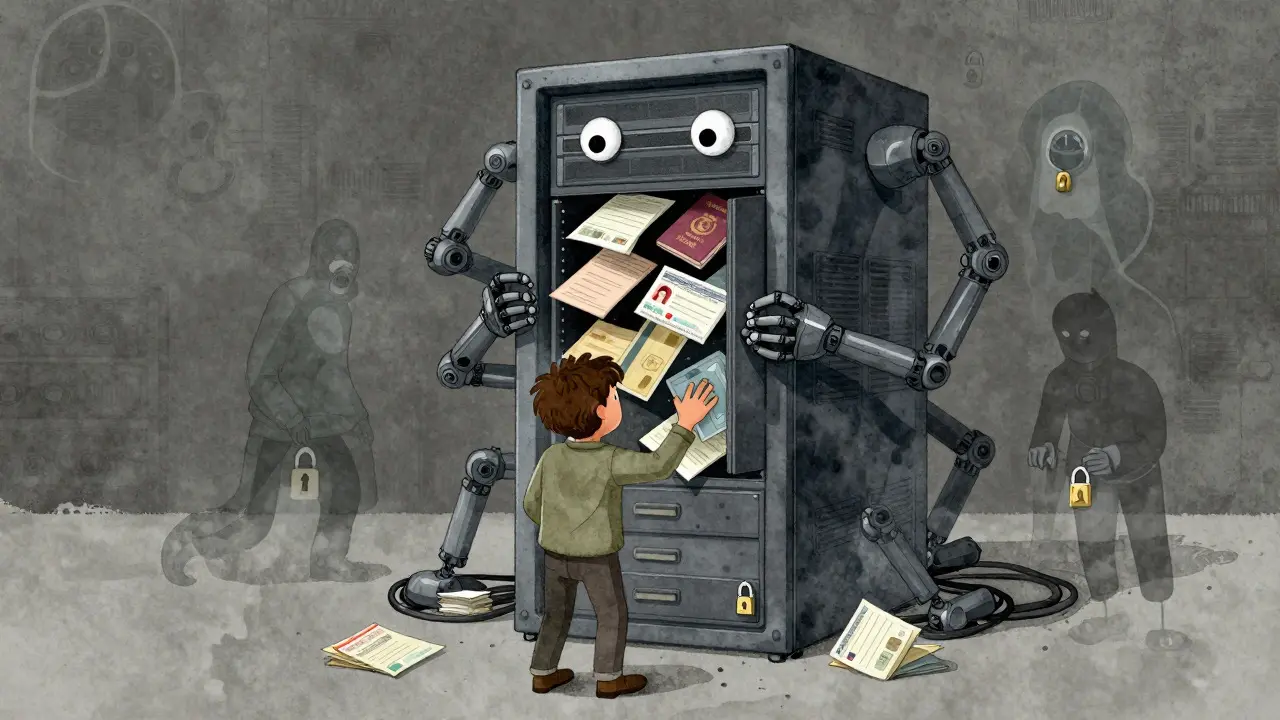
You know that sinking feeling when a website asks for your full date of birth just to confirm you’re over 18? It’s annoying. It’s unnecessary. And frankly, it’s dangerous. Every piece of personal data you hand over becomes a target for hackers, a liability for the company holding it, and a permanent scar on your digital footprint if things go wrong.
That era is ending. We are moving toward a new standard called Privacy-Preserving Identity Verification, which is a method allowing individuals to prove specific aspects of their identity without revealing unnecessary personal information. This technology flips the script: instead of handing over your entire life story to get verified, you only share the exact proof needed for the task at hand.
The Problem with Traditional Identity Checks
For decades, we’ve relied on centralized databases. When you sign up for a bank account or a social media platform, they copy your ID, store it in a server farm, and hope for the best. The problem? These systems are massive honeypots. A single breach can expose millions of records containing names, addresses, and passport numbers.
Traditional verification also suffers from "data hoarding." Companies collect more than they need because it’s easier to ask for everything upfront than to build complex logic to check specific attributes. This violates the core principle of data minimization found in regulations like the General Data Protection Regulation (GDPR) in Europe and the California Consumer Privacy Act (CCPA). If a company doesn’t have a legal reason to hold your data, holding it is a risk.
Privacy-preserving identity verification solves this by ensuring that verifiers never actually see the raw data. They only see the mathematical proof that the data meets certain criteria. No database to hack. No extra info to leak.
How It Actually Works: The Core Technologies
This isn’t magic; it’s advanced cryptography. Several technologies work together to make this possible. Understanding them helps you see why this is so secure.
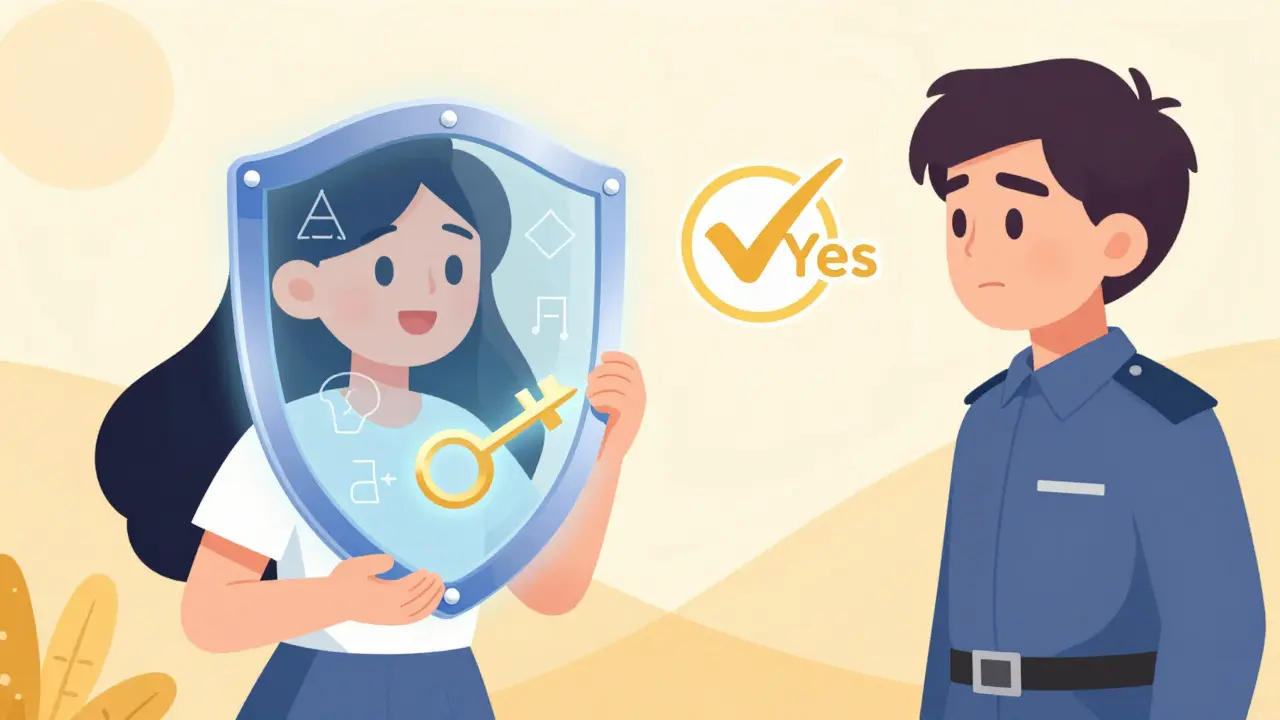
- Zero-Knowledge Proofs (ZKPs): This is the star of the show. A ZKP allows one party (the prover) to convince another party (the verifier) that a statement is true without revealing any information beyond the validity of the statement itself. For example, you can prove you are over 21 without revealing your birth year. The math confirms the age range is correct, but the actual number remains hidden.
- Decentralized Identifiers (DIDs): Instead of relying on a central authority like a government agency or a big tech company to issue an ID, DIDs allow you to create and control your own identifier. These are stored on a blockchain or distributed ledger, meaning no single entity can shut down your identity or steal the master key easily.
- Selective Disclosure: This feature gives you granular control. If a credential contains your name, address, and license number, selective disclosure lets you choose to reveal only your name while keeping the rest encrypted. You decide what gets shared, not the app developer.
- Secure Multi-Party Computation (SMPC): This allows multiple parties to jointly compute a function over their inputs while keeping those inputs private. It’s useful when several organizations need to verify something about you (like creditworthiness) without sharing your raw financial history with each other.
Together, these tools create a system where trust is established through mathematics rather than blind faith in a corporation’s security team.
Real-World Use Cases: Beyond the Hype
It’s easy to dismiss this as theoretical computer science, but it’s already being deployed in high-stakes industries. Here is how different sectors are using privacy-preserving verification right now.
| Industry | Use Case | Privacy Benefit |
|---|---|---|
| Banking & Fintech | KYC (Know Your Customer) and AML (Anti-Money Laundering) checks | Banks verify identity without storing sensitive documents, reducing regulatory liability and breach risks. |
| Healthcare | Patient identity verification for telemedicine and records access | Patients prove they are who they say they are without exposing medical history to third-party apps. |
| Government | Digital IDs and public service access | Citizens access services like voting or benefits without creating a centralized surveillance database. |
| Travel & Hospitality | Airport security and hotel check-ins | Passengers prove citizenship or visa status without handing over passports to every airline agent. |
| Gaming & Web3 | Age restriction enforcement and anti-fraud | Players prove they are adults to buy alcohol or enter mature games without linking their real-world identity to their avatar. |
In banking, for instance, Know Your Customer (KYC) processes are notoriously slow and invasive. With privacy-preserving methods, a bank can verify that your ID matches a government database entry without ever downloading your photo or address. The verification happens on-chain or via secure nodes, and the result is a simple "Yes" or "No" token.
Why Blockchain Is the Foundation
You might wonder why blockchain is mentioned here. Isn’t blockchain public? Yes, but that’s exactly why it works for privacy.
Blockchain provides an immutable, tamper-proof ledger. In the context of identity, it doesn’t necessarily store your personal data. Instead, it stores hashes (digital fingerprints) of credentials and Decentralized Identifiers (DIDs). Because the ledger is distributed across thousands of computers, no single hacker can alter the record of who issued what credential.
Projects like Ethereum and specialized layer-2 solutions are building infrastructure for Self-Sovereign Identity (SSI). SSI puts the user in charge. You hold your keys. You hold your credentials in a digital wallet. When you need to verify yourself, you present a cryptographic proof derived from those credentials. The blockchain acts as the neutral referee, confirming the signature is valid without seeing the content.
Challenges to Mass Adoption
Despite the promise, hurdles remain. Technology is only half the battle; human behavior and infrastructure are the other half.
- User Experience (UX): Cryptography is complex. For the average person, managing private keys and understanding wallets is intimidating. If the process takes more than three clicks, people will revert to password managers or worse, write passwords on sticky notes. Solutions must be invisible to the user.
- Computational Overhead: Generating zero-knowledge proofs requires significant computing power. While hardware is getting faster, mobile devices still struggle with heavy cryptographic operations. Optimizing algorithms for lightweight devices is a major focus for developers in 2026.
- Interoperability: There are many competing standards. A DID created on one blockchain might not be recognized by a verifier on another. Without universal protocols, we risk creating fragmented "walled gardens" of identity, defeating the purpose of decentralization.
- Recovery Mechanisms: In a truly decentralized system, if you lose your private key, you lose your identity. There is no "forgot password" button. Social recovery schemes exist, but they add complexity and potential attack vectors.
The Future: What Comes Next?
We are currently in the transition phase. Governments in the EU, Asia, and North America are piloting digital ID programs that incorporate these privacy features. By 2027, we expect to see mainstream adoption in high-value transactions like property sales and international travel.
The integration of Homomorphic Encryption will further enhance this space. This technique allows computations to be performed on encrypted data without decrypting it first. Imagine a credit bureau analyzing your spending habits to approve a loan without ever seeing your transaction details. That is the level of privacy we are heading toward.
For consumers, the benefit is clear: less spam, fewer breaches, and total control over your digital self. For businesses, it means lower compliance costs and higher customer trust. The question is no longer if we will adopt privacy-preserving identity verification, but how quickly we can overcome the technical friction to make it seamless.
What is the difference between traditional ID verification and privacy-preserving verification?
Traditional verification involves sending copies of your ID (like a passport scan) to a company, which stores it in a database. Privacy-preserving verification uses cryptography to prove facts about your identity (e.g., "I am over 18") without sending or storing the actual document or personal details.
Are Zero-Knowledge Proofs secure against future quantum computers?
Most current ZKP implementations rely on elliptic curve cryptography, which is vulnerable to quantum attacks. However, researchers are actively developing post-quantum cryptographic algorithms for ZKPs to ensure long-term security as quantum computing advances.
Do I need a blockchain wallet to use privacy-preserving identity?
Not necessarily. While the underlying technology often uses blockchain for anchoring Decentralized Identifiers (DIDs), the user interface can be a simple mobile app. You may interact with a "digital wallet" that holds your credentials, but it doesn't have to look or feel like a crypto trading wallet.
Can companies still track me if I use selective disclosure?
Selective disclosure prevents them from seeing your raw data, but metadata (like timestamps and IP addresses) can still be tracked. True anonymity requires combining selective disclosure with other privacy tools like mixers or anonymous networks, though most commercial solutions prioritize pseudonymity over complete anonymity.
Is privacy-preserving identity verification legally compliant?
Yes, it is often more compliant than traditional methods. Regulations like GDPR mandate data minimization. Since privacy-preserving systems do not store unnecessary personal data, they align perfectly with these laws, reducing legal risk for businesses.