
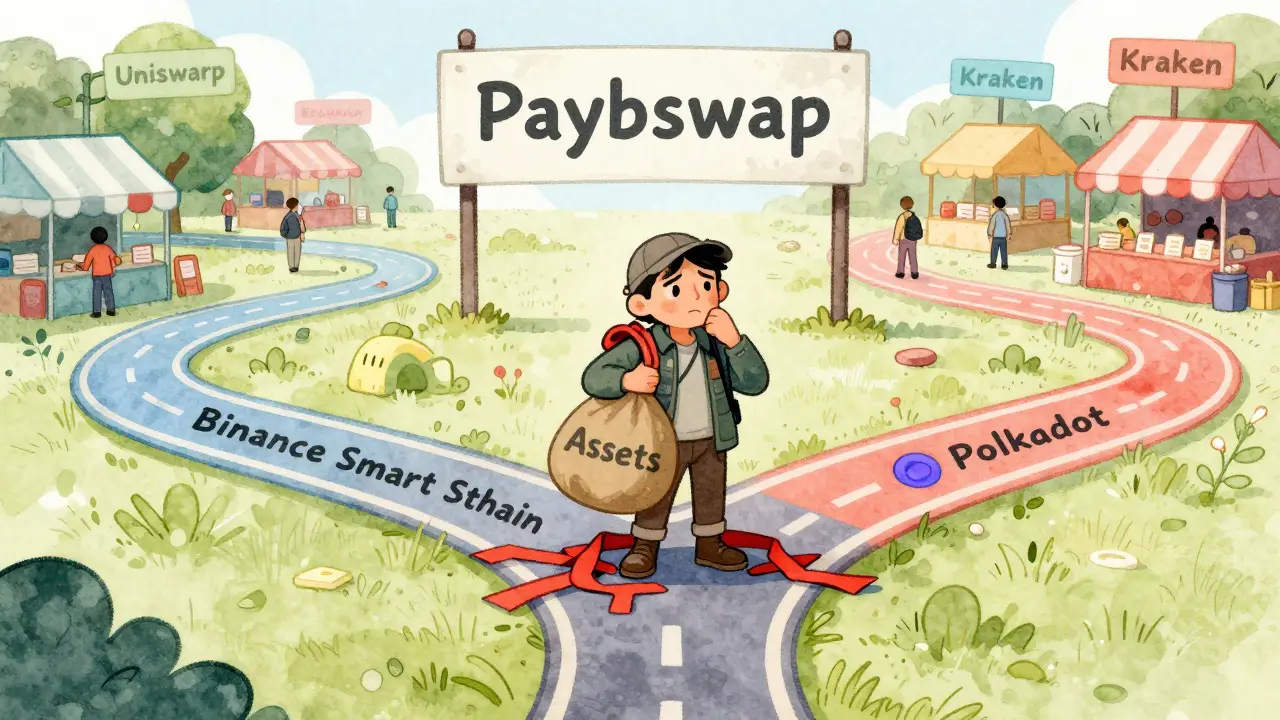
Trying to move assets between blockchains usually feels like a headache. You swap on one chain, bridge to another, wait for confirmations, and hope the bridge doesn't fail. That friction is exactly why Paybswap is a decentralized protocol and cross-chain automated market maker operating on multiple blockchain networks including Binance Smart Chain, Polkadot, and Ethereum. It promises to let you trade directly from Binance Smart Chain to Ethereum without leaving the platform, using Polkadot’s infrastructure as the connector.
But here is the hard truth about Paybswap in 2026: it is a ghost town compared to giants like Uniswap or centralized leaders like Kraken. While the technology sounds impressive on paper, the actual user experience, liquidity, and community trust are severely lacking. This review cuts through the marketing hype to tell you what actually happens when you try to use this platform today.
What Is Paybswap Really?
Paybswap isn’t your typical centralized exchange where you send money to a company and they hold it for you. It is a Decentralized Exchange (DEX). Specifically, it functions as an Automated Market Maker (AMM). In simple terms, instead of matching buyers with sellers order-by-order, you trade against a pool of funds provided by other users.
The main selling point is its cross-chain architecture. Most DEXs live on one blockchain. If you want to trade on Ethereum, you need Ethereum tokens. If you want to trade on BNB Chain, you need BNB. Paybswap tries to break that wall. It uses Polkadot’s cross-chain messaging infrastructure to enable interoperability between different blockchain ecosystems. Theoretically, this means you can hold assets on Binance Smart Chain and trade them for assets on Ethereum seamlessly within the same interface.
However, "theoretical" and "practical" are two very different things in crypto. Let’s look at how it stacks up against the competition.
Paybswap vs. The Giants: A Reality Check
In the 2026 crypto landscape, competition is fierce. To understand where Paybswap stands, we have to compare it to the platforms that actually dominate volume and user trust.
| Feature | Paybswap | Uniswap | Kraken |
|---|---|---|---|
| Type | Decentralized (Cross-Chain) | Decentralized (Multi-Chain) | Centralized (CEX) |
| Cross-Chain Native Support | Yes (via Polkadot) | Limited (Requires Bridges) | Yes (Internal Conversion) |
| KYC Requirement | No | No | Yes |
| Liquidity Depth | Very Low | Extremely High | High |
| User Base & Trust | Negligible | Dominant Leader | Top Rated (Best Overall) |
| Fees | Unknown/Variable | ~0.3% Standard | Tiered (Low for high volume) |
Look at that table. Uniswap leads the DEX space with massive liquidity across Ethereum, Polygon, and BNB Chain. Kraken is rated "Best Overall" for centralized trading due to its security and reliability. Paybswap? It has no visible market share, no clear fee structure, and minimal user activity. When a token shows a price of C$0 CAD or ₽0 RUB on tracking sites, it usually means there is no active trading pair or the liquidity is so thin it’s effectively zero.
The Cross-Chain Promise vs. The Bridge Risk
The core innovation of Paybswap is its reliance on Polkadot’s parachain ecosystem and XCM (Cross-Consensus Messaging) format to transfer value between heterogeneous chains. This is technically sophisticated. Polkadot was designed specifically to solve the fragmentation problem in crypto.
However, complexity brings risk. Every time you bridge assets between chains, you are trusting a piece of code and often a set of validators. In 2025 and 2026, bridge hacks were among the most common security failures in DeFi. By abstracting this process into a single click, Paybswap makes it easy for users, but if the underlying cross-chain module fails or gets exploited, your funds could be stuck or stolen.
Unlike established bridges that have undergone multiple audits and years of battle-testing, Paybswap lacks public documentation on its security history. There are no widely cited audit reports from firms like CertiK or OpenZeppelin available in mainstream search results. For a platform handling cross-chain transfers, this silence is deafening.
Liquidity and Slippage: The Hidden Cost
You might think, "Well, if I only trade small amounts, does it matter?" Yes, it matters. Here is why:
- Slippage: Liquidity is the amount of money in the trading pools. Deep liquidity means you can sell $10,000 worth of tokens without dropping the price significantly. Shallow liquidity means selling $100 could drop the price by 5%. Given Paybswap’s low visibility, its pools are likely shallow. You will lose more value to slippage than you save on fees.
- Price Impact: With few traders, the buy/sell spread is wider. You get a worse entry price and a worse exit price compared to high-volume exchanges.
- Failed Transactions: On congested or poorly optimized networks, transactions fail. Without robust support channels (which Paybswap lacks), you are left guessing why your transaction didn’t go through while still paying gas fees.
Compare this to Pioneex.US, which offers fees as low as 0.1% by aggregating liquidity from major exchanges like Binance and Huobi. Even though Pioneex is a different model, it highlights that efficiency comes from scale and aggregation, not just novel architecture.
Security and Regulatory Status
In 2026, regulatory compliance is no longer optional for serious players. Major exchanges are aggressively pursuing licenses in the EU and US. Kraken and Coinbase lead this charge. Paybswap operates in a gray area. As a decentralized protocol, it argues it cannot be regulated because no central entity controls it. But that also means no recourse if something goes wrong.
There is no information on whether Paybswap complies with Anti-Money Laundering (AML) standards. While this appeals to privacy advocates, it raises red flags for institutional adoption and long-term viability. If regulators decide to target cross-chain protocols for facilitating illicit flows, obscure platforms like Paybswap are often the first to shut down or freeze access.
User Experience and Support
I tried to find recent user reviews on Trustpilot, G2, or Reddit. The result? Silence. There are no significant communities discussing Paybswap. No Discord servers buzzing with developers. No Twitter sentiment analysis showing growth.
This absence of community is a critical metric. In crypto, community equals survival. Projects with active communities weather bear markets and technical issues. Projects without them vanish. Paybswap appears to be in the latter category. If you encounter a bug, a failed swap, or a locked wallet, who do you call? There is no customer support team listed. You are on your own.
Should You Use Paybswap in 2026?
Honestly? Probably not. Unless you are a developer testing specific cross-chain mechanics on Polkadot for educational purposes, there is little reason to put real capital into Paybswap right now.
If you want decentralized trading, stick with Uniswap. It has the deepest liquidity, highest security standards, and broadest multi-chain support in the DEX sector. If you need cross-chain convenience without managing keys, use a reputable centralized exchange like Kraken or Coinbase, which offer secure internal conversions between assets on different blockchains.
Paybswap represents an interesting technical concept-using Polkadot to unify fragmented chains. But concepts don’t pay bills. Liquidity, security, and trust do. And currently, Paybswap has none of those in abundance.
Alternatives to Consider
Instead of risking your funds on an unproven protocol, consider these alternatives based on your needs:
- For Pure DeFi Trading: Use Uniswap or SushiSwap. They are battle-tested, have massive liquidity, and support multiple chains via simple bridging tools.
- For Beginners: Stick to Coinbase or Kraken. They handle the complexity of different blockchains behind the scenes. You just see Bitcoin, Ethereum, etc., regardless of where they sit.
- For Yield Farming: Look at Aave or Compound. They offer better transparency and deeper liquidity for lending and borrowing strategies.
- For Cross-Chain Swaps: Use specialized aggregators like Changelly or fixed-rate services that partner with multiple liquidity providers, rather than relying on a single obscure DEX.
Is Paybswap safe to use?
Safety in crypto depends on code audits and liquidity depth. Paybswap lacks public audit reports from reputable firms and has very low liquidity. This increases the risk of smart contract exploits and high slippage. It is generally considered higher risk than established platforms like Uniswap or Kraken.
How does Paybswap compare to Uniswap?
Uniswap is the market leader in decentralized exchanges with billions in daily volume and deep liquidity across many chains. Paybswap focuses on native cross-chain trading via Polkadot but suffers from negligible user adoption and liquidity. Uniswap is safer and more efficient for most traders.
What are the fees on Paybswap?
Specific fee structures for Paybswap are not publicly documented in reliable sources. However, as a DEX, you will still pay network gas fees on Binance Smart Chain, Ethereum, and Polkadot. These gas fees can vary wildly depending on network congestion, potentially making small trades uneconomical.
Does Paybswap require KYC?
Like most decentralized exchanges, Paybswap does not require Know Your Customer (KYC) verification. You connect your wallet and trade anonymously. However, this lack of regulation also means there is no customer support or recovery option if you make a mistake or fall victim to a scam.
Why is Paybswap's token price showing as zero?
A price of zero or near-zero on trackers like CoinMarketCap usually indicates a lack of active trading pairs or extreme illiquidity. It suggests that there are very few people buying or selling the token, making it difficult to determine a fair market value or execute trades without significant price impact.