
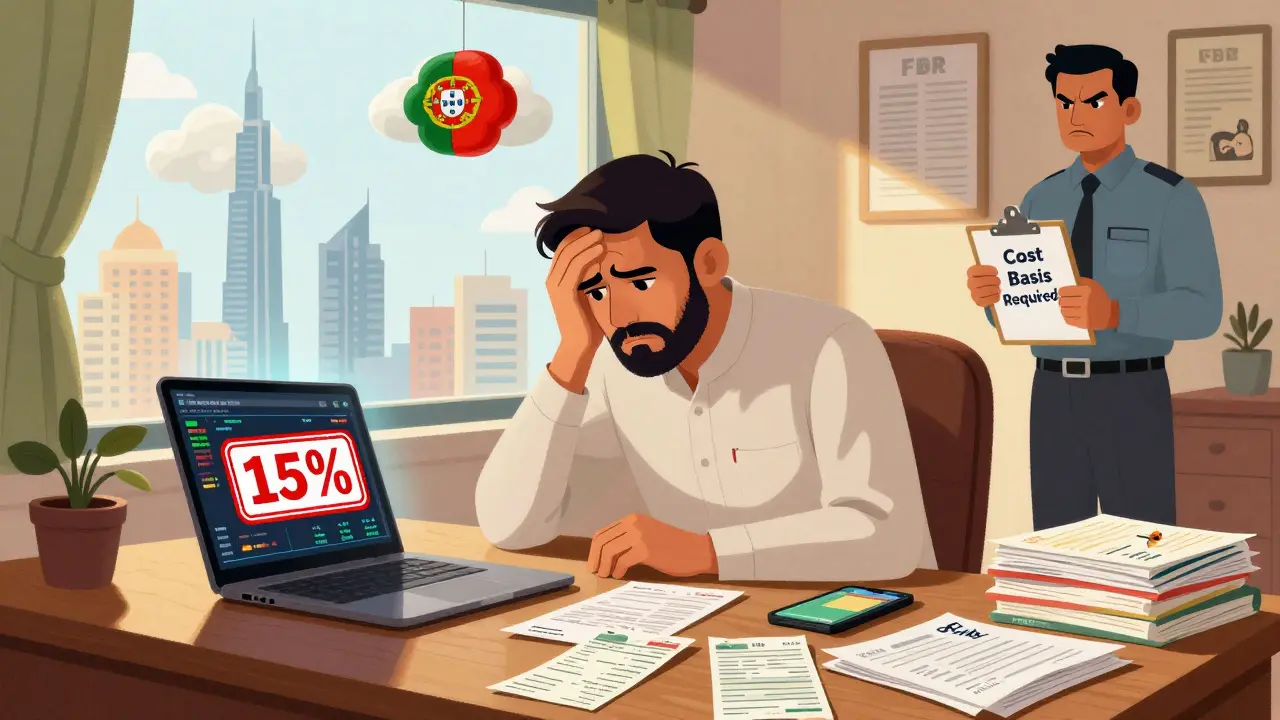
There’s a lot of noise online about Pakistan cutting crypto taxes to 0%. You’ve probably seen headlines claiming the government is ditching the 15% capital gains tax on cryptocurrency profits. That’s not true. As of March 2026, Pakistan still imposes a flat 15% tax on crypto profits - and there’s no official plan to drop it to 0%.
Why the Confusion?
The idea that Pakistan is moving to 0% crypto taxes likely comes from mixing up news from other countries. Places like Portugal, Dubai, and Singapore have zero crypto taxes for individuals. Some traders in Pakistan, hoping for similar treatment, started sharing rumors on Reddit and Telegram. One popular post from May 2025 said, "They’re going 0% like the UAE," and it got over 2,000 upvotes. But no government document, press release, or Finance Ministry statement supports that claim.The real story is simpler: Pakistan introduced a 15% capital gains tax on crypto in July 2025. It was part of a broader effort to bring digital assets into the formal economy. Before that, crypto was legally gray - you could buy and sell, but the government didn’t track it or tax it. Now, every time you sell Bitcoin, Ethereum, or any other coin for Pakistani rupees and make a profit, you owe 15% of that gain to the Federal Board of Revenue (FBR).
How the Tax Actually Works
It’s not complicated, but it’s easy to mess up. Here’s how it breaks down:- You pay 15% only when you sell crypto for fiat (PKR), not when you trade one coin for another.
- There’s no difference between holding crypto for 1 day or 1 year - short-term and long-term gains are taxed the same.
- If you made a profit of ₨100,000 from selling Bitcoin, you owe ₨15,000 in tax.
- There’s a small exemption: if your total annual crypto profit is under ₨50,000, you don’t pay anything.
What people often get wrong is thinking mining, staking, or airdrops are tax-free. They’re not. If you earn 0.5 BTC from staking, that’s treated as income. You have to calculate its value in PKR on the day you received it and add it to your annual income. Then you pay income tax on it - which can be as high as 35% if you’re in the top bracket.
Who’s Affected?
About 12.7 million Pakistanis owned crypto by late 2025, according to Chainalysis. That’s over 5% of the population. Most are retail traders - students, freelancers, small business owners. They’re not hedge funds. They’re people using crypto to send money to family abroad, avoid currency devaluation, or make extra income.But here’s the catch: the tax system wasn’t built for them. The FBR website doesn’t have a crypto tax form. You can’t just log in and file like you would for salary income. Instead, you have to manually track every purchase, sale, and transfer since you started trading - even if you bought your first Bitcoin in 2020. You need to convert all those old transactions into PKR using the exchange rate from the day you made them. Most people don’t have those records.

The Real Problem: Tracking Old Transactions
Imagine you bought 0.2 BTC in January 2022 for ₨120,000. Today, you sell it for ₨1,000,000. Your gain is ₨880,000. Tax due: ₨132,000. But you don’t have the receipt. You don’t have the screenshot. You used a peer-to-peer app, paid in cash, and never saved the chat. Now the FBR says you owe tax - but you can’t prove your cost basis. That’s a legal nightmare.A survey by the Pakistan Fintech Association found that 72% of crypto users are unsure how to calculate their gains for holdings made before July 2025. The government hasn’t given them a clear method. Some use the lowest price in 2024. Others use the average price on Binance. There’s no rule. That’s why third-party tools like Koinly and CoinTracker have exploded in popularity. Over 28,000 Pakistani users have connected their wallets to these platforms as of October 2025.
What About Exchanges?
Binance, Bybit, and other international platforms don’t report to Pakistan. But local exchanges like Rain and Coinswitch are now required to share transaction data with the FBR starting mid-2025. That means if you traded on Rain, they’ll send your entire history to the tax authority. If you only used international platforms, you’re still on the hook - but you’re flying blind.Trustpilot reviews of Pakistani crypto platforms show a pattern: users praise automated tax reports from Binance Pakistan (launched June 2025), but 63% of negative reviews complain about "confusing calculations for DeFi yields." If you earn interest from lending crypto on Aave or Compound, you’re supposed to report that as income. But the value changes hourly. How do you track it? Most people just guess.

How Pakistan Compares to Other Countries
Pakistan’s 15% flat rate isn’t the worst. India taxes crypto gains at 30% plus 1% TDS. The U.S. taxes crypto gains at 0-20% depending on income and holding period. But Pakistan has one major flaw: no long-term discount.In Germany, if you hold crypto for over a year, you pay 0% tax. In Switzerland, it’s 0% after six months. In Pakistan? Same 15% whether you held it for 7 days or 7 years. That’s a problem. It pushes people toward short-term trading - the exact opposite of what you want in a growing market. Experts like blockchain analyst Fahad Shahbaz warn this could scare away serious investors who look for stable, long-term environments.
On the flip side, Pakistan’s rate is better than India’s and more predictable than Bangladesh’s proposed 10% rate - which still hasn’t passed parliament. And unlike El Salvador, where Bitcoin is legal tender and gains are tax-free, Pakistan isn’t trying to become a crypto haven. It’s trying to collect revenue.
What’s Next?
The Pakistan Digital Assets Authority (PDAA) announced draft rules in October 2025 for "long-term holding incentives." That sounds promising. Maybe they’ll cut the tax to 10% for holdings over a year, or 5% for two years. But as of March 2026, those rules haven’t been finalized. No law has been passed. No official announcement has been made.The FBR is training 5,000 chartered accountants on crypto taxation between November 2025 and January 2026. That’s a sign they’re serious about enforcement. By 2026, you’ll likely see audits. You’ll likely see penalties for unreported gains.
And here’s the bottom line: there’s no 0% tax plan. Not now. Not next year. Not unless the government changes course completely. The 15% rate is here to stay - at least for now.
What Should You Do?
If you trade crypto in Pakistan:- Use a crypto tax tool like Koinly or CoinTracker. They’re not perfect, but they’re better than spreadsheets.
- Keep screenshots of every transaction - buys, sells, staking rewards, airdrops.
- Don’t assume your exchange will report for you. Most won’t.
- Start tracking your cost basis for every asset you owned before July 2025. Even if you think you lost the data, try checking old emails, wallet backups, or blockchain explorers.
- If your annual profit is under ₨50,000, you’re safe. But if you’re over that, prepare to file.
The government isn’t trying to crush crypto. They’re trying to bring it into the light. That’s a good thing - if you’re ready for it. But pretending the tax doesn’t exist won’t make it disappear. And hoping for 0% won’t save you from an audit.
Is there really a 0% capital gains tax on crypto in Pakistan?
No. Pakistan has a flat 15% capital gains tax on cryptocurrency profits as of July 2025. There is no official policy, law, or government announcement that lowers this rate to 0%. Claims about a 0% tax are rumors, often confused with policies in countries like Dubai or Portugal.
What happens if I don’t report my crypto gains?
If you don’t report, you risk an audit. The Federal Board of Revenue (FBR) is now receiving transaction data from local exchanges like Rain and Coinswitch. If your trading activity shows large profits and you haven’t filed, you could face penalties, interest charges, or even legal action. The government has started training accountants specifically to identify crypto tax evasion.
Are staking rewards and mining income taxed?
Yes. Any crypto you earn from staking, mining, or airdrops is treated as income. You must report its value in Pakistani rupees on the day you received it. This income is added to your total annual earnings and taxed at your regular income tax rate - which can be up to 35% if you earn over ₨12 million per year.
Do I have to pay tax if I trade crypto for crypto?
Yes. Swapping Bitcoin for Ethereum, or Dogecoin for Solana, counts as a taxable event. You must calculate the value of the crypto you sold in PKR at the time of the trade, then determine your profit or loss. If you made a profit, you owe 15% on that gain. This is different from countries like the U.S., where crypto-to-crypto trades aren’t always taxed - but in Pakistan, they are.
Is there a way to legally reduce my crypto tax bill?
Only one: keep your annual profit under ₨50,000. That’s the exemption threshold. Beyond that, there’s no legal deduction for holding longer, no loss carryforward, and no capital gains discount. The best strategy is to track your cost basis accurately and use tools like Koinly to avoid overpaying. Some traders also spread sales across multiple years to stay under the threshold - but this requires careful planning.
Will Pakistan ever lower the crypto tax rate?
Possibly, but not soon. The Pakistan Digital Assets Authority has signaled interest in introducing long-term holding discounts - maybe 10% for assets held over a year. But no law has been drafted or approved as of March 2026. Any change would require parliamentary approval and public consultation. Don’t assume a reduction is coming. Plan based on the current 15% rate.
Comments
Adam Ashworth
Let’s be real - this 15% tax is the least bad option Pakistan has right now. I’ve seen how people in emerging markets use crypto to dodge inflation, and honestly? The FBR is trying to bring order without crushing innovation. The real issue isn’t the rate - it’s the lack of infrastructure. No automated forms? No clear guidance on cost basis? That’s bureaucratic laziness, not policy malice.
They should’ve rolled out a simple dashboard with auto-import from Rain and Coinswitch. Instead, they’re forcing 12 million people to dig through 2020-era screenshots. That’s not taxation - that’s punishment by paperwork.
March 12, 2026 AT 14:44
Allison Davis
One thing everyone’s missing: staking rewards are income, not capital gains. That’s huge. If you earn 0.3 ETH from staking and it’s worth ₨45,000 that day, you’re taxed at your income bracket - up to 35%. But if you sell it later for ₨60,000? Only the ₨15,000 gain gets the 15%. Most people just lump it all together and overpay. Koinly helps, but you still need to know the difference.
March 14, 2026 AT 14:40
Tom Jewell
There’s a quiet tragedy here - people aren’t being taxed for speculation. They’re being taxed for survival. Imagine you’re a freelance designer in Lahore, paid in USDT because your bank won’t let you receive USD. You convert it to PKR to pay rent. The government sees ‘crypto profit’ - not ‘survival mechanism.’
The 15% isn’t evil. It’s tone-deaf. It assumes crypto is a luxury. For millions here, it’s a lifeline. And now they’re being asked to prove they didn’t steal their way out of poverty - with receipts from 2021.
We talk about innovation. But innovation without dignity is just exploitation dressed in blockchain.
March 15, 2026 AT 16:16
vishnu mr
bro u all are overthinking this lol
15% is nothing compared to india's 30%
at least pakistan has a clear rule
in india they just randomly audit u and say 'u owe 2 lakhs' and u have no way to prove u didnt make profit
here u at least know the number
just use cointracker and chill
March 15, 2026 AT 17:57
Grace van Gent-Korver
I love how Pakistan is trying to bring crypto into the light. That’s actually admirable. In the U.S., we treat it like a black market. Here, they’re trying to regulate it - even if clumsily. The real win isn’t the tax rate. It’s that they recognize it as real economic activity. That’s progress.
March 16, 2026 AT 18:23
Zephora Zonum
Of course the government didn’t drop it to 0% - that would be a joke. Only idiots think crypto should be tax-free. You think Elon Musk would be rich if Bitcoin was untaxed? No - he’d be just another guy with a Twitter account. This tax is fair. It’s not about punishment. It’s about accountability. People who get rich off volatility should pay their share. And if you can’t track your trades? That’s your fault. Not the system’s.
March 18, 2026 AT 09:35
Anthony Marshall
STOP listening to the haters. This 15% tax? It’s a gift. It means Pakistan is finally taking crypto seriously - not ignoring it like a teenager with a vape. You think Dubai got rich by letting people trade in the shadows? No. They built infrastructure. They created rules. And now they’re the global hub.
Pakistan’s doing the same. Yes, the system’s messy. But that’s phase one. Phase two? Automated filings. Phase three? Long-term discounts. You want 0%? Be patient. Build. Adapt. Don’t cry because the rules changed - learn them.
March 19, 2026 AT 01:42
Lindsay Girvan
15% is a joke. You hold for 7 years? Still 15%. You hold for 7 days? Still 15%. That’s not taxation - that’s theft with a spreadsheet. No country with real ambition taxes short-term and long-term the same. This isn’t a policy. It’s a panic. They’re scared of losing control. So they slap on the same rate and call it ‘fair.’ It’s not. It’s lazy.
March 19, 2026 AT 22:08
Douglas Anderson
I’ve helped a dozen Pakistani freelancers file their crypto taxes this year. The biggest problem? They don’t know what counts as income. Airdrops? Yes. Staking rewards? Yes. Even if you get 0.001 BTC from a referral bonus - that’s taxable.
And here’s the kicker: if you bought Bitcoin in 2020 for $200 and sold it for $60,000? You owe tax on $59,800 - even if you never touched the money. You need to convert every transaction to PKR on the day it happened. That’s brutal.
Use CoinTracker. Save screenshots. And for god’s sake, don’t assume your exchange will save you. They won’t.
March 20, 2026 AT 08:05
Tina Keller
There’s something poetic about this. Pakistan - a country with a history of currency instability - is trying to tame the very thing that helps people escape it. The 15% tax isn’t about revenue. It’s about integration. They’re saying: crypto isn’t a shadow economy anymore. It’s part of the national financial fabric.
And yes, the implementation is messy. But look at how many people are using Koinly. That’s not just compliance - that’s adoption. People aren’t fleeing the system. They’re learning how to work within it. That’s the quiet revolution here.
March 21, 2026 AT 00:47
vasantharaj Rajagopal
From a regulatory standpoint, the absence of a cost basis reconciliation mechanism for pre-July 2025 holdings constitutes a material compliance gap. The FBR’s failure to establish a deemed acquisition value protocol - whether based on historical Binance median, or a sliding scale derived from Chainalysis data - introduces significant uncertainty in tax liability calculation. This undermines the principle of legal certainty in fiscal law. Without a safe harbor provision, the tax regime becomes ex post facto in effect.
March 21, 2026 AT 00:53
ann neumann
They’re not taxing crypto. They’re weaponizing it. This isn’t about revenue - it’s about control. The FBR doesn’t care if you owe 15k or 150k. They care that you’re forced to hand over your entire trading history. Every wallet. Every timestamp. Every P2P chat. Why? Because once they have your data, they can track you. They can flag you. They can shut you down. And if you’re a freelancer sending money abroad? That’s suspicious. That’s ‘capital flight.’
They call it ‘bringing crypto into the light.’ I call it a digital surveillance net. And the 15%? That’s just the bait.
March 21, 2026 AT 04:28
William Montgomery
You people are acting like this tax is the end of the world. It’s not. It’s a hurdle. And if you’re smart, you turn it into a competitive advantage. If you’re the only one in your network who tracks everything? You’ll be the one they ask to help file. You’ll be the one who gets hired as a crypto consultant. This isn’t punishment - it’s a filter. The weak will quit. The smart will thrive.
March 22, 2026 AT 19:39
Mara Alves Mariano
Oh wow, a 15% tax? How original. Meanwhile, in Dubai, people are sipping kefir on yachts while their crypto gains are 0%. In Portugal, they’re buying islands with Bitcoin. And here? You’re scrambling to find a 2022 screenshot of a P2P trade because some bureaucrat decided crypto isn’t ‘real money’ until you fill out Form 7B-Δ.
Let me guess - next they’ll tax your WhatsApp voice notes. At least the UAE has vision. Pakistan has a spreadsheet.
March 23, 2026 AT 02:06
Sherry Kirkham
This is actually a really balanced approach. Yes, it’s not perfect - but compared to India’s 30% + TDS? This is a win. The real story here isn’t the rate. It’s that Pakistan is trying to build a framework. Most countries don’t even try. They just ban it. This? This is the first step toward legitimacy. And legitimacy attracts real capital. Not the kind that hides. The kind that builds.
March 24, 2026 AT 16:05
Jennifer Pilot
I find it deeply concerning that the FBR has not yet issued a formal circular on the treatment of DeFi yield accruals under Section 12B(4) of the Income Tax Ordinance, 2001. Furthermore, the absence of a recognized valuation methodology for cross-chain swaps - particularly those involving wrapped assets - introduces material uncertainty into the calculation of taxable events. This is not merely administrative inefficiency - it is a violation of the principle of tax certainty enshrined in OECD guidelines.
March 25, 2026 AT 16:46
Sharon Tuck
If you’re stressed about this, you’re not alone. But here’s the thing - you’re not just paying tax. You’re building a future. Every time you log into Koinly, every time you save a screenshot, you’re proving that crypto isn’t just a gamble. It’s a livelihood. And that matters. The FBR isn’t your enemy. They’re just slow. But you? You can be the one who makes it better. Start small. Document. Share. Help someone else. That’s how change happens.
March 26, 2026 AT 12:43
karan narware
Oh wow, 15%? How quaint. In India, we pay 30% and they still don’t know if staking is income or capital gain. At least here they have a number. The real joke? People complaining about paperwork while using Telegram groups to buy Dogecoin from strangers. You want transparency? Start by not losing your 2021 transaction history. Then come back.
March 27, 2026 AT 09:13
Michael Suttle
This is a trap. The FBR is using crypto taxes to build a national surveillance database. Every wallet you connect. Every exchange you use. Every screenshot you upload. They’re collecting fingerprints. And when they have enough data? They’ll start freezing accounts. ‘Suspicious activity.’ ‘Unexplained income.’ You think this is about money? No. It’s about control. The 15%? Just the first step.
March 29, 2026 AT 06:12
Jenni James
Let me clarify something for the uneducated masses: crypto-to-crypto trades are taxable events under Pakistan’s Income Tax Ordinance, 2001, Section 2(29). This is not a suggestion. It is a legal requirement. The fact that you didn’t know this speaks volumes about your financial literacy. If you can’t handle basic accounting, you shouldn’t be trading. Period.
March 31, 2026 AT 00:48
Chelsea Boonstra
So… if I sell ETH for PKR and then immediately buy BTC with it - that’s TWO taxable events? Both the sale and the purchase? So I’m taxed on the gain from ETH, then taxed again on the BTC I bought? That’s insane. Is there a loophole? Or is this just designed to screw retail traders?
March 31, 2026 AT 03:19
Alex Thorn
There’s a quiet dignity in this. People aren’t running from the system. They’re learning it. They’re using tools. They’re helping each other. That’s not rebellion. That’s community. The tax is harsh. But the response? That’s beautiful. In a country where trust in institutions is low, people are building their own infrastructure - not to evade, but to engage. That’s the real story.
March 31, 2026 AT 21:29
Howard Headlee
Stop whining. This tax? It’s a gift. It means crypto is real here. Not a meme. Not a scam. A legitimate asset class. And if you’re smart? You use this as a stepping stone. Start a YouTube channel. Build a Koinly tutorial. Offer tax help to your friends. Turn this mess into your business. The FBR didn’t create a problem - they created an opportunity. Go grab it.
April 1, 2026 AT 13:23
Julie Tomek
While the 15% flat rate on capital gains is administratively straightforward, its failure to differentiate between short-term speculation and long-term investment represents a significant economic distortion. Empirical studies from Germany and Switzerland demonstrate that holding-period-based exemptions encourage capital retention and market stability. Pakistan’s current framework incentivizes churn - the antithesis of sustainable asset growth. Furthermore, the absence of loss carryforward provisions exacerbates volatility, effectively penalizing risk-taking in an emerging market. This is not taxation. It is macroeconomic sabotage disguised as regulation.
April 2, 2026 AT 16:10
Craig Gregory
Let’s not pretend this is about fairness. The FBR doesn’t care if you’re a student or a freelancer. They care about revenue. And they’re using crypto as a cash cow. The ‘exemption’ under ₨50k? That’s just to make the numbers look better. The real targets? People who make ₨200k+ a year. They’ll get audited. Hard. And the tools? Koinly? They’re not helping you. They’re feeding data to the FBR. You’re not compliant. You’re being tracked.
April 4, 2026 AT 02:58