

When you trade crypto, do you ever feel like you’re jumping between five different apps just to get the best price? You check Binance for ETH/USDT, then switch to Uniswap because the spread is tighter, and finally hop over to KuCoin to catch a quick arbitrage. It’s exhausting. That’s where Orion Protocol comes in - not as another exchange, but as a bridge between them all.
What Is Orion Protocol?
Orion Protocol isn’t a traditional exchange like Binance or Coinbase. It’s a deCEX - a hybrid between a centralized exchange (CEX) and a decentralized exchange (DEX). Launched in 2021, it pulls liquidity from over 20 major platforms, including Binance, KuCoin, PancakeSwap, and QuickSwap, and lets you trade across them all through one interface. You don’t need separate accounts. You don’t need to move your funds between wallets. You just log in, pick your trade, and Orion finds the best rate across the entire crypto market.
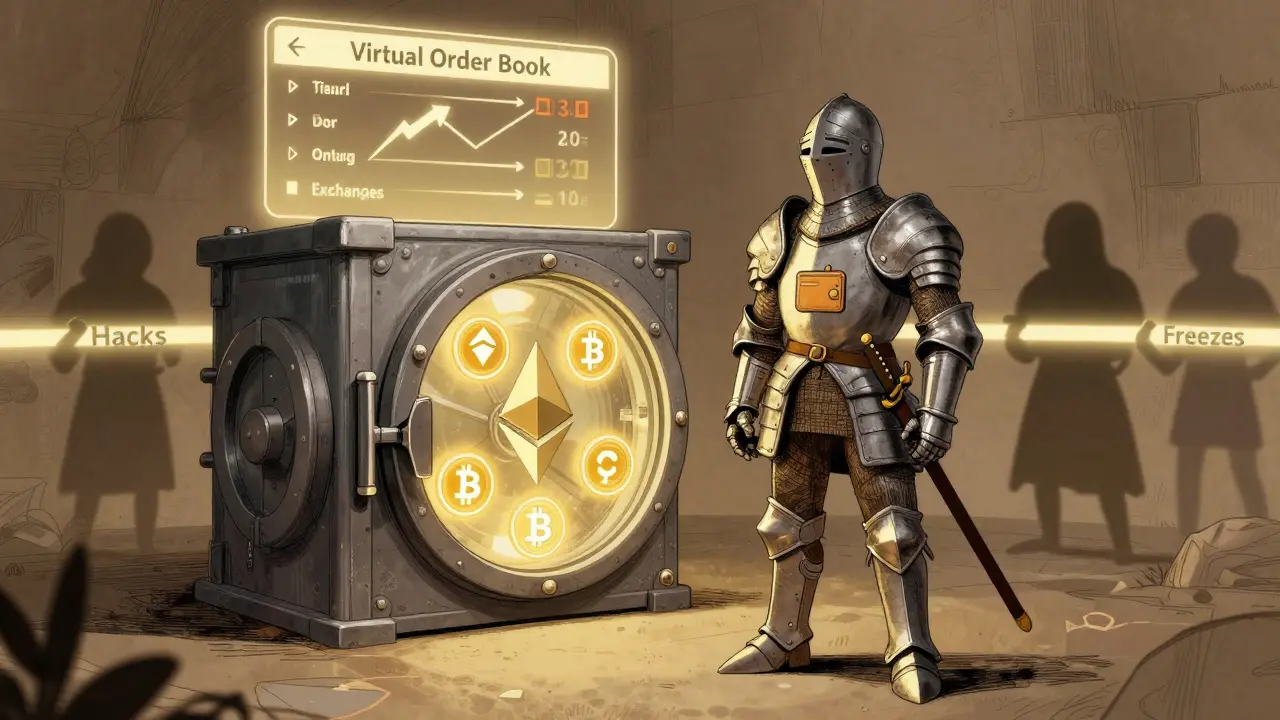
The magic lies in its Virtual Order Book. Unlike most DEXs that rely on Automated Market Makers (AMMs), which often suffer from slippage and poor liquidity on small pairs, Orion’s VOB executes trades off-chain. It matches orders like a traditional exchange, then settles them on-chain. This cuts latency, reduces price impact, and gives you tighter spreads - especially on less popular tokens.
How It Works: No Custody, Full Control
One of Orion’s biggest selling points is that it’s non-custodial. That means your crypto never leaves your wallet. When you place a trade, Orion connects directly to your connected wallet - MetaMask, WalletConnect, or others - and signs transactions on your behalf. No deposits. No withdrawals. No risk of exchange hacks.
This isn’t just a security feature. It’s a mindset shift. Most exchanges want you to trust them with your assets. Orion wants you to keep control. That’s why it works with hardware wallets, supports multi-sig setups, and doesn’t ask for KYC. If you’re tired of handing over your keys to platforms that get hacked or freeze accounts, Orion gives you a cleaner alternative.
The ORN Token: Necessary or Just a Tax?
Here’s the catch: to unlock full features - like zero fees, advanced trading tools, and staking rewards - you need to hold the native ORN token. It’s not optional for premium access. You can trade without it, but you’ll pay standard fees. Hold ORN, and those fees drop to 0% for both makers and takers.
But here’s the real kicker: Orion doesn’t just use ORN as a fee discount. It’s built into its entire business model. The platform uses a system called Delegated Proof of Broker (DPoB), where users can stake ORN to become brokers. These brokers use high-volume trading accounts on CEXs to execute trades for others, earning rebates and sharing profits. It’s a clever way to turn passive token holders into active market participants.
Still, if you’re new to crypto, this adds friction. You need to buy ORN first. And if the token drops, your access to lower fees shrinks. It’s a classic crypto trade-off: utility vs. volatility.
Performance: Fast, But Not Popular
Orion’s tech looks solid. But numbers don’t lie. According to traffic data, Orion gets only about 2,938 monthly visits - less than 0.5% of what Binance sees. Its bounce rate is 42%, and users stay for an average of just 4.44 seconds. That’s not a sign of efficiency. It’s a sign of confusion or frustration.
Why? Two reasons: poor customer support and a lack of clear onboarding. Users report long wait times for help. Documentation is sparse. If you’re used to Coinbase’s polished interface or Kraken’s 24/7 live chat, Orion feels like a beta release. It works - but it doesn’t guide you.
And while it aggregates liquidity from big exchanges, it doesn’t always have deep order books for niche tokens. If you’re trading a new memecoin that’s only listed on one small DEX, Orion might not find it. Its strength is in major pairs: BTC, ETH, SOL, USDT. For everything else, you might still need to go elsewhere.
How It Compares to the Competition
Let’s put Orion next to its closest rivals:
| Feature | Orion Protocol | Uniswap v3 | 1inch Network | Binance (CEX) |
|---|---|---|---|---|
| Type | DEX/CEX Aggregator | DEX Only | DEX Aggregator | Centralized Exchange |
| Liquidity Sources | 20+ CEXs + DEXs | On-chain DEXs only | 10+ DEXs | Binance’s own order book |
| Fee Structure | 0% with ORN token | 0.3% per trade | 0.1%-0.5% | 0.1% (maker), 0.1% (taker) |
| Custody | Non-custodial | Non-custodial | Non-custodial | Custodial |
| Order Type | Limit, Market, Stop-Loss | Market only | Limit, Market | Full CLOB |
| Best For | Traders wanting cross-exchange best prices | Simple swaps on Ethereum | Best DEX prices on Ethereum | High volume, regulated trading |
Orion stands out because it’s the only one that pulls from both CEXs and DEXs. 1inch and Curve only look at DEXs. Binance only has its own liquidity. Orion tries to have it all. But that also makes it more complex.

Who Is Orion For?
Orion isn’t for beginners. If you’re just buying Bitcoin and holding, skip it. It’s not for casual traders who want one-click swaps.
It’s for:
- Active traders who want the best price across all markets without juggling 10 wallets
- Users who hate giving up custody of their assets
- Those who already hold ORN and want to use it for fee discounts and staking rewards
- People tired of slippage on DEXs and want near-CEX execution without KYC
If you fit this profile, Orion is one of the few tools that can genuinely save you time and money. But if you’re not already deep into DeFi, the learning curve might not be worth it.
The Risks: Unregulated and Under-Adopted
Orion isn’t regulated by any government body. That means no investor protection, no insurance on funds, and no legal recourse if something goes wrong. It’s pure crypto - trust the code, not the company.
And adoption is still low. With only 2,938 monthly visits, it’s a niche player. That’s fine if you’re in that niche. But if Orion’s user base doesn’t grow, liquidity won’t improve. And if liquidity doesn’t improve, the whole model breaks.
Also, ORN’s price is volatile. If you stake it for rewards and the value drops 40%, your fee savings vanish. You’re betting on the token’s long-term value - not just the platform.
Final Verdict: A Brilliant Idea, Still Finding Its Footing
Orion Protocol has one of the most ambitious visions in crypto: to unify the entire trading landscape. The technology works. The non-custodial model is solid. The fee structure is unbeatable if you hold ORN.
But it’s not polished. Support is weak. Traffic is low. Onboarding is confusing. It’s like having a Ferrari with no steering wheel instructions.
If you’re a seasoned trader who hates fragmentation and wants full control, Orion is worth a try. Use a small amount first. Test the interface. See if the price execution matches your expectations.
But if you’re looking for a simple, reliable, and well-supported exchange - stick with Binance, Kraken, or Coinbase. Orion isn’t ready to replace them. Not yet.
Is Orion Protocol safe to use?
Yes, but with caveats. Orion is non-custodial, so your funds stay in your wallet. That makes it safer than centralized exchanges that hold your assets. However, it’s not regulated, so there’s no legal protection. If the platform has a bug or gets hacked, you have no recourse. Always use a hardware wallet and never invest more than you can afford to lose.
Do I need to buy ORN to trade on Orion?
No, you can trade without ORN - but you’ll pay standard fees. To get 0% trading fees and access advanced tools like real-time market signals and staking rewards, you must hold ORN tokens. Many users buy ORN upfront to unlock the full experience.
How does Orion get better prices than other exchanges?
Orion uses its Virtual Order Book to scan over 20 exchanges simultaneously. It finds the best bid and ask across both centralized (like Binance) and decentralized (like PancakeSwap) platforms. Then it executes the trade in one click. This eliminates the need to manually check each exchange, saving time and reducing slippage.
Can I use Orion on mobile?
Yes, Orion works through wallet connectors like MetaMask and WalletConnect, which are mobile-friendly. You can access it via your phone’s browser. There’s no official app yet, but the web interface is responsive and works well on mobile devices.
What blockchains does Orion support?
Orion primarily operates on Binance Smart Chain (BSC) for low-cost transactions, but it also integrates with Ethereum, Polygon, and other chains through bridged liquidity. This lets users trade across multiple networks without needing to switch wallets.
Comments
Steph Andrews
I tried Orion last month and honestly it's a game changer if you're tired of jumping between wallets
No more missing arbitrage opportunities because you forgot to switch tabs
And the fact that my funds never leave my wallet? Chef's kiss
March 14, 2026 AT 20:31
Prakash Patel
This is why crypto is dying. Everyone wants to overcomplicate a simple thing. Just use Binance. Done.
March 16, 2026 AT 16:52
Elizabeth Kurtz
I love how Orion respects your autonomy. Most platforms act like they're doing you a favor by holding your coins
Here, you're in charge. That's rare
And yeah, the interface is clunky but give it time. The tech is solid
March 18, 2026 AT 07:28
john peter
The concept is theoretically elegant, yet empirically underwhelming. One must interrogate the ontological foundations of non-custodial aggregation: does it truly resolve the liquidity fragmentation crisis, or merely repackage it under a veneer of technological sophistication?
Furthermore, the ORN tokenomics exhibit a latent structural vulnerability, contingent upon speculative valuation rather than intrinsic utility.
March 20, 2026 AT 05:44
Marc Morgan
Orion’s like that one friend who knows every bar in town and gets you the best deal - if you can find them in the dark
It works, but good luck getting help when you’re lost
March 21, 2026 AT 15:18
Anastasia Thyroff
I swear I spent 45 minutes just trying to connect my wallet
Then I got a 0.0003% better price on ETH
Was it worth it? Maybe
Do I regret it? YES
March 23, 2026 AT 05:08
Jesse Pals
Orion’s the real MVP if you’re into DeFi 🤝
Zero fees with ORN? Yes please
And no, I don’t need KYC - that’s the whole point 😎
March 24, 2026 AT 21:01
Diane Overwise
I mean... the idea is beautiful. Truly.
But the UX feels like a 2018 Android app made by a grad student who just learned React
Also ORN is down 60% since I bought it... so now I'm just holding it for the vibes
March 26, 2026 AT 07:27
Ann Liu
Orion’s Virtual Order Book significantly reduces slippage compared to AMM-based DEXs by leveraging off-chain order matching. This is a technical advancement over Uniswap v3’s constant product model. However, the low traffic volume suggests either poor marketing or genuine usability barriers. The non-custodial architecture remains a key advantage, but user education is severely lacking.
March 28, 2026 AT 00:38
Dionne van Diepenbeek
I just want to buy some SHIB why is this so hard
March 28, 2026 AT 22:26
Graham Smith
Orion Protocol represents the convergence of institutional-grade infrastructure with DeFi’s radical decentralization ethos. The DPoB mechanism is a paradigm shift in liquidity aggregation - it transforms passive token holders into active market-making nodes. This is not merely a trading platform; it is a nascent liquidity layer for the entire crypto ecosystem.
March 29, 2026 AT 10:36
Jerry Panson
I appreciate the ambition. The technical architecture is sound. However, the user experience must evolve to meet the expectations of mainstream adopters. A platform of this potential cannot afford to operate as a niche tool for the technically inclined. Accessibility is not optional - it is foundational.
March 29, 2026 AT 16:52
Katrina Smith
Orion? More like Or-I-don’t-wanna-deal-with-this
March 29, 2026 AT 22:23
Anastasia Danavath
I clicked "trade" and it took me to a page asking me to sign 7 things
Then my wallet froze
Now I’m just here crying into my coffee ☕
March 30, 2026 AT 12:07
Kira Dreamland
I came for the tech, stayed for the vibe
It’s not perfect but it feels like the future
And hey - at least no one’s asking for my SSN
March 30, 2026 AT 13:28