

Imagine you want to send money to a friend instantly and for free. You don't want to wait for block confirmations or pay high gas fees. This is the promise of State Channels is an off-chain scaling solution that allows participants to conduct multiple transactions without recording each interaction on the main blockchain. The idea sounds perfect. It was supposed to be the silver bullet for blockchain congestion. But if you have tried using them, you might have hit a wall. Why are they not everywhere? Why do we still see slow networks and high fees despite this technology existing since 2015?
The short answer is that state channels come with heavy trade-offs. They solve speed but create new problems around security, liquidity, and user experience. Understanding these limitations is crucial if you are building on blockchain or just trying to use it efficiently. Let’s look at why this technology remains niche rather than mainstream.
The Liquidity Trap: Your Money Gets Stuck
The biggest hurdle for most users is capital efficiency. To open a state channel, you must lock up funds on the main chain. This isn’t a small fee; it is collateral equal to your maximum transaction volume. If you want to send $100 worth of Bitcoin via the Lightning Network is a layer-2 protocol built on Bitcoin that uses state channels for instant payments., you need to deposit at least $100 into the channel first.
This creates a "liquidity trap." Your money is frozen until you close the channel. For large transactions, this means locking up significant capital for potentially long periods. Dr. Christian Decker from Blockstream noted in 2022 that this capital inefficiency is the primary adoption barrier. If you run out of balance in one direction (e.g., you spent all your channel funds), you cannot receive more until you rebalance. Rebalancing often requires complex routing through other nodes or closing and reopening channels, which costs time and sometimes on-chain fees.
For small businesses or casual users, this is a dealbreaker. A coffee shop owner doesn’t want to lock thousands of dollars in crypto just to accept daily tips. This is why Deloitte found in 2023 that 78% of small enterprises avoid state channels due to insufficient capital for liquidity maintenance.
The Liveness Problem: You Must Stay Online
State channels assume both parties are online and watching. This is called the "liveness requirement." Here is how it works: when you update the channel state (send money), you sign a new state. If your counterparty tries to cheat by broadcasting an old state to the blockchain, you must detect this and submit the correct, newer state within a specific time window.
If you are offline during this window, you lose your funds. There is no automatic recovery. This makes state channels terrible for sporadic interactions. If you open a channel with a vendor once a year, you can’t keep your phone on 24/7 waiting for a dispute.
To fix this, developers created "watchtowers"-third-party services that monitor the blockchain for you. However, this introduces a new problem: trust. You now rely on a central server to save your money. If the watchtower goes down or acts maliciously, you are vulnerable. As of late 2023, many mobile clients still suffer from frequent channel failures because users disconnect from the internet, confirming that the liveness issue is far from solved.
Security Risks and Smart Contract Bugs
While state channels move transactions off-chain, they still rely on smart contracts on the main chain to enforce rules. These contracts are complex. A bug in the code can drain the entire channel. NADCA Business Consulting highlighted in 2023 that dishonest users or buggy contracts pose significant risks.
Consider the scenario where a participant broadcasts an outdated state. The honest party has seconds to react. If the smart contract logic has a flaw, or if the network is congested and your transaction gets stuck, you could lose everything. Unlike regular on-chain transactions where you can simply wait for confirmation, state channel disputes are adversarial and time-sensitive. The Blockchain Research Institute reported that 67% of developers cite dispute resolution complexity as their biggest technical headache.

Complexity for Developers and Users
Building with state channels is hard. ConsenSys Academy estimated in 2023 that developers need 8-12 weeks of dedicated study to become proficient. Why? Because you aren’t just writing simple transfer functions. You are managing cryptographic signatures, timeout mechanisms, and dispute resolution logic.
For end-users, the experience is clunky. Opening a channel feels like setting up a bank account. Closing it feels like filing taxes. You have to manage balances, worry about routing fees, and ensure your node is synced. Compare this to sending an email or a standard SMS payment. The friction is high. Reddit users frequently complain about the hassle of rebalancing channels 3-4 times a week just to keep payments working. This complexity limits state channels to power users and specific applications like gaming or micropayments, where the benefits outweigh the setup effort.
Comparison with Other Scaling Solutions
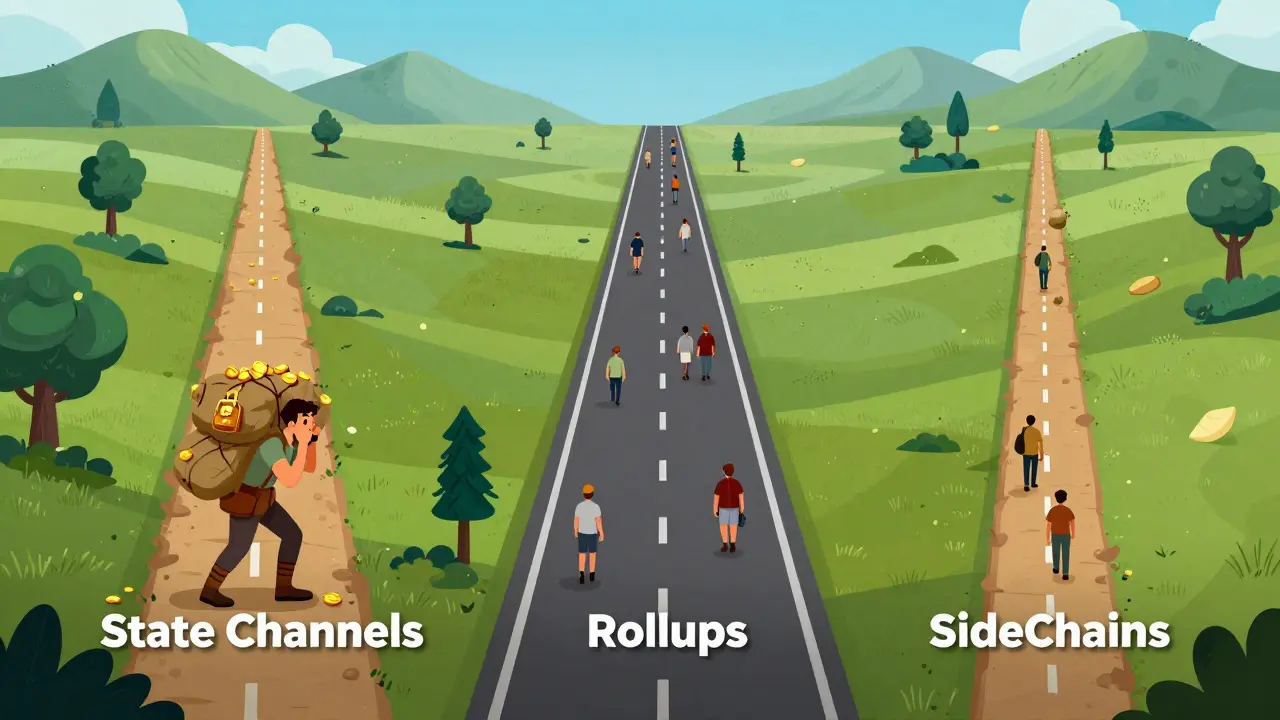
State channels are not the only way to scale. Rollups and sidechains offer different trade-offs. Let’s compare them to see where state channels fit.
| Feature | State Channels | Rollups (Optimistic/ZK) | Sidechains |
|---|---|---|---|
| Capital Efficiency | Low (Must lock full amount) | High (Shared pool) | Medium |
| Liveness Requirement | Yes (Must stay online) | No | No |
| Best Use Case | Frequent bilateral payments | General purpose DApps | High throughput apps |
| Security Model | Main chain security | Main chain security | Independent security |
| Adoption Rate (2023) | <3% | 55% | 42% |
Rollups, such as Optimistic and ZK-Rollups, have dominated the market because they allow anyone to transact without pre-locking funds or staying online. They batch transactions and post proofs to the main chain. This makes them ideal for decentralized exchanges and NFT marketplaces. Sidechains, while having lower security guarantees, offer full EVM compatibility and ease of use. State channels excel only in narrow scenarios: peer-to-peer payments between known parties who interact constantly.
When Should You Use State Channels?
Despite the limitations, state channels are not useless. They shine in specific contexts:
- Micropayments: Streaming video or music where you pay per second. On-chain fees would exceed the content value.
- Gaming: In-game asset transfers between players. High frequency, low value, known participants.
- Supply Chain: Frequent settlements between two established partners.
If your application fits these boxes, state channels are powerful. For general-purpose finance or social media, they are likely the wrong tool. Vitalik Buterin himself stated in 2023 that state channels cannot serve as a general-purpose scaling solution due to their participation requirements.
Future Outlook: Will It Get Better?
Innovations are addressing some pain points. Ethereum’s Account Abstraction (EIP-4337) allows for smarter collateral management, potentially reducing locked capital by 30-40%. Watchtower networks are becoming more robust, though trust issues remain. However, industry analysts at Forrester project that state channels will capture no more than 8% of the scaling market through 2027. They will remain a specialized tool, not the foundation of the internet of money.
As developers, we should choose tools based on fit, not hype. State channels solve a real problem but introduce new constraints. By understanding these limitations, you can build better systems and avoid costly mistakes.
What is the main limitation of state channels?
The main limitations are capital inefficiency (requiring users to lock up funds proportional to transaction volume) and the liveness requirement (participants must stay online to prevent cheating). These factors make state channels difficult for casual users and sporadic transactions.
Are state channels secure?
State channels inherit the security of the underlying blockchain, but they introduce risks related to smart contract bugs and malicious counterparties. If a user fails to respond to a fraudulent state broadcast within the challenge period, they can lose their funds. Proper implementation and monitoring are critical.
How do state channels compare to rollups?
Rollups are generally more capital efficient and do not require users to stay online, making them suitable for general-purpose applications. State channels are faster for bilateral interactions but require locked liquidity and continuous participation, limiting them to specific use cases like micropayments.
Why are state channels not widely adopted?
Adoption is limited by high technical complexity for developers, poor user experience (managing liquidity and staying online), and capital barriers for small businesses. As a result, they represent less than 3% of enterprise blockchain scaling solutions as of 2023.
Can I use state channels for everyday payments?
Technically yes, via networks like Lightning, but practically it is challenging. You need to manage channel balances, rebalance frequently, and keep your device connected. For most people, traditional on-chain payments or rollup-based solutions are currently easier and more reliable.
Comments
Yash Lodha
The whole concept of state channels is just another layer of control designed to keep the masses locked in digital cages while the elites siphon off value through complex routing fees that only they understand. They tell you it's for speed, but really it's about surveillance and forcing you to stay online so they can monitor your every transaction. The liquidity trap isn't a bug, it's a feature to ensure your capital is always vulnerable to their whims. I've seen how these systems fail when the 'watchtowers' go down, which conveniently happens right when you need them most. It's all part of the grand design to make decentralized finance feel centralized and oppressive. You think you're free because you're using crypto, but you're just dancing on a tighter leash. The bugs in the smart contracts are likely planted backdoors waiting for the right moment to trigger a mass liquidation event. Don't fall for the hype machine pushing this niche technology as a solution. It's a trap wrapped in technical jargon.
May 24, 2026 AT 05:33
Jesse Alston
I totally get why people are frustrated with the setup process! 😅 It can be really intimidating if you aren't used to managing nodes. But honestly, for specific use cases like gaming or micropayments, it still has potential. The key is understanding that it's not meant to replace rollups for general transactions. Maybe we need better UI wrappers that hide the complexity from the average user? 🤔
May 25, 2026 AT 07:39
Sarah C
Thank you for breaking this down so clearly. It really helps to see the comparison table between state channels and rollups. I agree that the liveness requirement is a huge barrier for casual users who just want to send money without worrying about staying connected. It makes sense why adoption is so low for everyday payments.
May 25, 2026 AT 08:10
Kimberly Herbstritt
Actually, I think the article oversimplifies the issue. State channels aren't failing because of bad tech; they're failing because users are lazy and don't want to learn how to manage their own keys properly. If everyone was willing to run a watchtower themselves, the trust issues would disappear. It's not the technology's fault that people prefer centralized convenience over true decentralization.
May 25, 2026 AT 18:57
Sharada Vakkund
Let's look at this from a different angle. While the barriers are high now, imagine the future where account abstraction handles the collateral management automatically. We could see a surge in adoption for IoT devices that need to transact frequently without human intervention. It's important to remember that infrastructure takes time to mature. Let's support developers who are working on these solutions rather than dismissing them entirely.
May 26, 2026 AT 20:16
Sudarshan Anbazhagan
one must consider the profound implications of capital inefficiency which is not merely a minor inconvenience but a fundamental flaw in the architecture of such systems the locking of funds creates a stagnation of economic activity that is detrimental to the very essence of monetary flow furthermore the reliance on third-party watchtowers introduces a centralization vector that undermines the core principles of blockchain technology it is imperative that developers recognize these structural weaknesses before investing significant resources into platforms that may ultimately prove obsolete in the face of more robust scaling solutions like zk-rollups which offer superior security and usability without the aforementioned constraints
May 27, 2026 AT 21:59
John Gonzalez Bentham
lol u guys r overthinking this. state channels r fine if u know wat u r doing. the problem is just bad UX. stop complaining and start coding. also rollups rnt perfect either they have their own issues with fraud proofs and verification times. its all tradeoffs. dont act like one solution fixes everything. nobody does.
May 29, 2026 AT 06:49
Ellie Riddell
It is amusing how we chase after technological silver bullets only to find they are made of lead. The irony is that in trying to solve congestion, we create new forms of friction that are just as annoying but harder to debug. Perhaps the real lesson here is that decentralization comes with a cost, and sometimes that cost is just accepting that things will be slow and expensive until the underlying network scales properly. Until then, we are just playing with toys that break easily.
May 30, 2026 AT 14:16
Destiny Kilby
i find the discussion around security risks quite concerning especially since many users do not fully understand the implications of leaving their nodes unattended for extended periods the lack of automatic recovery mechanisms means that human error can lead to significant financial losses which is something that should not be underestimated in any financial system
May 30, 2026 AT 15:19
Jerry CUNNINGHAM SR
It is crucial to acknowledge that while state channels have limitations, they serve a vital role in specific niches. For instance, in supply chain logistics where two parties engage in frequent, predictable transactions, the efficiency gains can be substantial. We should encourage innovation in this space while being realistic about its applicability to broader consumer markets. Collaboration between developers and enterprises can help refine these tools for their intended purposes.
May 30, 2026 AT 17:36
Shelby Cantu
Great insights on the liquidity trap. It really highlights why small businesses hesitate to adopt this tech. Keeping thousands of dollars locked up just for daily tips is not feasible for most. Rollups seem like a much better fit for general commerce right now.
May 31, 2026 AT 07:04
Ruben Michel
The persistent failure of state channels to achieve mainstream adoption is a testament to their inherent architectural inferiority compared to rollup technologies. The requirement for continuous liveness and the inefficient capital allocation render them obsolete for any serious financial application. Only those with a superficial understanding of blockchain scalability would advocate for their widespread use. The data clearly indicates that the market has spoken, preferring solutions that do not burden the user with such onerous operational requirements.
June 1, 2026 AT 14:12
Tricia Alach
its kinda wild how we try to force square pegs into round holes. state channels were never meant to be the main event, more like a side dish. but people keep ordering the steak expecting a salad. maybe if we stopped pretending they can do everything theyll find their place. also typos happen when ur typing fast dont judge me lol
June 2, 2026 AT 04:22