

The crypto market has seen hundreds of exchanges rise and fall, but few had a story as unique - and as quietly tragic - as LGO Markets is a hybrid cryptocurrency exchange launched in 2017 that blended institutional-grade infrastructure with blockchain transparency, designed specifically for hedge funds, family offices, and asset managers. Also known as Legolas Exchange, it was founded by Frédéric Montagnon, Julien Romanetto, and Ouziel Slama, and raised $21.6 million in BTC during its 2018 token sale.
By 2020, LGO wasn’t just another crypto exchange. It was one of the few platforms built from the ground up for institutions, not retail traders. While Coinbase and Binance chased volume, LGO focused on one thing: physically settled Bitcoin-to-USD trades. That means when you sold BTC on LGO, you didn’t get a digital IOU. You got actual U.S. dollars in your bank account and real Bitcoin in your wallet. No synthetic derivatives. No margin risk. No counterparty exposure. Just clean, settled trades - like how Wall Street works.
How LGO Markets Worked (The Hybrid Model)
LGO didn’t try to be fully decentralized like Uniswap, nor did it want to be a typical centralized exchange like Kraken. Instead, it created a middle ground. The platform used a blockchain-based matching engine that was transparent and tamper-proof - meaning no one could front-run your orders. At the same time, it partnered with regulated banks and custodians to handle fiat deposits, withdrawals, and asset custody.
This structure had real benefits:
- Users could deposit USD via bank transfer and trade BTC/USD without needing crypto upfront.
- At the end of each trading day, positions were settled - BTC went to your wallet, USD went to your bank.
- Trading was executed on a permissioned, auditable protocol that prevented manipulation.
- Security was handled by Ledger and led by Frédéric Martin, a former security architect from major financial institutions.
Think of it like this: LGO was the only crypto exchange that treated Bitcoin like gold - you didn’t just trade paper claims. You exchanged real assets.
Who Used LGO Markets?
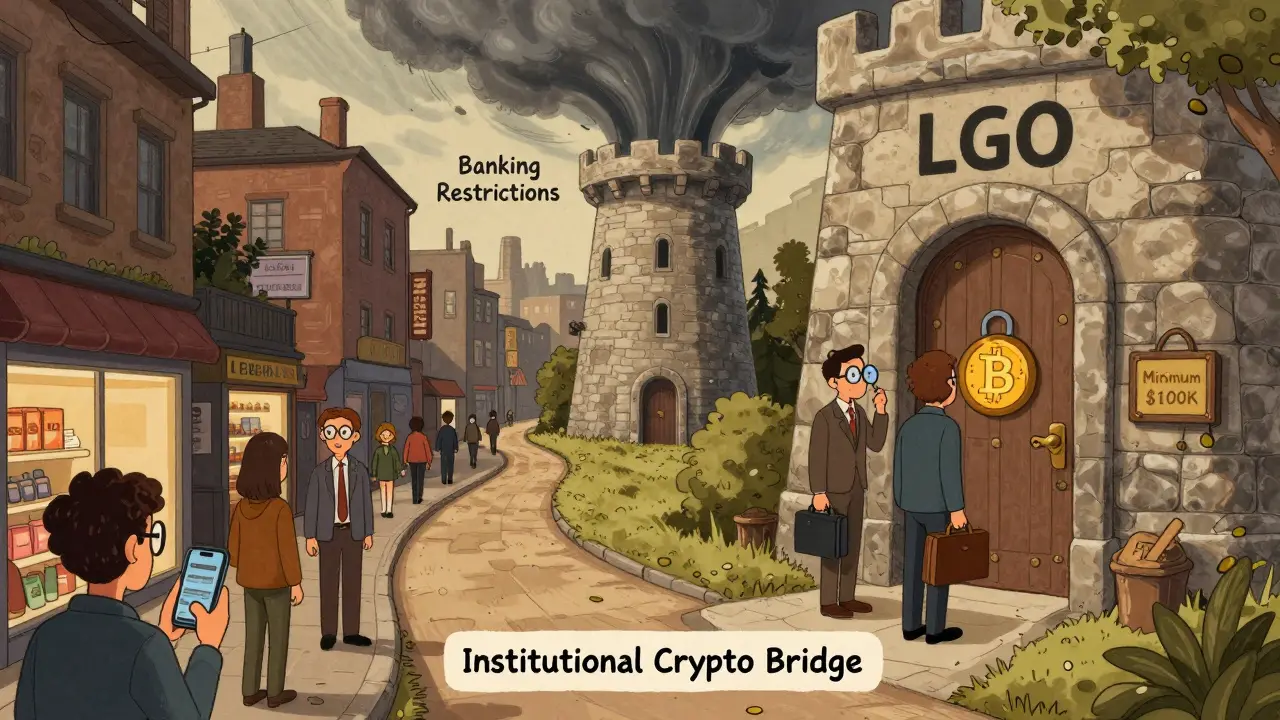
LGO didn’t care about casual traders. Its minimum deposit was $100,000. Its onboarding process took weeks. Its support team was reserved for institutional clients only. This wasn’t a platform for someone buying $500 of Bitcoin on a weekend.
Its user base? European hedge funds, family offices, and crypto-native asset managers who needed:
- Regulatory compliance under French financial laws (which allowed passporting across the EEA).
- Deep liquidity in BTC/USD without slippage.
- A clean audit trail for accounting and tax purposes.
- Integration with existing treasury systems via API.
According to Finance Magnates’ 2019 review, European institutional clients gave LGO a 4.1/5 rating on Trustpilot. Praise centered on the reliability of settlement and the professionalism of the support team. Criticisms? The API was underdeveloped compared to Coinbase Prime, and the onboarding was a bureaucratic nightmare - requiring not just KYC, but proof of source of funds, corporate structure documents, and legal opinions.
Why LGO Failed to Scale
LGO had a brilliant idea. But it was ahead of its time - and too niche to survive.
While Binance processed over $2.5 trillion in annual volume by 2021, LGO’s trading volume was estimated at less than 2% of the institutional market. Why?
- Too slow for retail: No mobile app, no low-deposit options, no meme coin trading. It wasn’t built for viral growth.
- Too complex for institutions: Even professional traders found the settlement workflow cumbersome. Most preferred using Coinbase Institutional or Kraken Pro, which offered faster API access and more trading pairs.
- Banking dependency: LGO relied on European banks to move fiat. When banks tightened rules on crypto in 2019-2020, LGO’s operations slowed.
- Limited trading pairs: It only offered BTC/USD. No ETH, no stablecoins, no altcoins. For institutions looking to diversify, this was a dealbreaker.
By late 2020, LGO was running out of runway. It had no retail user base to fall back on. It couldn’t compete with the scale of Coinbase. And it was too specialized to attract venture capital.
The Acquisition and the End
On October 24, 2020, Voyager Digital announced it had acquired LGO Markets for an undisclosed sum. The goal? To quickly gain access to European institutional clients and regulatory infrastructure.
Hugo Renaudin, LGO’s former Chief Product Officer, became CEO of Voyager. The plan was to merge LGO’s settlement tech with Voyager’s app, and combine the LGO and VGX tokens into a single utility token.
It didn’t work.
By mid-2021, LGO’s platform was fully integrated into Voyager. The LGO token was delisted from major exchanges. By Q3 2021, trading volume for the token had dropped to near zero. Then came the collapse of Three Arrows Capital in mid-2022 - a blow that triggered Voyager’s bankruptcy filing in July 2022.
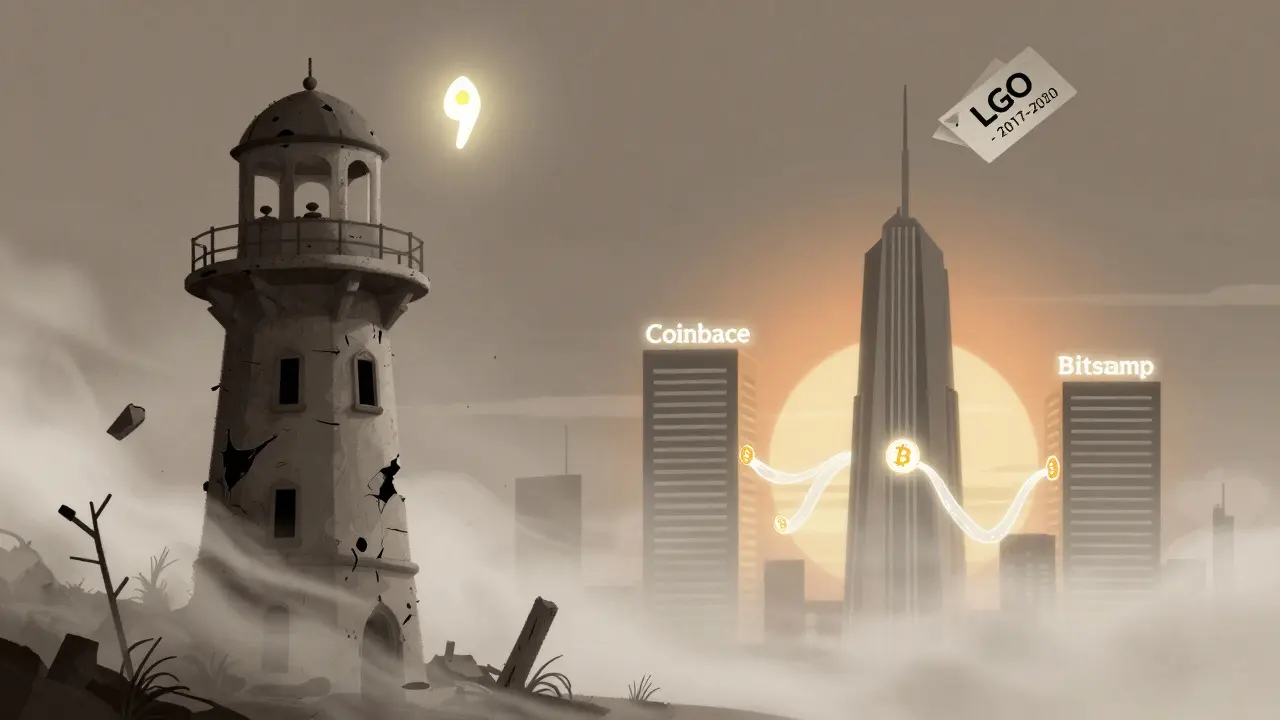
LGO Markets, as an independent entity, vanished.
What’s Left of LGO Today?
As of 2026, the LGO token still exists - barely. CoinGecko reports daily volume of just $548 across all exchanges. It’s not listed on any major platform. No one is trading it. No one is developing it. It’s a ghost.
The technology? Absorbed. The team? Dispersed. The clients? Moved to other platforms like Bitstamp, Coinbase Institutional, or Kraken Pro.
LGO’s legacy isn’t in its token price. It’s in proving that institutions want clean, settled, transparent crypto trading. The idea wasn’t wrong. The timing was.
Today, new platforms like Genesis and Cumberland are picking up where LGO left off - offering institutional-grade settlement, but with better APIs, more trading pairs, and stronger liquidity. LGO didn’t fail because it was bad. It failed because it was too good for its own good - a bespoke solution in a mass-market industry.
Could LGO Have Succeeded?
If LGO had:
- Added ETH/USD and stablecoin pairs by 2019,
- Lowered its minimum deposit to $25,000,
- Partnered with a U.S.-based custodian instead of relying only on Europe,
- Launched a mobile app for institutional traders,
…it might have survived.
But it didn’t. And now, it’s a footnote in crypto history - a quiet experiment that showed how hard it is to build a bridge between traditional finance and crypto, without the backing of a giant.
Is LGO crypto exchange still operating?
No. LGO Markets was acquired by Voyager Digital in October 2020 and fully integrated into its platform. After Voyager filed for bankruptcy in July 2022, LGO’s services were shut down. The exchange no longer exists as a standalone platform.
Can I still trade LGO tokens?
Technically, yes - but only on a handful of small, low-volume exchanges. Daily trading volume is under $600, according to CoinGecko. The token has no utility, no development team, and no backing. It’s effectively a dead asset with no future value.
Why did LGO Markets focus only on BTC/USD?
LGO targeted institutional clients who wanted to move between Bitcoin and U.S. dollars without exposure to volatile altcoins. By limiting pairs, they reduced complexity, minimized counterparty risk, and ensured tight spreads. It was a strategic choice - not a limitation.
Was LGO Markets regulated?
Yes. LGO operated under French financial regulations, which allowed it to serve clients across the entire European Economic Area. It partnered with licensed banks and custodians, and its compliance team included former regulators. This gave it an edge over U.S.-based exchanges that lacked EEA passporting rights.
How did LGO prevent front-running?
LGO used a proprietary blockchain-based matching engine that separated order submission, execution, and settlement. Orders were encrypted until matched, and no internal team or third party could see order flow ahead of execution. This eliminated the possibility of front-running, a common issue on centralized exchanges.
What happened to the LGO team after the acquisition?
Most of LGO’s leadership, including CEO Frédéric Montagnon and CTO Ouziel Slama, left after the acquisition. Hugo Renaudin joined Voyager as CEO but was later displaced after Voyager’s collapse. The team disbanded, and no public records show them working together on any new crypto project since.
Could LGO’s model come back?
Yes - and it already is. Platforms like Bitstamp Institutional, Cumberland, and Fidelity Digital Assets now offer physically settled BTC/USD trading with institutional-grade infrastructure. LGO proved the demand existed. Others just built it better, faster, and with more pairs.
Comments
Sanchita Nahar
LGO was just another crypto ghost story. $100k minimum? No mobile app? Why even bother? I tried to trade once and got stuck in KYC hell for 3 weeks. Then I just used Binance and moved on. Done.
February 14, 2026 AT 02:00
bala murali
The institutional-grade settlement architecture LGO implemented was theoretically elegant-leveraging permissioned blockchain consensus mechanisms to enforce atomicity in fiat-crypto asset transfers, thereby mitigating counterparty risk through cryptographic immutability. However, the operational overhead of regulatory compliance layers, compounded by fragmented banking correspondents within the EEA, created non-trivial friction in execution velocity. This structural impedance rendered the platform non-viable at scale, despite its conceptual superiority.
February 15, 2026 AT 07:21
Desiree Foo
I can't believe people still romanticize this. They had a chance to be the bridge between Wall Street and crypto-and they chose to be a boutique club for rich Europeans who liked paperwork. No ETH? No stablecoins? No mobile access? That's not innovation. That's arrogance. And now it's dead. Good riddance.
February 17, 2026 AT 04:15
Ace Crystal
LGO didn’t fail because it was bad-it failed because it was too pure. Too clean. Too honest. In a world where people trade memecoins for fun and exchanges bribe influencers to pump tokens, LGO was like showing up to a rave in a tuxedo. No one wanted to dance with them. But guess what? The future is coming. And it’s gonna look a lot like LGO. Buckle up.
February 18, 2026 AT 20:47
Jeremy Lim
I mean... wow. Just wow. 😔 The fact that they didn't add ETH/USD... 😭 Like, really? In 2019? And the onboarding? 😵💫 I had a friend try it. Took 47 days. He gave up and bought BTC on Robinhood. RIP LGO. Rest in peace, noble failure.
February 19, 2026 AT 18:53
Sakshi Arora
lgo was kinda cool but too slow and no altcoins? come on. why only btc/usd? that was the whole problem. also why so many docs? i just wanted to trade. not file my tax return again
February 21, 2026 AT 15:15
Ekaterina Sergeevna
Oh look, another ‘visionary’ startup that thought institutions wanted ‘transparency’ instead of liquidity, speed, and a decent API. How quaint. The real institutional players didn’t need LGO-they had Bloomberg terminals and access to prime brokers. LGO was a vanity project disguised as innovation. The fact that anyone took it seriously is proof that crypto’s ‘serious’ phase was just a bubble.
February 22, 2026 AT 13:24
Kaz Selbie
Let’s be real-LGO was a regulatory shell game wrapped in blockchain hype. They leaned into French compliance to ‘passport’ across the EEA, but their banking partners were all shaky. When the ECB started cracking down on crypto-fiat rails in 2020? Poof. Their entire model collapsed. They weren’t building infrastructure. They were renting it. And rent is due.
February 23, 2026 AT 04:06
Robbi Hess
LGO was the most beautiful corpse I’ve ever seen in crypto. A flawless settlement engine. Ironclad security. Institutional-grade compliance. And yet… it died alone. No retail fallback. No VC lifeline. No viral hook. It was like building a Rolls-Royce and only selling it to people who already owned three. The tragedy isn’t that it failed. It’s that it was so right… and so alone.
February 24, 2026 AT 06:38
krista muzer
i think lgo was kinda ahead of its time like seriously they were trying to make crypto feel like real finance and that's hard because most people just wanna get rich quick but if you think about it the whole point of crypto is to fix the old system right? so maybe lgo was the quiet hero we didn't appreciate until it was gone. now we got bitstamp and cumberland doing it better but lgo was the first to try. i just wish they had lowered the minimum or added eth. but still... respect.
February 24, 2026 AT 10:16
Tammy Chew
The notion that institutions prefer ‘clean settlement’ over yield farming or leveraged perpetuals is a fantasy peddled by academics who’ve never traded a single BTC. LGO’s downfall wasn’t its design-it was its delusion. Institutions don’t want transparency. They want leverage, anonymity, and speed. LGO was a museum piece in a world that moved to TikTok.
February 24, 2026 AT 16:03
Lindsey Elliott
LGO was the crypto version of a Nokia N95. Solid build. Great camera. Zero apps. And everyone moved on. The token is now worth less than my expired gym membership. At least the N95 had Snake.
February 26, 2026 AT 15:34
Santosh kumar
LGO tried to do the right thing. Not easy in crypto. Hope the team finds something new. The world needs more honest players.
February 28, 2026 AT 14:54