

Imagine trying to send an email from a Gmail account to someone using Outlook in the early days of the internet. It was messy, unreliable, or sometimes impossible. Now, it’s seamless. That shift didn’t happen by accident; it happened because we agreed on common rules for how different systems talk to each other. In the blockchain world, we are living through that same transition right now.
For years, blockchains operated like isolated islands. Bitcoin couldn’t easily talk to Ethereum, and neither could speak directly to Solana. This fragmentation created inefficiencies, higher costs, and security risks. Today, interoperability protocols and standards are bridging these gaps, creating a unified digital economy where assets and data flow freely across networks. But what exactly makes this possible? And why should you care if you’re just holding crypto?
The Four Layers of Blockchain Interoperability
To understand how blockchains connect, we need to look at the structure of interoperability itself. It’s not just about moving tokens from one place to another. It’s a layered approach, similar to how the internet works. We can break this down into four distinct levels:
- Foundational (Level 1): Basic data exchange. One system sends raw data to another without interpreting it. Think of this as sending a file attachment. The receiver gets the bytes, but doesn’t necessarily know what they mean yet.
- Structural (Level 2): Standardized formats. Here, we agree on syntax. If System A sends a transaction, System B knows exactly which field is the sender, which is the receiver, and which is the amount. JSON and XML are common examples in traditional IT, while specific blockchain serialization methods serve this role here.
- Semantic (Level 3): Shared meaning. This is where things get interesting. Both systems must agree on what the data represents. If I send "1 BTC," both sides must understand that this refers to the same asset on the same ledger. This requires shared vocabularies and ontologies.
- Organizational (Level 4): Governance and trust. This involves legal, social, and policy frameworks. Who is liable if a cross-chain bridge fails? How do different jurisdictions view the transferred assets? This is the hardest layer to standardize because it involves human institutions, not just code.
Most current blockchain projects focus heavily on Levels 1 and 2. However, true scalability and mass adoption will require solving Level 3 and 4 challenges. Without semantic agreement, we risk sending value to the wrong address or misinterpreting smart contract states. Without organizational alignment, regulatory crackdowns could fragment the network again.
Key Players in Cross-Chain Communication
Several ecosystems have emerged as leaders in building these bridges. Each takes a different philosophical and technical approach to solving the interoperability puzzle.
| Framework | Core Mechanism | Security Model | Best For |
|---|---|---|---|
| Polkadot | Relay Chain coordinating Parachains | Shared Security via Relay Chain Validators | Customizable blockchains needing deep integration |
| Cosmos | Inter-Blockchain Communication (IBC) Protocol | Independent Validator Sets per Zone | Sovereign chains wanting easy connectivity |
| Avalanche | Subnets with custom Virtual Machines | Shared Security within Subnets | Institutional applications requiring compliance |
| LayerZero | Omnichain Messaging Protocol | Ultra Light Nodes (ULNs) with Oracles | Decentralized apps needing multi-chain presence |
Polkadot operates on the concept of a Relay Chain. Imagine a central hub where all parachains (specialized side-chains) plug in. The Relay Chain handles consensus and security, allowing parachains to focus on their specific functions. This creates a tightly coupled ecosystem where interoperability is native. However, getting onto Polkadot is competitive, often requiring auctions for parachain slots.
In contrast, Cosmos promotes the idea of an "Internet of Blockchains." Instead of a central hub, Cosmos provides the tools (like the Tendermint consensus engine and the IBC protocol) for any blockchain to build its own zone. These zones can then connect peer-to-peer. This offers more sovereignty but requires each chain to manage its own security, which can be a barrier for smaller projects.
LayerZero takes a different tack. It’s an omnichain interoperability protocol that allows any blockchain to communicate with any other. It uses Ultra Light Nodes (ULNs) to verify transactions without relying on heavy validators. This makes it highly flexible for decentralized applications (dApps) that want to operate across multiple chains simultaneously without being locked into one ecosystem.
How Cross-Chain Bridges Actually Work
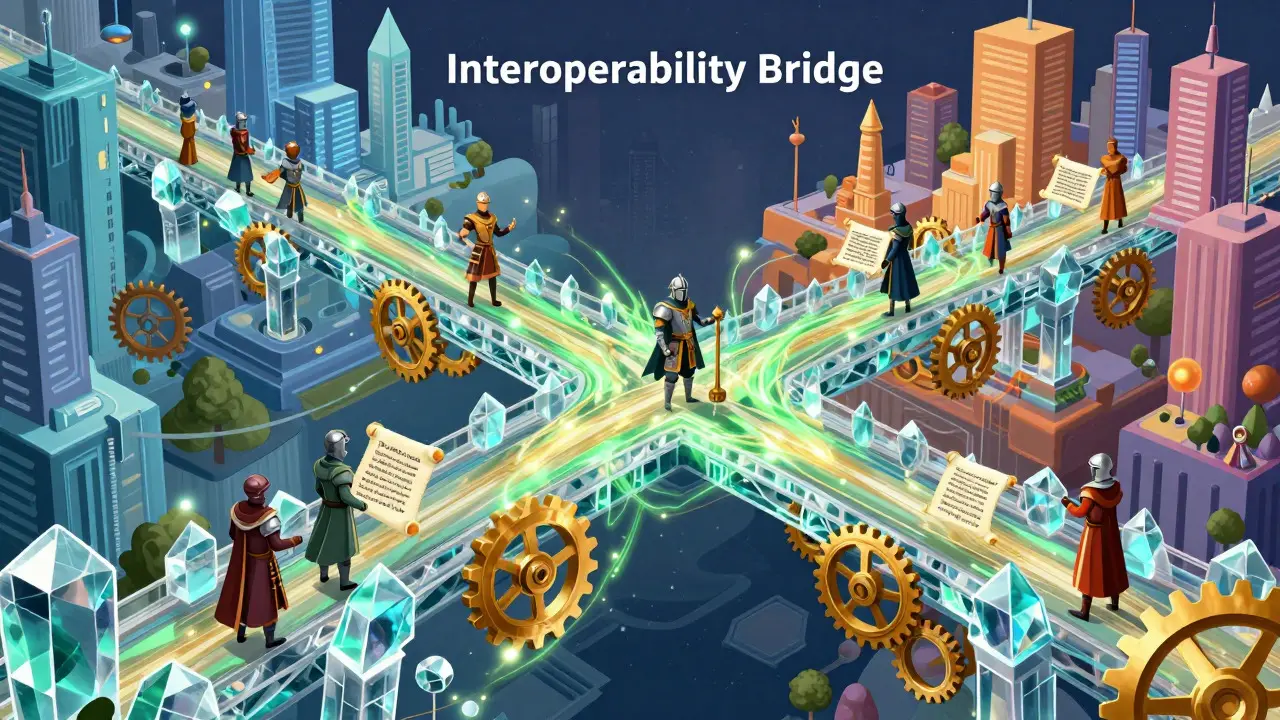
When you move assets between blockchains, you’re rarely moving the actual coin. You’re usually locking it on one chain and minting a wrapped version on another. Let’s walk through a typical scenario using a generic bridge model:
- Locking: You send your original tokens (e.g., ETH) to a smart contract on the source chain. This contract locks your funds, effectively removing them from circulation on that chain.
- Verification: A validator or oracle network detects this transaction. They verify that the lock-up occurred correctly.
- Minting: Once verified, a corresponding amount of wrapped tokens (e.g., wETH) is minted on the destination chain and sent to your wallet there.
- Burning (for reverse transfers): If you want to go back, you burn the wETH on the destination chain. The bridge verifies the burn and releases the original ETH from the lock-up contract on the source chain.
This process relies heavily on trust in the bridge operators. If the smart contract has a bug, or if the validators collude, users can lose everything. This is why security audits and decentralized validation models are critical components of modern interoperability standards.
Security Risks and Mitigation Strategies
Interoperability introduces new attack vectors. According to various industry reports, cross-chain bridges have been among the most targeted areas for hackers, losing billions of dollars in exploits. Why? Because they sit at the intersection of multiple systems, increasing the complexity and potential points of failure.
Common vulnerabilities include:
- Smart Contract Bugs: Errors in the code that manages the lock/mint process.
- Validator Collusion: If a small group of validators controls the bridge, they might double-spend or steal funds.
- Oracle Manipulation: Feeding false data about transaction confirmations to the bridge.
To mitigate these risks, developers are adopting several strategies. First, Multi-Signature Wallets and decentralized autonomous organizations (DAOs) are used to control bridge keys, ensuring no single entity has full power. Second, ZK-Rollups and zero-knowledge proofs are being integrated to provide cryptographic proof of transactions without revealing underlying data, enhancing privacy and security. Third, insurance protocols are emerging to cover losses in case of breaches, adding a financial safety net.
The Role of Standards in Shaping the Future
Just as TCP/IP standardized the internet, blockchain needs universal standards to scale. Currently, we see efforts from organizations like the World Wide Web Consortium (W3C) and various industry consortia to define common interfaces for verifiable credentials and decentralized identifiers (DIDs).
These standards ensure that a digital identity created on one blockchain can be recognized and utilized on another. For example, a degree certificate issued on a university’s private chain could be verified by an employer on a public chain like Ethereum. This semantic interoperability is crucial for real-world applications beyond finance, such as supply chain management, healthcare records, and government services.
Furthermore, regulatory bodies are beginning to take notice. The European Union’s Markets in Crypto-Assets (MiCA) regulation includes provisions for interoperability, aiming to prevent market fragmentation. Compliance-ready interoperability layers will become essential for institutional adoption.

Practical Implications for Users and Developers
For everyday users, improved interoperability means lower fees and faster transactions. You won’t need to keep separate wallets for every chain. Instead, a single interface could aggregate your assets across Bitcoin, Ethereum, Solana, and others, allowing you to swap or spend them seamlessly.
For developers, it opens up new design possibilities. You can build a dApp that leverages the low cost of one chain for storage, the speed of another for processing, and the security of a third for finality. This modular approach encourages innovation and specialization.
However, users must remain vigilant. Always use reputable bridges, check for recent audits, and start with small amounts when testing new cross-chain features. The landscape is evolving rapidly, and today’s best practice might be tomorrow’s vulnerability.
Conclusion: Toward a Unified Digital Economy
Interoperability is not just a technical feature; it’s the foundation of a connected blockchain future. As protocols mature and standards solidify, the barriers between chains will continue to dissolve. We are moving from a fragmented web of isolated ledgers to a cohesive, interoperable network where value and information flow freely. This shift will drive efficiency, foster innovation, and ultimately bring blockchain technology closer to mainstream utility. The journey is complex, but the destination-a truly open and connected digital economy-is worth the effort.
What is the difference between Polkadot and Cosmos?
Polkadot uses a central Relay Chain to coordinate security and consensus for its parachains, creating a tightly integrated ecosystem. Cosmos, on the other hand, provides tools for independent blockchains (zones) to connect peer-to-peer via the IBC protocol, offering more sovereignty but requiring each chain to manage its own security.
Are cross-chain bridges safe?
Cross-chain bridges carry inherent risks due to their complexity and high-value targets. While many have been hacked, newer protocols are implementing stronger security measures like decentralized validators, multi-signature controls, and zero-knowledge proofs. Users should always research the bridge's audit history and consider starting with small amounts.
What is semantic interoperability in blockchain?
Semantic interoperability ensures that different blockchains not only exchange data but also understand its meaning. For example, if one chain sends a token representation, the receiving chain must recognize it as the same asset with the same properties. This requires shared vocabularies and standards, going beyond simple data transfer.
How does LayerZero achieve interoperability?
LayerZero is an omnichain messaging protocol that uses Ultra Light Nodes (ULNs). These nodes combine data from oracles and relayers to verify transactions cryptographically, allowing any blockchain to communicate with any other without needing a shared consensus mechanism or heavy validator sets.
Why is interoperability important for DeFi?
Interoperability allows liquidity to flow freely across different decentralized finance platforms and blockchains. This reduces fragmentation, lowers trading costs, and enables users to access a wider range of financial products without being locked into a single ecosystem. It enhances efficiency and user experience in the DeFi space.