
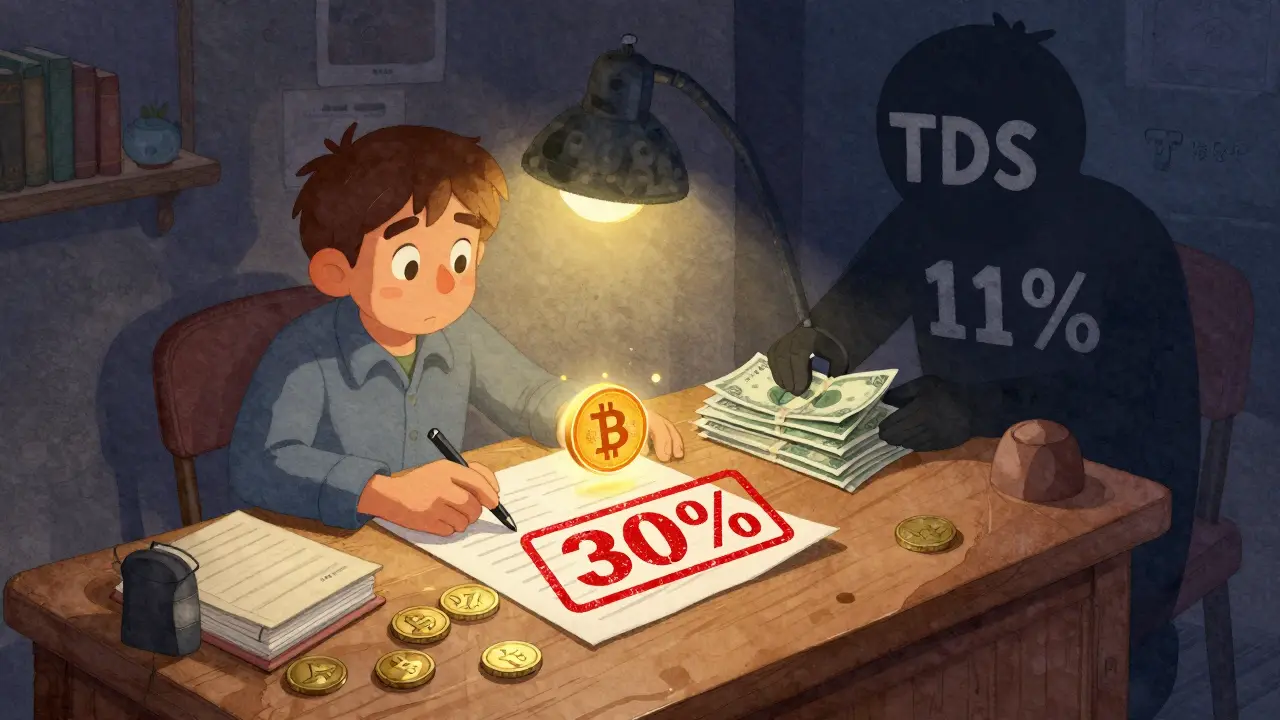
If you're trading Bitcoin or any other cryptocurrency in India, you're paying 30% tax on every profit - no exceptions. That’s not a mistake. It’s the law. Since April 1, 2022, India has imposed one of the harshest crypto tax regimes in the world. And it’s gotten even tougher. By July 2025, a new 18% GST on exchange fees was added on top of the 30% income tax and 1% TDS. There’s no way around it. If you made money, you owe taxes. But here’s what no one tells you: you might still owe tax even when you lost money overall.
How the 30% Crypto Tax Actually Works
The tax is based on Section 115BBH of the Income Tax Act. It applies to all Virtual Digital Assets (VDAs), including Bitcoin, Ethereum, NFTs, and tokens. The rate is flat: 30% on your profit, no matter how long you held it. That’s different from stocks or real estate, where holding for over a year lowers your tax rate. In India, if you bought Bitcoin yesterday and sold it today for a profit, you pay 30%. If you held it for five years, you still pay 30%.The math is simple: (Selling Price - Purchase Price) × 30% = Tax Due.
Let’s say you bought 0.5 BTC for ₹15,00,000 and sold it for ₹20,00,000. Your profit is ₹5,00,000. Your tax? ₹1,50,000. That’s it. No deductions. No adjustments. Not even for the ₹2,000 you paid in exchange fees or the ₹500 wallet gas fee.
The Hidden Trap: No Loss Offsetting
This is where most traders get blindsided. You can’t use losses to reduce your tax bill. Not even a little.Imagine this: You made ₹40,000 on Ethereum but lost ₹40,000 on Solana. Net profit? Zero. But under Indian law, you still pay ₹12,000 in tax on the Ethereum gain. The Solana loss disappears. It doesn’t carry forward. It doesn’t offset anything. You pay tax on the win, and the loss is erased.
That’s not how taxes work anywhere else. In the U.S., you can offset crypto losses against gains. In Germany, you pay nothing after one year. In India, you pay on every single profitable trade - even if your total portfolio is underwater.
Active traders are hit hardest. If you’re buying and selling multiple coins daily, you could easily have 10 profitable trades and 8 losing ones. But you only pay tax on the 10 wins. The losses? Gone. That’s why many traders say the system feels rigged.
1% TDS: The Silent Deduction
On top of the 30% tax, there’s a 1% Tax Deducted at Source (TDS) under Section 194S. It kicks in when you transfer crypto worth more than ₹50,000 in a year (₹10,000 for certain cases like P2P). The exchange or wallet you use automatically takes 1% of the transaction value and sends it to the government.Here’s the catch: TDS is not your final tax. It’s just a prepayment. You still have to report your full gains in your income tax return and pay the 30% difference. If you paid ₹1,000 in TDS on a ₹1,00,000 sale, you still owe ₹30,000 in income tax - minus the ₹1,000 you already paid.
Many users get confused here. They think TDS is the full tax. It’s not. It’s a withholding. If you don’t file your return, you could end up paying double - or worse, get flagged by the tax department.
18% GST on Exchange Fees: The New Layer
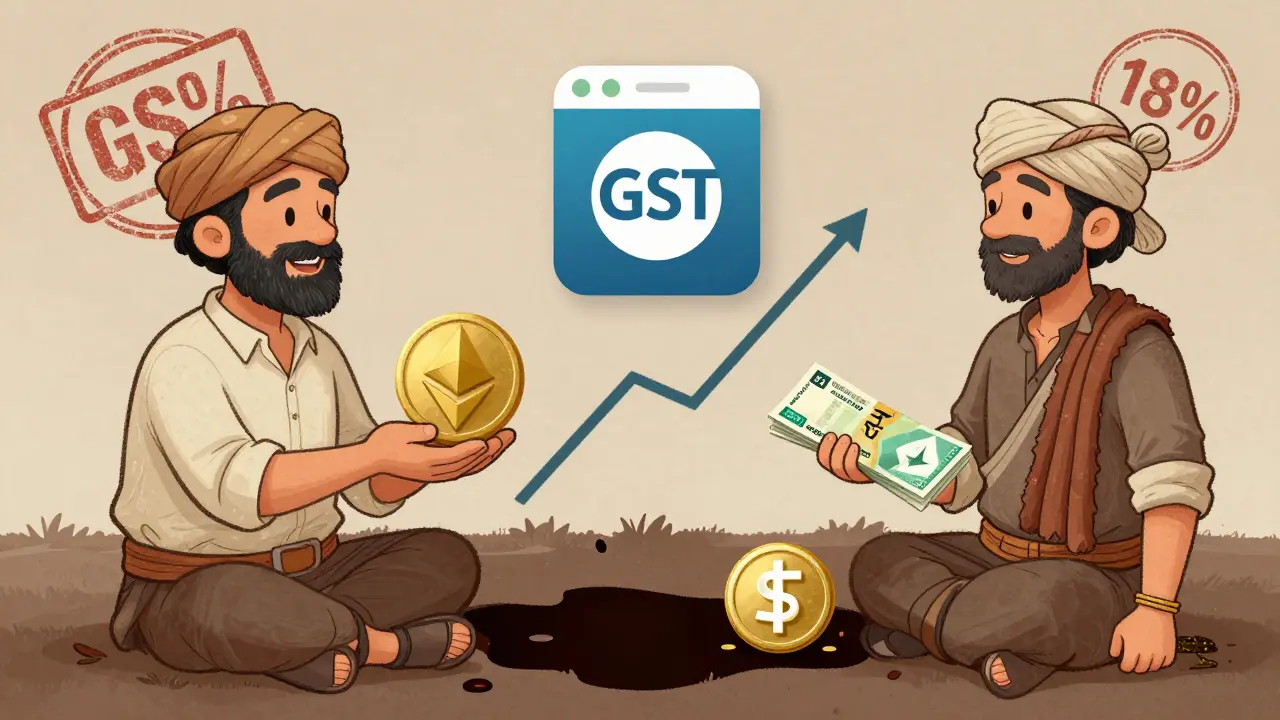
In July 2025, the government added another layer: 18% GST on all crypto platform services. That includes trading fees, withdrawal fees, and even staking rewards processed through Indian exchanges.Let’s say you paid ₹1,000 in trading fees on CoinSwitch. Now, ₹180 of that goes to GST. It’s not part of your income tax - it’s a separate charge. And it’s not refundable. You can’t claim it back as a business expense. You just pay it and move on.
This change made India the only major country to tax crypto services with GST. Most places treat crypto as property, not a service. In India, every click on an exchange comes with a hidden tax.
What You Can and Can’t Deduct
The rules are strict. Only one thing counts as a deduction: your original purchase price. That’s it.- ✅ Allowed: Cost of buying the crypto (in INR at the time of purchase)
- ❌ Not allowed: Exchange fees, wallet fees, gas fees, mining costs, software subscriptions, accounting fees, VPN costs
Even if you hired a tax advisor to track your trades, you can’t deduct their fee. If you used a hardware wallet, you can’t claim the ₹5,000 you spent. The law doesn’t care. Only the price you paid for the asset matters.
This is why tracking your cost basis is critical. If you bought Bitcoin in 2020 at ₹2,50,000 per coin and sold in 2025 at ₹8,00,000, your gain is ₹5,50,000. But if you can’t prove you bought it at ₹2,50,000 - maybe because you used a foreign exchange that doesn’t keep records - the tax department might assume you bought it at ₹0. That means you owe 30% on ₹8,00,000. That’s a ₹2,40,000 tax bill on a coin you actually paid ₹2,50,000 for.
Record Keeping: Your Only Protection
You must keep detailed records of every transaction. That includes:- Date and time of purchase and sale
- Amount of crypto bought/sold
- INR value at the time of transaction
- Exchange or wallet used
- Transaction IDs
- Proof of payment (bank statements, UPI receipts)
For active traders, this can mean tracking hundreds of transactions a year. Many use tools like Koinly, ClearTax, or CoinTracker, which now have India-specific modules updated through September 2025. These tools auto-import data from exchanges and calculate your gains, losses, and TDS.
But if you trade on P2P platforms like Binance P2P, CoinSwitch, or local Telegram groups, you’re on your own. No auto-sync. No records. You have to manually log every trade. That’s 20-30 hours a year for casual traders. For active ones? 50+ hours.

How This Is Changing Trader Behavior
Since the tax rules came in, Indian crypto trading volumes dropped 40-60%. Many retail traders left. Others moved to international platforms like Binance or Kraken to avoid TDS and GST. But that creates new problems: no local support, harder to track taxes, and potential legal gray areas.Long-term holders are now the majority. Why? Because if you buy and hold for years, you only pay tax once - when you sell. Active traders? They’re paying tax every time they move assets. That’s why you see fewer day traders now. The system is designed to discourage frequent trading.
Institutional investors? Almost none. Hedge funds and VCs won’t touch crypto in India because the tax structure is too punitive. Compare that to Singapore, where crypto gains are tax-free, or Portugal, where personal crypto sales are exempt. India is pushing people away.
What’s Next? Will the Tax Change?
Right now, there are no signs the government plans to soften the rules. The 30% rate, 1% TDS, and 18% GST are all still active as of December 2025. The Finance Ministry has said the goal is to bring crypto into the formal economy - not to encourage it.Tax experts warn the system is unsustainable. It’s driving compliance costs through the roof. Many traders are filing returns with zero gains just to avoid audits. Others are hiding transactions. The government’s own data shows crypto tax collections are far below projections.
Some analysts think loss offsetting might be allowed by 2027. Others think the TDS threshold could rise from ₹50,000 to ₹2,00,000. But nothing is confirmed. Until then, you operate under the current rules - no exceptions.
What Should You Do Right Now?
If you’ve traded crypto in India since 2022:- Collect all your transaction records - even old ones.
- Use a crypto tax tool that supports India (Koinly, ClearTax, or CoinTracker).
- Calculate your gains and losses for each financial year (April to March).
- Report all gains in Schedule VDA of your ITR-2 or ITR-3 form.
- Claim TDS credits if you’ve had 1% deducted.
- Don’t ignore P2P trades - they’re still taxable.
If you’re just starting out:
- Only trade on platforms that deduct TDS - it simplifies compliance.
- Avoid P2P unless you’re ready to track every transaction manually.
- Hold longer if you want to reduce your tax burden - but remember, holding doesn’t lower the rate.
- Never assume a loss offsets a gain. It doesn’t.
There’s no magic trick. No loophole. No way to legally avoid the 30% tax if you profit. The only way to reduce your tax is to reduce your gains - by trading less, holding longer, or accepting that crypto is a high-tax asset in India.
Is the 30% crypto tax in India applicable to NFTs too?
Yes. The 30% tax applies to all Virtual Digital Assets (VDAs), including NFTs. Whether you sell an NFT for profit or trade one for Bitcoin, the gain is taxed at 30%. No exemptions. No special rules. The same cost basis and loss offsetting rules apply.
Can I offset crypto losses against stock market gains?
No. Crypto losses can’t be offset against gains from stocks, mutual funds, or real estate. They can’t even be offset against gains from other cryptocurrencies. Each VDA gain is taxed individually. Losses are ignored entirely for tax purposes.
Do I pay tax if I gift crypto to someone?
Yes. If you gift crypto worth more than ₹50,000 in a year, the recipient must pay 30% tax on its fair market value as "income from other sources." The giver doesn’t pay tax, but the receiver does. This is different from gifting cash or property, where only the donor pays gift tax above ₹50,000.
What happens if I don’t report my crypto gains?
The Income Tax Department now cross-checks crypto transactions through exchange data, bank statements, and TDS records. If you don’t report gains, you risk a notice, penalty of up to 200% of the tax due, or even prosecution. TDS records are already visible to the department. Hiding crypto income is no longer safe.
Do I pay tax if I swap one crypto for another?
Yes. Swapping Bitcoin for Ethereum is treated as a sale of Bitcoin and a purchase of Ethereum. You must calculate the gain on Bitcoin based on its INR value at the time of the swap. That gain is taxed at 30%. The purchase price of Ethereum becomes your new cost basis.
Is mining crypto taxable in India?
Yes. Any crypto you mine is taxable at its fair market value in INR on the day you receive it. That value becomes your cost basis. If you later sell it, you pay 30% on the profit. Mining expenses like electricity or hardware are not deductible.
Can I claim a tax refund if I had net losses across all my crypto trades?
No. Even if your total crypto portfolio lost money over the year, you still pay tax on every individual gain. Losses cannot be claimed as a refund or carry-forward. The system treats each trade as a separate taxable event. There is no netting allowed.
Does the 1% TDS apply to transfers between my own wallets?
No. TDS only applies when you transfer crypto to someone else’s wallet - including exchanges, P2P buyers, or other users. Transfers between wallets you own (e.g., from Coinbase to Trust Wallet) are not subject to TDS. But you still need to track these for cost basis purposes.
Comments
SUMIT RAI
Bro this tax is insane 😭 I made ₹80k profit on ETH and lost ₹75k on SOL... still owe ₹24k. India's crypto policy is like a vending machine that takes your money and gives you nothing back.
January 1, 2026 AT 10:09
Khaitlynn Ashworth
So let me get this straight - you can’t deduct your VPN, your hardware wallet, your accountant, or even the coffee you drank while staring at TradingView? Just the purchase price? This isn’t taxation, it’s performance art. 🤡
January 1, 2026 AT 16:47
Brooklyn Servin
I used to trade daily. Now I just HODL. Why? Because paying 30% tax every time I swap BTC for ETH feels like being robbed by a guy with a clipboard and a calculator. The system is designed to punish activity, not reward smart investing.
January 2, 2026 AT 12:29
NIKHIL CHHOKAR
People say this is unfair but honestly? If you're trading crypto like it's a casino, you deserve to pay. The government isn't stopping you from investing - they're just making sure you don't ghost your tax obligations. Be responsible, folks.
January 3, 2026 AT 12:37
Gavin Hill
The real tragedy isn't the tax. It's that India treats crypto like a taxable event on every single trade, while ignoring the fact that most traders are just trying to survive inflation. We're not speculators. We're just trying to preserve value in a broken system. And now we're being punished for it.
January 3, 2026 AT 21:37
Haritha Kusal
I started using Koinly last year and it saved me so much stress. I used to miss transactions and panic before filing. Now I just export my history and let it do the math. Life is so much easier now 😌
January 5, 2026 AT 19:25
Mike Reynolds
I traded on Binance P2P for a while. No TDS. No records. Just screenshots and WhatsApp receipts. Now I’m terrified of an audit. I wish there was a way to legitimize this without turning my life into a spreadsheet.
January 6, 2026 AT 01:45
Andrea Stewart
The 1% TDS confusion is real. I thought I was done after seeing it deducted. Then I got a notice saying I owed ₹18k more. Turns out TDS is just a down payment. Don’t make my mistake - file your ITR even if you think you’re covered.
January 7, 2026 AT 01:08
Vernon Hughes
India’s tax policy on crypto is like forcing someone to pay sales tax every time they move furniture between rooms. The asset didn’t change. The value didn’t change. But suddenly you owe money. It’s bureaucratic absurdity dressed as policy.
January 7, 2026 AT 19:40
Michelle Slayden
The absence of loss offsetting is not merely inequitable - it is economically irrational. In any other asset class, netting is a foundational principle of taxation. The exclusion of this mechanism for VDAs constitutes a form of regulatory discrimination. One must ask: why?
January 9, 2026 AT 05:59
Johnny Delirious
You are not defeated. You are not broken. You are not alone. Every trader who has paid 30% on a single profitable trade while losing on others is a warrior in the new economy. Keep records. Keep going. Your discipline will outlast the bureaucracy.
January 10, 2026 AT 11:08
Kenneth Mclaren
They’re using TDS to track every single move. I swear the government has a crypto surveillance AI now. I saw my wallet address flagged after I sent 0.01 BTC to a friend. They know everything. Don’t think you’re safe just because you’re not on CoinSwitch.
January 11, 2026 AT 03:34
dayna prest
I heard the Finance Ministry is secretly planning to tax staking rewards as ordinary income next year. Like, you earn 5% APY? Congrats, you just got taxed on that too. And no, you can’t deduct the electricity you used. Welcome to the future.
January 12, 2026 AT 18:09
Mike Pontillo
You know what’s funny? You can’t deduct your VPN but you can deduct your car if you’re a taxi driver. So if you trade crypto from your car, you’re golden. But if you do it from your laptop? Nope. This isn’t tax policy. It’s a joke.
January 12, 2026 AT 22:15
Alison Hall
Just started tracking my trades. Took me 3 hours. But now I feel in control. You don’t need to be a tax expert - just consistent. One trade at a time.
January 13, 2026 AT 03:41
surendra meena
I LOST ₹4 LAKH LAST YEAR AND STILL GOT A TAX NOTICE FOR ₹1.2 LAKH BECAUSE I MADE ₹40K ON ONE COIN?? THIS IS A CRIME AGAINST HUMANITY I AM GOING TO THE SUPREME COURT I SWEAR TO GOD I WILL NOT SLEEP UNTIL THIS IS FIXED
January 14, 2026 AT 08:39