
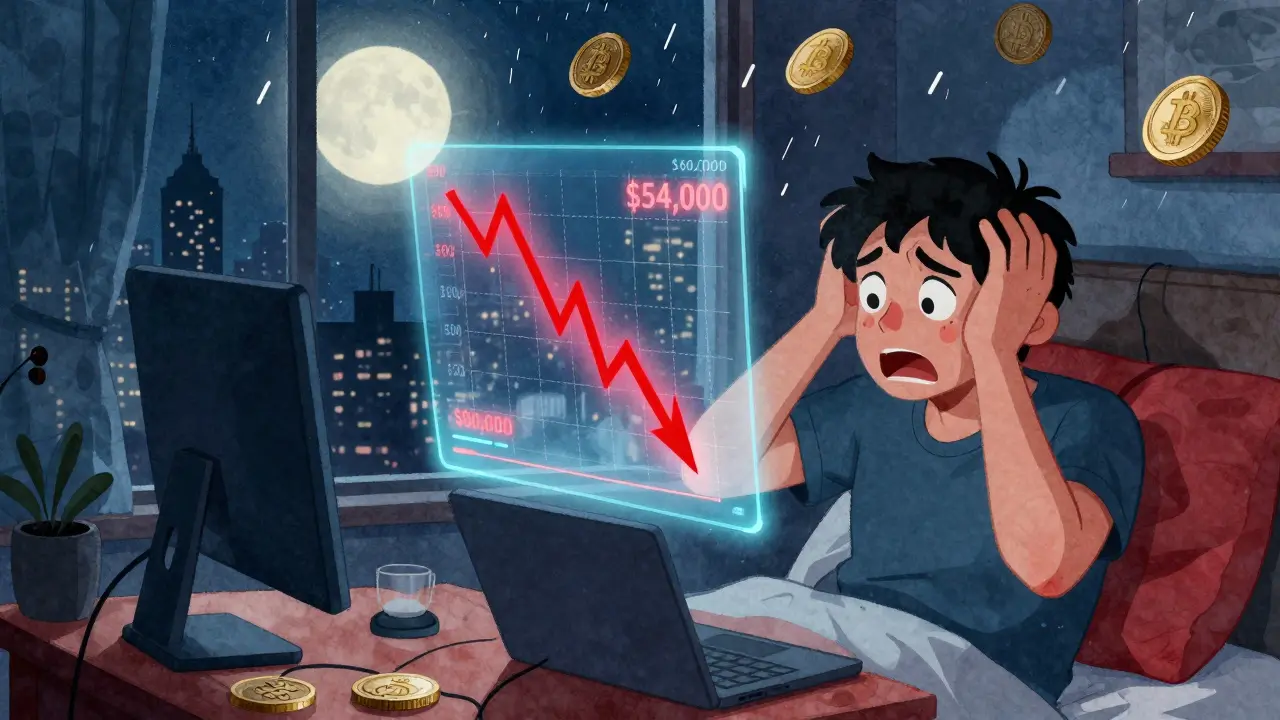
Imagine buying Bitcoin is the world's leading cryptocurrency, known for its high volatility and 24/7 market activity at $60,000. By the time you wake up the next morning, it’s dropped to $54,000. You panic, sell, and watch it rebound to $62,000 an hour later. This scenario plays out daily in the crypto markets. The difference between seasoned traders and beginners often comes down to one tool: the stop-loss order is an automated trading instruction that sells an asset when it reaches a specific price to limit losses.
A stop-loss isn't just a safety net; it’s a discipline enforcer. It removes emotion from your exit strategy, ensuring you don’t hold onto losing positions hoping they’ll turn around. But setting a stop-loss incorrectly can be just as damaging as not having one. Place it too tight, and you get shaken out by normal market noise. Place it too wide, and you risk wiping out a significant portion of your portfolio. Getting this right requires understanding how these orders work, where to place them, and how to adjust them as the market moves.
Understanding How Stop-Loss Orders Work
Before you click "set," you need to know what happens behind the scenes. When you set a standard market stop-loss is a type of stop-loss that converts into a market order once the trigger price is hit, executing immediately at the best available price, you are telling your exchange: "If Bitcoin hits this price, sell my coins immediately." The moment the price touches your stop level, the order becomes a market order. This means execution is guaranteed, but the price is not. In fast-moving markets, you might experience slippage is the difference between the expected price of a trade and the actual price at which the trade executes, often caused by low liquidity or high volatility. If Bitcoin crashes rapidly, your stop at $59,000 might execute at $58,500 because there were no buyers at the higher price.
To mitigate this, many traders use a stop-limit order is a conditional order that becomes a limit order when the stop price is reached, allowing traders to specify the minimum price they are willing to accept. Here, you set two prices: the stop price (the trigger) and the limit price (the minimum sale price). For example, if Bitcoin drops to $59,000, your order activates, but it will only sell if someone is willing to buy at $58,900 or higher. The downside? If the price plummets below $58,900 without hitting your limit, your order never fills, and you’re left holding the bag. Most beginners should stick to market stop-losses for simplicity and guaranteed execution, accepting minor slippage as the cost of certainty.
Where to Place Your Stop-Loss: Technical Levels vs. Percentages
The biggest mistake new traders make is picking a random percentage, like 5% or 10%, without looking at the chart. While simple, this approach ignores the market’s structure. Instead, look for support levels are price points where Bitcoin has historically found buying pressure and bounced back up, indicating a floor for the asset's value. These are areas where large institutional players have previously bought in, creating a natural barrier against further declines.
Here’s how to find them:
- Identify Previous Lows: Look at the daily or weekly chart. Where did Bitcoin bounce before? If it touched $58,000 three times and rose each time, $58,000 is strong support.
- Place Below the Level: Don’t set your stop exactly at $58,000. Traders cluster their stops here, making it a target for "stop hunts"-brief dips designed to trigger mass sell-offs before the price rebounds. Set your stop slightly below, perhaps at $57,500, to give the market room to breathe.
- Use Moving Averages: Dynamic support often forms around key moving averages, such as the 50-day or 200-day Simple Moving Average (SMA). Placing your stop just below these lines aligns your exit with broader trend shifts.
If technical analysis feels overwhelming, start with a percentage-based rule, but base it on volatility. Bitcoin’s average daily range can exceed 5%. A 2% stop-loss will likely trigger during normal fluctuations. A 10-15% buffer below your entry price is often more realistic for swing trading, while day traders might use tighter 3-5% stops based on intraday patterns.

The Golden Rule: Position Sizing and Risk Management
Your stop-loss distance determines your position size, not the other way around. Many traders decide, "I want to buy $1,000 worth of Bitcoin," then set a stop-loss. This is backward. You should first decide how much capital you’re willing to lose on this single trade.
The industry standard is to risk no more than 1-2% of your total trading account on any single position. Let’s say you have a $10,000 portfolio. Your maximum loss per trade is $200 (2%). If you buy Bitcoin at $60,000 and set your stop-loss at $57,000, your risk per coin is $3,000. To keep your total loss under $200, you can only buy:
| Parameter | Value |
|---|---|
| Total Account Balance | $10,000 |
| Risk Percentage (2%) | $200 |
| Entry Price | $60,000 |
| Stop-Loss Price | $57,000 |
| Risk Per Coin | $3,000 ($60k - $57k) |
| Maximum Position Size | 0.066 BTC ($200 / $3,000) |
This means you’d only invest about $3,960 (0.066 BTC * $60,000), leaving the rest of your capital safe. This method protects you from ruin even if you have a string of bad trades. Never increase your position size to compensate for a wider stop-loss. If the market is too volatile for your comfort, reduce your position size instead.
Advanced Strategies: Trailing Stops and Adjustments
Static stop-losses are good for protecting capital, but they don’t help you lock in profits. Enter the trailing stop-loss is a dynamic order that adjusts its stop price upward as the asset's price rises, maintaining a fixed distance or percentage below the highest price reached. This tool allows you to let winners run while automatically securing gains if the trend reverses.
For example, if you buy Bitcoin at $60,000 and set a 10% trailing stop, your initial stop is at $54,000. If Bitcoin rises to $70,000, your stop-loss automatically moves up to $63,000 (10% below $70,000). If the price then drops to $63,000, you sell, locking in a substantial profit. You never have to guess when the top is; the market tells you.
Experienced traders also manually adjust stops as the market evolves:
- Tightening Stops: After a strong move in your favor, move your stop to breakeven or just below the recent consolidation zone. This eliminates risk entirely.
- Widening Stops During Consolidation: If Bitcoin enters a sideways range after your entry, widen your stop slightly to avoid being stopped out by normal choppy price action. However, do not widen it so much that your risk exceeds your predefined limit.
- Event-Based Adjustments: Before major events like Federal Reserve announcements or ETF decisions, volatility spikes. Consider tightening your stops temporarily to protect against gap-downs, or widen them significantly if you’re willing to ride out the turbulence.

Common Pitfalls and How to Avoid Them
Even with the best intentions, stop-loss strategies can fail. Here are the most common traps:
Placing Stops at Obvious Levels: Round numbers like $50,000 or $60,000 attract thousands of stop-loss orders. Market makers know this and may push prices briefly below these levels to trigger cascading sell-offs before reversing. Always place your stop a few hundred dollars below these psychological barriers.
Ignoring Liquidity: On smaller exchanges or during off-hours, liquidity dries up. A market stop-loss can result in massive slippage. Stick to major platforms like Binance, Coinbase, or Kraken, which have deep order books and tighter spreads.
Emotional Interference: The worst thing you can do is cancel your stop-loss because you "feel" the price will bounce. Trust your plan. If you consistently find yourself wanting to remove stops, your position size is likely too large, causing undue stress. Reduce your exposure until you can sleep soundly.
Over-Trading: Setting stop-losses on every tiny fluctuation leads to transaction fees eating into your profits. Use wider stops for longer-term holds and reserve tight stops for active day trading.
Implementing Stop-Losses on Major Exchanges
The mechanics vary slightly by platform, but the core functionality is similar. On centralized exchanges like Binance is one of the largest cryptocurrency exchanges globally, offering advanced trading tools including stop-loss and trailing stop features, you’ll find the option under "Conditional Orders" or "Stop Limit." On Coinbase Advanced Trade is a professional trading interface offered by Coinbase, providing users with access to stop-loss, take-profit, and bracket orders, you can set these directly from the order ticket. Always double-check that your order type is correct (Market vs. Limit) before confirming.
Remember, stop-loss orders are client-side instructions on most centralized exchanges. If the exchange goes offline or experiences extreme latency, your order might not execute. For ultimate security, some institutional traders use decentralized finance (DeFi) protocols with smart contract-based stops, though these come with higher complexity and gas fees. For most retail traders, reputable centralized exchanges offer sufficient reliability.
What is the best percentage for a Bitcoin stop-loss?
There is no single "best" percentage. It depends on your trading style and the current volatility. Day traders often use 2-5% stops, while swing traders might use 10-15%. The key is to base your stop on technical support levels rather than an arbitrary number, and ensure your position size limits your total risk to 1-2% of your account.
Can a stop-loss guarantee I won’t lose money?
No. A stop-loss guarantees execution (if it’s a market order), but not the price. During rapid crashes or low liquidity, slippage can cause your order to fill at a significantly lower price than your stop level. Additionally, if the market gaps down overnight, your stop might trigger at a much worse price than intended.
Should I use a stop-limit or market stop-loss for Bitcoin?
For most traders, a market stop-loss is safer because it ensures your position is closed. A stop-limit order gives you price control but carries the risk of non-execution if the price falls through your limit. Unless you are an experienced trader comfortable with partial fills, stick to market stops to avoid being stuck in a losing position.
How do I calculate my position size based on my stop-loss?
First, determine your maximum risk (e.g., 2% of your account). Then, calculate the dollar amount you stand to lose per coin (Entry Price - Stop Price). Divide your maximum risk by the loss per coin. For example, if you risk $200 and your stop is $3,000 away from entry, you can buy 0.066 BTC ($200 / $3,000).
What is a trailing stop-loss and when should I use it?
A trailing stop-loss automatically moves up as the price rises, locking in profits. Use it when you believe Bitcoin is in a strong uptrend but want to protect against a sudden reversal. It allows you to capture large gains without needing to monitor the market constantly or guess the top.