
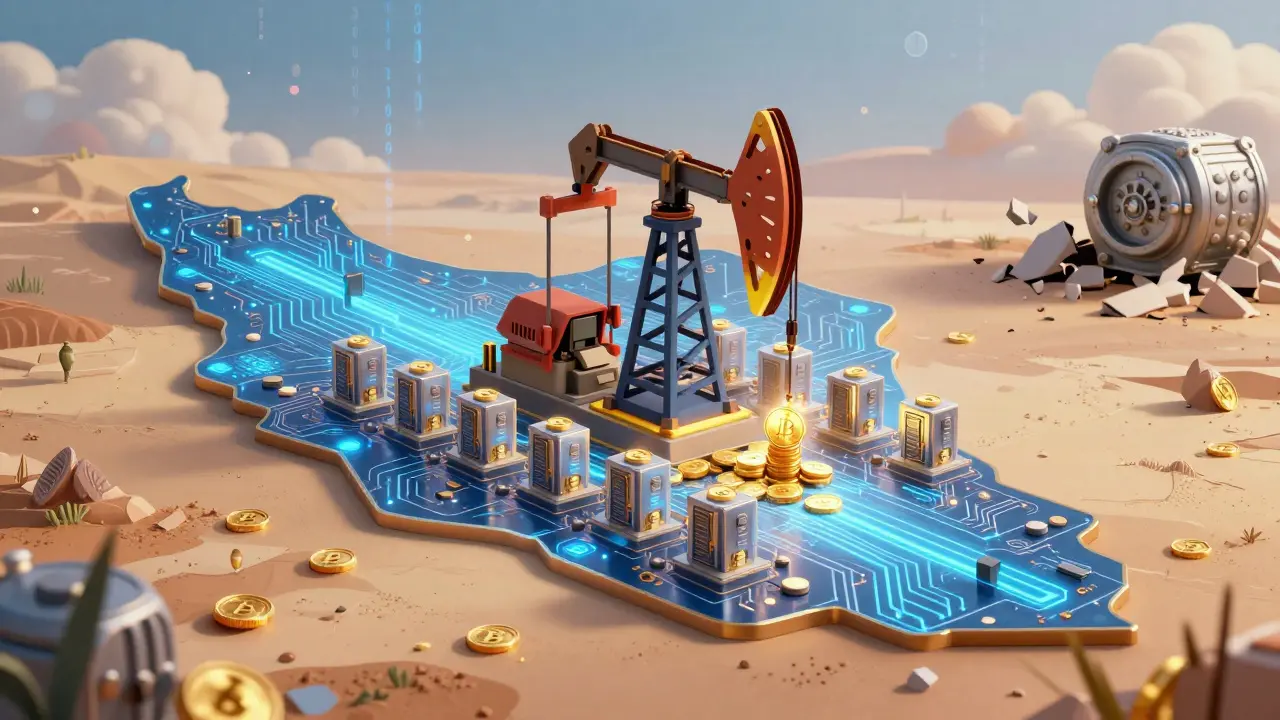
Imagine a country cut off from the global banking system, unable to sell oil or import goods through traditional channels. Now imagine that same country turning its abundant natural gas into digital gold, effectively printing foreign currency in plain sight. This isn't science fiction; it is the reality of Iran's Bitcoin mining strategy, a sophisticated state-level operation designed to bypass international sanctions. Since the United States withdrew from the Joint Comprehensive Plan of Action (JCPOA) in 2018, Tehran has transformed from an opportunistic player into one of the world's most aggressive mining hubs, controlling roughly 4.5% of global hash rate.
This shift represents more than just economic survival; it is a fundamental reengineering of how a sanctioned nation interacts with the global economy. By monetizing subsidized electricity and leveraging military-backed infrastructure, Iran has created a parallel financial ecosystem that generates hundreds of millions of dollars annually. For anyone tracking the intersection of cryptocurrency and geopolitics, understanding this model is crucial. It reveals how decentralized technology can be centralized by state actors to achieve strategic autonomy.
The Evolution from Opportunity to Official Policy
In the early days of Bitcoin, Iran’s involvement was scattered and informal. Miners operated in the shadows, attracted by cheap power but lacking government support. That changed dramatically around 2020. Facing escalating pressure on its oil exports, the Iranian leadership recognized that Bitcoin offered a way to access hard currency without triggering SWIFT-based sanctions. The regime shifted from tolerance to active promotion, issuing licenses for over 10,000 mining farms by 2022 and permitting approximately 90 domestic exchanges to operate.
This policy pivot was not accidental. A think tank attached to the president’s office began publishing reports explicitly highlighting cryptocurrency’s role in sanctions avoidance. Supreme Leader Ali Khamenei viewed Bitcoin generation as direct compensation for lost access to US dollar transactions. The result was a rapid scaling of operations, with $4.18 billion worth of cryptocurrencies flowing out of Iran in 2024 alone-a 70% increase from the previous year. This volume demonstrates that the strategy has moved beyond experimental phases into a core component of national fiscal policy.
| Nation | Primary Method | State Involvement | Effectiveness |
|---|---|---|---|
| Iran | Bitcoin Mining & Trade | High (IRGC-led) | High ($4B+ annual flow) |
| Venezuela | Petro (State Token) | High | Low (Failed adoption) |
| North Korea | Hacking/Theft | Medium (Military units) | Variable (High risk) |
| Russia | Trading & CBDCs | Medium | Moderate (Growing) |
The Role of the IRGC and Military Infrastructure
You cannot understand Iran’s mining success without looking at the Islamic Revolutionary Guard Corps (IRGC). Unlike typical commercial miners who worry about profit margins, the IRGC operates with political protection and access to resources that private entities cannot match. They have established massive facilities, such as the 175-megawatt farm in Rafsanjan, Kerman province, often located on military bases or within zones controlled by religious foundations like Astan Quds Razavi.
These operations benefit from rock-bottom electricity tariffs-effectively free energy due to political connections. The IRGC views these mines not just as revenue generators but as strategic assets. Investigations reveal that IRGC-affiliated firms processed $8 billion in transactions through major exchanges like Binance since 2018. This level of integration means that mining is no longer just an economic activity; it is a tool of state power. The proceeds fund missile programs and support proxy organizations, making enforcement against these entities a national security priority for Western governments.

Energy Subsidies and Grid Strain
The engine behind this operation is energy. Iran possesses significant natural gas reserves, which it burns to generate electricity at costs substantially below global market rates. While US miners pay between $0.03 and $0.08 per kWh, Iranian state-affiliated miners access power near zero cost. This subsidy creates an unfair competitive advantage, allowing them to run older, less efficient ASIC miners profitably while others shut down during bear markets.
However, this comes at a steep domestic price. The electricity consumed by Iranian miners requires the equivalent of approximately 10 million barrels of crude oil annually to generate. During summer months, when demand peaks, mining facilities consume power that could otherwise serve civilian homes and hospitals. This has led to nationwide blackouts and public outrage. Citizens report mixed feelings: some praise increased access to crypto services, while others criticize the impact on their daily lives. The government faces a delicate balancing act, occasionally ordering temporary shutdowns of mines to stabilize the grid, only to restart them once conditions improve.
Bypassing Banking Systems: The New Financial Pipeline
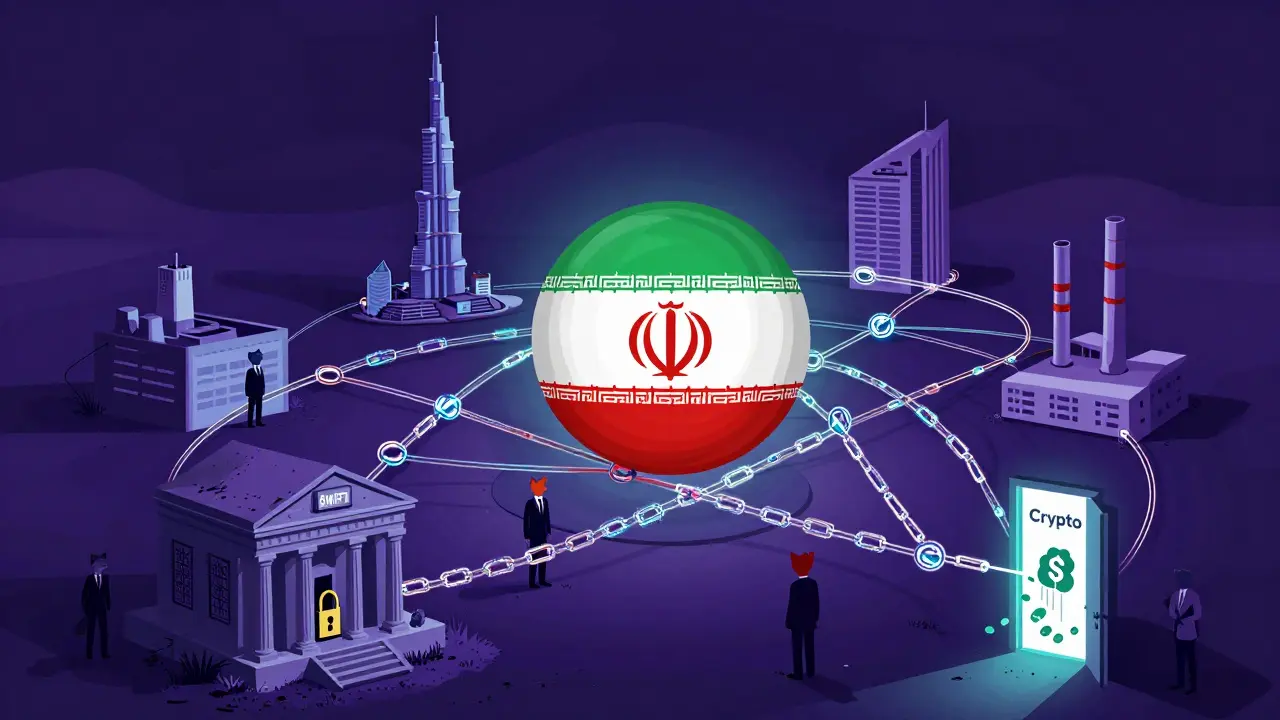
Traditional sanctions rely on cutting off access to the SWIFT network and correspondent banking relationships. Bitcoin ignores these borders entirely. Iran uses mining proceeds to facilitate imports directly. In August 2024, the country executed its first official import order using cryptocurrency, totaling $10 million. This milestone marked a shift from holding crypto as an asset to using it as a functional medium of exchange for essential goods.
To move this value globally, Iran employs a complex web of intermediaries. Blockchain analytics firms like Elliptic and Chainalysis note that "teapot" refineries in Beijing, shell companies in UAE free zones, and TRON-based stablecoin systems now handle the majority of Iran-linked flows. These layers obscure the origin of funds, making it difficult for compliance officers at Western banks to trace transactions back to Iranian sources. Additionally, Iran has signed bilateral cooperation agreements with countries like Russia and negotiated deals with others including Austria and South Africa to explore crypto-based financial transactions, further legitimizing these flows on a diplomatic level.
Challenges and Future Trajectory
Despite its successes, the strategy faces mounting headwinds. Hardware access remains a critical bottleneck. Due to sanctions, Iranian miners cannot legally purchase new ASICs from manufacturers like Bitmain. They rely on gray market suppliers and smuggled equipment, which drives up costs and limits efficiency upgrades. As Bitcoin mining becomes more competitive, relying on second-hand hardware puts Iranian operations at a technical disadvantage.
International enforcement is also tightening. The US Treasury’s Financial Crimes Enforcement Network (FinCEN) issued advisories in June 2025 warning institutions about exposure to Iranian crypto flows. Global exchanges are increasingly implementing geographic blocking and enhanced KYC procedures to avoid secondary sanctions. Furthermore, the environmental cost is becoming harder to ignore. If global trends favor renewable energy and energy-efficient algorithms, Iran’s reliance on fossil-fuel-heavy, subsidized power may become less sustainable over the next decade.
Yet, the resilience of this model suggests it will persist. With plans to increase mining capacity by 50% over the next two years and expand domestic exchange infrastructure, Iran shows no sign of slowing down. The emergence of central bank digital currencies (CBDCs) and deeper integration with decentralized finance (DeFi) applications indicate that Tehran intends to evolve its toolkit continuously. For the global community, this presents a long-term challenge: how to enforce financial restrictions in an era where money can be generated and moved digitally, outside the reach of traditional border controls.
Is Bitcoin mining legal in Iran?
Yes, Bitcoin mining is legal and heavily regulated in Iran. The government issues licenses to mining farms and encourages the industry as a method to generate foreign currency. However, using cryptocurrency as a payment method for local transactions was initially banned before recent shifts allowed limited use for imports.
How does Iran afford the electricity for mining?
Iran subsidizes electricity for licensed mining operations, particularly those affiliated with the state or military groups like the IRGC. These entities often receive power at negligible costs, sometimes ignoring bills entirely due to political protection, which allows them to remain profitable despite global energy price fluctuations.
What percentage of global Bitcoin mining is in Iran?
As of mid-2025, Iran accounts for approximately 4.5% of the global Bitcoin hash rate. This makes it one of the top four mining jurisdictions worldwide, trailing only the United States, Kazakhstan, and Russia, despite operating under heavy international sanctions.
Does the IRGC control Iranian Bitcoin mining?
The IRGC plays a dominant role in Iran's mining sector. They operate large-scale industrial farms, often on military bases, and leverage their political influence to secure resources and regulatory favors. Estimates suggest they control a significant portion of the country's total mining output and related revenues.
Can Western banks detect Iranian Bitcoin transactions?
Detection is difficult but improving. Iranian operators use mixing services, offshore exchanges, and stablecoins to obscure transaction origins. However, blockchain analytics firms like Elliptic and Chainalysis help regulators identify patterns linked to known Iranian wallets, leading to increased scrutiny and occasional sanctions on specific entities.