
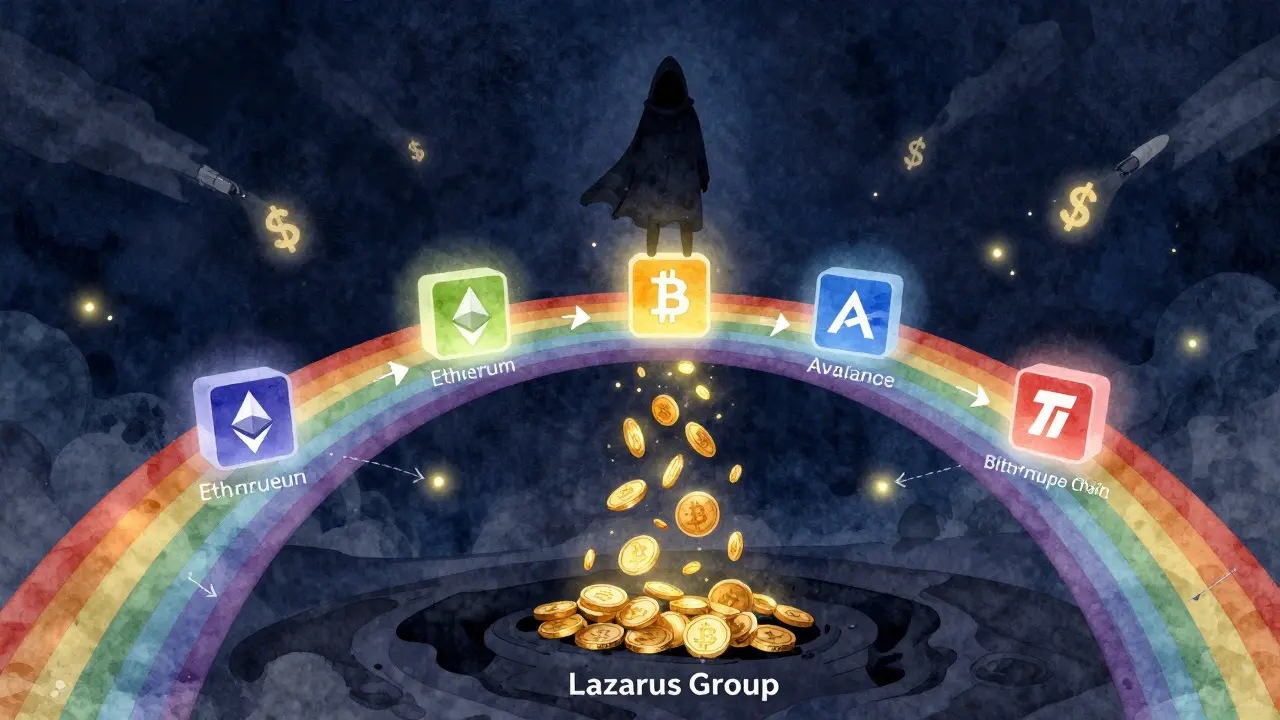
North Korean hackers aren’t just stealing cryptocurrency-they’re rewriting the rules of how money moves online. In 2025, a single attack on Bybit drained over $1.5 billion, making it the largest crypto heist in history. But the real story isn’t the amount stolen. It’s how they got away with it. Cross-chain crypto laundering has become their signature move, turning blockchain transparency into a weapon against investigators.
Why Cross-Chain Laundering Works
Blockchains were designed to be public and traceable. Every transaction leaves a digital fingerprint. But when funds jump from Ethereum to Tron, then to Bitcoin, then to BitTorrent Chain-all within minutes-the trail doesn’t just get cold. It fractures. That’s the core of DPRK’s strategy.Instead of relying on old-school mixers like Tornado Cash (which have been shut down or sanctioned), North Korean hackers now use cross-chain bridges. These are automated services that let users swap assets between different blockchains. The Lazarus Group, the hacking arm of North Korea’s Reconnaissance General Bureau, has mastered this. They’ve moved over 9,500 BTC through the Avalanche Bridge alone. They don’t just hop chains-they flood them.
Think of it like this: if you stole cash and tried to clean it through one bank, regulators would notice. But if you split it into 50 tiny deposits across 20 different banks in 10 countries, it becomes a nightmare to track. That’s exactly what DPRK hackers do. They trigger hundreds of micro-transactions across six or more blockchains in under an hour. The goal isn’t secrecy-it’s overload. They flood compliance systems until they break.
The Tools They Use
The hackers aren’t guessing which bridges to use. They’ve tested them. They know which ones have weak KYC checks, which ones don’t log user identities, and which ones are ignored by analytics tools. TRM Labs and Elliptic have identified the most exploited platforms:- Avalanche Bridge - Used for massive BTC transfers
- Ren Bridge - Favored for converting ERC-20 tokens to native assets
- BitTorrent Chain (BTTC) - A low-visibility chain with minimal monitoring
- Tron (TRC-20) - Fast, cheap, and often overlooked by analysts
After stealing Ethereum or other tokens from exchanges or wallets, they immediately convert them into stablecoins or Bitcoin. Why Bitcoin? Because it’s the most liquid asset globally. Once converted, the funds sit still-sometimes for months. That’s a new tactic. In the past, they cashed out fast. Now, they wait. They’re not just laundering-they’re preparing for a coordinated, large-scale exit through over-the-counter (OTC) desks in places like Dubai, Turkey, or Southeast Asia, where oversight is weak.
From Technical Hacks to Human Exploits
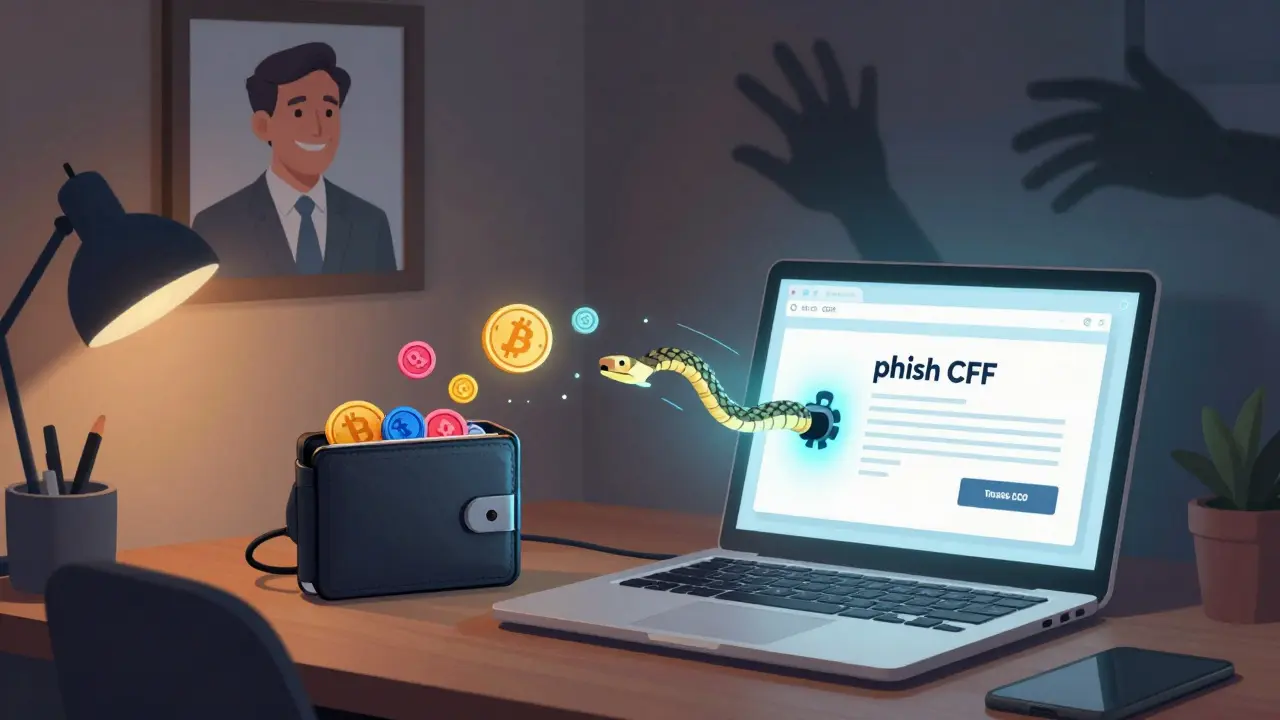
The old days of brute-force code exploits are fading. In 2025, DPRK hackers are targeting people, not just platforms. They’re sending fake job offers to crypto traders, creating cloned social media profiles of well-known figures, and phishing executives with malicious links disguised as wallet updates. Elliptic calls it the “weak point in cryptocurrency security”: the human.One case in 2024 involved a senior executive at a DeFi project who clicked a link in a DM that looked like it came from his CFO. The link installed a keylogger. Within 48 hours, $18 million in ETH and SOL was drained. The hackers didn’t break into a smart contract. They tricked a person. And because the funds came from a personal wallet-not an exchange-they bypassed most security alerts entirely.
This shift means even small holders are at risk. You don’t need to run a billion-dollar exchange to be targeted. If you hold $50,000 in crypto and post about it on Twitter, you’re on their radar.
How Investigators Are Fighting Back
Blockchain analytics firms aren’t sitting still. TRM Labs launched TRM Phoenix in 2022-the first tool that can automatically trace funds across multiple chains. It doesn’t just follow one coin. It maps the entire flow: from Ethereum to Tron, to BTTC, to Bitcoin, and even back again. They combine on-chain data with threat intelligence-knowing which addresses belong to Lazarus, which exchanges have been compromised, and which OTC desks are known to cash out stolen crypto.In February 2025, after the Bybit heist, TRM, Chainalysis, and Elliptic worked with the FBI and Europol to freeze over $400 million in traced funds. That’s a record. But here’s the catch: they only caught 30% of the stolen amount. The rest? Still moving. Still hidden.
Why? Because North Korea doesn’t need to hide everything. They just need to hide enough. One successful OTC sale of $200 million in Bitcoin can fund an entire year of missile tests. The math is brutal: even if 70% gets traced, 30% is still enough to keep their weapons program running.
The Bigger Picture: Nuclear Weapons and Crypto
This isn’t just about stolen crypto. It’s about nuclear weapons.A 2024 UN report cited by multiple member states confirmed that North Korea’s missile and nuclear programs are funded primarily by cybercrime. The $2 billion stolen in 2025 alone could buy hundreds of ballistic missiles. The Biden administration estimates that nearly half of North Korea’s foreign currency earnings come from crypto theft. That’s not a side hustle-it’s state policy.
And it’s working. The regime has turned a handful of hackers into its most valuable asset. While sanctions starve their economy of oil and steel, their cyber units are printing digital cash faster than any central bank. They’ve built a self-sustaining cycle: hack → launder → buy weapons → threaten global stability → repeat.

What This Means for You
If you’re a crypto user, this isn’t someone else’s problem. It’s yours.- Never click links in DMs-even if they look real.
- Use hardware wallets for anything over $5,000.
- Enable multi-sig on exchange accounts if available.
- Monitor your wallet activity with tools like Etherscan or Tronscan.
- Assume any large, unexplained transaction from your wallet is a sign of compromise.
Exchanges are also under pressure. The FBI has published lists of known Lazarus addresses. If your exchange doesn’t block those addresses, it’s not just negligent-it’s enabling crime.
The Arms Race Isn’t Over
North Korea is investing heavily in AI-driven laundering tools. Early tests show they’re automating the selection of obscure blockchains based on real-time monitoring of analytics firm activity. If Chainalysis starts tracking BTTC, they’ll shift to a new chain no one’s heard of yet. If a bridge gets shut down, they’ll create a fake one with the same name.Law enforcement is catching up-but slowly. The gap between offense and defense is widening. And unlike traditional crime, there’s no border to cross, no passport to check, no airport to intercept. Just code. And money.
The next big heist might not come from an exchange. It might come from your friend’s wallet. Or your own.
How do DPRK hackers launder crypto across chains?
They use cross-chain bridges like Avalanche Bridge and Ren Bridge to convert stolen assets from one blockchain to another-such as from Ethereum to Tron to Bitcoin. They flood the system with rapid, automated transactions to overwhelm tracking tools, then move funds into obscure chains or OTC markets where oversight is weak.
Is cross-chain laundering harder to trace than mixing services?
Yes. Traditional mixers like Tornado Cash were centralized and often had known addresses. Cross-chain laundering uses decentralized, automated bridges that don’t require user identity. The funds change format, chain, and asset type repeatedly, making it harder for analysts to follow a single trail. This method also avoids the sanctions that have shut down many mixers.
Why is Bitcoin the preferred asset after theft?
Bitcoin is the most liquid, globally recognized cryptocurrency. Once stolen funds are converted to BTC, they can be moved through OTC desks in unregulated regions without triggering exchange-based alerts. Unlike altcoins, Bitcoin’s value is stable and widely accepted, making it ideal for large-scale cash-outs.
Can blockchain analytics firms stop DPRK laundering?
They can slow it down-but not stop it. Tools like TRM Phoenix and Chainalysis can trace complex flows, but DPRK hackers adapt faster. They use new chains, fake bridges, and AI-driven obfuscation. The best defense is early detection: freezing wallets before funds are fully laundered. Most seized assets are caught within 72 hours of theft.
Are individual crypto users at risk from DPRK hackers?
Absolutely. While exchanges are still primary targets, hackers now focus on individuals through phishing, fake job offers, and social engineering. If you post about your holdings or use weak passwords, you’re a target. Personal wallets without hardware security are especially vulnerable.
How much crypto has North Korea stolen in total?
Since 2017, North Korean hackers have stolen over $3 billion in cryptocurrency. In 2025 alone, estimates exceed $2 billion, with the Bybit heist accounting for $1.5 billion of that. The Lazarus Group is responsible for the vast majority of these thefts.
Is there any way to prevent cross-chain laundering?
Not completely-but you can reduce risk. Exchanges should block known malicious addresses. Users should use hardware wallets and avoid clicking suspicious links. Regulators need to enforce KYC on cross-chain bridges-which currently have almost none. Until bridges are regulated like exchanges, laundering will continue to thrive.
Comments
Daniel Verreault
Bro this is wild. Cross-chain bridges are basically the wild west now. Lazarus doesn’t even bother with mixers anymore-they just spam 200 micro-transactions across BTTC, Tron, and Avalanche like it’s a video game cheat code. And honestly? Most analytics tools are still stuck in 2021. They’re looking for patterns when the hackers are just flooding the system until it crashes. It’s not evasion-it’s overload warfare.
December 29, 2025 AT 14:08
Jacky Baltes
The real tragedy isn’t the theft-it’s the normalization of it. We built blockchains to be transparent, immutable, decentralized. Now we’re using them as invisible conduits for state-sponsored crime. The irony is thick enough to choke on. We didn’t break the system. We weaponized its own ideals against itself.
December 30, 2025 AT 00:40
Kenneth Mclaren
Wait-so you’re telling me the government knew about this and didn’t shut it down? This is deep state crypto manipulation. The FBI? They’re in on it. The same people who froze $400M? They’re the ones who let the other $1.1B slip through. Why? Because they want crypto to fail. They want you to think it’s all a scam so they can push CBDCs. This isn’t North Korea-it’s a psyop.
December 30, 2025 AT 01:00
Alexandra Wright
Oh wow. So the solution is to use a hardware wallet? Cool. Meanwhile, your 72-year-old aunt just got phished because she clicked a ‘wallet update’ link from ‘CFO’-who was actually a Discord bot trained on her LinkedIn. You think crypto security is about tech? Nah. It’s about teaching people not to be idiots. And nobody wants to do that. So here we are. Welcome to the dumpster fire.
December 30, 2025 AT 18:54
Jack and Christine Smith
ok so i just read this and i think i need to cry. i have like 12k in btc and i use a phone wallet. i just clicked a link yesterday from someone who said they were from coinbase. i think i’m doomed. also i love my dog. his name is benny. he’s a corgi. he’s the only thing keeping me sane. plz tell me im not gonna lose everything. 🥲
January 1, 2026 AT 08:06
Jackson Storm
Actually, the real innovation here isn’t the tech-it’s the patience. Before, they’d cash out in days. Now? They let funds sit for months. Why? Because they’re waiting for the market to cool down so they can dump without triggering alerts. It’s like a sniper waiting for the perfect shot. And the OTC desks in Dubai? They’re not even asking questions anymore. It’s a well-oiled machine.
January 1, 2026 AT 18:38
Raja Oleholeh
India is safe. We don’t use these chains. DPRK is weak. USA is weak. Only China strong. 💪🇨🇳
January 2, 2026 AT 05:46
Phil McGinnis
Let me be clear: this entire narrative is a distraction. The real issue is not North Korea. It’s the collapse of institutional trust. When governments cannot secure their own financial infrastructure, they blame foreign actors to avoid accountability. The fact that you believe this story uncritically is evidence of your intellectual surrender.
January 2, 2026 AT 23:23
Ian Koerich Maciel
Thank you for this incredibly detailed and sobering analysis. It’s rare to encounter such a well-structured, evidence-based exposition on a topic so often clouded by sensationalism. I’m deeply concerned about the trajectory of decentralized finance when it becomes a vector for state-sponsored aggression. The moral weight of this issue is staggering.
January 4, 2026 AT 15:48
Andy Reynolds
Imagine if these hackers were using their skills to build open-source tools instead of stealing billions. Like, imagine a world where the Lazarus Group built a decentralized, self-auditing bridge that actually made cross-chain transfers safer for everyone. Instead? They turned the internet’s greatest innovation into a cash-printing press for nuclear missiles. The tragedy isn’t the theft-it’s the waste.
January 6, 2026 AT 12:28
Willis Shane
It is imperative to recognize that the current regulatory framework is woefully inadequate to address the operational tempo of these cyber-entities. The asynchronous nature of blockchain transactions, coupled with jurisdictional arbitrage, renders traditional compliance protocols obsolete. We require a supranational regulatory body with real-time enforcement authority.
January 7, 2026 AT 04:37
Jake West
So you’re saying a bunch of dudes in Pyongyang are smarter than everyone in Silicon Valley? Yeah right. This is just FUD. Crypto is the future. If you’re scared of a few North Korean hackers, maybe you shouldn’t have invested in it in the first place. Also, hardware wallets are for losers. I keep my seed phrase in a Google Doc. 🤷♂️
January 8, 2026 AT 18:30
Shawn Roberts
WE GOT THIS FAM!!! 🚀 blockchain is unbreakable if we all stay woke and use multi-sig and never click links!!! THE FUTURE IS BRIGHT AND THE HODL IS REAL!!! 💪🔥
January 9, 2026 AT 22:36
Abhisekh Chakraborty
Bro this is so messed up I just cried in my coffee. I just lost 5k last week and I didn’t even know how. I think they got me through my phone. I’m so scared. Who do I even talk to? I don’t have family who gets crypto. I just want to sleep. 😭
January 10, 2026 AT 15:51
dina amanda
They’re using this to fund nukes so they can nuke us. That’s why the government won’t stop it. They want the chaos. They want the fear. They want you to panic and buy gold. This is all a setup. Watch what happens next.
January 12, 2026 AT 15:44
surendra meena
Wait wait wait-so you mean to tell me that these bridges are NOT regulated? That’s illegal! That’s a national security threat! They need to shut them down! Now! I’m calling my senator! And I’m posting this everywhere! THIS IS THE END OF CRYPTO!!!
January 12, 2026 AT 23:34
Kevin Gilchrist
They’re not just laundering crypto-they’re laundering *power*. Every dollar they steal is a brick in the wall of their regime’s survival. And we’re sitting here debating whether to use a hardware wallet? We’re not just bystanders. We’re accomplices. Every time you ignore the risk, you’re handing them another $50,000. The blood’s on your keys.
January 14, 2026 AT 14:29
Elisabeth Rigo Andrews
Let’s be honest: the entire DeFi ecosystem is a Ponzi scheme dressed in blockchain jargon. The fact that we’re shocked that a state actor exploited it is the real joke. We built a financial system with zero accountability and then acted surprised when it collapsed under its own weight. This isn’t a hack-it’s a coronation.
January 16, 2026 AT 08:09
Adam Hull
TRM Labs, Chainalysis, Elliptic-these are all fronts for the same intelligence conglomerate. The ‘frozen funds’? They were never real. The ‘traced flows’? Fabricated. This entire narrative is engineered to justify increased surveillance, centralized control, and the eventual death of privacy. The real villain isn’t Pyongyang. It’s the surveillance-industrial complex.
January 17, 2026 AT 01:31
Mandy McDonald Hodge
i just wanted to say thank you for writing this. i’ve been scared to even check my wallet lately. but knowing what to look for… it helps. i’m getting a ledger now. and i’m telling my mom about the DM thing. she’s 68 and uses crypto to send me money. she’s gonna be safe now. 💙
January 17, 2026 AT 03:53
Bruce Morrison
Use hardware wallets. Don’t click links. Monitor your addresses. Simple. Effective. Done.
January 18, 2026 AT 16:14
Andrew Prince
One must question the epistemological foundations of this discourse. If blockchain is inherently transparent, how can it be simultaneously exploited via opacity? The contradiction suggests not a failure of technology, but a failure of semantic framing. We are conflating immutability with inviolability. The former is a cryptographic guarantee; the latter, a sociopolitical delusion. The real vulnerability is not in the code-it is in the mythos we have constructed around it.
January 18, 2026 AT 21:03
Jordan Fowles
This is the quiet war of the 21st century. No bombs. No troops. Just code, wallets, and a few lines of JavaScript that fund missiles. We treat crypto like a financial instrument, but it’s really a geopolitical weapon. And we’re the ones holding the trigger.
January 19, 2026 AT 07:48
Steve Williams
Thank you for sharing this vital information. It is a sobering reminder that technological advancement must be matched with ethical responsibility. I hope governments and institutions take immediate action to secure the integrity of decentralized financial systems for the benefit of all humanity.
January 19, 2026 AT 10:07