

Imagine trying to play a game of soccer where every player is following a different rulebook. One player thinks hands are fine, another believes the game ends after ten minutes, and a third thinks the goal is actually a different size. That is exactly what the world of digital assets looked like for years. Because International Coordination on Crypto Regulation is the global effort to synchronize laws governing digital assets to prevent legal loopholes and protect investors, we are finally seeing a move toward a shared playbook.
The problem is simple: blockchain doesn't care about borders. A developer in Estonia can launch a token that is traded by a user in Tokyo and hosted on a server in Virginia. Without a unified approach, companies just move to wherever the rules are laziest-a practice called regulatory arbitrage. To stop this, the world's biggest financial powers are trying to agree on a set of "global standards" so that a stablecoin or a DeFi protocol is treated similarly regardless of where it's headquartered.
The Blueprint for Global Rules: The FSB and IOSCO
If you want to understand who is actually driving the bus, look at the Financial Stability Board (FSB). They aren't passing laws themselves, but they set the recommendations that member countries follow. Their core philosophy is "same activity, same risk, same regulation." In plain English: if a crypto asset acts like a bank deposit, it should be regulated like one. As of late 2024, about 93% of FSB members have plans to update their frameworks, with most aiming for full alignment by 2025.
Supporting this is the International Organization of Securities Commissions (IOSCO). While the FSB looks at the big-picture financial stability, IOSCO focuses on the nuts and bolts of market integrity. They've rolled out eighteen policy recommendations specifically for Crypto Asset Service Providers (CASPs). By applying traditional securities standards to these new digital entities, they're trying to ensure that the "wild west" era of exchange collapses becomes a thing of the past.
The Big Divide: UK-US Partnership vs. the EU Approach
Right now, the world is splitting into a few different regulatory styles. On one side, you have the UK and the US. In September 2025, these two powers launched the Tech Propensity Deal. This is essentially a transatlantic pact to cooperate on digital asset rules. Instead of just reacting to new tech, the US and UK want to lead the way, leveraging their massive capital markets to create a template for the rest of the world.
Inside the US, the friction between the Securities and Exchange Commission (SEC) and the Commodity Futures Trading Commission (CFTC) has been legendary. However, 2025 saw a surprising shift toward harmony. The two agencies began issuing joint statements to clarify who controls what, specifically regarding spot commodity products. They even held a massive roundtable in September 2025 to discuss complex topics like perpetual contracts and innovation exemptions for decentralized finance.
Then there is the European Union. The EU didn't wait for a global consensus; they built their own fortress called MiCA (Markets in Crypto-Assets). Unlike the more flexible UK-US approach, MiCA is far more risk-averse. It prioritizes consumer protection and strict compliance. While the EU keeps an eye on what the UK-US task force is doing, they are sticking to their own rigorous script, creating a multi-polar world where the EU is the "safe, strict" zone and the US/UK are the "innovation-focused" zones.
| Framework/Region | Primary Goal | Philosophy | Key Characteristic |
|---|---|---|---|
| FSB / IOSCO | Global Stability | Same risk, same rule | High-level recommendations |
| EU (MiCA) | Consumer Protection | Risk-averse / Compliance | Comprehensive, codified law |
| UK-US Pact | Market Leadership | Innovation-friendly | Bilateral cooperation/flexibility |
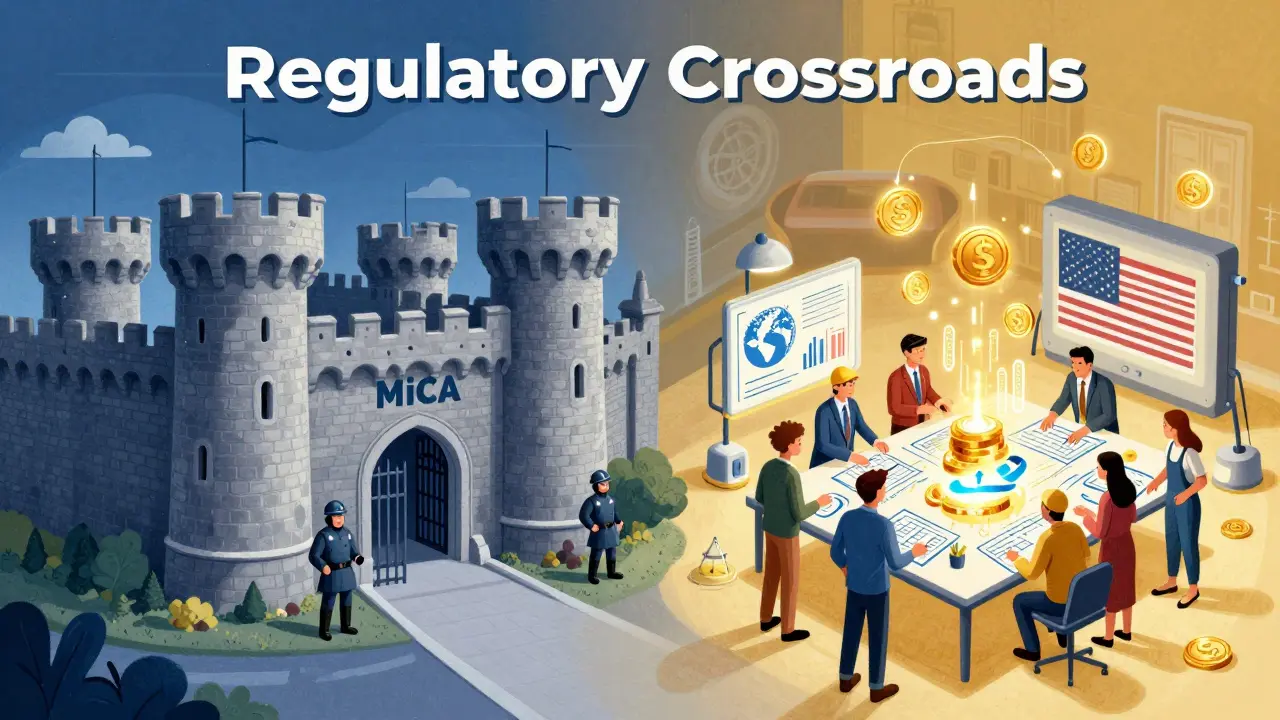
Cleaning Up the Pipes: Money Laundering and FATF
You can't have a functioning global financial system if criminals can move billions in seconds without any one country knowing. This is where the Financial Action Task Force (FATF) comes in. Their Recommendation 15 is the gold standard for anti-money laundering (AML) and countering the financing of terrorism (CFT) in the crypto space.
The FATF is essentially the world's financial police. By mid-2025, they've been focusing on "mutual evaluations," which is a fancy way of saying they audit countries to see if they're actually enforcing the rules. If a country is found to be a weak link, it ends up on a list that makes it very hard for that country's banks to interact with the rest of the world. This pressure forces emerging economies to build better crypto oversight systems, even if they don't have the resources of the EU or US.
The Stablecoin Struggle and the CBDC Factor
Stablecoins are a special headache for regulators. Because they claim to be pegged to a real-world currency, they act like a bridge between the old world and the new. The fear is a "bank run": if everyone loses confidence in a stablecoin's reserves at once, it could crash the token and spill over into traditional markets. In the US, the GENIUS Act is one of the latest attempts to bring domestic order to stablecoin issuance, but the real challenge is making sure these rules don't clash with other countries.
Adding to the chaos is the rise of Central Bank Digital Currencies (CBDCs). About 91% of central banks are now exploring their own digital currencies. This creates a weird dynamic: governments are building the very technology they are trying to regulate in the private sector. When a government-backed digital dollar interacts with a private stablecoin, you need more than just a legal agreement-you need technical standards and interoperability that actually work across borders.

Remaining Gaps: Why We Aren't "There" Yet
Despite all these fancy deals and roundtables, a few big problems remain. First, the "offshore" problem. Many crypto services still operate out of jurisdictions that simply ignore the FSB or FATF. Until there is a real mechanism for cross-border enforcement-meaning a regulator in New York can actually hold a company in a tax haven accountable-the system is leaky.
Second, the legal systems are just too different. A "security" in the US might not be a "security" in France. This is why some regulators, like Commissioner Pierce of the SEC, have suggested a cross-border sandbox. The idea is to let companies test new products in a controlled environment where regulators from two different countries watch and learn together. While the UK-US Tech Propensity Deal opened the door for this, the actual implementation is still lagging behind the hype.
What is the "same activity, same risk, same regulation" principle?
This is a core philosophy promoted by the Financial Stability Board (FSB). It means that if a crypto-asset provider is performing a function similar to a traditional bank (like lending or taking deposits), they should be subject to the same regulatory requirements as that bank, regardless of the fact that they use blockchain technology instead of a traditional ledger.
How does MiCA differ from the US approach?
MiCA (Markets in Crypto-Assets) is a comprehensive, codified law across the EU that sets clear, strict rules for all participants. The US approach has been more fragmented, relying on existing securities laws and enforcement actions by the SEC and CFTC, though it is moving toward more formal coordination through initiatives like the Tech Propensity Deal.
Why is the FATF important for crypto?
The FATF sets the global standards for Anti-Money Laundering (AML) and Counter-Terrorism Financing (CFT). Their Recommendation 15 specifically targets crypto-assets to ensure that digital currencies aren't used to hide money or fund illegal activities, forcing countries to implement "Travel Rule" compliance for exchanges.
What is the Tech Propensity Deal?
Announced in September 2025, this is a bilateral agreement between the UK and the US to coordinate their digital asset regulations. The goal is to create a shared framework that encourages innovation while maintaining financial stability, positioning both nations as leaders in the global regulatory landscape.
Will CBDCs replace private cryptocurrencies?
Not necessarily, but they change the landscape. With 91% of central banks exploring CBDCs, the focus is shifting toward how these public digital assets will interact with private ones. Coordination is now focusing on technical interoperability and how CBDCs affect the demand for private stablecoins.
What's Next for the Market?
If you are a developer or an investor, don't expect a single "Global Law of Crypto" any time soon. Instead, expect a "multi-polar" world. You'll likely see the EU continuing its strict MiCA path, while the US and UK try to lure companies with a more flexible, innovation-first environment.
The real test will be cross-border enforcement. Watch for the first time the UK and US actually execute a joint enforcement action against an offshore entity-that will be the signal that coordination has moved from "talking shops" to actual power. In the meantime, the trend is clear: the era of the unregulated loophole is closing. Whether you're in a DeFi protocol or a centralized exchange, the rules are finally arriving.
Comments
Rob Mitchell
The FSB's 'same risk, same regulation' approach is the only way to stop the bleeding. It brings much needed stability to the sector.
April 9, 2026 AT 05:26
James Bone
Look at all these bureaucrats trying to put a leash on a decentralized beast. It's honestly laughable. They think a few 'roundtables' in DC will stop the inevitable collapse of their own prehistoric banking systems. We're just playing a game of pretend where the government pretends they have control and we pretend to care. Pure comedy.
April 9, 2026 AT 20:55
Aaliyah BROTHERS
THEY WANT TOTAL CONTROL!!! This 'coordination' is just a fancy word for a GLOBAL PRISON!!! Why is the US shaking hands with these EU puppets anyway??? It's a total sell-out of our sovereignty!!! They'll use these CBDCs to track every single cent we spend on a hotdog!!! WAKE UP PEOPLE!!!
April 11, 2026 AT 20:27
Heather Warren
It is quite helpful to see the distinction between MiCA and the US approach. This clarity will likely help smaller firms plan their compliance budgets more effectively.
April 13, 2026 AT 12:29
Surender Kumar
its kinda cool to see things finally geting organized. hope it dont kill the vibe of the early crypto days though haha
April 14, 2026 AT 02:41
daniella davis
pls... as if anyone actually cares about the FSB. they're just basic. the real power is in the DeFi protocols that they can't even spell correctly lol. so embarrassing that people think a 'blueprint' actually works in the real world
April 14, 2026 AT 17:30
Lela Singh
MiCA is a absolute powerhouse of a framework! Truly a masterclass in consumer protection!
April 15, 2026 AT 08:02
7stargee Emmanuel Obani
Waste of time 🙄
April 16, 2026 AT 23:14
Kelly Cantrell
The FATF is just a tool for the globalists to purge any real financial independence. They'll blacklist any country that refuses to let them spy on their citizens' wallets. It's a slow-motion coup of the global economy.
April 17, 2026 AT 19:03
Terrance Hausmann
I think it's great that we're seeing more dialogue. While the transition might be bumpy for some, having a shared set of rules will eventually make the market more accessible for the average person who is currently terrified of getting scammed by an offshore exchange with no accountability. We just need to stay patient and supportive of the innovators who are actually trying to do things the right way while still pushing the envelope of what's possible with blockchain technology.
April 18, 2026 AT 23:01
Will Dixon
yeah its just a way to make sure big banks can get in on the action without losing their shirts
April 19, 2026 AT 23:33
Carroll Foster
Oh sure, let's just use 'innovation exemptions' to let the big players hedge their bets while the retail traders get the crumbs. What a brilliant strategy for 'market integrity'!
April 19, 2026 AT 23:51
ssjuul z
Let's keep the energy high on this! Proper rules actually make the game better for everyone in the long run! 🚀
April 20, 2026 AT 00:16
Rima Dinar
I truly believe that if we provide a supportive environment for these new regulations to take root, the developers in emerging markets will find a way to thrive despite the strictness. It is all about mentoring the next generation of fintech leaders to understand that compliance isn't a barrier but actually a bridge to institutional capital and wider adoption across the globe, which is exactly what we need for a sustainable ecosystem.
April 21, 2026 AT 09:23
Hope Johnson
We must consider the ontological shift occurring here. We are moving from a world of trust based on social contracts and sovereign entities to one based on mathematical proofs, yet we are trying to govern it with the same bureaucratic tools that failed the 2008 crisis. It is a fascinating contradiction to watch the state attempt to codify a technology that was specifically designed to remove the need for a central authority, and I wonder if the friction we see between the US and EU is simply a reflection of their differing philosophical views on the nature of liberty and collective security. In the end, the technology will likely outpace the legislation, leaving us in a perpetual state of catching up, but the attempt itself reveals a lot about our current societal values and the desperation of the existing power structures to maintain relevance in a decentralized age.
April 23, 2026 AT 05:38
aletheia wittman
omg the drama between the SEC and CFTC is literally the best part of this whole thing lol
April 24, 2026 AT 16:54