
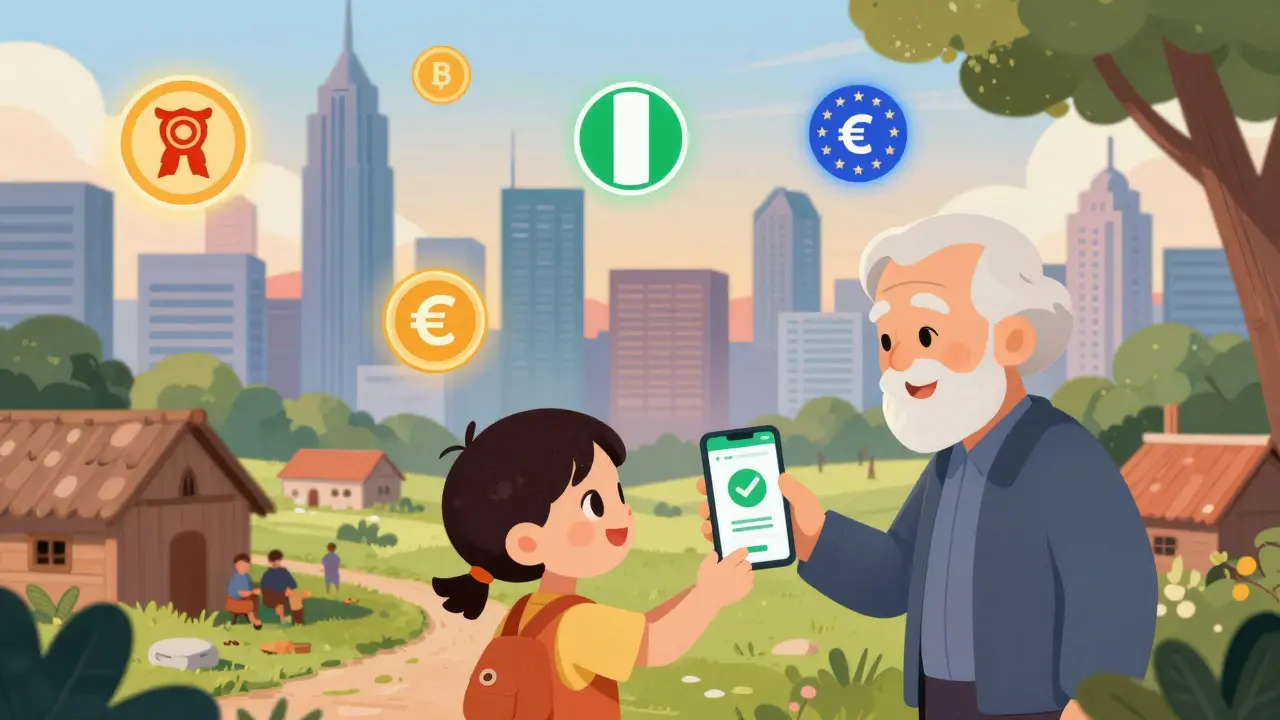
By 2026, central bank digital currencies are no longer a theoretical concept-they’re a reality in over 60 countries, with pilot programs running in dozens more. The Bahamas, Nigeria, and Jamaica have fully launched their CBDCs, and the rest of the world is racing to catch up. But this isn’t just about replacing cash. It’s about rewriting the rules of money itself.
What Exactly Is a CBDC?
A Central Bank Digital Currency is a digital form of a country’s fiat currency issued and regulated by its central bank. Unlike Bitcoin or Ethereum, CBDCs aren’t decentralized. They’re not mined. They’re not governed by code alone. Every unit is backed by the full faith and credit of the government, just like paper bills-but in digital form. Think of it as your bank account, but controlled directly by the central bank. You don’t need a commercial bank to hold it. You can hold it in a digital wallet issued by the central bank itself. This changes everything-from how payments move across borders to how governments track spending.The Global Race: Who’s Leading?
According to the Atlantic Council, 134 countries and currency unions are now exploring or developing CBDCs. That’s up from just 35 in 2020. Nearly all of them-98% of global GDP-are in the game.- China launched its Digital Yuan in 2020 and now has over 260 million users. It’s used for everything from grocery shopping to government subsidies.
- Europe is testing wholesale CBDCs for interbank settlements. The ECB’s digital euro project is in its final testing phase, with a rollout expected by 2027.
- India launched its digital rupee in 2023 and has expanded it to 12 major banks, handling over $10 billion in transactions by early 2026.
- Nigeria’s eNaira saw 8 million wallets created in its first year, with 70% of users coming from rural areas previously unbanked.
- The Bahamas’ Sand Dollar is now the primary payment method for public services, reducing transaction costs by 40%.
These aren’t experiments anymore. They’re national infrastructure projects.
The 5P Framework: How Countries Build CBDCs
The International Monetary Fund (IMF) created a clear roadmap: the 5P methodology is a five-phase approach for CBDC development: Preparation, Proof-of-Concept, Prototypes, Pilots, and Production.- Preparation: Legal frameworks, technical requirements, and stakeholder alignment.
- Proof-of-Concept: Small-scale tests to validate the core technology.
- Prototypes: Building full-scale models with real-world conditions.
- Pilots: Limited public rollout, often in specific regions or user groups.
- Production: Nationwide launch with full integration into payment systems.
Most countries are stuck in the pilot phase. But the ones that moved fastest-like China and Nigeria-had clear goals: financial inclusion and control.

Why Governments Love CBDCs
Governments aren’t chasing CBDCs because they’re cool. They’re chasing them because they solve real problems.- Financial inclusion: Over 1.4 billion adults still don’t have bank accounts. A smartphone and a digital wallet can give them access to the formal economy.
- Payment efficiency: Cross-border payments take days with traditional systems. CBDCs can settle in seconds.
- Monetary control: Central banks can track money flow in real time. This helps fight tax evasion, money laundering, and illegal funding.
- Programmable money: A CBDC can be coded to expire if not spent within 30 days-perfect for stimulus payments. Or it can only be used for healthcare or education.
- Reduced reliance on cash: Cash costs billions to print, transport, and secure. Digital money cuts those costs.
In New Zealand, for example, over 60% of cash transactions are under $20. Replacing those with digital payments could save the Reserve Bank millions annually.
The Dark Side: Privacy, Security, and Banking Disruption
But CBDCs aren’t risk-free.- Surveillance: Every transaction is recorded. Governments can see exactly where you spend your money. No anonymity. No privacy. Critics call this a surveillance state’s dream.
- Banking disintermediation: If people move all their money from commercial banks to central bank digital wallets, banks lose deposits. That means they can’t lend as much. Credit could dry up.
- Cyberattacks: A single breach in a national CBDC system could freeze an entire economy. No backup. No cash alternative. That’s a nightmare scenario.
- Infrastructure gaps: In rural Africa or parts of Southeast Asia, internet access is spotty. A CBDC that requires constant connectivity won’t work.
Some countries are trying to fix this. The EU is testing offline functionality for its digital euro. India allows QR-code-based transfers without internet. But these are workarounds-not solutions.

The U.S. Path: Skip CBDC, Embrace Stablecoins
While most of the world is building CBDCs, the United States is doing something very different. In 2025, the U.S. government shifted from crypto skepticism to crypto promotion. The CFTC and OCC relaxed rules. Banks were told they could accept Bitcoin and Ether as collateral. JPMorgan announced plans to offer crypto-backed lending. The Federal Reserve is even considering direct access to payment rails for fintech firms. Instead of a digital dollar is a central bank digital currency issued by the Federal Reserve, the U.S. is betting on stablecoins are private digital currencies pegged 1:1 to the U.S. dollar, regulated and issued by private firms. Companies like Circle and Coinbase are now issuing regulated stablecoins. These are used for cross-border payments, treasury management, and even paying employees. In 2026, over $300 billion in stablecoin transactions flowed through U.S. financial systems. The U.S. isn’t building a CBDC. It’s building a private-sector alternative that works like one-without the government control.The Hybrid Future: CBDCs and Stablecoins Coexist
The future of money won’t be one system. It’ll be two.- CBDCs will dominate government payments, social benefits, and national infrastructure.
- Stablecoins will dominate commerce, international trade, and corporate treasury operations.
Imagine this: You get your salary in your country’s CBDC. You use it to pay rent. But when you buy a car from a German company, you convert a portion into a regulated U.S. dollar stablecoin for faster settlement. That’s already happening in Singapore and the UAE.
Tokenized real-world assets-like bonds, real estate, and even carbon credits-are being traded on blockchain platforms using stablecoins as the settlement layer. In 2026, over $50 billion in asset-backed tokens were issued globally, mostly in the U.S. and EU.
This isn’t chaos. It’s evolution. Governments keep control. The private sector keeps innovation.
What Comes Next? 2026 and Beyond
By 2028, we’ll likely see:- At least 20 more countries launch full CBDCs.
- Stablecoins become the default for B2B payments between the U.S., EU, and Asia.
- CBDC interoperability agreements between major economies (e.g., EU digital euro + China digital yuan).
- Regulatory clashes: Will the U.S. allow its citizens to use foreign CBDCs? Will China block U.S. stablecoins?
- Privacy laws will be rewritten. Expect legal battles over transaction data ownership.
The world is moving toward a new monetary order. It won’t be paper. It won’t be Bitcoin. It’ll be a mix of state-backed digital currency and privately issued, regulated digital money.
The question isn’t whether CBDCs will change the future of money. The question is: Who will you trust to control it?
Are CBDCs the same as Bitcoin?
No. Bitcoin is decentralized, mined by volunteers, and has no central authority. CBDCs are issued and controlled by central banks. They’re not anonymous. They’re not volatile. They’re designed to be as stable as cash-just digital.
Can I opt out of using a CBDC?
In countries that have launched CBDCs, cash is still legal tender. You can still use paper money. But over time, governments may reduce cash circulation to cut costs. Some nations, like Sweden, are already phasing out ATMs. You won’t be forced to use a CBDC-but it may become the only convenient option.
Will CBDCs replace banks?
Not entirely, but they’ll change their role. If people move their savings from commercial banks to central bank digital wallets, banks lose deposits. That means less money to lend. Banks may shift to offering services like crypto custody, wealth management, or loan underwriting-but they won’t be the main gatekeepers of money anymore.
Is my money safe in a CBDC?
Yes-because it’s backed by the government, just like cash. Unlike crypto, CBDCs don’t crash. They don’t lose value. But if the government’s system is hacked, your money could be frozen or stolen. Security is the biggest technical challenge.
Why is the U.S. not launching a digital dollar?
The U.S. isn’t skipping CBDCs because it’s against them. It’s because it’s betting that regulated stablecoins will do the same job-with less government control. The U.S. prefers private innovation over public infrastructure. That’s why JPMorgan and Circle are leading the charge, not the Federal Reserve.
Comments
Dianna Bethea
I've been following this since the digital yuan launched and honestly it's wild how fast adoption spread. Not just in cities but rural areas too. Nigeria's eNaira is a game changer for farmers who never had access to banking before. This isn't just tech-it's dignity. And the programmable money part? Imagine stimulus checks that can't be spent on alcohol or cigarettes. That's policy with teeth.
People freak out about surveillance but let's be real-cash is already traceable if you're doing something shady. This just makes the system fairer for everyone.
February 24, 2026 AT 05:46
Phillip Marson
CBDCs are just the government's way of saying 'we see everything' and they're gonna make you pay for it. You think you're getting convenience but you're getting shackles. They'll freeze your account if you buy the 'wrong' thing. Next thing you know you're banned from buying a latte because your spending pattern 'doesn't align with national priorities'. This is not progress this is control dressed up as innovation.
February 25, 2026 AT 18:03
Alyssa Herndon
I think about how this affects people who don't live in cities. My cousin in rural West Virginia still uses cash because the internet cuts out for days after storms. If CBDCs become the only option, what happens to her? I get the efficiency but I also worry about who gets left behind. Maybe the solution isn't ditching cash but making digital and physical coexist longer than we're planning.
It feels like we're rushing into something without asking the quietest voices.
February 27, 2026 AT 04:29
Ifeanyi Uche
Naija we did it first and yall still tripping? eNaira work like magic for small traders. No more waiting for bank transfers. No more middlemen taking 20% just to send money from Lagos to Kano. The government ain't perfect but they finally did something right. Stop crying about surveillance when your phone already tells Amazon what you ate for breakfast.
February 28, 2026 AT 04:50
Jeff French
The 5P framework is actually solid. Preparation to Production is textbook infrastructure rollout. What's fascinating is how the U.S. bypassed all that by letting private actors build the rails. Stablecoins as settlement layer is genius. It’s like letting SpaceX build the rocket while NASA handles the launchpad. Different models, same destination. Interoperability will be the real challenge though.
March 1, 2026 AT 13:20
Elana Vorspan
I’m just so hopeful about this 🌟 Imagine kids in India getting paid for doing chores in digital rupee-learning money early, safely, without needing a bank account. And cross-border payments in seconds? No more waiting 3 days for your aunt in Canada to send birthday money. This is the future I want to live in. Let’s not let fear of surveillance drown out the real good here.
March 2, 2026 AT 02:33
Kenneth Genodiala
It's amusing how the U.S. is now the 'innovator' while Europe and China are the 'authoritarian' ones. Please. The U.S. doesn't want a CBDC because it doesn't want to regulate its own financial hegemony. Stablecoins are just crypto with a lawyer. And don't get me started on JPMorgan's 'crypto-backed lending'-that's just leverage dressed in a suit.
March 3, 2026 AT 17:17
Danny Kim
So let me get this straight. The U.S. is betting on private companies to issue digital dollars… while refusing to issue one itself. That’s like hiring a pizza guy to deliver your house. And you’re shocked when the pizza guy starts charging extra for pepperoni? This isn’t innovation. It’s deregulation with a marketing budget.
March 4, 2026 AT 21:50
Cathy Sunshine
I’ve been thinking about this nonstop. The real tragedy isn't surveillance-it's that we’re letting governments monopolize the infrastructure while private actors get to monetize the experience. We’re building a digital highway but only the state owns the toll booths. And the companies? They’re the ones selling you the GPS. It’s beautiful. And terrifying. And deeply capitalist. I’m not sure if I’m inspired or horrified.
March 6, 2026 AT 07:10
Shannon Black
The cultural implications are profound. In many African and South Asian societies, money is not merely transactional-it’s relational. A CBDC that removes anonymity may erode trust in informal economies. Gift-giving, community lending, religious offerings-all these rely on untraceable exchange. We must not replace efficiency with cultural erasure.
March 7, 2026 AT 00:48
Richard Cooper
CBDCs are just digital cash. End of story. Why are we making this so complicated? People are overthinking. Just let people use it or not. Cash is dying anyway. Get over it.
March 7, 2026 AT 02:59
Dee Resin
Oh wow so now the U.S. is the cool kid on the block because it lets corporations issue money? That’s not innovation. That’s outsourcing control to billionaires who already own too much. Meanwhile, Nigeria and the Bahamas are building systems for people. And we’re here giving Visa a monopoly on the future. Real inspiring.
March 8, 2026 AT 11:30
Tanvi Atal
India's digital rupee? Still not working in villages. Internet too slow. Phones too old. Government spent billions on tech but forgot the people. This is all theater. Real change needs roads, not wallets.
March 10, 2026 AT 01:40