
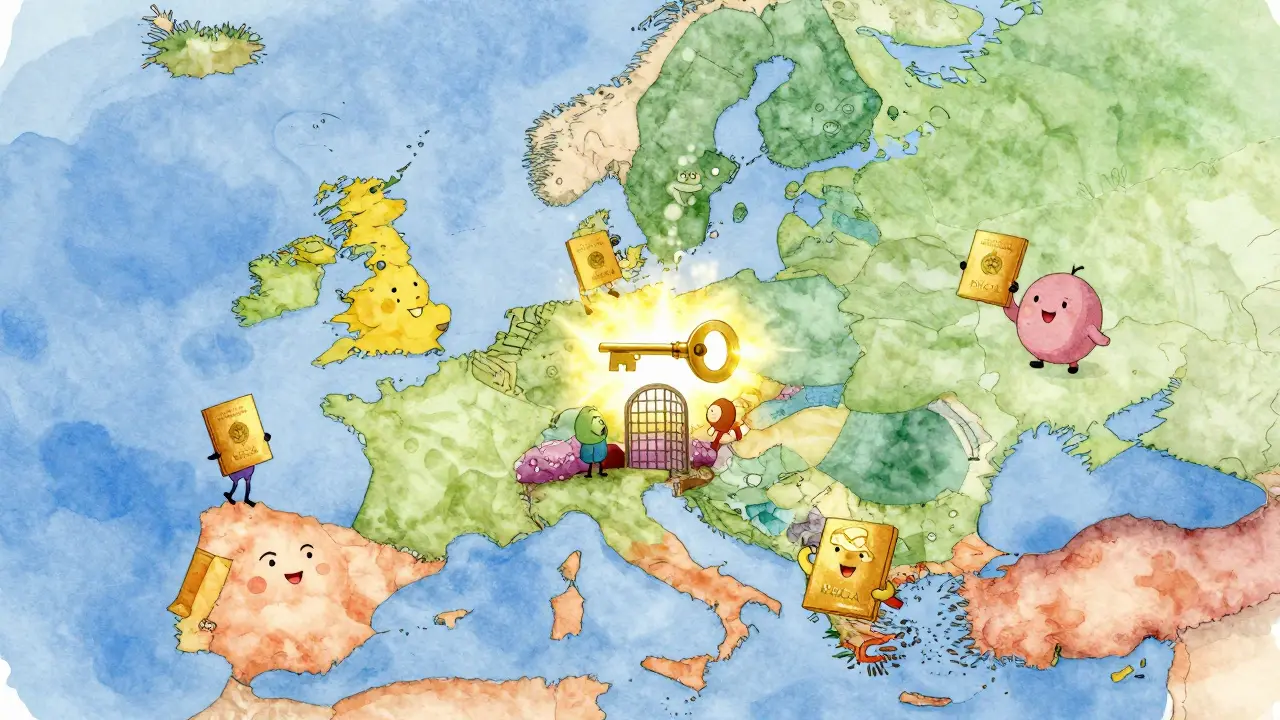
Running a crypto business in Europe used to mean guessing which rules applied where. That guesswork ended on December 30, 2024, when the Markets in Crypto-Assets Regulation (known as MiCA) fully took effect. This law created a single rulebook for the entire European Union, but it didn’t create a single regulator. Instead, each of the 27 member states appointed its own National Competent Authority (NCA) to handle licensing and supervision.
If you are a crypto company looking to operate in the EU, understanding who these authorities are is your first step. You cannot just pick any office; you must choose one specific country’s NCA to be your home supervisor. Once licensed there, you can use a "passporting" system to offer services across other EU countries. But if you get it wrong, or if you ignore the ongoing supervision, you face fines, shutdowns, or worse. Here is exactly how the system works, who the key players are, and why the whole setup might change soon.
What Is a National Competent Authority?
A National Competent Authority (NCA) is the government agency in an EU country responsible for regulating financial markets, including cryptocurrency businesses. Under MiCA, every EU member state had to designate one existing regulator to take on this role. These aren't new agencies built from scratch; they are usually the same bodies that have overseen banks, stock exchanges, and insurance companies for decades.
The NCA is your primary point of contact. When you apply for a Cryptoasset Service Provider (CASP) license, you submit your application to one NCA. That authority checks your governance, your capital reserves, your anti-money laundering (AML) protocols, and your consumer protection measures. If they say yes, you get a license. If they say no, you stay out of the market. After you’re licensed, the NCA keeps watching you through audits, regular reports, and incident reviews.
This structure creates a "single passport" model. Think of it like a driver’s license. If you get your license in Germany, you can drive legally in France, Spain, or Italy without getting three more licenses. Similarly, a crypto firm licensed by Germany’s NCA can serve customers across the EU, provided they notify the other countries’ NCAs. However, the home NCA remains the boss. They set the tone for how strictly MiCA is interpreted in their jurisdiction.
Key NCAs Across Major EU Markets
Not all NCAs are created equal. Some are faster with approvals, some are stricter on compliance, and some have more experience with digital assets. For most crypto firms, the choice of NCA is a strategic business decision. Here are the major players you need to know:
- Germany - BaFin: The Bundesanstalt für Finanzdienstleistungsaufsicht (BaFin) is Germany’s financial watchdog. It brought deep banking and securities expertise to crypto oversight. BaFin started issuing MiCA licenses in mid-January 2025, showing a methodical, careful approach. Many large firms chose Germany because of its stable legal environment and strong economy.
- France - AMF: The Autorité des Marchés Financiers (AMF) handles France’s markets. Known for sophisticated surveillance tools, the AMF focuses heavily on market integrity and investor protection. France has long been proactive in crypto regulation, making the AMF a familiar name to industry veterans.
- Netherlands - DNB/Autoriteit Financiële Markten: The Netherlands moved fast. Its NCA issued some of the very first MiCA licenses on December 30, 2024. This speed attracted early adopters who wanted regulatory clarity immediately. The Dutch approach balances innovation with strict adherence to AML rules.
- Malta - MFSA: The Malta Financial Services Authority (MFSA) has a history of being crypto-friendly. Malta was an early hub for blockchain startups, and its NCA continued that trend under MiCA by processing initial licenses quickly alongside the Dutch authority.
- Spain - CNMV: The Comisión Nacional del Mercado de Valores (CNMV) oversees Spain’s securities market. Like its counterparts, it now supervises crypto asset issuers and service providers, focusing on transparency and retail investor safety.
- Italy - CONSOB: The Commissione Nazionale per le Società e la Borsa (CONSOB) manages Italy’s financial markets. It applies traditional securities logic to crypto, ensuring that token offerings don’t slip through regulatory cracks.
| Country | NCA Name | First Licenses Issued | Key Characteristic |
|---|---|---|---|
| Germany | BaFin | January 2025 | Methodical, high volume of approvals |
| Netherlands | DNB / AFM | December 2024 | Fastest implementation |
| Malta | MFSA | December 2024 | Crypto-experienced, agile |
| France | AMF | Early 2025 | Strong market surveillance |
| Spain | CNMV | Mid-2025 | Focus on retail protection |
How the Licensing Process Works
Getting a license isn’t just about filling out a form. It’s a rigorous process designed to ensure that only serious, compliant firms enter the market. Here is what you can expect when dealing with an NCA:
- Choose Your Home State: You pick one EU country to be your base. This decision affects your costs, your legal team’s needs, and potentially your speed to market. Most firms look at where their headquarters already are or where the NCA reputation aligns with their risk appetite.
- Submit Comprehensive Documentation: You must prove you have robust governance, enough capital to survive downturns, clear risk management frameworks, and solid consumer protection policies. You also need to show how you prevent money laundering and terrorist financing.
- NCA Review: The NCA reviews your application. In the first six months of MiCA, over 40 CASP licenses were issued across the EU. Germany and the Netherlands led the pack. Processing times varied, with some NCAs taking weeks and others taking months.
- Ongoing Supervision: Once licensed, the work continues. You must report incidents, undergo audits, and maintain your capital levels. The NCA monitors your trading activities and custody arrangements to ensure client assets are safe.
The cost of compliance varies by country. Some NCAs charge higher supervisory fees, while others have lower administrative costs but require more extensive local presence. Smaller firms often struggle with these costs, which is why many industry observers worry that MiCA could favor big players over startups.

The Bigger Picture: EU-Level Oversight
While NCAs handle day-to-day supervision, they don’t work alone. They are part of a multi-layered system involving several EU-wide bodies. Understanding this hierarchy helps you see where the real power lies.
ESMA (European Securities and Markets Authority) sits at the top for coordination. ESMA doesn’t issue individual licenses, but it sets the technical standards that NCAs must follow. It maintains public registers, including blacklists of non-compliant firms, and ensures that all 27 NCAs interpret MiCA consistently. Without ESMA, you might find that a license valid in France is rejected in Poland due to differing interpretations.
For stablecoins, the European Banking Authority (EBA) plays a crucial role. Stablecoins pose unique risks because they mimic currency. The EBA oversees prudential standards, checking that issuers hold enough reserves and manage liquidity properly. If a stablecoin becomes "significant"-meaning it has a huge user base or market cap-the EBA steps in directly.
Then there’s the European Central Bank (ECB). The ECB watches the broader financial stability picture. If a crypto crash threatens the banking system or monetary policy, the ECB can intervene. It’s the ultimate backstop for systemic risk.
Finally, starting in 2026, the Anti-Money Laundering Authority (AMLA) will begin direct supervision of the largest cross-border crypto firms for AML/CFT compliance. This adds another layer of scrutiny, especially for global giants operating in the EU.
Why the System Might Change Soon
The current NCA-based model is temporary, at least in the eyes of EU leaders. There is a growing push to centralize supervision under ESMA. Why? Because managing 27 different regulators is inefficient. As Verena Ross, chair of ESMA, noted in October 2024, building regulatory expertise "27 times in different national supervisors" wastes resources. She argued for a single European-level body to handle the biggest players.
Maria Luís Albuquerque, the EU commissioner for financial services, confirmed in September 2024 that the Commission is considering transferring supervisory powers to ESMA for "the most significant cross-border entities." This would include major crypto exchanges and issuers. The goal is a more integrated, competitive European capital market.
This shift makes sense for large firms. They hate dealing with 27 different sets of bureaucrats. A single ESMA supervisor would mean one set of rules, one point of contact, and consistent enforcement. But smaller firms and member states worry. National governments fear losing sovereignty over their financial markets. And small startups might feel even more distant from a powerful Brussels-based regulator.
The timeline for this change is unclear. Legislative processes in the EU move slowly. The current NCA system will remain in place for years. But smart operators are watching closely. If ESMA takes over supervision of major firms, the role of NCAs will shrink to handling smaller, domestic players.

Practical Tips for Navigating the NCA Landscape
If you are planning to launch or expand a crypto business in the EU, here is how to navigate the current landscape effectively:
- Pick Your Jurisdiction Wisely: Don’t just choose the cheapest option. Look at the NCA’s track record. Germany and the Netherlands have shown they can process licenses quickly. Malta offers agility. France offers prestige. Match your business size and risk profile to the right regulator.
- Prepare for High Compliance Costs: MiCA is not cheap. Budget for legal fees, audit costs, and supervisory fees. The regulations require detailed reporting and robust internal controls. Underestimating these costs is a common mistake for new entrants.
- Stay Updated on Technical Standards: ESMA regularly updates technical standards. For example, in April 2025, the EU adopted new rules on preventing market abuse. Ignoring these updates can lead to penalties. Subscribe to ESMA newsletters and monitor NCA guidance notes.
- Plan for Centralization: Even if ESMA doesn’t take over tomorrow, prepare for it. Build systems that meet the highest EU-wide standards, not just local ones. This future-proofs your business against regulatory shifts.
- Engage Early: Don’t wait until your application is ready to talk to the NCA. Many regulators offer pre-application meetings. Use them to clarify doubts and understand expectations. Building a relationship with your supervisor early can smooth the path to approval.
Conclusion
The era of wild west crypto in Europe is over. The National Competent Authorities under MiCA provide a clear, albeit complex, path to legitimacy. While the system is fragmented across 27 countries, it offers legal certainty that many other jurisdictions lack. For now, choosing the right NCA is critical. In the future, ESMA may simplify things by centralizing oversight. Until then, adapt, comply, and stay informed.
Who issues crypto licenses in the EU?
Each of the 27 EU member states has a designated National Competent Authority (NCA) that issues licenses. Examples include BaFin in Germany, AMF in France, and the MFSA in Malta. You apply to one NCA, and if approved, you can passport your services across the EU.
When did MiCA fully come into effect?
The Markets in Crypto-Assets Regulation (MiCA) entered full effect on December 30, 2024. This date marked the start of formal licensing and supervision by National Competent Authorities.
Will ESMA replace national regulators?
There are plans to transfer supervisory powers for the largest cross-border crypto entities to ESMA. However, this change is still under consideration and will likely take years to implement. For now, NCAs remain the primary supervisors.
Which countries issued the first MiCA licenses?
The Netherlands and Malta issued some of the first licenses on December 30, 2024. Germany followed shortly after in January 2025. These countries were among the fastest to operationalize the new framework.
What is the role of AMLA in crypto regulation?
The Anti-Money Laundering Authority (AMLA), launching in 2026, will directly supervise the largest cross-border crypto firms for anti-money laundering and counter-terrorist financing compliance. It adds a centralized layer to the existing NCA system.