
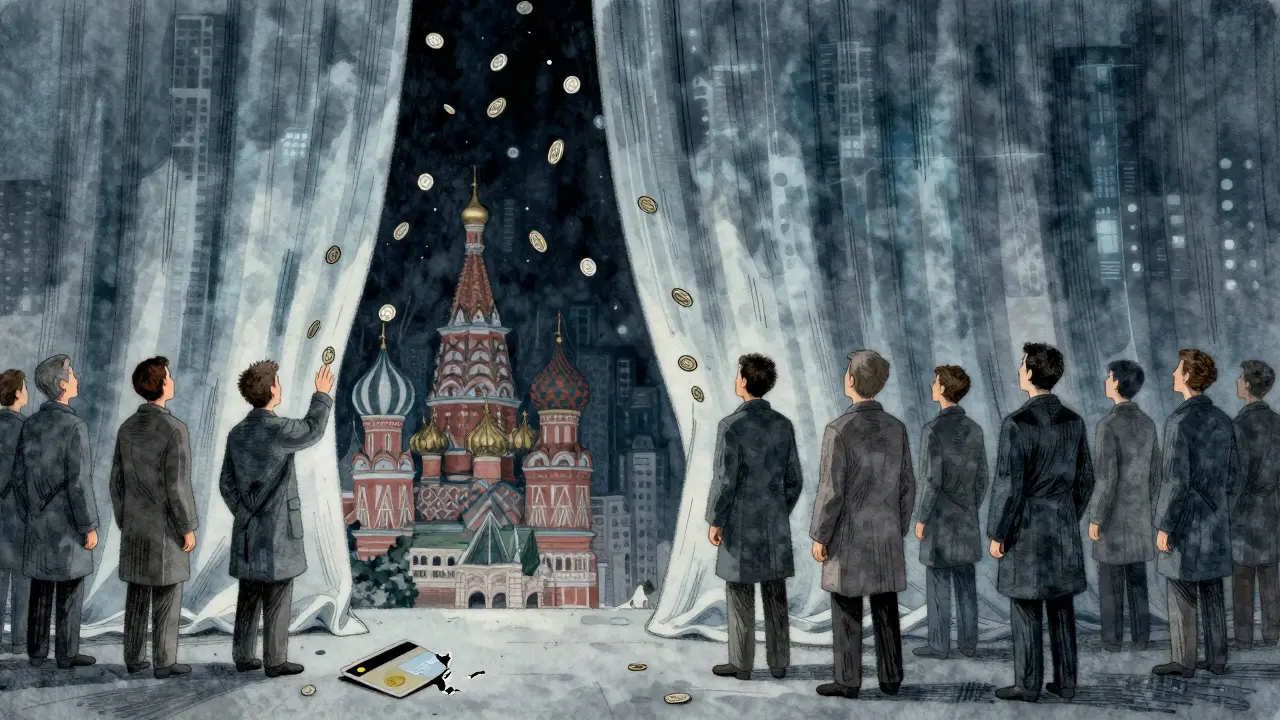
Living in Wellington, I watch global markets shift with a calm detachment that most people in sanctioned regions cannot afford. But when it comes to the situation for Russian citizens trying to access cryptocurrency exchanges, the reality is stark and unforgiving. If you are holding digital assets and looking at your bank account from Moscow or St. Petersburg, you are likely facing a wall. The era of simply signing up on a major exchange and buying Bitcoin with a ruble card is over. It hasn’t just slowed down; it has been systematically dismantled by regulators who view crypto not as an investment opportunity, but as a threat to financial sovereignty.
The landscape today is defined by what experts call a "regulatory iron curtain." While the government allows a tiny elite to use crypto for international trade, ordinary citizens are effectively locked out of the formal banking system for any crypto-related activity. This isn't just about inconvenience; it's about survival of your capital. Understanding these restrictions isn't optional-it's essential if you want to keep your funds safe and accessible in 2026.
The Legal Paradox: Ownership vs. Usage
To understand where we stand today, we have to look back at the foundational law that created this mess. In July 2020, Russia passed Law No. 259-FZ. On paper, this seemed like progress. It legalized cryptocurrency transactions and recognized them as property. However, the catch was brutal: the law explicitly banned using crypto for domestic payments. You could own it, but you couldn't spend it within Russia.
This created a bizarre dual-track system. For years, the Central Bank of Russia (CBR) tolerated retail trading because they couldn't stop it. But after February 2022, everything changed. Western sanctions severed Russian banks from SWIFT, and suddenly, the CBR saw crypto as a leaky bucket for capital flight. They didn't ban ownership, but they made it nearly impossible to move money between fiat and crypto through legal channels. The result? A market where owning Bitcoin is legal, but getting rubles into it without risking your bank account is practically illegal.
The "Highly Qualified Investor" Trap
If you think there’s a loophole, there is-but only if you’re rich. The Bank of Russia has consistently pushed for a framework where cryptocurrency transactions are permissible only for "highly qualified investors." This isn't a vague term; it has specific, steep financial thresholds.
To qualify, you need an investment portfolio worth at least 100 million rubles (roughly $1.1 million USD) or an annual income exceeding 50 million rubles (about $550,000 USD). For the vast majority of Russians, this door is closed. In May 2025, the regulator tightened the screws further, recommending that financial institutions cap their crypto exposure at just 1% of their capital. Why? Because they don't trust it. They view it as too risky for the broader economy. So, while the government creates a sanitized pathway for elites to hedge against ruble devaluation, everyone else is left navigating the shadows.
| Category | Access Level | Key Restrictions | Primary Risk |
|---|---|---|---|
| Ordinary Citizens | Severely Limited | No direct bank support; KYC hurdles on global exchanges | Bank account freezes; frozen assets on offshore platforms |
| Highly Qualified Investors | Controlled Access | Must prove 100M+ RUB portfolio or 50M+ RUB income | Strict monitoring; limited to approved venues |
| ELR Participants | Sanctioned Pathway | Only for foreign trade; vetted companies only | Complex compliance; high administrative burden |
The Death of Direct Fiat On-Ramps
Let’s talk about the practical nightmare: how do you actually buy crypto? Two years ago, you might have used a local broker or a direct credit card purchase. Today, those doors are shut. Major global exchanges like Coinbase and Binance have drastically restricted services for Russian users. Coinbase has reportedly frozen thousands of accounts to comply with sanctions. Binance, while still operating, requires rigorous proof-of-address verification and limits services for users with significant holdings.
The Central Bank has issued explicit warnings. In June 2023, they stated that frequent small-scale peer-to-peer (P2P) transactions could lead to bank account blocks. This is a critical point. If you try to use your Sberbank or Tinkoff card to transfer rubles to a P2P seller, the bank’s anti-money laundering (AML) algorithms will flag it. Once flagged, your account can be blocked indefinitely. This has forced millions of users off the grid and into informal networks.

P2P Trading: The Only Lifeline Left?
With direct options gone, Peer-to-Peer (P2P) trading has become the primary method for Russian citizens to enter the crypto market. Platforms like Paxful and LocalBitcoins (or their successors) allow users to buy crypto directly from other individuals. But this is not a free-for-all. It is a minefield.
Here is how it works in practice: You find a seller willing to accept rubles via bank transfer. You send the money. The seller releases the crypto. Sounds simple, right? Wrong. The risk lies in the source of the seller's funds. If the seller is receiving dirty money-proceeds from scams or sanctions evasion-and you send clean rubles to them, your bank account becomes tainted. The Central Bank monitors these flows closely. According to a September 2025 survey, 68% of Russian users reported identity verification failures, and 41% experienced sudden account freezes related to P2P activity.
You are essentially acting as an unlicensed money changer. The Central Bank knows this. Their guidance is clear: if you trade frequently, even in small amounts, you are inviting scrutiny. Many users now rely on trusted circles or offline arrangements, which introduces counterparty risk-the chance that the other person simply disappears with your money.
The Experimental Legal Regime (ELR): Not for You
You may hear about the Experimental Legal Regime (ELR), introduced in summer 2023. This allows certain vetted companies to use digital currencies for foreign trade. It sounds promising, but let’s be clear: this is not for retail investors. It is designed for large corporations needing to bypass SWIFT sanctions to import goods. It requires government approval, strict auditing, and is limited to specific transactions. For the average citizen wanting to save in Bitcoin or Ethereum, the ELR is irrelevant. It reinforces the bifurcation of the market: one path for the state-approved elite, another for the rest.

Global Exchanges and Sanctions Compliance
Why are global exchanges so strict? It’s not just bureaucracy. The United States and European Union have imposed severe penalties on entities aiding sanctions evasion. The EU’s 19th Sanctions Package specifically targets "dirty Russian crypto" schemes. Exchanges know that if they facilitate transactions for Russian citizens, they risk being cut off from the global financial system themselves.
As a result, KYC (Know Your Customer) requirements have become draconian. Binance now demands detailed documentation from Russian users. Trustpilot reviews reflect the frustration: ratings for major exchanges among Russian users hover around 2.5 out of 5, with complaints centering on frozen accounts and limited functionality. Even if you manage to verify, you may find yourself unable to withdraw funds or trade certain pairs. The platform may accept your deposit but block your exit. This is a common tactic to remain compliant while minimizing user backlash.
Navigating the Risks: Practical Advice
If you are determined to hold crypto despite these restrictions, you must adopt a security-first mindset. Here are the hard truths you need to accept:
- Never link your primary bank account directly to crypto purchases. Use separate cards or accounts if possible, though even these are monitored. Be prepared for them to be frozen.
- Diversify your entry points. Don’t rely on a single P2P seller or platform. Rotate sellers to avoid patterns that trigger AML alerts.
- Understand the tax implications. While enforcement is spotty, the Ministry of Finance is tracking large transactions. Keep records of all trades, even P2P ones.
- Consider DeFi cautiously. Decentralized Finance protocols don’t require KYC, but they are technically complex and carry smart contract risks. Furthermore, bridges between fiat and DeFi often involve centralized intermediaries that are subject to the same restrictions.
- Verify everything. Scams thrive in uncertainty. Phishing sites targeting Russian users claiming to offer "sanction-free" access are rampant. Always double-check URLs and contract addresses.
The learning curve is steep. You need to understand blockchain mechanics, wallet security, and regulatory nuances. Most successful users in this environment possess advanced technical knowledge and international connections. Without these, you are vulnerable.
The Future Outlook: Fragmentation and Underground Markets
Where is this going? Bernstein analysts predict that Russia’s crypto market will remain fragmented and underground until at least 2028. Legitimate participation will stay confined to the top 0.1% of wealthiest citizens. Meanwhile, Chainalysis reports that 87% of Russian crypto transactions now occur outside regulated channels. This creates a massive black market.
In October 2025, First Deputy Governor Vladimir Chistyukhin announced that banks would be allowed to operate in the crypto sector, but with strict capital limits. This sounds like easing, but it’s really just controlled expansion for institutional players. For ordinary citizens, the message remains the same: stay away. The Central Bank views crypto as a threat to ruble stability and capital controls. Until that changes, the restrictions will persist.
The irony is palpable. Russia has some of the brightest blockchain developers in the world, yet its citizens are barred from participating in the technology they helped create. Instead, they are pushed toward offshore exchanges with questionable compliance or into risky P2P networks. This isn't just bad policy; it's a systemic failure that punishes the very people who might benefit most from financial innovation.
Can Russian citizens legally own cryptocurrency in 2026?
Yes, ownership is legal under Law No. 259-FZ. However, using crypto for domestic payments is banned, and accessing it through traditional banking channels is heavily restricted due to Central Bank regulations aimed at preventing capital flight.
Will my bank account be frozen if I use P2P trading?
There is a significant risk. The Central Bank has warned that frequent small-scale P2P transactions can trigger anti-money laundering (AML) alerts, leading to account blocks. Banks are mandated to monitor these activities closely.
What is the "Highly Qualified Investor" status and why does it matter?
It is a regulatory category for individuals with portfolios over 100 million rubles or incomes over 50 million rubles. Only these investors may have limited, sanctioned access to crypto markets through approved financial institutions, shielding them from some of the restrictions faced by ordinary citizens.
Are global exchanges like Binance still available to Russian users?
Partially. Binance and others still operate but with severe limitations. They require enhanced KYC verification, including proof of address, and may restrict services for accounts with large balances. Many features are disabled to comply with international sanctions.
Is the Experimental Legal Regime (ELR) open to individual investors?
No. The ELR is designed exclusively for vetted companies engaged in foreign trade. It allows them to use digital currencies to bypass sanctions on imports and exports. It is not a pathway for retail investment or personal savings.
What are the biggest risks of using offshore exchanges?
The primary risks include account freezes due to sanctions compliance, lack of customer support, potential loss of funds if the exchange collapses, and difficulty withdrawing assets. Many offshore platforms operate in legal gray areas and may not honor withdrawal requests during geopolitical tensions.