

You own Bitcoin. You believe it will go up in price over the next year. But right now, you need cash for a down payment on a house or to cover business expenses. Do you sell your coins? If you do, you trigger a taxable event and lose your position in the market if prices rise. This is where crypto borrowing comes in. It allows you to use your digital assets as collateral to secure a loan without selling them. This mechanism has evolved from a niche experiment into a multi-billion dollar industry. By July 2026, traditional banks and decentralized protocols alike offer these services. Understanding how this works is no longer just for tech enthusiasts; it is essential financial literacy for anyone holding significant digital assets. Let’s break down exactly how crypto-backed loans work, the risks involved, and how to choose the right platform.
How Crypto-Backed Loans Work
At its core, a crypto-backed loan is simple. You deposit cryptocurrency into a lender’s wallet or smart contract. In return, they give you cash (fiat like USD or EUR) or stablecoins (like USDC). You keep your crypto. You pay back the loan plus interest. If you repay on time, you get your crypto back. If you don’t, the lender sells your crypto to cover the debt.
The key difference between this and a traditional bank loan is that there is usually no credit check. The lender doesn’t care about your income or employment history. They only care about the value of your collateral. This makes it accessible but also risky. Since crypto prices swing wildly, the lender needs protection against your collateral losing value overnight.
This protection comes through the Loan-to-Value (LTV) ratio, which is the percentage of your collateral's value that you can borrow. For example, if you have $10,000 worth of Ethereum and the LTV is 50%, you can borrow $5,000. Most platforms set LTVs between 50% and 75% for volatile assets like Bitcoin and Ethereum. Stablecoins often allow higher LTVs, sometimes up to 90%, because their value doesn’t fluctuate much.
The Three Models of Crypto Lending
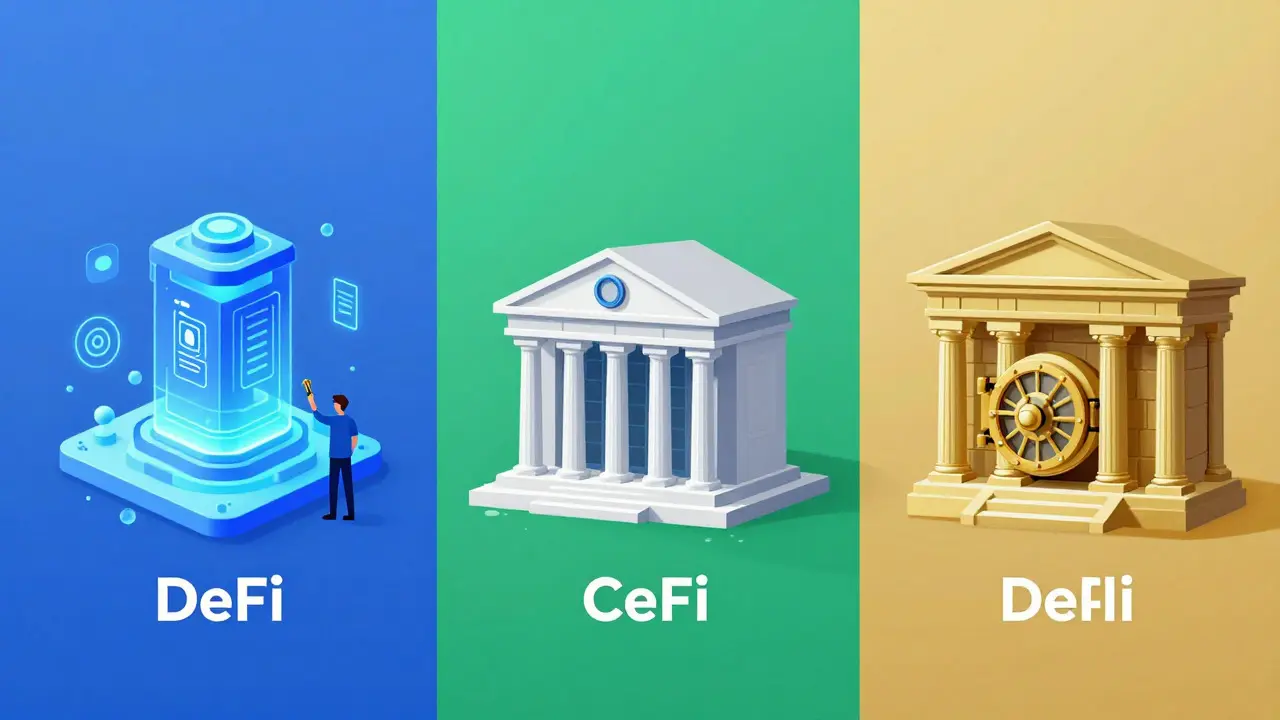
Not all crypto loans are created equal. You generally have three options, each with different trade-offs regarding control, cost, and risk.
| Model | Control & Custody | Typical LTV | Interest Rates | Key Risk |
|---|---|---|---|---|
| DeFi Protocols (e.g., Aave, Compound) |
You hold keys via non-custodial wallets | 50% - 75% | Variable (Market-driven) | Smart contract bugs, user error |
| CeFi Platforms (e.g., Nexo, Kraken) |
Platform holds custody | Up to 90% | Fixed or Variable | Counterparty risk (platform bankruptcy) |
| Traditional Banks (e.g., Sygnum, UBS) |
Bank holds custody | 40% - 60% | Higher (Premium service) | Regulatory changes, strict KYC |
Decentralized Finance (DeFi) platforms operate on blockchains like Ethereum. There is no middleman. Smart contracts automatically handle the loan issuance and liquidation. You connect your wallet, deposit assets, and borrow instantly. No identity verification (KYC) is required. However, you must manage your own security. If you lose your private keys, your funds are gone forever. Also, if the smart contract has a bug, hackers might drain the protocol.
Centralized Finance (CeFi) platforms look like regular banking apps. You sign up, verify your ID, and send crypto to their address. They lend you fiat or stablecoins. These platforms often offer better customer support and higher LTVs. But remember the collapses of Celsius and BlockFi in 2022? When CeFi platforms fail, users often lose everything because the platform was likely lending out your collateral to others. This is counterparty risk.
Traditional Banks are entering the space. Swiss banks like Sygnum and major institutions like UBS now offer "Lombard loans" backed by crypto. These are highly regulated and safe from platform bankruptcy, but they require high minimum deposits (often $100k+) and charge higher interest rates. They are best for institutional investors or high-net-worth individuals who want regulatory certainty.
Understanding Liquidation: The Biggest Risk
The most dangerous part of crypto borrowing is liquidation, which occurs when your collateral value drops below a safety threshold. Because crypto is volatile, lenders protect themselves by setting a "maintenance margin." If your collateral falls too close to the loan amount, the system automatically sells your crypto to pay off the loan before you lose more than you borrowed.
Here is how it plays out in real life:
- You deposit $10,000 in Bitcoin.
- You borrow $5,000 in USDC (50% LTV).
- The platform sets a liquidation threshold at 110% LTV. This means if your Bitcoin drops so much that it is only worth slightly more than your $5,000 loan, you are in danger.
- If Bitcoin crashes 40% in a day, your collateral is now worth $6,000. Your LTV rises to 83%. You might still be safe, depending on the specific terms.
- If Bitcoin crashes 50%, your collateral is worth $5,000. Your LTV hits 100%. The system triggers a liquidation.
- Your Bitcoin is sold immediately. You lose your asset, and you still owe any fees incurred during the sale.
To avoid this, experts recommend keeping your LTV well below the maximum. If the max is 75%, try to stay under 50%. During bear markets or high volatility, consider adding more collateral to lower your LTV ratio. Many platforms offer alerts to notify you when your position gets close to liquidation.
Interest Rates and Costs
Nothing is free. Crypto loans come with interest, and the rates vary significantly based on the asset you borrow and the asset you pledge.
Borrowing stablecoins (like USDC or DAI) is common because you need spendable cash. Interest rates for stablecoin loans typically range from 5% to 12% APR, depending on demand. If everyone wants to borrow USDC, rates go up. If few people want to borrow, rates drop.
Borrowing volatile assets like Bitcoin or Ethereum is less common for daily spending but useful for traders who want to leverage their positions. These rates can be higher, often 10% to 20% APR, due to the increased risk for the lender.
In DeFi, rates are dynamic. They change every block based on supply and demand. In CeFi, rates might be fixed for the term of the loan, which provides predictability but might be more expensive overall. Always calculate the total cost of borrowing, including origination fees, withdrawal fees, and network gas fees (for DeFi), before taking out a loan.
Tax Implications: Why Borrowing Beats Selling
One of the main reasons people choose crypto loans over selling is tax efficiency. In many jurisdictions, selling crypto is a taxable event. You realize capital gains or losses based on the difference between your purchase price and the sale price.
When you take out a loan, you are not selling. You are borrowing. Therefore, no capital gains tax is triggered. You can access liquidity while keeping your original cost basis intact. If Bitcoin goes up in price while you hold the loan, you haven’t missed out on the upside.
However, watch out for two things:
- Interest Deductibility: In some countries, interest paid on investment loans is tax-deductible. Check with a local tax professional. Rules vary widely between the US, EU, and other regions.
- Liquidation Events: If you get liquidated, that is considered a sale. You will owe taxes on the gain or loss at the moment of liquidation. This can create an unexpected tax bill during a market crash.
Always consult a tax advisor familiar with digital assets in your country. Tax laws are evolving rapidly, especially with regulations like the EU’s MiCAR coming into full effect in 2024 and ongoing developments in the US.

Step-by-Step: How to Take Out a Crypto Loan
If you decide to proceed, here is the general process. Note that steps vary slightly between DeFi and CeFi.
For Centralized Platforms (CeFi):
- Create an Account: Sign up on a reputable platform like Kraken, Nexo, or Coinbase. Complete KYC (Know Your Customer) verification by uploading ID and proof of address.
- Deposit Collateral: Transfer your crypto from your personal wallet to the platform’s deposit address. Wait for confirmations (usually 1-3 blocks for Bitcoin, seconds for Ethereum).
- Select Loan Terms: Choose how much you want to borrow and what currency (USD, EUR, USDC). Review the LTV ratio and interest rate.
- Accept Agreement: Read the terms carefully. Pay attention to liquidation thresholds and fee structures.
- Receive Funds: The platform sends the loan amount to your linked bank account or internal wallet. This can take anywhere from minutes to 24 hours.
For Decentralized Platforms (DeFi):
- Set Up a Wallet: Use a non-custodial wallet like MetaMask or Ledger. Ensure you have enough ETH or MATIC to pay for gas fees.
- Connect to Protocol: Go to a site like Aave.com or Compound.finance. Connect your wallet.
- Approve Tokens: Interact with the smart contract to approve the transfer of your collateral tokens. This costs a small gas fee.
- Supply Collateral: Deposit your crypto into the protocol. It appears in your dashboard as supplied assets.
- Borrow: Click borrow on the desired asset (e.g., USDC). Enter the amount. The protocol checks your health factor (a metric similar to LTV). If healthy, the funds are sent to your wallet instantly.
Risk Management Strategies
To survive in crypto lending, you need discipline. Here are pro tips to protect your capital:
- Monitor Your Health Factor: In DeFi, your "Health Factor" indicates how close you are to liquidation. A factor above 2.0 is very safe. Below 1.0 means liquidation. Set up alerts.
- Diversify Collateral: Don’t put all your eggs in one basket. Using multiple assets as collateral can sometimes reduce risk, though it adds complexity.
- Avoid Maxing Out LTV: Just because you *can* borrow 75% doesn’t mean you *should*. Aim for 40-50% to give yourself a buffer against market dips.
- Check Platform Solvency: For CeFi, research the platform’s track record. Are they transparent about reserves? Have they survived previous bear markets?
- Use Insurance: Some DeFi protocols offer insurance products to cover smart contract failures. Consider this if you are locking up large amounts of capital.
The Future of Crypto Borrowing
By 2026, the landscape has matured. The wild west days of unregulated lending are fading. Regulatory frameworks like MiCAR in Europe provide clearer rules for lenders. Traditional banks are offering hybrid solutions, combining the ease of crypto with the safety of banking regulation.
We are also seeing the rise of Real World Asset (RWA) integration. Platforms like Centrifuge allow borrowers to use tokenized real estate or invoices as collateral alongside crypto. This expands the utility of blockchain lending beyond just speculative assets.
As institutional adoption grows, we expect lower interest rates and more sophisticated risk management tools. For the average user, this means safer, more efficient access to liquidity. But the core principle remains: never borrow more than you can afford to lose, and always respect the volatility of your collateral.
Is it safe to use crypto as collateral?
It is relatively safe if you manage your Loan-to-Value (LTV) ratio carefully. The primary risk is liquidation if the market crashes. Secondary risks include platform failure (in CeFi) or smart contract bugs (in DeFi). To mitigate this, keep your LTV low (under 50%) and use reputable, audited platforms.
What happens if I don't repay my crypto loan?
If you miss payments or your collateral value drops too low, the lender will liquidate your collateral. They sell your crypto to cover the loan balance plus any fees. If the sale covers the debt, you lose your crypto but owe nothing more. If the sale doesn't cover the debt (rare in crypto loans due to conservative LTVs), you may still owe the difference, depending on the jurisdiction and contract terms.
Do I need good credit to get a crypto loan?
Generally, no. Most crypto lending platforms, especially DeFi protocols, do not check your credit score. They rely entirely on the value of your collateral. However, some centralized platforms or traditional banks offering crypto loans may perform a credit check as part of their broader KYC/AML processes.
Which is better: DeFi or CeFi for crypto loans?
It depends on your priorities. Choose DeFi if you want privacy, self-custody, and transparency, and are comfortable managing technical risks. Choose CeFi if you prefer a user-friendly interface, customer support, and potentially higher LTVs, accepting the risk that the platform could fail. Traditional banks are best for large sums requiring regulatory safety.
Are crypto loans taxable?
Taking out the loan is usually not a taxable event. However, paying interest may be deductible in some countries. Crucially, if your collateral is liquidated, that is treated as a sale, triggering capital gains tax. Always consult a tax professional in your specific jurisdiction.