

You don't pay a miner to secure the internet. The network pays them. But where does that money come from? It comes from two places: newly created coins and the fees you pay to send your own transactions. This combination is called the block reward, which is the financial incentive paid to miners or validators for adding a new block of transactions to the blockchain. Understanding how this works isn't just academic-it explains why your transaction costs $0.01 on one day and $50 on another, and whether networks like Bitcoin will stay secure forever.
The Two Parts of a Block Reward
Every time a new block is added to a blockchain, the person who did the work gets paid. That payment has two distinct parts. First, there is the block subsidy. These are brand-new coins that didn't exist before. The protocol creates them out of thin air and gives them to the winner. Second, there are transaction fees. These are the tips users attach to their transfers to get processed faster.
In the early days of Bitcoin, the subsidy was huge-50 BTC per block-and fees were negligible. Today, the dynamic is shifting. As the subsidy shrinks over time, fees become more important. If you're a validator or miner, you're betting that the future value of these rewards outweighs the electricity or hardware costs you spend today. If you're a user, you're paying a market rate for security.
Bitcoin: The Fixed Supply Model
Bitcoin uses a proof-of-work consensus mechanism with a fixed maximum supply of 21 million coins. Its economic model is built on scarcity. When Satoshi Nakamoto launched Bitcoin in 2009, the goal was to create digital gold. To do that, the issuance had to slow down predictably.
This slowing process is called the halving. Every 210,000 blocks (roughly every four years), the block subsidy is cut in half. Here is what that looks like in practice:
- 2009-2012: 50 BTC per block
- 2012-2016: 25 BTC per block
- 2016-2020: 12.5 BTC per block
- 2020-2024: 6.25 BTC per block
- 2024-2028: 3.125 BTC per block
By the year 2140, the subsidy will effectively reach zero. At that point, Bitcoin miners will rely 100% on transaction fees. Critics argue this is dangerous. If fees don't cover the cost of securing the network, miners might shut down, leaving the chain vulnerable. Supporters counter that as Bitcoin becomes more valuable, even small fees will be worth fighting for. So far, the hashrate-the total computing power securing Bitcoin-has kept rising despite halvings, suggesting the model holds up.
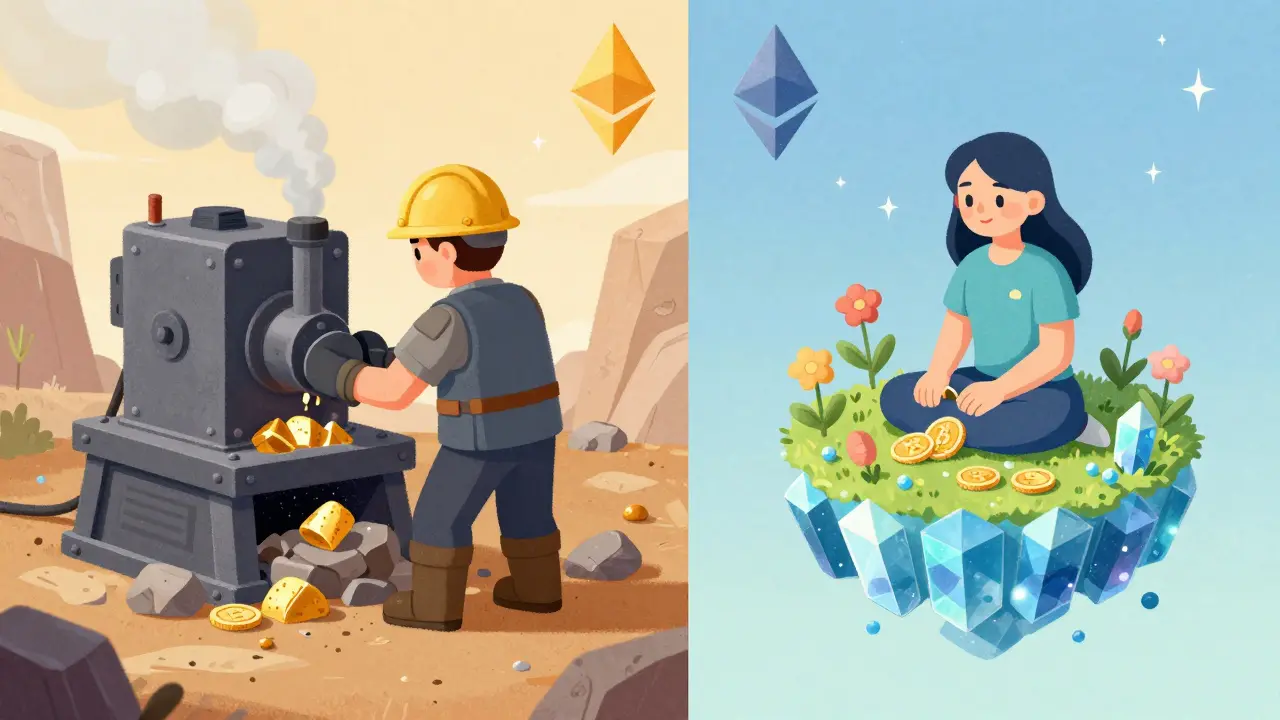
Ethereum: The Staking Model
Ethereum took a completely different path. In September 2022, it completed "The Merge," switching from proof-of-work to proof-of-stake (PoS). Instead of buying expensive ASIC machines and burning electricity, validators lock up ETH to participate. They earn rewards based on how much ETH they stake relative to the whole network.
Ethereum doesn't have a hard cap on its total supply. However, it introduced EIP-1559 in August 2021. This change burns a portion of transaction fees instead of giving them to validators. When network activity is high, more ETH is burned than is issued as rewards. This can make Ethereum deflationary. In quiet times, it remains inflationary, but at a low rate-typically between 0.2% and 0.5% annually. This is significantly lower than Bitcoin's pre-halving inflation rates.
| Feature | Bitcoin | Ethereum |
|---|---|---|
| Consensus Mechanism | Proof-of-Work (PoW) | Proof-of-Stake (PoS) |
| Supply Cap | Hard cap: 21 Million | No hard cap (deflationary pressure via burn) |
| Reward Source | Newly minted BTC + Fees | Staking rewards + Tips (Priority fees) |
| Issuance Trend | Predictable decrease (Halvings) | Variable based on staked amount & activity |
| Security Cost | Electricity & Hardware | Opportunity cost of locked capital |
The Race to Zero Subsidy
All blockchains face the same long-term question: What happens when the free money runs out? For Bitcoin, this is a scheduled event. For others, it's a design choice. Let's look at how other networks handle this.
Litecoin follows Bitcoin's model closely but with a faster block time of 2.5 minutes and a higher supply cap of 84 million coins. Its halvings happen twice as often, but the economic principles are identical. Predictability is the key selling point here.
Monero chose a different approach called tail emission. After its initial mining phase ended around 2022, Monero didn't stop issuing coins. Instead, it settled on a constant reward of 0.6 XMR per block, forever. The idea is to ensure miners always have an incentive to secure the network, regardless of fee volume. Economists debate whether this creates mild inflation or simply stabilizes the security budget.
The risk with Bitcoin's model is centralization. As subsidies drop, only the most efficient miners survive. Small operations with high electricity costs go bankrupt. Large farms with cheap power buy their equipment. This concentrates hash power in fewer hands, potentially making the network less decentralized.

Why Fees Matter More Than You Think
If you've ever tried to send Bitcoin during a busy period, you know fees can spike. In December 2021, average fees hit over $55. Why? Because block space is limited. Only so many transactions fit in a 1MB block (or ~4MB with SegWit). Users bid against each other to get included.
For Ethereum, the situation is similar but more complex. With EIP-1559, part of your fee goes into the fire. The rest goes to the validator. This changes behavior. Users are more sensitive to price because they see exactly how much is being destroyed. Validators care about the "tip" component, which they keep.
As block subsidies shrink, the fee market becomes the primary security engine. If fees are too low, attackers could theoretically outbid honest miners/validators to rewrite history. This is known as a "tragedy of the commons." The community must collectively agree to pay enough fees to keep the network safe. Layer-2 solutions like the Lightning Network (for Bitcoin) and Arbitrum/Optimism (for Ethereum) aim to move traffic off the main chain, reducing congestion and keeping base-layer fees manageable while still generating revenue through settlement.
Real-World Implications for Investors and Users
How does this affect you? If you're holding Bitcoin, the halving reduces the sell pressure from miners. Fewer new coins entering the market can support price appreciation if demand stays steady. If you're staking Ethereum, your yield drops as more people stake. Early stakers earned over 10%; now it's closer to 3-4%. You need more ETH to earn the same dollar amount.
For everyday users, understanding block reward economics helps you choose when to transact. Sending non-urgent transactions during peak hours wastes money. Using Layer-2 networks often bypasses these issues entirely. And for developers, designing tokenomics requires careful thought. Will your project survive without inflation? Can it generate enough organic fee revenue to attract validators?
The transition from subsidy-dependent security to fee-dependent security is the next great test for blockchain technology. Bitcoin is leading the way, showing that a predictable monetary policy can endure for over a decade. Ethereum is proving that flexible, software-driven adjustments can maintain security while reducing environmental impact. Both models have trade-offs, but both rely on one fundamental truth: people must be paid to protect the ledger.
What is the current Bitcoin block reward?
As of the April 2024 halving, the Bitcoin block subsidy is 3.125 BTC. This amount will be halved again to 1.5625 BTC around 2028. Miners also collect transaction fees, which vary daily based on network congestion.
Does Ethereum have a maximum supply?
No, Ethereum does not have a hard cap on its total supply. However, it implements a fee-burning mechanism (EIP-1559) that destroys ETH with every transaction. During periods of high activity, more ETH is burned than is issued as staking rewards, causing the total supply to decrease temporarily.
What happens to Bitcoin miners after all 21 million coins are mined?
After approximately the year 2140, no new bitcoins will be created. Miners will rely entirely on transaction fees for income. Proponents believe that as Bitcoin becomes more widely used, the volume of transactions will generate sufficient fees to incentivize continued network security.
Why do block rewards matter for decentralization?
Block rewards determine who can afford to secure the network. As rewards shrink, smaller participants may exit due to unprofitability, leading to centralization among large mining pools or staking providers. This concentration of power can threaten the democratic nature of the blockchain.
How does the halving affect cryptocurrency prices?
The halving reduces the rate at which new supply enters the market. If demand remains constant or increases, basic supply-and-demand economics suggest prices should rise. Historically, Bitcoin has seen bull markets following halvings, though past performance does not guarantee future results.