

Imagine sending a large payment in cryptocurrency and watching it disappear from your wallet, only to reappear minutes later because the network decided that block didn't count. It sounds like a glitch, but it’s actually how decentralized networks protect themselves from fraud. This is where block confirmation comes in. It is the single most important metric for determining if your money has truly moved or if it’s still up for grabs.
You’ve probably heard the rule of thumb: wait for six confirmations on Bitcoin. But why six? And does that number apply to Ethereum, Solana, or stablecoins? The answer isn’t a single number. It depends entirely on which blockchain you are using, how much you’re sending, and who is receiving it. Getting this wrong can cost you time, fees, or worse-your funds.
The Mechanics of Finality
To understand why we need multiple confirmations, we first have to look at how a blockchain works. When you send a transaction, it doesn’t go straight into a permanent ledger. It sits in a waiting area called the mempool until a miner or validator picks it up and packs it into a new block.
Once your transaction is included in that first block, you have 1 confirmation. This means the network acknowledges your transaction exists. However, in probabilistic consensus systems like Proof-of-Work (PoW), blocks can sometimes be orphaned. If two miners find a block at the same time, one branch might become longer than the other. The shorter branch gets discarded, and any transactions in those orphaned blocks are returned to the mempool.
Each subsequent block added on top of your transaction’s block acts as another layer of security. These are your additional confirmations. Every new block makes it exponentially harder and more expensive for an attacker to rewrite history and reverse your transaction. This process is known as achieving transaction finality.
- 0 Confirmations: Transaction is in the mempool. Highly reversible. Do not ship goods yet.
- 1 Confirmation: Transaction is in a block. Low risk of reversal, but possible during high congestion.
- 3+ Confirmations: Generally considered safe for small retail transactions.
- 6+ Confirmations: The industry standard for high-value Bitcoin transfers.
Bitcoin: The Six-Confirmation Standard
Bitcoin operates on a Proof-of-Work consensus mechanism with an average block time of roughly 10 minutes. Because mining power can fluctuate, there is always a non-zero chance that an attacker could create a parallel chain that overtakes the main network-a scenario known as a 51% attack or chain reorganization.
The "six confirmations" rule emerged from mathematical analysis of this risk. With each passing block, the probability of a successful double-spend drops dramatically. By the time six blocks have passed (approximately 60 minutes), the computational cost required to reverse the transaction becomes astronomically high for anyone without majority control of the global mining hash rate.
| Confirmations | Approximate Time | Risk Level | Typical Use Case |
|---|---|---|---|
| 1 | ~10 minutes | Low | Coffee purchases, small tips |
| 3 | ~30 minutes | Very Low | Exchange deposits, medium trades |
| 6 | ~60 minutes | Negligible | Large institutional transfers, OTC deals |
For a merchant selling a $5 coffee, waiting an hour is bad business. They might accept zero or one confirmation, accepting a tiny risk that the payment could vanish. For a company moving millions in treasury reserves, that tiny risk is unacceptable. They will wait for six or more.
Ethereum and Layer 2 Variations
Ethereum switched from Proof-of-Work to Proof-of-Stake (PoS) with the Merge, changing its finality dynamics. While Bitcoin relies on probabilistic security over time, Ethereum uses a deterministic finality gadget called Casper FFG. Technically, a transaction is finalized after two epochs (roughly 12-15 minutes). However, most services play it safe.
Circle, the issuer of USDC, recommends 12 confirmations for Ethereum Mainnet, which takes about 3 minutes given the ~12-second block time. This buffer accounts for potential edge cases in validator behavior.
Things get complicated with Layer 2 solutions like Arbitrum, Base, or Optimism. These chains post data to Ethereum Mainnet for security. While a transaction might seem instant on the L2, true economic finality often requires waiting for the underlying Ethereum blocks to settle. Some ZK-rollups require up to 65 Ethereum blocks for full finality, which can translate to several hours of waiting time despite the L2 interface showing the funds instantly.

High-Speed Chains: One Is Enough?
Newer blockchains designed for speed use different consensus mechanisms, such as Byzantine Fault Tolerance (BFT) or optimized Proof-of-Stake. On these networks, finality is near-instantaneous.
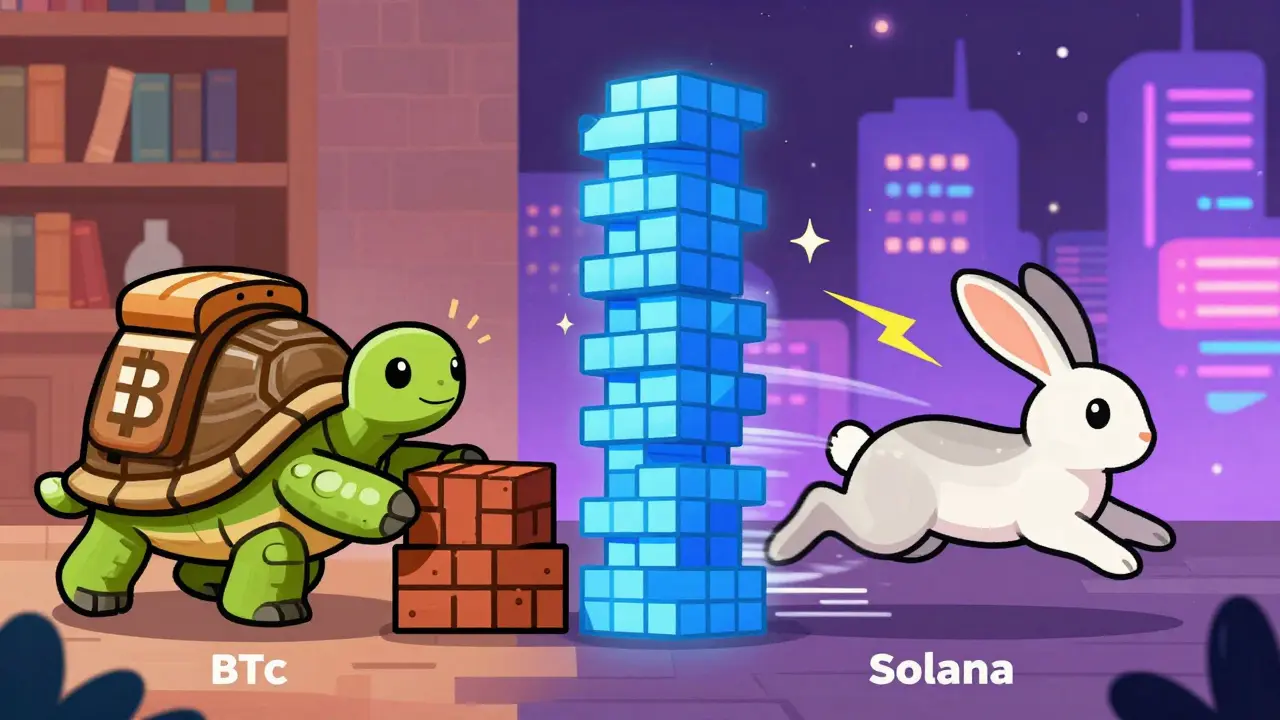
Take Solana, for example. Circle lists just 1 confirmation as sufficient, taking approximately 400 milliseconds. Similarly, Aptos and Sui achieve finality in under a second with a single block. Why? Because their consensus algorithms are designed to reach agreement among validators almost immediately, rather than relying on the accumulation of work over time.
Even Polygon PoS, while connected to Ethereum, only requires 2-3 confirmations (about 8 seconds) for practical finality in many contexts. This drastic reduction in required blocks allows for real-time payments and gaming interactions that would be impossible on Bitcoin.
Exchange Policies vs. Protocol Reality
Just because the protocol says a transaction is safe doesn’t mean the exchange agrees. Centralized exchanges (CEXs) add their own layers of caution to prevent fraud and manage liability. Their requirements often exceed the minimum technical needs.
Consider bitFlyer, a major exchange operating in Japan and Europe. Their deposit policies are significantly more conservative than the bare-minimum protocol standards:
- Bitcoin (BTC): Requires 3 confirmations (~30 mins).
- Ethereum (ETH): Requires 50 confirmations (~10-12 mins).
- Litecoin (LTC): Requires 12 confirmations.
- Ethereum Classic (ETC): Requires a staggering 20,000 confirmations due to historical vulnerabilities.
This discrepancy highlights a key reality: operational finality is different from protocol finality. Exchanges prioritize customer trust and regulatory compliance over speed. If you send ETH to an exchange expecting it to appear in 3 minutes (12 confirmations), you might be surprised when it takes 10 minutes because the exchange waits for 50.
How to Choose the Right Threshold
So, how many confirmations do *you* need? It depends on your role in the transaction.
If you are a merchant: Assess the value. For low-value items, 1 confirmation on fast chains or even 0 on Bitcoin (with monitoring tools) might suffice. For high-ticket items, never ship until the recommended threshold for that specific chain is met. Use payment processors like Cryptomus that automate this logic based on risk scoring.
If you are a user: Check the destination. Sending to a personal wallet? You can usually relax once you hit the standard protocol threshold (e.g., 6 for BTC, 12 for ETH). Sending to an exchange? Check their help center. Assuming they follow the general rule will likely lead to support tickets and delayed access to your funds.
If you are a developer: Build flexibility into your apps. Hardcoding "wait for 6 blocks" breaks when users switch from Bitcoin to Solana. Implement dynamic confirmation listeners that adjust based on the network’s current block time and finality rules.
Frequently Asked Questions
What happens if I send crypto with insufficient confirmations?
If you treat a transaction as complete before it has enough confirmations, there is a risk that the block containing your transaction could be orphaned or reversed. In a worst-case scenario, the funds return to your original wallet, but the recipient may have already shipped goods or released assets. This is known as a double-spend attack. For high-value transfers, this risk is significant; for small amounts, it is rare but possible.
Why does Ethereum need 12 confirmations when Bitcoin needs 6?
The difference lies in block times and consensus mechanisms. Bitcoin blocks take ~10 minutes, so 6 confirmations equal ~60 minutes of security depth. Ethereum blocks take ~12 seconds, so 12 confirmations equal only ~2-3 minutes. Despite the higher number, Ethereum’s total wait time is often shorter than Bitcoin’s. The numbers are calibrated to provide equivalent levels of security assurance relative to each chain’s specific architecture.
Can I speed up the confirmation process?
You cannot force the network to confirm faster, but you can influence miners or validators. On Bitcoin, paying a higher transaction fee increases the likelihood that your transaction will be picked up quickly. On congested networks, using tools like RBF (Replace-By-Fee) or CPFP (Child-Pays-For-Parent) can boost the priority of stuck transactions. However, once the transaction is in a block, you must simply wait for subsequent blocks to be mined.
Do Layer 2 networks like Arbitrum have their own confirmation counts?
Yes, but they are tied to Ethereum. A transaction on Arbitrum is confirmed quickly on the L2 itself, but for full economic finality, it often relies on the underlying Ethereum blocks. Some services require waiting for a certain number of Ethereum blocks (e.g., 12 to 65) to ensure the L2 state is securely anchored to the main chain. Always check the specific service’s documentation for L2 finality times.
Is 1 confirmation ever safe?
On modern BFT-based chains like Solana, Aptos, Sui, and Algorand, yes. These networks achieve near-instant finality, meaning 1 block is effectively irreversible. On probabilistic chains like Bitcoin, 1 confirmation is risky for anything valuable. Merchants sometimes accept 0-1 confirmations for micro-payments, accepting a small risk of reversal in exchange for speed.
Comments
Kwon Bill
The semantic distinction between probabilistic finality on PoW chains versus deterministic finality on BFT-based architectures is often conflated in retail discourse. When we analyze the Nakamoto consensus model, we are dealing with an asymptotic approach to certainty rather than absolute truth until the hash rate differential becomes economically prohibitive for a reorg. Conversely, Tendermint-style protocols offer immediate finality upon block commit, which fundamentally alters the risk calculus for high-frequency trading applications.
June 13, 2026 AT 15:40
Mauricio Contreras Loredo
Oh great, another article explaining basic math like it's quantum physics. I've been running nodes since 2013 and I still don't need a flowchart to tell me that six blocks is safe. Keep dreaming about your instant finality while my satoshis sit pretty.
June 13, 2026 AT 22:04
Kumaran sowkarpet
hey guys! just wanted to say this is super helpful info :) i always get confused when sending eth vs btc because the times are so different. thanks for breaking it down simply! :D
June 15, 2026 AT 06:53
Filbert Reeves
you think you know what finality is? its all a lie controlled by the central banks who secretly mine half the blocks to reverse transactions they dont like. i have seen the code. they insert backdoors in the mempool software. wake up sheeple. the six confirmation rule is just a psychological trick to keep you waiting while they steal your coins. do not trust the network. ever. nothing is real. only cash is real but even that is printed by liars. stay paranoid stay safe.
June 16, 2026 AT 16:55
Amit Thakur
Listen up! The L2 narrative is completely broken if you dont understand the settlement layer dynamics. Arbitrum and Optimism are essentially sidechains with security assumptions tied to ETH mainnet finality. If you are building dApps, you need to account for the fraud proof window or ZK proof verification time. Ignoring this latency will cause massive UX friction and user abandonment. Stop treating L2s as magic speed boosts without reading the whitepapers!
June 17, 2026 AT 01:46
Eric Scheinberg
It is imperative to note that exchange policies often diverge from protocol specifications due to liability concerns. For instance, the requirement of fifty confirmations for Ethereum deposits on certain platforms is an operational heuristic rather than a cryptographic necessity. Users must distinguish between technical irreversibility and custodial acceptance thresholds.
June 17, 2026 AT 18:02
Charles Pawlikowski
typical tech bro nonsense. why do we need so many confirmations? because people are stupid and try to double spend. if everyone was honest like us americans we wouldnt need any checks. but no lets wait an hour for bitcoin. whatever. just send it and pray. :)
June 18, 2026 AT 01:39
Andrea Burd
Boring. I already knew this. The writing style is tedious and overly cautious. Real innovators dont worry about confirmations they innovate around them. This post feels like it was written by someone who has never actually moved money on chain.
June 18, 2026 AT 17:24
Akeem Whittaker
You need to look at the validator set size and decentralization metrics before trusting single-block finality on newer chains. Solana might be fast but the hardware requirements for validators create a centralization vector that increases long-term risk compared to Bitcoin's distributed mining. Speed comes at a cost of security assumptions.
June 20, 2026 AT 09:30
Manish Prajapat
The philosophical implication of 'finality' is interesting. In Bitcoin, finality is a social consensus backed by energy expenditure. In PoS, it is a mathematical agreement among stakeholders. One relies on physical reality, the other on economic incentive structures. Which one is more robust against existential threats?
June 20, 2026 AT 12:20
sreeja boora
This article lacks proper citation of primary sources regarding the Casper FFG implementation details. Furthermore, the comparison between Indian blockchain adoption rates and Western standards is absent. We must ensure that global perspectives are included in such technical discussions rather than focusing solely on US-centric exchanges like bitFlyer.
June 22, 2026 AT 00:43
Suman Patil
Let's bring some peace to this thread! Everyone here has valid points whether you prefer the slow steady grind of BTC or the lightning speed of SOL. The key is understanding your own risk tolerance. If you are moving millions take the extra time. If you are buying coffee go fast. Let's learn from each other instead of fighting over which chain is best. Together we can build a better crypto future! 🚀
June 22, 2026 AT 18:35
pankaj chawla
I agree with the point about dynamic confirmation listeners for developers. Hardcoding values is a recipe for disaster when networks upgrade or change parameters. We should advocate for standardized APIs that expose current finality requirements directly from node providers.
June 23, 2026 AT 00:16
Jessica Lane
I appreciate the detailed breakdown of Layer 2 complexities. It is concerning how many users assume instant finality on Arbitrum without understanding the underlying Ethereum anchoring process. Could you elaborate more on the specific risks associated with bridge withdrawals during periods of high mainnet congestion?
June 23, 2026 AT 07:43