

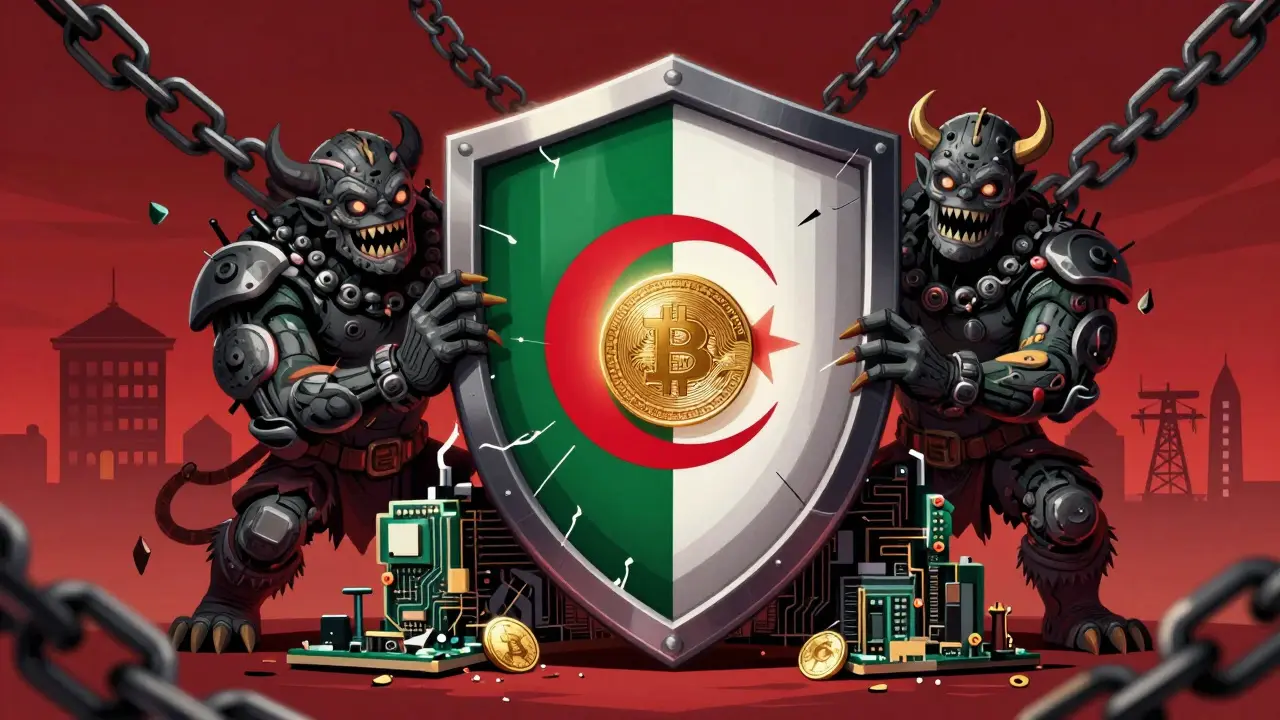
Imagine trying to buy a coffee with Bitcoin in Algiers. In most of the world, you might just need a specific app or a willing merchant. In Algeria, that simple transaction could land you in prison for up to a year and cost you nearly $8,000 in fines. This isn't a hypothetical scenario from a dystopian novel; it is the current reality under Law No. 25-10, enacted in July 2025.
If you have been following the news from North Africa, you know that Algeria has long held a skeptical view of digital assets. But the landscape shifted dramatically between the vague warnings of the past and the iron-clad criminal code of today. The journey started with the 2018 Financial Law restrictions, which planted the seeds of prohibition but left plenty of gray areas. Today, those gray areas are gone. The government has moved from ambiguous regulation to total eradication.
The Ambiguous Start: 2018 Financial Law Restrictions
To understand why the 2025 crackdown feels so severe, we need to look back at where it all began. For years, Algeria’s stance on cryptocurrency was defined by silence and sporadic warnings rather than clear legislation. That changed with the introduction of the Financial Law of 2018.
This law was significant because it was the first time the Algerian state formally prohibited the purchase, sale, and use of virtual currencies. It signaled a clear intent: the government did not want cryptocurrencies operating within its borders. However, the law had a major flaw-it lacked teeth. There were no clearly defined penalties, no specific enforcement mechanisms, and no detailed scope of what constituted a violation.
For many Algerians, this created a confusing environment. On one hand, the Bank of Algeria issued repeated warnings against using crypto. On the other hand, there was no immediate legal consequence if you were caught holding Bitcoin or Ethereum. This ambiguity allowed a discreet crypto community to grow. People used digital assets to hedge against high inflation and strict capital controls, knowing that while they were technically breaking the rules, the risk of prosecution was low and undefined.
The 2018 law essentially served as a warning shot. It established the principle that crypto was illegal, but it didn’t build the cage. That came seven years later.
The Turning Point: Law No. 25-10 (2025)
On July 24, 2025, the ambiguity ended. Algeria published Law No. 25-10 in its Official Journal, marking a dramatic shift from regulatory hesitation to comprehensive criminal prohibition. Local media described it as a "thunderbolt" hitting the crypto sector, and rightly so. This law didn’t just tighten the screws; it removed the door entirely.
Unlike the 2018 framework, Law No. 25-10 leaves no room for interpretation. It explicitly criminalizes every conceivable interaction with digital assets. Here is what is now banned:
- Issuance: Creating new coins, tokens, or any form of virtual asset.
- Trading: Buying, selling, or exchanging cryptocurrencies on any platform.
- Possession: Simply holding crypto in a wallet, whether you are a casual user or a long-term investor.
- Payment: Using crypto to buy goods or services.
- Investment & Speculation: Trading based on price movements or investing in crypto projects.
- Advertising & Promotion: Marketing crypto services, creating content about it, or influencing others to use it.
- Mining: Using computational power to validate transactions or secure networks.
Note that last point carefully. Even passive activities like mining or sharing educational content about blockchain technology are now criminal offenses. The law targets not just traders and exchanges, but also influencers, advertisers, and developers. If you talk about crypto, you are breaking the law.
Penalties and Enforcement: The Cost of Non-Compliance
The real shock of Law No. 25-10 lies in its penalty structure. Algeria has adopted a zero-tolerance approach, imposing harsh criminal sanctions on anyone caught violating these provisions. The message is clear: the state views crypto not as a financial innovation, but as a threat to national security.
| Offense Type | Prison Sentence | Fine Range (USD) | Fine Range (DZD) |
|---|---|---|---|
| Any Crypto Activity (Possession, Trading, Mining, etc.) | 2 months to 1 year | $1,540 - $7,700 | 200,000 - 1,000,000 DZD |
These penalties apply universally. Whether you are running a large-scale exchange operation or simply holding a small amount of Bitcoin in a private wallet, the maximum punishment is the same: one year in prison and a fine of up to $7,700. These are some of the harshest cryptocurrency penalties globally.
Enforcement is coordinated across multiple agencies. The Bank of Algeria oversees the financial system, ensuring banks do not facilitate crypto transactions. The Banking Commission monitors institutions, while judicial authorities handle prosecutions. Security agencies conduct digital and physical monitoring to detect illegal activities, particularly those linked to organized crime or terrorism financing. This multi-agency approach creates a comprehensive surveillance network designed to leave no corner of the market unchecked.

Why Did Algeria Go So Hard?
You might wonder why Algeria chose such an extreme path when neighboring countries like the UAE and Bahrain are embracing crypto with open arms. The motivations behind this hardline stance are rooted in three key concerns: monetary sovereignty, anti-money laundering (AML), and energy consumption.
Monetary Sovereignty: The primary justification is protecting the Algerian Dinar. The government views crypto as a direct threat to the dinar’s status as the sole legal tender. By banning crypto, Algeria aims to prevent capital flight and maintain control over its monetary policy. In a country with strict capital controls, allowing citizens to move money freely across borders via blockchain undermines the state’s ability to manage its economy.
AML and CTF Compliance: Algeria has been under pressure to align with international standards set by the Financial Action Task Force (FATF). Authorities argue that cryptocurrencies provide a convenient vehicle for money laundering and terrorist financing. While many countries regulate crypto to mitigate these risks, Algeria decided that elimination was the only safe option.
Energy Concerns: Crypto mining requires significant electricity. Given Algeria’s reliance on energy subsidies and infrastructure challenges, the government sees mining as a drain on national resources. Banning mining helps preserve energy for domestic use and industrial growth.
How Algeria Compares to the Rest of the World
To appreciate how isolated Algeria’s position is, consider the global context. In Europe, regulators are implementing frameworks like MiCA (Markets in Crypto-Assets) to integrate crypto into mainstream finance. The United States is moving toward clearer regulations rather than blanket bans. Even traditionally conservative jurisdictions are opting for oversight instead of criminalization.
| Region/Country | Regulatory Approach | Key Focus |
|---|---|---|
| Algeria | Total Criminal Prohibition | Monetary sovereignty, AML/CTF |
| European Union | Integrated Regulation (MiCA) | Consumer protection, market stability |
| UAE / Bahrain | Embracing Frameworks | Innovation, financial hub development |
| United States | Evolving Regulation | Tax compliance, securities law |
| China | Strict Ban (with nuances) | Currency control, social stability |
Algeria’s approach places it in a small group of countries with total prohibitions, similar to China. However, even China has shown some flexibility with digital yuan initiatives, whereas Algeria’s law explicitly rejects all forms of virtual assets, including stablecoins and central bank digital currencies (CBDCs) unless directly issued and controlled by the state.
Impact on the Algerian Crypto Community
The human impact of Law No. 25-10 has been severe. Despite the technical ban since 2018, many Algerians relied on crypto to cope with high inflation and limited access to foreign currency. The 2018 law’s vagueness allowed a discreet community to thrive. Now, that community faces complete legal extinction.
Users who previously operated in the shadows must now go deeper underground. The risk of imprisonment makes even casual participation dangerous. Content creators, educators, and influencers have stopped discussing crypto altogether to avoid prosecution. The dream of borderless finance has hit a solid wall of resistance.
For businesses, the implications are equally stark. International partnerships may be complicated by Algeria’s extreme position, especially as global commerce increasingly integrates crypto options. Companies looking to operate in Algeria must ensure strict compliance, avoiding any association with digital assets.
Future Outlook: Can This Ban Last?
As global cryptocurrency adoption continues to grow, maintaining such a restrictive stance becomes increasingly difficult. The comprehensive nature of the ban, extending to information sharing and educational content, raises questions about practical enforcement capabilities. How can a government monitor every conversation or blog post about blockchain technology?
Moreover, regional competitors embracing crypto may gain economic advantages in cross-border transactions and financial innovation. Algeria risks isolating itself further from global financial trends. While the government remains firm, the pressure to adapt may increase over time, especially if international business relationships suffer due to the lack of digital payment options.
For now, however, the message is clear. Algeria is not interested in regulating crypto; it is interested in eradicating it. Until the legislative landscape changes, the safest course of action is complete avoidance.
Is it legal to hold Bitcoin in Algeria?
No. Under Law No. 25-10, simply possessing cryptocurrency, including Bitcoin, is a criminal offense punishable by up to one year in prison and fines of up to $7,700 USD.
What was the difference between the 2018 Financial Law and the 2025 Law?
The 2018 Financial Law prohibited crypto usage but lacked clear penalties and enforcement mechanisms, creating a gray area. The 2025 Law No. 25-10 established specific criminal penalties, expanded the scope to include possession and advertising, and activated multi-agency enforcement.
Can I mine cryptocurrency in Algeria?
No. Mining is explicitly banned under Law No. 25-10. The government cites energy consumption concerns and the need to protect national resources as reasons for prohibiting mining activities.
Why does Algeria ban cryptocurrency?
Algeria bans crypto to protect the Algerian Dinar's status as sole legal tender, prevent capital flight, comply with FATF anti-money laundering guidelines, and conserve energy resources.
Are there any exceptions for Central Bank Digital Currencies (CBDCs)?
The law prohibits all virtual assets unless directly issued and controlled by the state. Currently, Algeria has not launched a CBDC, so no exceptions exist for private or public digital currencies.